Past Newsletters - Apr 2009

Premier Series
Featured Wineries & Wines
Membership Type
Nine Vines South Australia Shiraz Viognier 2007 - Australia 1 Red 1 White; 2 Reds
Bodegas Garci Grande Mozares Rueda Verdejo Viura 2007 – Spain 1 Red 1 White; 2 Whites
Paso a Paso La Mancha Tempranillo 2007 – Spain 2 Reds
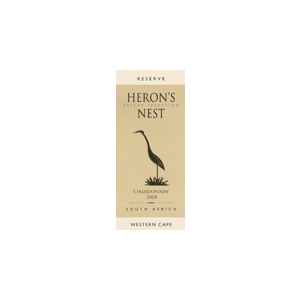
Heron’s Nest Stellenbosch Chardonnay 2008 – South Africa 2 Whites


Master Series
Featured Wineries & Wines
Membership Type
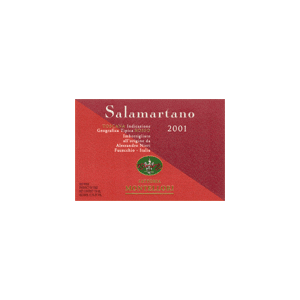
Fattoria Montellori Salamartano 2001 – Italy 1 Red 1 White; 2 Reds
Bodegas Garci Grande Mozares Rueda Verdejo Viura 2007 – Spain 1 Red 1 White
Nine Vines South Australia Shiraz Viognier 2007 - Australia 2 Reds


Collector Series
Featured Wineries & Wines
Membership Type
Fattoria Montellori Salamartano 2001 – Italy 1 Red 1 White; 2 Reds
Joseph Drouhin Premier Cru Chablis 2006 – France 1 Red 1 White
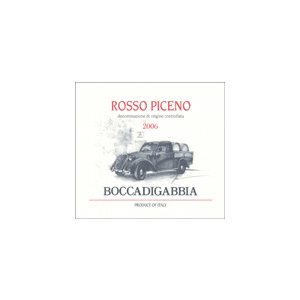
Boccadigabbia Rosso Piceno 2006 – Italy 2 Reds


Nine Vines South Australia Shiraz Viognier 2007 - Australia

Nine Vines South Australia Shiraz Viognier 2007Nine Vines belongs to Angove’s Pty. Ltd., one of Australia’s largest privately owned wineries. This winery began with Dr. William Angove, an accomplished general practitioner and surgeon, who emigrated with his wife and young family from Cornwall in 1886 to establish a medical practice in South Australia.  Although he enjoyed a distinguished medical career, Dr. Angove’s most enduring legacy survives in the viticulture of South Australia.  His early experimentation with vines, winemaking, and distilling led to the establishment of a proud family business.  Dr. Angove’s initial plantings in the township of Tea Tree Gully in the Adelaide foothills were the forerunner of one of the largest vineyards in the southern hemisphere — the magnificent Nanya Vineyard at Renmark in South Australia’s Riverland.

Since 1950, Angove’s has steadily expanded its operations and structure. The Renmark facility has grown to become a major winemaking and distilling entity with storage capacity for more than 15 million liters of wine and spirits.  In Australia, Angove’s is known not only for its fine table wines (still wines under 14% alcohol), but also for its exceptional line of fortified wines and spirits.  Angove’s produces sherry, port, vodka, and an especially fine line of pot-stilled brandies under the name of St. Agnes.  The 5 Star Liqueur Brandy from St. Agnes is a gold-medal winner that consistently receives the highest critical acclaim from tasters and critics.

In 1983, the fourth generation of the family took control of Angove’s when John Carlyon Angove succeeded his father as Managing Director of the company. John has taken up where his father left off, with increased development and investment in all aspects of the winery.  In addition, Victoria, John’s eldest daughter and a member of the fifth generation, is now actively involved in ensuring ongoing growth in her role as International Business Development Manager, so much so that Angove’s wines can be found today in over 30 different countries around the globe.  This is testimony to Victoria’s ability and the outstanding quality of Angove’s many critically acclaimed, award-winning wines.

Like most Australian wineries, Angove’s fashions an entire portfolio of wines at varying levels of quality and age worthiness.  Angove’s Vineyard Select offerings and the distinct Nine Vines Series are this family’s top wines.  Angove’s Nine Vine Series is an exemplary line of wines.  It is so named because only nine vines remain from the original 19th century Tea Tree Gully Vineyard in the Adelaide Hills that Dr. Angove planted.  These ancient vines serve as a reminder of the vibrancy of a wine-growing region that has played a vital role in the development of a nation as well as an integral part in the Angove family’s winemaking heritage.

Shiraz or Syrah?

Whether we refer to this great varietal as Shiraz or Syrah, we are talking about the same illustrious grape.  Grown for centuries in the Rhône Valley of France, where it is responsible for all or part of many of the greatest red wines of France (Hermitage and Châteauneuf-du-Pape specifically), the exact origin of this full-flavored varietal remains in debate.  However, historians do agree that it was brought to Europe from the Middle East, but when and by whom remains a mystery.

Some historians maintain that it was the Crusaders who first brought Syrah to France, while others point to the earlier Roman legions under Probes, and yet others claim it was the remnants of Alexander the Great’s army on its return from Persia.  The latter theory is particularly intriguing, since Alexander himself was so enamored of the wines he found around the city of Shiraz in Central Persia that he insisted on staying there, far longer than he should have, apparently, since he died there.  Nonetheless, the one point that has been ascertained that everyone seems to agree upon is that the name Shiraz, from the Persian city of that name, is the origin of the varietal’s name.  In any case, Syrah flourishes today not only in the south of France but in other Mediterranean climates.  It fares particularly well in California and Australia, where it is often called by its original name – Shiraz.  Australia’s Barossa Valley is home to many of the oldest un-grafted Shiraz vines on earth, many of which are crafted into wines of extraordinary flavor, power, and texture.

Tasting Notes:  The 2007 Angove’s Nine Vines Shiraz (94%) Viognier (6%) is ample testimony to South Australia’s reputation for furnishing the world’s finest Shiraz.  Made in the famous Côte Rôtie style of France’s Rhône Valley, an appellation where small quantities of aromatic white Viognier grapes are often added to the brooding dark Shiraz must, the 2007 Nine Vines Shiraz Viognier captures all the inherent beauty of the classic blend, a cépage that offers the consumer plenty of aromatic fireworks along with depth, power, and a velvet-like texture.  For starters, the Nine Vines Shiraz Viognier exhibits a nose redolent with crushed blackberry, exotic fruits, bacon fat, vanilla, and spice.  And in the mouth the Nine Vines remains surprisingly textured and smooth for such a young offering: it exudes plenty of berry fruit flavors and soft vanilla tones that melt inexorably into the firm tannic structure and hefty alcohol that give this wine its long finish and healthy underpinning.  We suggest you give this delicious Rhône style red at least thirty minutes of aeration before serving (at no more than 66º F).  Anticipated maturity: 2009-2014. 

Accompaniments:  Given the rich flavor profile and the velvety texture of the 2007 Nine Vines Shiraz Viognier, it possesses a wealth of culinary complements from which to choose.  Rich, stick-to-your-ribs kinds of fare provide premier showcases for the Nine Vines Shiraz Viognier.  Consequently, filet mignon or a whole beef tenderloin served medium rare with grilled or sautéed portabella mushrooms; rack of lamb encrusted with a glazed onion and herb manioc; venison stew; and rich heady cassoulets all get our nod to accompany the 2007 Nine Vines Shiraz Viognier.  A heady ratatouille served with homemade pasta, a hunk of aged cheese, and some freshly baked bread; and grilled Ahi tuna on focaccia with an authentic Provencal aioli or herb mayonnaise provide other superb complements.

For the Love of Cheese:  Fine gourmet cheeses and well-made wines share a natural affinity for one another.  In our experience, Rhône style wines, and the 2007 Nine Vines Shiraz Viognier in particular, have a proclivity for soft and semi-hard cheeses.  Consequently, a firm highly flavored English cheese like Wensleydale offers a superb accompaniment to the Nine Vines Shiraz Viognier. The creamy texture and full nutty flavors of Wensleydale truly accentuate the savory fruit in the wine.  Other gourmet cheeses, too, such as Reblochon from France and a Mahon from Spain, offer more noble partnerships with the Nine Vines Shiraz Viognier.  For more advice on wine and cheese pairings or to learn more about gourmet cheeses we suggest you contact us at www.cheesemonthclub.com. Enjoy!

Bodegas Garci Grande Mozares Rueda Verdejo Viura 2007 – Spain

Bodegas Garci Grande Mozares Rueda Verdejo Viura 2007Mozares is produced by Bodegas Garci Grande, a revered bodega with prime vineyards in Rueda along the Adaja River.  The Rueda D.O. is home to many of Spain’s greatest white wines.  Here, indigenous varietals predominate, and Verdejo reigns supreme as the sovereign grape.  Bodegas Garci Grande fashions a number of delicious, top quality Verdejo and Viura based wines in its new winery, constructed over 14th century subterranean vaults.

Bodegas Garci Grande was founded in 1989 and shares the same ownership as the highly touted Bodegas Gormaz in Ribera del Duero and several other notable properties from now-fashionable viticultural regions.  Just a few years ago these properties and their respective D.O.’s (designated appellations) were virtually unknown in the United States; but, thanks to the viticultural renaissance sweeping Spain, we are now fortunate beneficiaries of these wine wares. 

The name Mozares is believed to be derived from the name of the Christians who repatriated the land under the Castilian Kings after the crusade against the Moors in Medieval Spain. These people had maintained their habits under Muslim domination, including drinking wine. The Mozares Verdejo Viura memorializes a style of white wine highly appreciated in Rueda for centuries.

Spain: The Land Time Forgot?

Spain has been called “the land that time forgot.”  Sadly, when it came to wine, this adage rang true throughout much of the 20th century.  Spain has been the world’s third-largest producer of wine for decades (after Italy and France) and it has more acreage under vine than any other wine-producing nation.  Yet, with the exception of Rioja and the lovely, affordable Cava of Penedes, Spanish wines were little known in the United States until quite recently.

In comparison to France, Italy, and other leading wine-exporting nations, Spain had failed miserably in the decades of the 1970s and 80s to exploit its fine array of ancient vines and indigenous grape varieties.  It failed, too, in marketing her wines in the United States and elsewhere.  In addition, most Spanish producers had steadfastly refused to modernize their winemaking operations or spend money to improve the quality of their wines, leaving Spain behind many other nations in the overall quality quotient.  Furthermore, Spain, who had long prided herself on great, old-style reds, had become locked in a stereotype that it seemed incapable of obliterating.  Spain was seen almost exclusively as the world’s purveyor of 19th-century-style reds, period.  These were wines that spent years in old American oak barrels, and they tasted like it, only occasionally for the better but more often for the worse.  The vast majority of Spain’s white wines were even less appealing.  Moreover, for generations only one name was synonymous to most of the world with fine Spanish wine – Rioja – much to the detriment of other excellent Spanish reds and an intriguing number of white wines from lesser-known locales.

Fortunately for Spain and American consumers, the decade of the 1990s saw a renaissance in winemaking in Spain that has quickly ushered in that nation’s second Siglo d’Oro (Golden Age).  Aided by such forward thinking and able importers as Classical Wines of Spain, De Maison Selections, and the redoubtable Jorge Ordonez, the sleeping giant of wine has awakened at last, bearing both new and old styles of interesting, high-quality wines to our shores.  Spain, the land that not so long ago time seemed to have forgotten, has definitely been rediscovered.  Bierzo, Jumilla, Castilla y Leon, Montsant, Priorat, Rueda, and Rias Baixas are just a few of the Spanish wine regions whose wines have been reborn in the contemporary age of oenological exploration. And these designated names are only the beginning. Savvy consumers, take note: Spain is a veritable wine lover’s paradise, and there has never been a better time to hunt for affordable treasure and liquid gold among its vineyards than now.  

Tasting Notes:  Imbued with a sunny, straw-colored robe that recalls the sun-drenched plains of northern Spain, the 2007 Mozares Verdejo (60%) Viura (40%) makes a stunning first impression.  And it only gets better.  Scented and savory, the 2007 Mozares Verdejo Viura is pungent with the aromas of grapefruit and pear, fresh-squeezed lime, and cut flowers.  Sprightly but intense, the Mozares provides a mouthful of wine with racy fruit, herbal intensity, and refreshing acidity; no flabby insipid-tasting wine here.  Powerful and passionate on the palate, this well-made wine finishes with panache and leaves one begging for more.  What more could one expect from this wine?  Serve the 2007 Mozares Verdejo Viura moderately chilled, and as often as you can.    

Accompaniments:  In Spain, the 2007 Mozares Verdejo Viura serves as the perfect tapas wine, a wine to sip and perhaps even guzzle while consuming as many of those “tasty little appetizers” known as tapas as one can hold.  But why wait to go to Spain?  Tapas are rapidly growing in popularity in this country, so why not try your hand at a few tapas classics such as Artichoke Rice Cakes with Manchego Cheese, Prawn Croquettes, Salt Cod Fritters, Ceviche, Spiced Clams, Smoked Mussels, Empanadas, or simple toasted rounds covered with thin slices of the peerless Jamon Ibérico, the delicious acorn-fed ham that truly has no equal.  For the less adventuresome, why not set out a plate of jumbo shrimp and let the 2007 Mozares work its magic.  Nearly all kinds of cow, sheep, and goat’s milk cheese provide superb accompaniments to this wine, too.  Hearty Chicken Salads, made with fruit, walnuts, and Mediterranean herbs offer other tasting pairings with Mozares.  Enjoy!

Paso a Paso La Mancha Tempranillo 2007 – Spain

Paso a Paso La Mancha Tempranillo 2007Paso a Paso, meaning step by step in Spanish, is another successful venture of the indefatigable Jorge Ordonez, one of the leading importers of Spanish wines in the United States.  Like its red predecessor and cousin Mano a Mano, Paso a Paso springs from the finest terroir in La Mancha and is playing to great critical acclaim.  Moreover, everything about Paso a Paso reflects Ordonez’s natural, hands-on approach to winemaking.  Perhaps even more importantly, Paso a Paso further establishes La Mancha as a quality wine-producing region for both red and white wines: the property produces an excellent white wine from Verdejo in addition to exceptional Tempranillo.

La Mancha is just beginning to show the world that it has more than Cervantes’ celebrated hero Don Quixote as its only claim to fame.  With his first release of Mano a Mano in 2004 and Paso a Paso in 2008, the Spanish oenologist Rafael Cañizares offers testimony to what Ordonez and others have been claiming about La Mancha: it is a veritable treasure trove of undiscovered wines, many from old vines.  Paso a Paso’s vines average 40 years or more.  Moreover, Rafael Cañizares demonstrates with Paso a Paso that the Tempranillo variety in La Mancha can be every bit as compelling as the classic Tempranillo of Rioja.  And with his first release of Paso a Paso, Cañizares has given us a glimpse of what to expect from this once-forgotten wine region. 

Tasting Notes:  Produced from hand-harvested grapes from La Mancha’s finest vineyards, Rafael Cañizares has fashioned a world-class wine in the 2007 Paso a Paso Tempranillo.  For starters, bright berry fruit and spicy vanilla tones combine to form a delectable aroma in this rich, regal-robed Tempranillo.  Furthermore, Cañizares has fashioned in this Paso a Paso a smooth, eminently drinkable red wine that embodies grace, style, and a mouthful of fulfilling flavors.  And for the patient taster willing to allow this delicious Tempranillo a few minutes in the glass to come to fore, all kinds of berry and spice tones well up to greet the eager palate.  Over time, subtlety and complexity emerge as well.  Consequently, we suggest you allow the 2007 Paso a Paso some time to air (15-20 minutes in a glass or decanter would be optimal) and then let it linger on the tongue.  Enjoy!

Accompaniments:  The 2007 Paso a Paso Tempranillo is a charmer from start to finish.   It is also a natural party wine and a superb partner to pasta, meat, and grilled vegetables. It is equally at home with a charcoal broiled filet as it is with barbecued spare ribs and Eggplant Parmigiana.  A traditional antipasti consisting of capicolla, pepperoni, prosciutto, salami, and hard Provolone cheese provides a hearty starter for this wine.  Wood-roasted barbecue chicken with smoked Gouda, red onion, and cilantro offers another partner with which to savor this wine’s heady flavors.  The 2007 Paso a Paso Tempranillo provides a great companion to Buffalo wings, pizzas, stews, and tapas, too.  Spanish cheeses, such as Manchego, Mahon, and Zamarano, pair superbly as well and require little or no preparation.

Heron’s Nest Stellenbosch Chardonnay 2008 – South Africa

Heron’s Nest Stellenbosch Chardonnay 2008Heron’s Nest is a special venture of the Clos Malverne estate and a pure expression of handcrafted wine from Stellenbosch, the most renowned wine region on the Cape of South Africa.  Clos Malverne is a family-owned and -run property that fashions a small quantity of nearly all the finest varietals and styles of wine South Africa has to offer.

At the heart of Clos Malverne is the original 10-hectare farm named Malvern Heights that Seymour Pritchard purchased in 1969 from J.W. Billingham.  The area was named after the rolling hills around Malvern in Colonel Billingham’s native England.  When Seymour Pritchard began his winemaking exploits at the estate in the 1980’s, he changed the name from Malvern Heights to Clos Malverne in deference to the mostly French varietals that he and his fellow South Africans had begun fashioning in their own right into world-class wines.

Since the 1990’s Clos Malverne has increased its vineyard plantations and shifted its focus to the crafting of the finest Cape Blend in South Africa.  Clos Malverne was one of the first South African wineries to produce the classic Cape Blend, a cépage of Cabernet Sauvignon and Pinotage.  Clos Malverne now fashions two such excellent Cape Blends: Heron’s Nest, a basket-pressed Cabernet Sauvignon/Pinotage for early consumption, and Clos Malverne Auret, a luxury blend of the same varietals for extended ageing.  Clos Malverne’s 1998 Auret was the first Cape Blend to garner 5 stars in the prestigious Platter Guide.  Clos Malverne continues to win awards for its world-class wines, which are now available internationally.

In addition to its now famous classic Cape Blends, Clos Malverne fashions excellent Chardonnay, Sauvignon Blanc, Cabernet Sauvignon, Cabernet Sauvignon/Merlot, Cabernet Sauvignon/Shiraz, and Pinotage as well as a highly touted rosé.

The Pritchard FamilyTasting Notes:  The tasty, friendly, easy-to-drink white wines of South Africa may be some of the wine world’s best-kept secrets.  And the 2008 Heron’s Nest Chardonnay provides ample testimony to the quality and value flowing from the Cape of South Africa.  Made in the Macon style of southern Burgundy, the 2008 Heron’s Nest Chardonnay is a crowd-pleasing white wine that offers up plenty of ripe apple fruit and overt charm in a soft, refreshing format.  A dollop of peach and a hint of oak add to this Chardonnay’s comely profile without overwhelming the essence of the grape or adding a sugary dimension.  No fat, oak-laden flavors or smoke and mirrors here:  Heron’s Nest Chardonnay is all about capturing the purity of Chardonnay fruit and the distinctive terroir of South Africa’s luminous Cape.  Yet there is plenty going on in the glass.  We suggest serving this Chardonnay moderately chilled (40º-50º F) and giving it just a few minutes to evolve in the glass.  Enjoy!

Accompaniments:  With its lovely fruit and easy, open manner, the 2008 Heron’s Nest Chardonnay is ideal for drinking with or without food.  It makes for a wonderful aperitif or party time wine.  It accompanies seafood and pastas with aplomb. A lobster, crab, shrimp, and orzo salad is an ideal accompaniment to the 2008 Heron’s Nest Chardonnay.  Smoked clams, mussels, and oysters are perennial favorites, too.  Grilled chicken over angel hair pasta served with a savory cream sauce is also hard to beat.  And Pasta Primavera offers a tasty, vegetarian alternative that complements the wine in style, as well.  For something a little more off-beat, we suggest this Heron’s Nest with a classic woodfired calzone stuffed with cheese and prosciutto.  And for those with an aversion to cooking, a plate of crisp, mountain-grown apples, pears, and an assortment of gourmet cheeses offers a simple and delicious alternative to turning on the oven.

Fattoria Montellori Salamartano 2001 – Italy

Fattoria Montellori Salamartano 2001Editor’s Note: Although The International Wine of the Month Club does occasionally offer a wine from an individual estate every couple of years, on only one previous occasion can we recall offering to our members the same wine from the same vintage. In the case of the 2001 Fattoria Montellori Salamartano, we sent this wine to our reds only Collector Series members in 2007. After tasting the wine several times again with various panels, it became quite apparent that the outstanding 2001 Salamartano was not only still at the top of its game, it was even better than ever. Consequently, when we learned from Alessandro Nieri, the estate’s proprietor, that he had held back several hundred cases of this wine, we felt compelled to ask him for more, so that we could share this excellent Super Tuscan with a larger number of our members. We trust you will enjoy this special wine as much as we have! Unfortunately, by the late 1960s, the demand for Zinfandel and other traditional California varieties was on the wane in favor of Chardonnay, Cabernet Sauvignon, and other French grape varieties.  White wine became the craze throughout the 1970s, which sent red Zinfandel to the proverbial backburner among consumers.  The Trincheros responded by creating the world’s first white Zinfandel in 1972 as an outlet for their award-winning Zinfandel grapes. White Zinfandel was an immediate sensation, and most other Napa Valley producers followed suit.  The rest is history.  However, the Trincheros’ quest has always been to produce only the finest premium California wines – a dream the family revived with the Trinchero Family Estate and a host of small family vineyards.

A couple of years ago, we discovered Fattoria Montellori and the estate’s enthusiastic, serious-minded proprietor Alessandro Nieri.  Shortly afterwards, we met Dr. Marco Razzauti, Montellori’s exuberant 30-year-old viticulturist and oenologist, and it quickly became clear to us just how committed this estate is to making world-class Chianti and Super Tuscan reds.  What is happening at Montellori is nothing short of enthralling.  And, instead of smoke and mirrors leading the way, as is sometimes the case in the world of wine, it is a solemn revitalization of the estate’s vineyards and a complete dedication to natural, sustainable agronomy that has pushed the quality quotient at Montellori to ever-higher levels.  This estate’s total makeover is due to the vast improvements in viticultural practices that Dr. Razzauti instituted several years ago and Montellori’s decision to limit production.  Needless to say, the results speak volumes, loudly and clearly.   

Fattoria Montellori is located off the beaten track, away from the glitz and glamour of the well-worn wine road that winds its way from Florence to Siena.  Instead, Montellori is tucked away in the Montalbano zone of Chianti to the west of Florence, near the stately Tuscan town of San Miniato.  San Miniato is renowned for its wealth of beautifully preserved Romanesque and Renaissance churches, which thrust their many spires skyward.  This pretty town is equally celebrated for its savory truffles and heavenly wines.  The latter treasures constitute some of Tuscany’s most hedonistic pleasures.

Thanks to the foresight of Alessandro Nieri’s father, Giuseppe, Fattoria Montellori owns six distinct vineyards, all of which possess a unique soil, microclimate, exposure, and altitude.  Red wine is king at Montellori, as it is throughout Tuscany.  Not surprisingly, Chianti is the estate’s most important wine, at least in terms of production.  And what a Chianti it is!  However, in recent years, Montellori has fashioned three outstanding Super Tuscan offerings: Moro, Dicatum, and Salamartano.  Moro is a single-vineyard offering that comes closest to Chianti in style.  It is a blend of primarily Sangiovese to which small amounts of Cabernet Sauvignon and Malvasia Nera are added.  Meanwhile, Dicatum is the most traditional of this estate’s offerings.  It is 100% Sangiovese from the hillside vineyard Cerreto Guidi, the last vineyard that Giuseppe Nieri personally planted.  Salamartano, on the other hand, is a classic Bordeaux blend of Cabernet Sauvignon and Merlot that has been aged in small barriques.  It is Montellori’s most expensive and age-worthy wine.  In addition to the estate’s exemplary reds, Montellori turns out several excellent white wines, including Mandorlo, an artful non-traditional blend of Chardonnay, Viognier, Marsanne, Roussanne, and Clairette. 

Tasting Notes:  The 2001 Montellori Salamartano remains a titan of a wine that captures all the glory of Cabernet Sauvignon and Merlot as well as the ethereal beauty of the scintillating Tuscan landscape.  Named for the ancient room (Salamartano) in which Etruscan warriors from rival villages were locked to fight for their respective clans, Montellori’s 2001 Salamartano possesses a rich Bordeaux style robe, an aromatic bouquet, complex, nuanced flavors, and plenty of strength and vigor.  With more than seven years of ageing under its belt, the Cabernet and Merlot in this Salamartano have come to magnificent terms.  Blueberry and cassis scents and savors fold deftly into muted complex earth tones, and a long, textured mid palate unfolds for hours to reveal the hidden secrets of this wine’s soul.  However, if you want to capture all that this magnificent Super Tuscan has to offer, we strongly suggest you allow the 2001 Salamartano ample time to collect itself by airing in a decanter for at least an hour before serving.  You will be glad you did.  The patient will inherit the rich center, silky texture, and explosive finish of Salamartano. This wine is truly a testament to the quality-minded persistence that prevails at Montellori as well the virtues of the superb 2001 vintage.  We recommend consuming this splendid Super Tuscan at no more than 60º F-66º F. 

Accompaniments:  Although we have thoroughly enjoyed the 2001 Fattoria Montellori Salamartano on its own, we heartily recommend serving it with food, especially grilled meats and vegetable ragouts.  Certainly, Salamartano offers the perfect excuse to run to the kitchen and re-create the delights of the Tuscan table.  Some irresistible Tuscan classics to consider with this wine include a myriad of thinly slices smoked meats; white bean dishes served with flat Tuscan onion bread and a few slices of hard cheese; and herb roasted chicken or pheasant, stuffed with braised vegetables, porcini mushrooms and a hint of truffle.  Duck, game hens, and most especially Florentine Steak offer other memorable choices that will showcase the complexity and strength of this remarkable wine.  Our only caveat would be to avoid heavy tomatoes sauces with Salamartano as they can sometimes dim the complexity and dull the luster of the finest Tuscan reds.  Buon Appetito!

Joseph Drouhin Premier Cru Chablis 2006 – France

Joseph Drouhin Premier Cru Chablis 2006Joseph Drouhin is one of the most respected names in the world of wine.  Founded in 1880 by Joseph Drouhin, this prestigious Burgundy firm is presently being run with great critical and commercial success by the fourth generation of the Drouhin family: Frédéric, Laurent, Philippe, and Véronique Drouhin are firmly at the helm.  They have taken over for their legendary father, Robert, who retired in 2003.

A négociant (wholesale merchant) and domain grower and producer, Maison Joseph Drouhin fashions many of Burgundy’s greatest red and white wines, including several spectacular Premier Cru and Grand Chablis, and the celebrated Marquis de la Guiche Montrachet, a wine that has been called “the world’s greatest white wine.”  Furthermore, the tremendous critical acclaim Drouhin’s wines have received across the board in recent years underscores just how terrific the entire Drouhin portfolio is from top to bottom.  Beholden of 150 acres of prime Burgundy vineyards, which are spread throughout the region’s top communes, plus 125 acres in Oregon, one could spend a lifetime discovering the wines of Burgundy and the lure of Chardonnay and Pinot Noir, without ever leaving Maison Drouhin.

Equally adept with Chardonnay and Pinot Noir, Maison Drouhin possesses some of the finest vineyards in Chablis and Chassagne-Montrachet for white wines and equally superb holdings for reds on both the Côte de Beaune and Côte de Nuits.  All of Drouhin’s estate wines are grown and produced using sustainable methods of agriculture.  The Drouhin fields are plowed and natural compost is spread; and wild grass still grows between the vineyard rows, which means no chemical fertilizers or herbicides are ever used.  Moreover, Maison Drouhin has for years used the most natural weapons against insects and vine diseases by introducing natural bacteria and predators into the vineyards, rather than resorting to systemic control through chemicals.  All of Maison Drouhin’s grapes remain hand harvested and, for the estate’s red wines, only natural, wild yeasts are employed during fermentation.  The results are simple: Drouhin produces only the best at every level of quality.

Chablis

Chablis is a distinct part of Burgundy as well as one of the world’s finest white wines.  Since the 12th century, when Cistercian monks introduced Chardonnay into the region, the name Chablis has been synonymous with outstanding white wine.  No wonder, then, that so many generations of California producers tacked the name Chablis onto their inferior generic wares, hoping to elevate their simple white wines in the eyes of consumers.

Joseph Drouhin Premier Cru Chablis 2006 Today, all authentic Chablis is derived exclusively from Chardonnay grapes that are grown in Chablis’ chalky, limestone-rich soil known as Kimmeridgian.  The name Kimmeridgian is in reference to an identical landmass that scientists identified in England’s Kimmeridge Bay.  Chablis possesses one of the world’s greatest terroirs for the cultivation of white grapes; the Chablis appellation (A.O.C.) sits upon what was once the floor of an ancient sea bed dating from the Second Jurassic Period (also known as Kimmeridgian) that now feeds the region’s Chardonnay vines.  Because of this special terroir, Chablis yields unique, dry, mineral rich wines of considerable finesse and flavor. 

The French National Institute of Appellation d’Origine Controlée (A.O.C.) recognizes four distinct areas of Chablis: Petit Chablis, Chablis, Chablis Premier Cru, and Chablis Grand Cru.  All offer the taster a special experience. However, in recent years it is the Chablis and Premier Cru appellations that have come to fore, producing some of the region’s finest quality and value.  In total all four districts of Chablis cover just 7,000 hectares (15,400 acres).  The best parcels typically occupy the region’s hillsides, making such choice parcels in Chablis and the surrounding Premier Cru and Grand Cru vineyards the most apt to yield the region’s fullest, most complex wines.

Joseph Drouhin Premier Cru Chablis 2006

Tasting Notes:  A ripe, gentle, personality-filled Chablis, the 2006 Joseph Drouhin Premier Cru Chablis hits all of the high notes in an impeccably balanced, pristine format.  From its light, golden green glow and pure refreshing aroma of fresh-picked apples, coriander, orange zest, and minerals to its creamy texture and clean, racy finish, the 2006 Drouhin Premier Cru Chablis reveals the subtle complexity and ultimate charm of authentic Premier Cru Chablis.  The true beauty of this Premier Cru lies in its balance; it is ripe but not overblown, fresh but not sharp, and so very easy to drink.  It is lovely wine now but will continue to deepen in flavor and improve in bottle for several more years.  For optimum enjoyment, we suggest serving this Premier Cru Chablis only moderately chilled at least initially (no more than 40º F), and then allowing it to shed its chill as you sip it over time.  Patience will repay the taster and reveal all the charm inherent in this authentic Chablis.  For the overzealous, and we understand the tendency in the face of temptation, we strongly recommend you have a second or third bottle on hand.  

Accompaniments:  Premier Cru Chablis is perhaps the planet’s greatest still aperitif, but having made such a bold proclamation we believe it is equally true that Premier Cru Chablis and seafood are practically synonymous.  Among world-renowned chefs and serious food aficionados  there is an unwritten rule that states that Chablis and seafood were made for one another, and with the 2006 Joseph Drouhin Premier Cru Chablis we see no reason to play the contrarian.  Considering this wine’s origins in Kimmeridgian soil from atop an ancient sea bed, it should come as no surprise that the fruits of the sea, especially shellfish, provide a vast array of gastronomic delights to accompany Drouhin’s Premier Cru Chablis.  Steamed lobster or King Crab served with drawn butter is one of our most memorable pairings.  Raw, steamed, or sautéed oysters, clams, and mussels constitute equally impressive accompaniments.  Scallops provide a myriad of complements, too.  Caviar offers yet another impressive marriage. However, as exquisite as seafood can be for those who love it and can eat it, the wonders of the sea need not constitute the sole partners with this wine.  This Premier Cru Chablis shines with chicken and simply prepared game birds, too, as well as with creamy cow’s milk cheeses.  Brie, Camembert, and other crusted cheeses offer splendid accompaniments and require very little preparation.   Salut!

Boccadigabbia Rosso Piceno 2006 – Italy

Boccadigabbia Rosso Piceno 2006Boccadigabbia is a small producer of premium wines in one of Italy’s finest but least-known wine regions – the Marches – but even by the modest standards of the Marches, Boccadigabbia’s 17-acre estate is quite diminutive.  However, by now we should have all come to the realization that good things do indeed come in small packages, or at least from small estates, and this is especially true of the top wines from Italy.  Therefore, it should come as no surprise that Boccadigabbia is the Marches’ premier producer of Rosso Piceno, a delicious blend of Sangiovese and Montepulciano that emanates from the region’s sun drenched hills, which rise above the gleaming Adriatic Sea.  Rosso Piceno is also the region’s most important and prolific DOC, surpassing even Verdicchio in both prestige and sheer volume.

Until 1950, Boccadigabbia belonged to Prince Luigi Girolamo Napoleon Bonaparte, a direct descendent of the Napoleon Bonaparte we all know from legend and lore as well as high school history class.  Moreover, the Boccadigabbia estate was one of the first to plant French varietals under the Napoleonic administration in the early 19th century, and this practice continues even today under Elvio Allessandri, the present owner.

Under the auspicious leadership of Elvio Allessandri, Boccadigabbia has gained international distinction to match the well-deserved accolades the estate has always received in Italy.  And in addition to being the Marches’ foremost producer of traditional Rosso Piceno, Boccadigabbia is now fashioning miniscule quantities of Akronte, a very fine Cabernet Sauvignon; La Castelletta, a distinctive blend of Pinot Gris, Pinot Blanc, and Pinot Noir; Montalperti, a barrel-fermented Chardonnay that is ranked among the finest in Italy; and Garbi, a spunky, refreshing blend of Chardonnay and Trebbiano.  Given the outstanding quality and limited availability of Boccadigabbia’s wines, we are extremely pleased to be able to offer to our members this estate’s exemplary Rosso Piceno.

Tasting Notes:  A traditional wine from a traditional region, unencumbered by the so-called exigencies of the international market, the 2006 Boccadigabbia Rosso Piceno does the Marches proud.  This classic, nearly opaque Rosso Piceno remains bold and brooding, but thoroughly packed with flavor.  Boccadigabbia makes the finest and fullest Rosso Piceno we have ever tasted, and the 2006 vintage in Central Italy is one of best we have seen in a decade.  An entrancing, deep-down scent of black fruits, tinged with licorice and truffle, haunt the nose.  Equally full, rich, and immensely flavorful on the palate, too, the 2006 Boccadigabbia Rosso Piceno delights and surprises as it unfolds for hours in the glass: its savor of black fruits, earth, roses, violets, and forest woodlands all meld harmoniously with the wine’s tannins.  Big boned, but not coarse, the 2006 Boccadigabbia Rosso Piceno finishes beautifully and sets the bar for all Rosso Piceno.  Yet, like most of Italy’s finest red wines, the Boccadigabbia Rosso Piceno is best when allowed to breathe for an hour or more in a decanter.  Consequently, the extended aeration afforded this wine will more than repay the patience expounded.  We suggest serving the Boccadigabbia Rosso Piceno at cool room temperature (62°-66° F).  Enjoy!

Accompaniments:  The traditional hearty, stick-to-your-ribs kind of foods that typify the Marches are indeed the perfect accompaniments to the 2006 Boccadigabbia Rosso Piceno.  Pork bracciole, also known as the tomato, onion, and herb-infused loin of pork the local inhabitants refer to as porchetta, remains one of our favorite Marchesan dishes with the Boccadigabbia Rosso Piceno.  Sweet or hot Italian sausage cooked to perfection in a thick, mouthfilling tomato sauce makes for another fine pairing.  In fact, most beef, bean, pasta, and pork dishes get our nod with this wine, too.  For those avoiding meat, cheese tortellini served with fresh pesto sauce provides an intensely gratifying experience with this wine, as well.  And if you want to turn an old-fashioned pizza into a special affair, open a bottle of the 2006 Boccadigabbia Rosso Piceno ahead of time, and have a party.  Lest you think this wine a mere country bumpkin, we are equally proud to serve it in the company of more sophisticated Northern Italian or Piedmontese fare, so as you like it!


logo for wine club
Since 1994
Home
Join Our Wine Club
Gift Memberships

Membership Renewals
Reorder Your Favorites
More Information
Wine of the Month Club
Current Selections
Past Selections
Testimonials
Other Gourmet Gifts
Corporate Gifts
Wedding Gift Ideas
All About Wine
Website Tools
Who We Are
Contact Us

1 - 800 - 625 - 8238
(Outside US call: 949-206-1904)
P.O. Box 1627, Lake Forest, CA 92609