Past Newsletters - Mar 2009

Premier Series
Featured Wineries & Wines
Membership Type
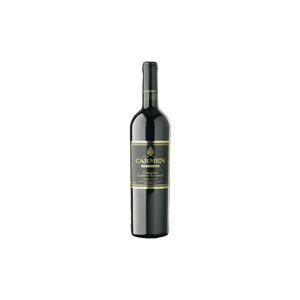
Carmen Reserve Carmenere Cabernet Sauvignon 2005 1 Red 1 White; 2 Reds
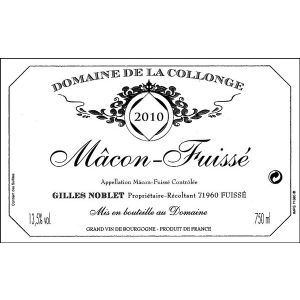
Domaine de la Collonge Macon-Fuissé 2007 1 Red 1 White; 2 Whites
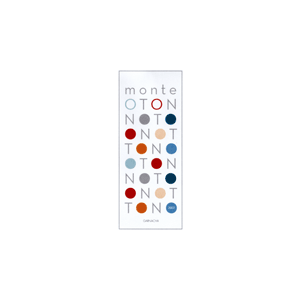
Bodegas Borsao Monte Oton Campo de Borja 2007 2 Reds
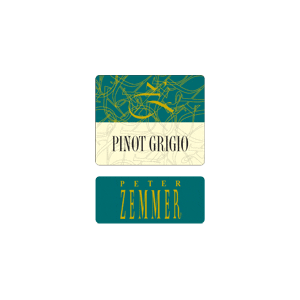
Peter Zemmer Alto Adige Pinot Grigio 2007 2 Whites


Master Series
Featured Wineries & Wines
Membership Type
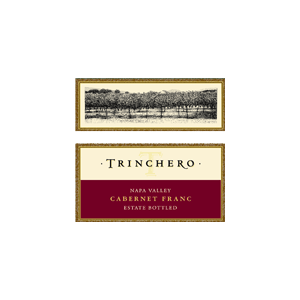
Trinchero St. Helena Napa Valley Estate Reserve Cabernet Franc 2005 1 Red 1 White; 2 Reds
Domaine de la Collonge Macon-Fuissé 2007 1 Red 1 White
Carmen Reserve Carmenere Cabernet Sauvignon 2005 2 Reds


Collector Series
Featured Wineries & Wines
Membership Type
Trinchero St. Helena Napa Valley Estate Reserve Cabernet Franc 2005 1 Red 1 White; 2 Reds
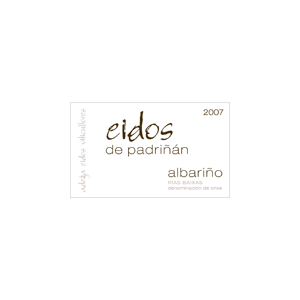
Bodega Eidos de Padriñán Rias Baixas Albariño 1 Red 1 White
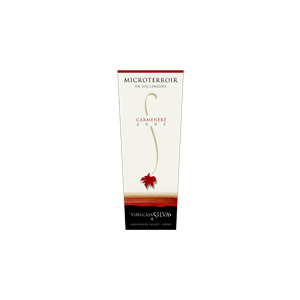
Casa Silva Carmenère Microterroir de Los Lingues 2005 2 Reds


Carmen Reserve Carmenere Cabernet Sauvignon 2005 – Chile

Carmen Reserve Carmenere Cabernet Sauvignon 2005Carmen is an amazing property. Furthermore, this great Chilean estate has the uncanny ability to consistently turn out top-notch wines from each of its premium varietals, and the 2005 Carmen Reserve Carmenere Cabernet Sauvignon is indeed another great effort from Chile’s “grande dame” of exquisite properties.

Carmen is Chile’s oldest wine brand, dating back to 1850. A century-and-a-half ago Christian Lanz founded Viña Carmen and lovingly named the estate’s beautiful vineyards for his wife. Today, Viña Carmen remains the showpiece Lanz envisioned more than a century-and-a-half ago. Combining tradition, superb vineyards and a state-of-the-art winery that was constructed in 1992, Viña Carmen is currently South America’s leading winery. In the 1990’s, winemaker Alvaro Espinoza, a proponent of organic viticulture, moved Carmen to the forefront of South American producers and brought international renown to this venerable property, a position it retains today under winemaker María del Pilar González. Wine & Spirits magazine has named Carmen “Top Winery of the Year” at least four times, and current offerings look to be some of the finest this winery has produced to date.

Presently, the more than 500 acres of Carmen Vineyards spread across several valleys and many microclimates surrounding Chile’s capital, Santiago. This constellation of microclimates allows Carmen to select the best grape varieties for each area and to excel with many different grapes and styles of wine. The winery has been extremely successful with French varietals, including the unique, lesser-known Bordeaux varietals, which includes Chile’s own “indigenous” grape, Carmenere.

Internationally renowned winemaker Alvaro Espinoza, who joined Carmen in 1993 and helped establish the winery’s stellar reputation, was instrumental in isolating and identifying Carmenere as a unique grape variety. He then went on to produce some of South America’s most exciting Carmenere-based wines. Alvaro also instituted organic farming at Carmen. Beginning the endeavor with a 50-acre vineyard for Cabernet Sauvignon and Chardonnay for the winery’s luxury “Nativa” label, Carmen’s mission each year has been to increase the vineyard parcels grown under environmentally sustainable standards. Under María del Pilar González, Carmen has continued to expand its use of organic methods of viticulture and reduce Carmen’s impact upon nature. Presently, Carmen uses no pesticides in their vineyards and is leading the way in Chile toward more environmentally sensitive viticulture. In addition, many of Carmen’s wines are bottled unfiltered. The winery has also made the commitment to use lighter bottles in an effort to cut waste and reduce the environmental impact of transport.

Carmenere (car-men-yehr)

Belonging to the Cabernet family, Carmenere is one of Bordeaux’s six permitted varietals for red wine, but it is now typically used only in small amounts, if at all, by the winemakers of that region. During the phylloxera infestation of the mid-1800s, Carmenere vines were hit especially hard, and the varietal was thought to have been almost wiped out. As the vineyards of Bordeaux were replanted, Carmenere was largely forsaken in favor of varietals that produced more consistent yields and were less prone to disease. Luckily for Carmenere, over the years it had enjoyed the good fortune of being mistaken for both Merlot and Cabernet Franc, leading to its unintentional importation to other countries. This occurred in Italy, New Zealand, and most notably in Chile, where cuttings believed to be Merlot were imported and widely planted prior to the Bordeaux phylloxera outbreak of the mid-1800s. Only in the 1990s were these “Merlot” vines discovered to be, in fact, Carmenere. Chile is now the largest producer of Carmenere wines worldwide, and the grape is used both in blends as well as in pure varietal wines, the latter being quite a departure from its traditional role in Bordeaux. The warmer, drier climate of Chile is much more favorable to the healthy growth and production of Carmenere, which when handled properly produces wines with intense red fruit, earth, smoke, and spice flavors. However, Carmenere’s tannins are softer than those of Cabernet Sauvignon, making it easier to drink and enjoy in its youth and a great companion to Cabernet Sauvignon in blends such as the Carmen Reserve.

Tasting Notes:  From the moment the cork exits the bottle, the 2005 Carmen Reserve Carmenere Cabernet Sauvignon fills the room with its breath. At first sniff, it is all Carmenere one breathes with its earthy, berry spice coming to fore; but after fifteen minutes or more in the glass, a second seductive wave caresses the nose. A potpourri of blackberry, wild blueberry, bramble, and roasted coffee well up in this wine to complement Carmenere’s forward thrust. On the palate this wine continues to work its charm, coating the mouth with rich textured fruit that is redolent with blackberry, cassis, and wood smoke. Each sip begs to be savored, pleading the gullet not to swallow and end the interlude, but alas . . .  the goodness doesn’t end when the wine slips down the throat. The finish on this Carmen Reserve combines consummate flavor with ripe tannins that linger to haunt the senses. A medium- to full-bodied wine, the 2005 Carmen Reserve Carmenere Cabernet Sauvignon aptly demonstrates how well the finest Chilean reds combine the best attributes of fine Bordeaux with the ripe textured feel of a New World wine. We suggest serving the Carmen Reserve Carmenere Cabernet after at least twenty to thirty minutes of breathing time. Actually, a half hour in a decanter would work absolute magic with this wine, so be sure not to cheat yourself.

Accompaniments:  For Carmenere fans, food will be strictly optional with the 2005 Carmen Reserve Carmenere Cabernet Sauvignon. However, this 2005 Carmen Reserve has the ability to elevate fine cooking to the level of “haute cuisine.” Perhaps better still, good everyday fare becomes a memorable meal in the company of this excellent offering from Carmen, so why not serve it with food? Veal Medallions served over caramelized onions, and artichoke heart risotto with sweet peas, mushrooms, and sweet peppers in Madeira wine sauce provide a particularly fine accompaniment to this wine.  Prosciutto Wrapped Chicken Breasts stuffed with fresh herbs and Manchego cheese offer another opportunity to enjoy the 2005 Carmen Reserve Carmenere Cabernet Sauvignon. Duck and lamb are two other favorite pairings, but spicy eggplant dishes and a midweek meatloaf will do nicely, as well. We can also endorse the Carmen Reserve Carmenere Cabernet with hard cheeses and rich, potentially artery-clogging sauces. This unfiltered wine has a way of cutting through fat and grease, thereby assuaging the fear of instant cardiac arrest. 

For the Love of Cheese:  With its propensity for fat busting, the 2005 Carmen Carmenere Cabernet Sauvignon is a natural accompaniment to many cheeses. Like mature red Bordeaux, this wine complements Cantal, Port Salut, and other fine French cheeses with aplomb. It also holds up beautifully to a wide array of hard and crusted cheeses. For more delicious cheese selections and details on our outstanding international gourmet cheese club, please visit our website at www.cheesemonthclub.com and enjoy all that life has to offer.

Domaine de la Collonge Macon-Fuissé 2007–France

Domaine de la Collonge Macon-Fuissé 2007Gilles Noblet at Domaine de la Collonge continues to fashion some of the Macon’s (the area of southern Burgundy that is known for its elegant Chardonnay wines) finest and most enjoyable white wines from several renowned appellations. Noblet’s Domaine de la Collonge is a small family-owned and -run domain of only 22 acres. Gilles is the fourth-generation member of his family to make wine at this prized property. For the record, Gilles’ wife also comes from a traditional winemaking family. Madame Noblet is the sister of Jacky Janodet of Domaine des Fine Graves in nearby Moulin-à-Vent, so wine and winemaking run deep in the heart and soul of this couple as well as in the terroir of the domaine’s well-tended vineyards.

The name Domaine de la Collonge derives from the sector or area (known as an aire) of the Fuissé commune that is called Collonge. Most of Gilles Noblet’s estate is spread along the hills of la Collonge, which yield on average only a little more than six thousand cases of Pouilly-Fuissé each year. However, Monsieur Noblet also fashions small quantities of exceptional Macon-Fuissé, Pouilly-Loché, and St. Véran – all elegant Chardonnay wines from the Macon similar to Pouilly-Fuissé.

Although not certified organic, Gilles Noblet practices sustainable agriculture and uses non-interventionist methods at Domaine de la Collonge. No artificial fertilizers or insecticides are employed, and only natural yeast is used in fermentation. Moreover, the average age of the vines for Domaine de la Collonge is more than forty years, while many vines are considerably older. Noblet’s old vines and reduced yields result in wines that are more generous and concentrated than the average Maconnais white.

In appellations that traditionally turn out large quantities of wine, Gilles Noblet decided a long time ago to dance to a different beat. Rather, the Noblet style of Chardonnay is one of elegance, purity, and the honest expression of each appellation’s terroir. Noblet’s Macon-Fuissé and Pouilly-Fuissé feature a real balance between flesh and bone, fruit and minerality, if you will. In addition, Noblet uses traditional wooden foudres (large wooden tanks) with temperature control elements for fermentation to ensure texture and a gentle roundness in his wine. He also ages his wine in a combination of foudres and small oak barriques; only 20% or less are new each year. The limited use of new oak is practiced expressly, so that the oak barrels impart roundness and texture to the wine, rather than the overwhelming taste of oak that destroys the natural delicacy of Macon-Fuissé and its siblings. In essence, the wines of Domaine de la Collonge are classic white Burgundies as well as some of the most compelling wines of the Maconnais.

Tasting Notes: Excellence and consistency go hand in hand at Domaine de la Collonge. Gilles Noblet’s 2007 Macon-Fuissé is a bright shimmering wine in both color and flavor. With every sip of this racy white wine, one sees and tastes the golden clusters of Chardonnay grapes that mature gently and slowly under the Maconnais sun. What's more, the 2007 Domaine de la Collonge Macon-Fuissé exhibits as much flavor as Noblet’s elegant, seductive Pouilly-Fuissé. On the nose, this stylish Macon-Fuissé offers up the beguiling scents of acacia flowers and apple blossoms. On the palate, the 2007 Domaine de la Collonge Macon-Fuissé follows through with gentle fruit, pinpoint purity, and subtle minerality – all of which add up to an elegant, nuanced, refreshing glass of Chardonnay that will please even the most ardent critics of overblown, over-oaked Chardonnays. And like Pouilly-Fuissé, the 2007 Domaine de la Collonge Macon-Fuissé is best served well chilled (40° F), at least initially, and then allowed to evolve slowly in the glass. Salut!

Accompaniments:  The 2007 Domaine de la Collonge Macon-Fuissé is an easy wine to drink, as an aperitif and with food. It is an easy white wine to pair with food because it provides understated elegance to complement a wide variety of dishes, especially those made with fish and other fine fruits of the sea. Scallop and crab dishes constitute some of our favorite offerings with Gilles Noblet’s wines.  Scallops sautéed in a light cream sauce with pistachio nuts are a perennial favorite. A simple crab cocktail or dip offers another memorable pairing to Gilles Noblet’s elegant 2007 Macon-Fuissé.  Flounder stuffed with crabmeat makes a wonderful partner, too. In addition, baked or grilled sole, sea bass, and grouper offer other fine choices with this wine. And for those not beholden to the sea for sustenance, imaginative chicken salads, light pastas, and healthy organic greens served with dried cranberries and goat cheese present other excellent pairings with this dazzling Macon-Fuissé. Furthermore, short of French Champagne, we cannot think of a better way to kick off a relaxing evening or a pleasant interlude than with a bottle of Gilles Noblet’s 2007 Macon-Fuissé. Moreover, this wine complements a wide array of fruits and cheeses, so we suggest you keep an extra bottle or two on hand to share after dinner with friends. It will help wash away the weather-stained cares of life. Enjoy!

Bodegas Borsao Monte Oton Campo de Borja 2007 – Spain

Bodegas Borsao Monte Oton Campo de Borja 2007Monte Oton is the newest venture from the highly acclaimed Spanish producer Bodegas Borsao.  Bodegas Borsao is located in the town of Borja, which is set amid the undulating hills of Zaragoza in sight of Mt. Moncayo, the highest mountain in the Iberian Range.  Borja is an ancient town whose origins can be traced back to the 4th century B.C. and beyond.  The original name of the town was Bursao, from which the name of the bodega is loosely derived.  Founded in 1958, Bodegas Borsao is a meticulously run winery that sits astride the lower part of the Ebro River, just south of the Rioja and the southern tip of Navarra.  This is Garnacha country, home to one of Spain’s most important but undervalued red varietals.  Such is the importance of the local Garnacha grape in Campo de Borja that this viticultural enclave is known as “The Garnacha Land of Spain.”

Not surprisingly, Bodegas Borsao specializes in the production of Garnacha, the region’s most important varietal.  Nearly three-quarters of the grape production in Campo de Borja is devoted to Garnacha, or Grenache, as the grape is known to the rest of the world.  From vineyards located high in the hills of Moncayo (1,200 – 3,000 feet above sea level), Bodegas Borsao fashions a host of Grenache-based wines.  The winery’s entry level red, the delicious, easy-drinking Viña Borgia, is born of 100% Garnacha. The winery’s newest venture, Monte Oton, is even more appealing.  It, too, is comprised of 100% Garnacha, but it offers a richer, fuller, more structured experience than the Viña Borgia.  The bodega also offers a special selection labeled simply as Borsao.  It is typically a blend of 75% Garnacha and 25% Tempranillo, which is Spain’s other ubiquitous varietal.  As one would expect, red wine is king at Bodegas Borsao, but this well-run modern winery also fashions small quantities of very good white and rosé wines in addition to its extensive portfolio of excellent Grenache based reds.

Tasting Notes:  Another brilliant effort from Bodegas Borsao, the 2007 Monte Oton offers tremendous eye appeal, incredible structure, and a wealth of seductive flavors.  Deep ruby red with purple highlights, the 2007 Bodegas Borsao Monte Oton paints a portrait of hedonistic pleasure, which it aptly displays with bright fruit-laden aromas that pour forthrightly from the glass and beg to be inhaled.  Cherry, berry, cola, and spice all make their appearances and affirm one’s highest hopes.  Nearly explosive in the mouth, this vibrant, youthful red may even offer more flavor and depth than some wine drinkers are accustomed to.  In short, the 2007 Monte Oton is no wimpy wisp of a Grenache; it is a first rate Grenache from old vines that is packed with flair and flavor.  It drinks like a first rate the Côtes-du-Rhône from the south of France, but like its Borsao siblings it outperforms the vast majority of Côtes-du-Rhône offerings we have tasted recently.  And the 2007 Monte Oton has not even reached its prime. With a few more months in bottle, the 2007 Monte Oton will simmer down and shed just enough of its youthful tannin to be downright irresistible.  However, there is no need to wait to enjoy this wine.  Just open a bottle and pour it into a glass.  In a few short minutes the fireworks will begin.  For optimum enjoyment we suggest serving the 2007 Monte Oton at cool room temperature (no more than 66º F).  Enjoy!    

Accompaniments:  The 2007 Bodegas Borsao Monte Oton is the ideal wine for rich, piquant dishes, as it can hold its own with most any food or sauce you want to pair with it.  However, it does equally well with everyday fare.  So whether it is barbecued chicken, mom’s midweek meatloaf, or spicy ribs, Monte Oton is ready to stand and deliver.  Traditional southern Italian specialties such as Pasta Fresca, Eggplant Parmigiana, and Sausage and Peppers work well, too.  Other notable accompaniments include brick-oven-baked calzones stuffed with three kinds of cheeses; a whole Rotisserie Roasted Chicken stuffed with onion, garlic, and Mediterranean herbs; and all kinds of cheeses.  Like all of Bodegas Borsao’s red wines, 2007 Monte Oton provides an outstanding accompaniment to cow and sheep’s milk cheeses as well as to Chèvre (goat cheese).  The rich fruit and overt charm of the 2007 Monte Oton pair beautifully with traditional Spanish cheeses such as Iberico (Eye-BEAR-ee-coh), Idiazábal (Eee-dee-ya-ZA-bal), Manchego (Mahn-CHAY-go), Mahon (Ma-Hone), and Tetilla (Teh-Tee-ya).  This wine also does justice to Brie, Camembert, and other crusted cheeses like few other red wines.  And of course there is no law that prohibits you from enjoying the Monte Oton by itself; if there were, we would all be in jail.

Peter Zemmer Alto Adige Pinot Grigio 2007 – Italy

Peter Zemmer Alto Adige Pinot Grigio 2007Editor’s Note: Peter Zemmer was recently named “Best European Winemaker” at one of Europe’s leading wine competitions. Peter, named for his grandfather and the founder of the estate, drastically limits yields at his family’s domain in the Alto Adige and fashions wines of exquisite charm and distinction from a growing number of varietals.

In Cortina amidst the alpine hills and valleys of the South Tyrol (Alto Adige) nestles the Zemmer family winery. Founded in 1928 by Peter Zemmer, this family-owned and -run operation has recently emerged as one of the zone’s leading producers of both white and red wines, thanks to the visionary leadership of Helmuth Zemmer and his talented winemaker son Peter, the firm’s current guardians.

The hallmark of Zemmer’s wines is always a pure, precise, highly focused aroma that defines the essence of the varietal or varietals from which they are made. In addition, the aroma of a Zemmer wine is merely the prelude to the rich flavors that lie within. Zemmer’s wines are consistently gratifying libations that appeal to the purist taster; they are completely unmanipulated expressions of their cepage and terroir. In other words, no smoke or mirrors are employed here. The annual harvest comes only from Zemmer’s own vineyards and those that are bound by tradition to the Zemmer property. White wines, most notably Chardonnay, Pinot Bianco, Pinot Grigio, Sauvignon Blanc, and a luxury blend labeled Cortinie Bianco, dominate this producer’s outstanding portfolio; but Zemmer also fashions fine, full-bodied red wines that merit serious attention, too.

Tasting Notes: The 2007 Zemmer Alto Adige Pinot Grigio is another outstanding example of the Zemmer style. This is bright, clean, full-bodied Pinot Grigio that amplifies both the grape varietal and the mineral-rich style of Pinot Grigio for which Alto Adige is renowned. Zemmer has once again hit the mark with the 2007 Pinot Grigio, demonstrating why Alto Adige remains Italy’s premier DOC for Pinot Grigio. Wrapped in a sunny yellow robe, Zemmer’s exemplary 2007 Alto Adige Pinot Grigio exudes a beguiling bouquet of spring flowers, stone fruits, and minerals. And, unlike many lesser Pinot Grigios, this offering doesn’t wilt in the glass. It remains elegant, but long on the palate, before finishing completely dry. Moreover, a very pleasant lemon and tropical fruit drop finish continues long after the wine has found its way home. Simply put, Zemmer’s Pinot Grigio combines eminent drinkability with serious flavor and panache, so it is no wonder that many commentators and critics refer to Zemmer’s wines as “sexy.” Enjoy this noble Pinot Grigio well chilled (35°-40° F) or only slightly cool (50º F). We prefer it cool, but as you like it.

Accompaniments: Well-made Pinot Grigio is one of the world’s consummate aperitifs. It also renders a great service to light meals and simple foods, especially when gastronomic accompaniments involve seafood, pasta, and salads. The 2007 Zemmer Alto Adige Pinot Grigio rises to the aforementioned challenge and goes a step further. Because it possesses a highly aromatic profile and enough body and flavor to back up its initial appeal, we are not afraid to serve it throughout a meal. With Zemmer’s Pinot Grigio there are plenty of crisp, mouth-filling flavors to assure that guests won’t tire of the wine before they sit down at the table. The 2007 Zemmer Alto Adige Pinot Grigio pairs especially well with a variety of hors d’oeuvres, including tapas. It is a natural with sushi, sashimi, California rolls, and tempura, too. Some other favorite accompaniments include grilled shrimp served with a light Dijon mustard and dill sauce; real lump crabmeat mixed with a chive cream and served over a Parmesan tuile; oysters sautéed in butter, cream, and fresh herbs; and grilled trout with almonds. A tray of uncrusted cheeses provides another successful marriage. However, regardless of what you choose to serve with the 2007 Zemmer Pinot Grigio, we strongly suggest you invite over someone special to enjoy it with you: the true wine lover is never stingy.

Trinchero St. Helena Napa Valley Estate Reserve Cabernet Franc 2005 – U.S.A.

Trinchero St. Helena Napa Valley Estate Reserve Cabernet Franc 2005Trinchero is a historic name in Napa Valley and one of California’s best kept secrets in premium Bordeaux varietals.  The Trinchero family immigrated to the United States from Italy in the 1920s during Prohibition.  After World War II they purchased the abandoned 19th-century Sutter Home Winery that had lain fallow for decades.  They revived the winery and the brand, and by 1960 the Trinchero family had garnered an enviable reputation for quality wines, most notably single-vineyard Zinfandels from Amador County.  In the early 1960s, Sutter Home was at the forefront of fine wine production in California.

Unfortunately, by the late 1960s, the demand for Zinfandel and other traditional California varieties was on the wane in favor of Chardonnay, Cabernet Sauvignon, and other French grape varieties.  White wine became the craze throughout the 1970s, which sent red Zinfandel to the proverbial backburner among consumers.  The Trincheros responded by creating the world’s first white Zinfandel in 1972 as an outlet for their award-winning Zinfandel grapes. White Zinfandel was an immediate sensation, and most other Napa Valley producers followed suit.  The rest is history.  However, the Trincheros’ quest has always been to produce only the finest premium California wines – a dream the family revived with the Trinchero Family Estate and a host of small family vineyards.

The Trinchero family owns 200 acres of the some of the finest vineyard land in Napa Valley.  Trinchero’s Reserve wines (of which the St. Helena Cabernet Franc is a part) all come from the family’s own home Napa Valley estate, which includes vineyards in Calistoga, St. Helena, Rutherford, and southern Napa Valley along San Pablo Bay.  In addition to the family’s elite Napa Valley vineyards, the Trincheros own 200 acres of vines in nearby Lake County and an additional 525 acres in Santa Barbara County.  All of Trinchero’s estate bottled wines are produced using sustainable methods of agriculture and with the utmost care for the environment.

As of 2007, Trinchero opened a brand-new 22,000-square-foot winery in St Helena, which replaces the old Folie à Deux Winery that served the Trincheros for many years.  In addition to housing a state-of-the-art winemaking facility, Trinchero’s new winery is also home to a stunning Tuscan style Culinary Center that will serve as the headquarters for Trinchero’s internationally recognized Vine to Dine (a registered trademark) wine and culinary education program. However, what is most impressive about Trinchero Family Estates is the high quality wine they fashion, with the least amount of environmental impact.

Trinchero Family Estates and Environmental Leadership

Trinchero Family Estates (TFE) is a leader in the employment of sustainable methods of agriculture, recycling, and green land management.  Trinchero Family Estates employs only sustainable, organic, and biodynamic practices in their estate vineyards.  They eschew the use of potentially harmful chemicals and work with the state of California and other vineyards to develop healthy, natural alternatives to harsh chemicals.  No chemical pesticides or herbicides are used at TFE, and natural groundcovers such as barley and clover prevail throughout all the estate vineyards.  Furthermore, botanical oils and natural predators take the place of potentially hazardous chemicals.  TFE also recycles 50 million gallons of water annually and recycles 20 tons of office paper, 850 tons of cardboard, and 100 tons of plastic each year.  All proceeds from recycling revert to TFE’s employees in the form of an employee-in-need fund.  In addition, Trinchero has planted over 3,000 oak trees near their vineyards and created extensive greenbelts and lakes to improve the natural environment.  Not surprisingly, Trinchero Family Estates has received California’s Waste Reduction Awards Programs (WRAP) Award for seven consecutive years.

Tasting Notes:  Suave, sophisticated, and smooth as satin, the 2005 Trinchero St. Helena Napa Valley Estate Reserve Cabernet Franc makes most other New World renditions of this glorious varietal look crude and uninteresting.  Furthermore, Trinchero’s Estate Cabernet Franc blows away a goodly number of St. Emilion Grand Cru and Pomerol offerings, too.  It hails from a tiny plot of just three acres at Trinchero’s Main Street Vineyard, located just behind the winery.  For centuries, Cabernet Franc has played a pivotal role in the blending of red Bordeaux wines, and it serves as the main player in Château Cheval Blanc, the greatest of all St. Emilion; so all we can say about Trinchero’s 2005 rendition of Cheval Blanc can be summed up in just one word: Wow!  This deep garnet wine offers a beguiling aroma of red and black fruits steeped in exotic herbal tea: crushed blackberry, raspberry, and strawberry all make their appearance in this wine in one seamless ensemble.  In the mouth, the Trinchero St. Helena Napa Valley Reserve Cabernet Franc is equally compelling.  It is rich in berry and chocolate flavors, and it is ripe and complex.  Moreover, this wine offers supreme balance and texture, which make it a joy to drink now.  We suspect this glorious Cabernet Franc will continue to improve in bottle, but why wait?  It is superb now with just twenty or thirty minutes of aeration.

Accompaniments:  The rich, complex flavors and supreme balance of the 2005 Trinchero St. Helena Napa Valley Estate Reserve Cabernet Franc pair beautifully with foods of equal stature.  Thick juicy steaks, wild game, winter stews, and hearty lasagnas are some of the Trinchero family’s favorite foods with their Reserve Cabernet Franc.  We second their notion and would add lamb and poultry to that list.  A duo of Veal Medallions and Lamb Loin wrapped with prosciutto ham gets a serious nod, as does Roasted Colorado Rack of Lamb served with potato gnocchi, pearl onions, and mushrooms.  These are two of our favorite offerings with this wine, but roast duck or chicken and many types of soft cow’s milk cheeses, too, provide enough pleasure in the company of Trinchero’s Reserve Cabernet Franc to offer most imbibers a glimpse of paradise.   However, no matter your choice of complement, this superb Cabernet Franc will surely shine.  Enjoy! 

Bodega Eidos de Padriñán Rias Baixas Albariño 2007 – Spain

Bodega Eidos de Padriñán Rias Baixas Albariño 2007Bodega Eidos is one of the bright new stars in Spain’s Rias Baixas appellation of Galicia, Spain’s cool, green region that rises from the pounding surf of the North Atlantic to the towering Pyrenees Mountains.  It was founded in 2000 by Manuel Villalustre, a well respected local viticulturist with 20 acres of old vines of Albariño.  In just a few short years, Bodega Padriñán has established itself as one of most compelling producers of white wines in Spain. Since the completion of his modern winery in 2003, Manuel Villalustre has fashioned two persuasive Albariño wines: Eidos and Veigas.  Eidos is the winery’s flagship offering.

Manuel Villalustre’s 100 separate parcels of vines are located at the most northern end of the Salnés Valley, among the steep hills of Padriñán, from which the winery draws its name. These hand-harvested vineyards are set among the gardens of the village of Sanxenxo, where they enjoy a commanding view of the sea.  However, each of these parcels occupies a south facing slope that protects it from the north wind and the stiff ocean breezes that buffet this coast. Superb fruit results from this region's favorable terroir and microclimate, resulting in the most concentrated and intense wines of Rias Baixas.  Little wonder, then, that vines have grown here since time immemorial.

Albariño: Spain’s Most Compelling White Grape

Albariño is an indigenous Spanish grape variety whose home is Rias Baixas and the Galician hills and hinterlands of northwest Spain and neighboring Portugal.  Albariño was once thought to be distantly related to Riesling, but some enologists now believe that Albariño may be more closely connected to the Petit Manseng variety of southwest France, which lies just to the north of Galicia and the towering Pyrenees Mountains.  However, no dry white Petit Manseng can match the body and finesse of Spain’s finest Albariño wines.  

In Portugal, Albariño goes by the name Alvarinho, where it typically ends up as a light summertime quaff in the guise of Vinho Verde.  Surely, nowhere could a single grape variety be more different than Albariño is in Spain and Portugal.  While Portugal picks this varietal early and makes a low alcohol wine (8.5%-9% on average), Spain, under the tutelage of Manuel Villalustre and similar minded individuals in Rias Baixas, turns out a full-bodied, intense Albariño with aromatic and flavor profiles more akin to Viognier – the greatest white variety of France’s Rhône Valley.

Because of its intense flavors and adaptability to difficult climates, Albariño is now extensively planted and studied in other locales around the world, including Australia, California, and South Africa.  Early reports from winemakers and consumers elsewhere appear promising for this late-maturing grape, but nowhere more than in Australia where extended growing seasons are common and the grape’s firm, bright acidity is much appreciated.  A debt of thanks belong to Manuel Villalustre and his Galician counterparts for helping resurrect over the past two decades the great Albariño varietal in Spain and sharing it with the world.

Tasting Notes:  In the days before pretty wine labels came into vogue, with pictures of exotic animals, flowers, and the inventive wares of well-known artists to adorn the bottle, there was a saying among wine lovers: “The simpler the label, the better the wine.”  In the case of Eidos de Padriñán, the adage still holds true.  As a classic wine of Spain, the Eidos de Padriñán Albariño sports the simplest of labels, but what rests within is not simple at all, nor has it anything to prove: the wine will speak volumes once it has been poured.  Made for wine drinkers who truly love dry white wine – and we mean classic dry white wine – the Eidos de Padriñán quenches like an ocean breeze.  Its aromatic profile is both fresh and profound.  The enticing scents of ripe pear and stone fruits, mingled with a pleasant, refreshing minerality, dominate the nose.  Full but not flabby, the 2007 Eidos de Padriñán enlivens the palate with a charismatic concoction of vibrant fruit, liquid stones, and bracing acidity, all of which add length and depth to an already brilliant offering.  Although thoroughly enjoyable when well chilled, the 2007 Eidos, like most first rate Albariño wines, is at its finest when served only lightly chilled.  At 50º-55º F, the Eidos will unfold gently in the glass and seduce those patient enough to allow the stinging chill of modern refrigeration to subside.  Enjoy!

Accompaniments:  In its native Galicia, tapas and seafood constitute the accompaniments of choice with Albariño.  And the 2007 Eidos shines on both counts.  It pairs beautifully with clams, mussels, and oysters, especially when served in a heady broth.  Cod, scrod, or almost any flaky white fish steamed in parchment or foil with chopped onion, garlic, tomatoes, olive oil, and herbs provides exemplary companionship to the 2007 Eidos de Padriñan Albariño.  Traditional tapas, marinated olives, stuffed mushrooms caps, full-flavored Spanish cheeses, and cured meats like prosciutto are perennial favorites, too.  However, one need not travel to Rias Baixas to appreciate this wine.  Asian stir-fries, sushi, sashimi, and grilled tuna steaks offer equally pleasing accompaniments and are easy to prepare or take out.  One simple favorite is Ahi tuna that is grilled medium rare, drizzled with a tangy ginger or teriyaki sauce, and then served over a bed of organic greens, shredded carrots, edamame, and broccoli.  This simple offering accentuates the taste of the wine and exemplifies the art of fusing Asian-accented recipes with traditional European wines like the 2007 Eidos.  Salud!

Casa Silva Carmenère Microterroir de Los Lingues 2005 –Chile

Casa Silva Carmenère Microterroir de Los Lingues 2005As recent reviews will attest, Casa Silva continues to astound critics and consumers alike with the quality as well as the variety of the wines it produces.  Since its inception, Casa Silva has been an exemplary, pioneering winery that is not afraid to push the quality envelope in each vintage with its exciting Carmenère wines, but with the first release of Microterroir de Los Lingues Casa Silva has entered a whole new realm.

Although the estate’s Colchagua vineyards are the oldest in the region, Casa Silva has only been making fine wine since 1997, the year this property began bottling premium wines under its own name.  However, historical accounts tell us that the Silva family’s predecessors were pioneers in Colchagua more than a century ago, when they brought the first grape varieties from France to their Angostura estate at the base of the towering Andes.  Today, the Silvas remain pioneers: they are Colchagua’s foremost experts on Carmenère, Chile’s emblematic red grape variety, and they produce the finest Sauvignon Gris and Viognier in South America, too.  Casa Silva contains many old vines, some approaching 100 years of age, which helps account for the quality and intensity one finds in each of the estate’s wines.

Casa Silva is located at the northern edge of the Colchagua Valley at the foot of the Cordilleran Andes.  This is a magical place that is steeped in sheer physical beauty as well as Chilean tradition.  Colchagua’s natural climatic conditions and terroir make it an extraordinary place to produce wine, which in no small way accounts for the great number of award-winning wineries now in Colchagua.  Here Carmenère is King, and Casa Silva’s Los Lingues Vineyard is the most prized vineyard in the entire realm.  Only the oldest and finest parcels of this great vineyard were used in making Microterroir.

Tasting Notes:  The 2005 Casa Silva Carmenère Microterroir de Los Lingues is, by all accounts, the ultimate expression of Chile’s finest and most emblematic red grape.  Furthermore, winemaker Mario Geise’s reputation as the “King of Carmenère” is no doubt solidified and enshrined for posterity with this wine, the estate’s first release of Microterroir.  A saturated purple color, a staggering perfume of blue and black fruits that fill a room with its breath, and layer upon layer of complex ripe fruit, chocolate, and spice flavors that coat the mouth and reappear long after the wine has made its way down the throat add up to a peak experience.  Elegant, opulent, and powerful all at once, the 2005 Microterroir de Los Lingues is knockout stuff upon which legends are made.  Aficionados of Chile’s unique varietal will no doubt be talking about this wine for years to come and wish they had a cellar full of it.  When we first tasted the estate’s 2005 Los Lingues Gran Reserva Carmenère  nearly two years ago we thought it would be hard to beat; little did we know that Casa Silva was ready to trump that effort with the 2005 Carmenère Microterroir – their finest and most expensive wine to date.  Enjoy this majestic effort now and for the next twenty years.  For optimal enjoyment we suggest serving the hedonistic 2005 Microterroir de Los Lingues at cool room temperature (60º-66º F), after fifteen or twenty minutes of aeration.

Accompaniments:  A wine with the complexity, elegance, and depth of the 2005 Casa Silva Carmenère Microterroir de Los Lingues needs nothing more than a clean vessel to work its magic.  For true Carmenère lovers, nothing else will be required.  However, given the caliber of this Carmenère and the smorgasbord of flavors contained therein, pairing it with foods of equal stature could be cause for gastronomic ecstasy.  Classic cuisine such as Beef Wellington, Duck à l’Orange, and Rack of Lamb would be a fine place to start.  Perhaps even more exciting is Churrasco, an Argentine- or Nicaraguan-style Grilled Beef Tenderloin.  It gets our nod every time we serve the finest Carmenère.  The rich flavors and spicy sauces of the Churrasco complement the Microterroir de Los Lingues perfectly.  Nonetheless, almost any grilled meat, even those with moderately spicy sauces, will find an indulgent partner in Casa Silva’s most opulent wine.  Gourmet cheeses and dark chocolate truffles offer other gastronomic delights with this sensuous beauty, so . . . as you like it.  Enjoy!


logo for wine club
Since 1994
Home
Join Our Wine Club
Gift Memberships

Membership Renewals
Reorder Your Favorites
More Information
Wine of the Month Club
Current Selections
Past Selections
Testimonials
Other Gourmet Gifts
Corporate Gifts
Wedding Gift Ideas
All About Wine
Website Tools
Who We Are
Contact Us

1 - 800 - 625 - 8238
(Outside US call: 949-206-1904)
P.O. Box 1627, Lake Forest, CA 92609