Featured Wines
July 2008
Premier Series |
|
Featured Wineries & Wines |
Membership Type |
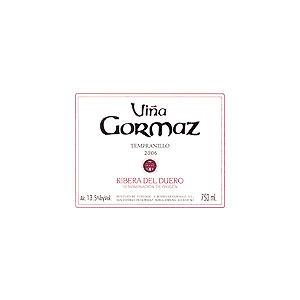
| Bodegas Gormaz Viña Gormaz Ribera del Duero | 1 Red 1 White; 2 Reds |
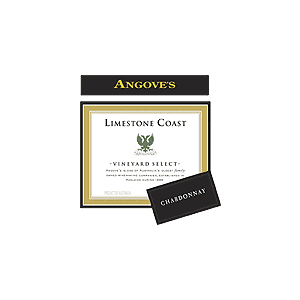
| Angove’s Limestone Coast Vineyard Select Chardonnay | 1 Red 1 White; 2 Whites |
| The Show California Cabernet Sauvignon | 2 Reds |
| Montevina Terra d’Oro Santa Barbara County Pinot Grigio | 2 Whites |
Master Series |
|
Featured Wineries & Wines |
Membership Type |
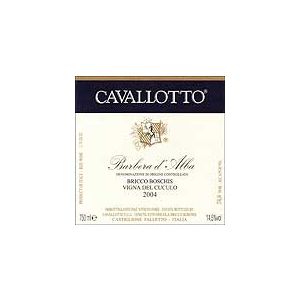
| Cavallotto Bricco Boschis Barbera d’Alba | 1 Red 1 White; 2 Reds |
| Angove’s Limestone Coast Vineyard Select Chardonnay | 1 Red 1 White |
| Bodegas Gormaz Viña Gormaz Ribera del Duero | 2 Reds |
Collector Series |
|
Featured Wineries & Wines |
Membership Type |
| Cavallotto Bricco Boschis Barbera d’Alba | 1 Red 1 White; 2 Reds |
| Vincent Girardin Rully Vieilles Vignes | 1 Red 1 White |
| Sandalford Margaret River Estate Reserve Cabernet Sauvignon | 2 Reds |
Bodegas Gormaz Viña Gormaz Ribera del Duero 2006 – Spain
Bodegas Gormaz has been turning out exemplary Ribera del Duero from old, head pruned Tempranillo vines since 1972. One of the original 16 bodegas of the D.O. Ribera del Duero, Bodegas Gormaz was originally founded as a cooperative consisting of some 360 growers in the Ribera del Duero province of Soria. Today, Bodegas Gormaz is privately owned and managed, and it is fashioning wines that simply must not be missed.
Brought to fore by Classical Wines of Spain, Bodegas Gormaz now consists of more than 1,300 acres of vines in Soria. As Soria lies at a very high elevation, it remains the least developed area of the appellation, just beyond the center of commercial development in the Ribera del Duero. Consequently, its vineyards have not been replanted, and most of the vines at Bodegas Gormaz are in excess of 50 years of age and have been propagated from vine to vine in pre-phylloxera fashion. In other words, the vineyards of Bodegas Gormaz grow on ungrafted rootstock, a rarity in the 21st century. What results is pure, rich, unadulterated Ribera del Duero from 100% old vine Tempranillo.
Ribera del Duero
Located in the heart of Spain in the ancient realm of Castile and León, Ribera del Duero has been a center of wine production for thousands of years. Even today, Ribera del Duero is one of the most important wine regions in Spain, as it remains the spiritual home of Tempranillo, Spain's most venerable red grape variety. Here the iconic Tempranillo, also known locally as Tinto Fino and Tinta del País, reaches its pinnacle and demonstrates to the world its inherent virtue.
Ribera del Duero occupies the hills and high meseta to the northeast of the city of Valladolid and stretches out along the Duero River, Spain's most beloved waterway. Not surprisingly, the region draws its name from the venerable Duero that plays an important role in the region's terroir. It seems that the soil of Ribera del Duero bears more than a passing resemblance to that of France's Burgundy, with a wide range of chalk, clay, marl and gravel, combined in varying degrees of prominence. However, whereas Burgundy's soil complexity results from plate tectonics, the soil in Ribera del Duero results from the Duero's erosion through the sedimentary layers of the Castilian meseta. The Duero River may likely play a role as well in moderating the rather harsh continental climate of the region, an area known for its dry, hot summers and cold winters. Add altitude (2,500-3,300 feet) and the intense luminosity of the Spanish meseta to the region's exemplary terroir, and it becomes apparent that Ribera del Duero possesses all the features it needs to showcase the many attributes of Tempranillo, Spain's quintessential grape variety.
Although Tempranillo provides heart and soul to nearly all the wines of Ribera del Duero, the Denominacion de Origen (DO) does permit small quantities of other grape varieties to appear in the appellation's red wines, most notably Cabernet Sauvignon, Merlot, Malbec, and Grenache. There is, however, no requirement that Ribera del Duero contain any grape other than Tempranillo. The extraordinary, trendsetting wines of Alejandro Fernández's Pesquera are made from 100% Tempranillo, while the legendary Vega Sicilia utilizes small quantities of Cabernet Sauvignon and Merlot to work its magic. Consequently, there is no one magic formula. However, what is certain is that world wide demand for the great wines of Ribera del Duero will continue to grow, as a cadre of astute producers in the zone continue to push the envelope on quality. Moreover, the relative value of the voluptuous red wines of Ribera del Duero are second to none. Just allow the red wine wares of Ribera del Duero a few years in bottle and a little time to breathe prior to serving, and they will more than handsomely reward the patient imbiber.
Tasting Notes: A juicy, purple potion, the 2006 Viña Gormaz highlights the approachable, friendly, downright irresistible side of old vines Tempranillo. Produced from vines more than 50 years old from Soria, the highest, most remote area of Ribera del Duero, the 2006 Viña Gormaz displays both true elegance and well as concentration of flavor. From start to finish, Viña Gormaz is a pleasure to drink. The scent of red fruits, raspberry and strawberry, caress the nose and a wealth of long, velvety flavors enliven the palate. Refreshing, yet satisfying, there are no tannic edges to tame with this wine, nor does one have to let it breathe forever to reveal its charm. From the first sniff to the last swallow that glides merrily down the eager gullet, the 2006 Viña Gormaz wins the day with its overt charm and sensuous vitality. Although hardly necessary for enjoyment, a bit of breathing time will almost certainly enhance the scent and savor of this outstanding Tempranillo. In addition, we suggest serving Viña Gormaz at cool room temperature (no more than 66° F).
Accompaniments: Given the silky, seductive nature of the 2006 Viña Gormaz, a wide variety of gustatory delights awaits both the serious gourmet and the ordinary gourmand alike. Whether you prefer butter and herb roasted chicken, a spicy country cassoulet, or an epicurean creation, the 2006 Viña Gormaz is ready to accompany just about any meat or poultry dish with aplomb. We have found this wine particularly well suited to tapas, too, the traditional "small dishes" that are featured appetizers in Spanish restaurants. In fact, two or three tapas can serve as a complete meal. Some fine tapas selections with the Viña Gormaz include mushroom soup; duck, quail, or pheasant confit; and a white bean and chicken dish with tomatoes, onions, and peppers. Venison stew, prepared with carrots and potatoes constitutes another winning partnership. Lightly grilled tuna steaks, served with a Mediterranean antipasto paste of chopped olives, tomatoes, roasted red peppers, and fresh basil makes for wonderful pairing with Bodegas Gormaz's Viña Gormaz, too. Furthermore, we strongly suggest that you not overlook other traditional Mediterranean favorites, even typical Italian specialties like lasagna. In fact, almost any food with which you would consider serving a fine Italian red, a smooth, full-bodied Châteauneuf-du-Pape, or similar hedonistic style of Rhône wine will work quite well with the 2006 Viña Gormaz Ribera del Duero. Enjoy!
Angove's Limestone Coast Vineyard Select Chardonnay 2006 - Australia
Angove's Pty. Ltd. is one of Australia's largest privately owned wineries. It began with Dr. William Angove, an accomplished general practitioner and surgeon, who emigrated with his wife and young family from Cornwall in 1886 to establish a medical practice in South Australia.
Although he enjoyed a distinguished medical career, Dr. Angove's most enduring legacy survives in the viticulture of South Australia. His early experimentation with vines, winemaking and distilling led to the establishment of a proud family business. Dr. Angove's initial plantings at the township of Tea Tree Gully in the Adelaide foothills were the forerunner of one of the largest vineyards in the southern hemisphere — the magnificent Nanya Vineyard at Renmark in South Australia's Riverland.
Since 1950, Angove has steadily expanded its operations and structure. The Renmark facility has grown to become a major winemaking and distilling entity with storage capacity for more than 15 million liters of wine and spirits. In Australia, Angove's is known not only for its fine table wines (still wines under 14% alcohol), but its exceptional line of fortified wines and spirits. Angove's produces sherry, port, vodka, and an especially fine line of pot stilled brandies under the name of St. Agnes. The 5 Star Liqueur Brandy from St, Agnes is a gold medal winner that consistently receives the highest critical acclaim from tasters and critics.
In 1983, the fourth generation of the family took control of Angove's when John Carlyon Angove succeeded his father as Managing Director of the company. John has taken up where his father left off, with increased development and investment in all aspects of the winery. In addition, Victoria, John's eldest daughter and a member of the fifth generation, is now actively involved in ensuring ongoing growth in her role as International Business Development Manager, so much so that Angove's wines can be found today in over 30 different countries around the globe. This is testimony to Victoria's ability and the outstanding quality of Angove's many critically acclaimed, award-winning wines.
Like most Australian wineries, Angove's fashions an entire portfolio of wines at varying levels of quality and age worthiness. Angove's Vineyard Select offerings are the winery's top wines. Angove's Nine Vine Series (and most notably the Viognier) is another exemplary line of wines. It is so named because only nine vines remain at the original 19th century Tea Tree Gully Vineyard in the Adelaide Hills that Dr. Angove planted. These ancient vines serve as a reminder of the vibrancy of a wine-growing region that has played a vital role in the development of a nation as well as an integral part in the Angove family's winemaking heritage.
Limestone Coast
A diverse, stunningly beautiful area of South Australia, the Limestone Coast is a world renowned destination for cavers, divers, and adventurers. This rugged coast displays a unique ecosystem, which includes prolific bird life and nearly 30 caves that are recognized as World Heritage Sights. It is also the home of more than forty family wineries and nearly 30,000 acres of vines. The Limestone Coast is home to several of Australia's leading viticultural appellations, including Coonawara and Padthaway. Chardonnay and Cabernet Sauvignon are the Limestone Coast's greatest claims to fame. Moreover, nearly 20% of Australia's premium wines hail from the Limestone Coast, even though this region comprises less than 10 % of the vineyard area in the country.
Tasting Notes: The 2006 Angove's Limestone Coast Vineyard Select Chardonnay is ample testimony to the Limestone Coast's reputation for furnishing many of Australia's greatest Chardonnay wines. Bright, complex, and packed with a cornucopia of flavor, the 2006 Angove's Limestone Coast Chardonnay exhibits a heady olfactory that happily follows through on the mid palate and nearly explodes on the finish. Scents of soft, ripe tropical fruits, zesty lime and melon tantalize the nose and fold effortlessly into the flavor profile of this complete Chardonnay. Savory hints of vanilla, butter, toast, and mineral emerge in the mid palate and carry through on the wine's vibrant finish that ever so adeptly displays the expert interplay of fruit, oak, and spice. A combination of the lithe spirit of Pouilly-Fuissé and the rich, mouth-filling Chardonnay wines of Napa Valley, the 2006 Angove's Limestone Coast Chardonnay offers a very appetizing, easy-to-drink Chardonnay that wears ever so well on the palate and keeps you coming back for more. We suggest you enjoy this delicious Chardonnay moderately chilled (40°-45° F).
Accompaniments: Given the rich flavor profile of the 2006 Angove's Limestone Coast Chardonnay, a wealth of foods from both land and sea offer superb accompaniments. Dill Seasoned Sea Scallops; Baked Grouper or Tilapia, served with a fruit salsa; and Crab Cakes, drizzled with saffron vinaigrette and a red pepper lime sauce comprise a few seafood selections that pair well with this splendid Chardonnay. For landlubbers, we suggest Roast Chicken, accompanied by a sweet corn and herb pudding; or Smoked Turkey, served with corn bread stuffing. Most cow and goat's milk cheeses offer wonderful companionship to Angove's Vineyard Select Chardonnay, too. Fried Goat Cheese Salad, served with organic baby lettuce, brandy soaked dried cherries, and walnuts, provides a splendid accompaniment when served with a light tarragon vinaigrette. And for the record, the 2006 Angove's Limestone Coast Chardonnay excels as an aperitif as well. Enjoy!
The Show California Cabernet Sauvignon 2006 – U.S.A.
The Show is back! Once again, The Show stars Charles Bieler, Joel Gott, and Roger Scommes in a (Scommegna) Production. Collectively, these three characters are known as The Three Thieves. However, the name Three Thieves does not connote any wrongdoing or lack of integrity on the part of this dynamic and wildly successful triumvirate. Instead, the name is meant tongue-in-cheek because these three guys have procured, though some would say "stolen" once again, some of the finest Cabernet grapes in Northern and Central California and turned them into one high-class, expensive-tasting Cabernet that shames the competition. Enter The Show, the name of this act of course. The Show is in its second year; the winery's first release was in 2005. However, the sequel is every bit as fine as the original.
Begun in 2003, The Three Thieves have rapidly become legendary for fashioning eco friendly wines that out class the competition. Joel Gott brings his reputation to the table or barrel if you will as one of the finest, yet unpretentious winemakers in California. A fourth generation winemaker, Gott enjoys nearly cult status in California where he has been putting out some of California's most interesting and affordable wines for years. He has been called "one of the most talented winemakers alive today" and his wines have received accolades in every major wine publication. The Show is one of his most recent ventures and an attempt to take his great show on the road. To help Gott in his endeavor to go national with The Show are partners Charles Bieler of the outstanding Château Routas in Provence and Roger Scommes (né Scommegna), advertising, entrepreneur and viticulturist extraordinaire. Together, they make a formidable team, and The Show is all the proof one needs of that
The Show is a blend of 80% Cabernet Sauvignon, with the remaining 20% of the cépage consisting of Merlot, Cabernet Franc, Petit Verdot, and a tiny quantity of Petite Sirah. The Show's labels were designed by Nashville's Hatch Show Print, who have made many a country music star a legend. The Show's labels come in three distinct colors and formats, even though the wine inside all of the bottles is exactly the same. Each of the three partners preferred a slightly different motif, so they went with all three, which should tell us a little something about these three thieves. We bet they got, or should we say stole or at least cajoled, all three designs for the same fee – more power to them. Enjoy The Show . . . it's a good one!
Tasting Notes: The 2006 The Show is a crowd pleaser and every bit as good as its predecessor, The Show's debut vintage. In fact, if more California wineries made affordable Cabernet like Bieler, Gott, and Scommes, there wouldn't much of a market for ridiculously priced California Cabernet Sauvignon, let alone Merlot or Syrah. Once again, this latest rendition of The Show opens up with an eye catching, royal purple robe and an immensely gratifying aromatic profile. Soft scents of black cherry, cedar, plum, and chocolate quickly set the tone for the wine's next act – a palate pleasing performance. Each sip of The Show glides across the tongue and quickly disappears delightfully down the gullet, even at this tender age. Soft tannins and a lovely patina of oak add both structure and finish to this charming fruit driven, medium-bodied Cabernet, which makes us wonder why more California wineries haven't followed suit. Shame on them! Meanwhile, enjoy The Show; it's a very talented Cabernet that's ohh so easy to drink. Furthermore, The Show needs no fuss to shine, so you can open it and drink it straight away. Nonetheless, allowing it 30 minutes or more of breathing time will double your pleasure and no doubt evoke a standing ovation. Cheers!
Accompaniments: The 2006 The Show Cabernet Sauvignon is the perfect accompaniment to everyday "All American fare." Steaks, chops, pork barbecue, grilled chicken, guacamole, corn chips, vegetables dips, and of course pizza and burgers provide all the props The Show ever needs. This gregarious Cabernet also shines with a hearty salad because, unlike so many other California Cabernets, there is so much more to The Show than just power and tannin. With this in mind, we can heartily recommend the 2006 The Show with more elaborate fare as well. So don't be afraid to put on your Sunday best and whip up some fancy fare; there is no need to dress down to enjoy this succulent red. Chateaubriand, served with a truffle sauce reduction, tiny game birds in puffed pastry, and other haute cuisine favorites will be as comfortable with The Show as a regular mid week meal. Take The Show on the road, too: it's a great picnic and party wine. And for the record, the 2006 The Show Cabernet Sauvignon does a terrific solo, too. Just be sure you have a clean glass, or two. And come to think of it, you may want to reserve a second bottle; it won't go to waste. Enjoy!Montevina Terra d'Oro Santa Barbara County Pinot Grigio 2006 – U.S.A.
Montevina is one of the oldest and most prestigious wineries in California. Set amid the foothills of the Sierra Mountains, Montevina lies at the heart of California's "Gold Rush Country." However, today Montevina is best known for its liquid gold in the form of excellent Syrah, Zinfandel, Barbera, Pinot Grigio, and other Italian grape varieties from Santa Barbara County as well as the Amador foothills.
The Trinchero family has owned Montevina since 1988, but this winery's passion for growing outstanding fruit and producing many of California's finest Rhône and Italian style varietals dates back even further to the 1960's. And since 1986 Jeff Meyers, unquestionably one of the most experienced California winemakers with Italian varietals, has been the General Manager and guiding force behind Montevina's huge success. Possessing an encyclopedic knowledge of the region's viticulture along with a knack for fashioning distinctive Mediterranean varietals that possess elegance as well as fabulous flavor, Jeff is one of the first California winemakers to be enormously successful with Mediterranean varieties. Montevina's Barbera, Pinot Grigio Sangiovese, Syrah, and Zinfandel, produced under the Terra d'Oro label, create a benchmark portfolio for these varieties that would be hard to find elsewhere. And unlike most of the wines from this estate's competitors, Montevina's wines are produced from a high percentage of old vines.
Trinchero Family Estates and Environmental Leadership
Montevina is an integral part of Trinchero Family Estates. Trinchero Family Estates (TFE) is a leader in the employment of sustainable methods of agriculture, re-cycling, and green land management. Trinchero Family Estates employs only sustainable, organic, and biodynamic practices in their estate vineyards, which include Montevina. They eschew the use of potentially harmful chemicals and work with the state of California and other vineyards to develop healthy, natural alternatives to harsh chemicals. No chemical pesticides or herbicides are used at TFE and natural ground covers such as barley and clover prevail throughout all the estate vineyards. Furthermore, botanical oils and natural predators take the place of potentially hazardous chemicals. TFE, also, recycles 50 million gallons of water annually and re-cycles 20 tons of office paper, 850 tons of cardboard, and 100 tons of plastic each year. All proceeds from recycling revert to TFE's employees in the form of an employee-in-need fund. In addition, Trinchero has planted over 3,000 oak trees near their vineyards and created extensive greenbelts and lakes to improve the natural environment. Not surprisingly, Trinchero Family Estates has received California's Waste Reduction Awards Programs (W.R.A.P.) Award for seven consecutive years.
Tasting Notes: The 2006 Montevina Terra d'Oro Pinot Grigio is born on the steep, well-drained hills of the estate's Los Alamos Vineyard in sunny Santa Barbara County. With well-drained soils, natural methods of production, and plenty of tender loving care, Montevina has fashioned an outstanding New World Pinot Grigio that wears a handsome straw-colored robe and recalls the rarified light of Santa Barbara. Bright, clean, flavorful, and surprisingly well-structured, this Pinot Grigio offers a beguiling bouquet and flavor of citrus blossoms, mineral, coconut and pineapple that enliven the senses and glide over the palate. Long and lovely in the mouth, the Terra d'Oro Pinot Grigio provides more flavor and character than one is accustomed to finding in Pinot Grigio. Moreover, it finishes with both verve and subtle complexity. Wow! Enjoy this magical Pinot Grigio moderately chilled (40° F).
Accompaniments: The fruits of the California Coast, both onshore and offshore, provide outstanding accompaniments to the 2006 Montevina Terra d'Oro Pinot Grigio. Bold enough to hold up to crab—steamed, stuffed, or wrapped in a dip—the Terra d'Oro Pinot Grigio does not suffer from the wimp factor that afflicts some members of Pinot Grigio family. Consequently, clams, scallops, shrimp, mussels, and almost anything that swims, will pair well with this wine. Steam or stir fry some fresh garden vegetables and one needs nothing more than a clean glass to provide a perfect accompaniment. And if you haven't gotten around to cooking anything, don't worry. The 2006 Montevina Terra d'Oro Pinot Grigio can hold court by itself, and it will shine as brightly on the tongue as it does in the glass, without a morsel. Enjoy!
Cavallotto Bricco Boschis Barbera d'Alba 2004 – Italy
Alfio Cavallotto is one of the new bright stars to emerge in Italy's Piedmont. However, Cavallotto is neither new to the scene, nor are his wines indicative of the light, modern style of Barbera and Barolo. Cavallotto is a real traditionalist, and his wines make few concessions to the contemporary predilection for technology over technique. Rather, it is this house's penchant for making authentic, muscular, cask-aged Barberas and Barolos that reflect the great terroir of Castiglione Falletto and have caused Alfio Cavallotto's star to rise.
The Cavallotto estate uses only indigenous yeasts and long macerations to extract the fullest representation from each vineyard and wine it produces, and the results are sublime – age worthy Piedmontese treasures that are both structured and ultimately decadent. Cavallotto's most compelling offerings emanate from his premier 10-acre vineyard known as Bricco Boschis. Both Barbera and Barolo emerge from this little gem. Production from this single vineyard cru is predictably small, rarely more than 2,100 cases.
Piemonte or PiedmontIn the north of Italy, nestled just beneath the great Alpine wall as it tumbles out of Switzerland and the gleaming Mediterranean Sea, lies Piemonte (Italy's Piedmont). It is a region of myriad beauty. It is also the region of Italy closest to France in proximity as well as in the sheer quality and variety of exceptional wines it produces. For centuries, Italy's Piedmont remained a prize to be won among warring European powers; no doubt at least in part because of the province's world-famous cuisine that still draws happily on the abundance and quality of local truffles. Yet today it is the superbly made wines of Italy's Piedmont that garner the most international recognition: complex, hedonistic red wines, still delicate whites, and sweet haunting Muscats. With such exquisite fare, should anyone question why the hearty robust delights of the Piedmontese table remain the region's most famous ambassadors to a hungry and thirsty world?
Ask the Panel
Question: It seems to me that Barbera is a wine that is showing up more and more in wine shops and restaurants as of late. But what is a Barbera? Is it a grape or a type of wine?
Response: Barbera is a prolific grape variety whose origin is Italy's Piedmont. It is now grown extensively throughout northern and central Italy, but most of the finest Barbera wines still hail from two traditional Piedmontese appellations: Barbera d'Alba and Barbera d'Asti. The finest wines of Barbera d'Alba are often produced alongside Barolo. In the five villages of Barolo, Barbera vines typically grow on the lower slopes of the appellation's steep hills, while Nebbiolo (for Barolo) occupies the higher ground, but extreme elevation and other factors can reverse this planting. As a general rule, Barbera d'Alba fashions fuller, more age-worthy wines than Barbera d'Asti. However, both appellations turn out exceptional wines, so one's preference for one over the other remains more a question of style than quality. At their best, Piedmontese Barberas display intense flavors of berries, black fruits, and spice, bolstered by a good dose of natural acidity. Today, Barbera is the second most widely planted grape variety in Italy. Furthermore, Barbera has increasingly found favor abroad, especially in Argentina, Australia, and California, which no doubt accounts for its increased appearance and popularity.
Tasting Notes: A deep, brooding, classic Barbera d'Alba, the 2004 Cavallotto Bricco Boschis displays an intense robe, a beguiling scent, and a wealth of deep down-flavor. Blackberry, cherry, currant, and mulberry flavors lay steeped in this robust, traditional-styled Barbera d'Alba, but patience will be required for near-term consumption. Full-bodied and endowed with ample ripe tannins, the 2004 Cavallotto Bricco Boschis remains an infant, a wine that can please now but will benefit immensely from additional time in bottle. With ample aeration (we recommend an hour or more), this wine displays a wealth of penetrating flavors as well as a suave, sophisticated, supremely textured feel in the mouth. Nevertheless, just another year in bottle will bring all the latent goodness of this fabulous Barbera to fore. Anticipated maturity: 2009-2014.
Accompaniments: The complex, nuanced flavors of Piedmontese cuisine provide several perfect foils to Cavallotto's 2004 Bricco Boschis Barbera. Rarely, even in the Piedmont, does one sit around and sip the region's legendary reds, Barbera and Barolo, without some tasty morsel to accompany the wine. When consumed at table with traditional Piedmontese cooking, with its rich flavors and savory sauces, one comes to easily appreciate the royal nature of great Barbera. Certainly, risottos, made with authentic Arborio rice, constitute many of our favorite choices with this wine. We are especially fond of a regional risotto that calls for a whole cut-up chicken, mushrooms and/or truffles. Curiously, it is dashed with a first-rate balsamic vinegar from nearby Modena, and cooked at a snail's pace. In another direction, milk-fed veal that is pounded and gently sautéed to perfection in butter and herbs provides another ideal dish to showcase Cavallotto's single-vineyard Bricco Boschis Barbera. Less regional dishes do well, also. Roast loin of pork, stuffed with a bread, onion, and herb farce provides a savory treat. Marinated steaks and pork tenderloins offer tasty uncomplicated alternatives, too. In addition, Cavallotto's Bricco Boschis Barbera presents one of the finest accompaniments to hard cheeses. Hunks of authentic Italian Parmesan or Provolone cheese pose no threat to this wine and offer a great way to finish a meal fit for a king or queen.
Vincent Girardin Rully Vieilles Vignes 2006 – France
Vincent Girardin is one of the scions of the great Girardin family of Santenay of southern Burgundy. Born in Santenay on the Côte de Beaune, Vincent is part of a winemaking family whose roots stretch back to the 17th century. He is in many ways the archetypal Burgundy grower and producer. That is to say, his domaine is a true family affair. Vincent tends the vineyards, works in the cellar, and makes the wines; while his wife of nine years Véronique complements him in running their formidable domaine. The Girardin family has for generations been well represented among the finest names in Burgundy. Vincent's father, Jean, was a renowned winemaker as is his brother, Jacques. Vincent has been producing fine estate bottled offerings at his domaine since 1982.
Vincent began his winemaking career with only 2 hectares (4.4 acres) of vines. However, when Jean retired, Vincent took over several additional hectares, from which he fashions exceptional red and white Burgundy. The white wines of Vincent Girardin display great finesse and a pure aromatic profile; they are impeccably balanced white wines that exude considerable richness as well as refreshing vibrancy. Correspondingly, Girardin fashions intense, profound red wines that balance ripe fruit with a tannic structure for ageing. This estate's wines all reflect considerable care and exceptional breeding, which render them capable over time of unmistakable grandeur.
Success in winemaking requires great rigor and attention to detail at all times for each individual wine. Therefore, at Domaine Vincent Girardin respect begins in the vineyard and surrounding lands. No herbicides or insecticides are used at the estate. The grapes are all hand harvested and then sorted twice, once in the vineyard and a second time in the winery. The sorting process eliminates any grapes or elements that would render an ensuing wine less than optimal. The pressing of grapes is a gentle affair at this estate, and the resulting wines are all aged in the finest oak barrels. A carefully controlled ageing process allows each wine to achieve its full potential. Vincent Girardin employs very little fining or filtration of his wines, also, in order to preserve their natural qualities.
Burgundy
Burgundy is a wine as well as a place. In fact, it is many wines and many distinct locales, all of which were once part of the ancient Duchy of Burgundy. Situated several hundred kilometers southwest of Paris, Burgundy is hallowed ground to serious lovers of the vine. From its golden hillsides, whose center slopes are so aptly named the Côte d'Or, flow France's most expensive and profound wines. Names such as Romanée Conti, Chambertin, Clos de Vougeot, and Le Montrachet among others have been delighting serious wine aficionados for centuries. Yet there is much more to Burgundy and its wines than a few illustrious names. For starters, Burgundy is the ancestral of home of two of the world's most revered grape varieties, Chardonnay and Pinot Noir.
Clearly, Burgundy is much more than a single wine or one great vineyard: it is a special place, a land almost entirely devoted to wine in one fashion or another. However, what remains surprising to many wine drinkers is that Burgundy is a white wine as well as red, the best of which come from Chardonnay and Pinot Noir respectively and exclusively. With a few rare exceptions, the finest Burgundies emanate from the region's core, the Côte d'Or, which begins on the fabled Côte de Nuits, just to the south of Dijon, and flows all the way south to Santenay at the tip of the Côte de Beaune. Fine Burgundy wines from these illustrious hillsides are worth their weight in gold. Salut!
Tasting Notes: Due to consummate winemaking and exceptional terroir, the 2006 Domaine Vincent Girardin Rully Vieilles Vignes shines brightly from the glass with the glory of the morning sun. Scented with the aroma of acacia and budding spring flowers, homemade butter, and soft, ripe cheese, this Vieilles Vignes (old vines) Rully is a delight to sniff and savor. It is full and satisfying in flavor, yet ever so elegant and smooth in body and texture. As one panel member so saliently stated, "Now, this is one Chardonnay I can really drink." We recommend only moderate chilling (40°-45° F) of Vincent Girardin's Vieilles Vignes Rully for optimal flavor and enjoyment.
Accompaniments: Since the 2006 Vincent Girardin Rully Vieilles Vignes is indeed one Chardonnay you can really drink, it makes for a splendid aperitif. In short, this is one easy-to-drink white Burgundy that goes down ohhh so easy. Yet part of the glory of fine white Burgundy is the possibility of pairing such a wine with equally great food, so you may want to have a second bottle on hand to complement poached salmon, scallops, or veal medallions with mushrooms and cream (Escalopes de Veau à la Crème). Each constitutes a veritable feast with this lovely Rully. And these are just a few of the dishes that we have found to provide superb accompaniment to Vincent Girardin's elegant, full-flavored white Burgundies. Other excellent choices include most fish, fowl, and even tender cuts of pork. Bon Appétit!
Sandalford Margaret River Estate Reserve Cabernet Sauvignon 2005 – Australia
Sandalford is one of the oldest and largest privately owned wineries in Western Australia. Founded in 1840 by Western Australia's first Surveyor General, John Septimus Roe, the Sandalford Estate began as part of only the second land title in Western Australia. Roe named the estate after the English priory at Sandalford, where his father was rector. Since 1991, historic Sandalford Wines has been owned by the Prendiville family. It still occupies the original 40 hectares of the grant, spread out along the banks of the beautiful Swan River, less than a 30-minute drive from Perth. Moreover, Sandalford is unequivocally one of Western Australia's leading purveyors of premium wines.
In 1970, Sandalford planted one of the first vineyards in the Margaret River, south of Perth. Since then Margaret River has become Western Australia's most important appellation for premium grapes. Sandalford's Margaret River vineyard comprises 600 acres that are entirely dry farmed. This vineyard is the source of all the winery's estate offerings. Meanwhile, Sandalford's Estate Reserve selections reflect the epitome of winemaking under the direction of Winemaker Paul Boulden.
In addition to making some of the continent's most exquisite wines from traditional Bordeaux varietals, most notably Cabernet Sauvignon, Sauvignon Blanc, and Semillon, Sandalford Wines also fashions excellent Shiraz and Chardonnay. Furthermore, all of the estate's top wines are featured at Sandalford's luxury restaurant. Under the direction of Chef Mark Ford, the restaurant at Sandalford has become a must stop for both locals and visiting dignitaries in search of exemplary cuisine. Set amid vines more than a century old, the restaurant serves a fantastic array of local specialties, which makes it easy to understand why it has been deemed "one of the top half-dozen winery restaurants in the country." In all respects, Sandalford warrants serious attention from gourmands and oenophiles alike. And then there is the view: What more could one ask?
Tasting Notes: The 2005 Sandalford Estate Cabernet Sauvignon is well endowed in a deep purple robe and an amplifying bouquet. In true Margaret River fashion this Estate Reserve Cabernet provides a seductive aromatic profile that tantalizes the nose with scents of blackberry, mint, and eucalyptus – the calling cards of classic Australian Cabernet. Better still, this wine's aromatic fireworks follow through on the palate and offer the taster a rare treat: great flavor and hedonistic pleasure. These two attributes are rarely synonymous in such a young Cabernet Sauvignon. Medium to full bodied, the Sandalford Estate Reserve Cabernet Sauvignon expresses the easy accessibility and eminent beauty of Margaret River. Moreover, bright acidity and long, ripe tannins add length to the wine's finish and speak to the longevity and ultimate potential of this comely offering. For optimum pleasure, allow the 2005 Sandalford Estate Reserve Cabernet Sauvignon at least thirty minutes of aeration before consuming. However, to those patient and disciplined enough to forego instant gratification, we heartily recommend the cellaring of this Margaret River classic for several more years, as time will quite assuredly pay handsome dividends in regard to this classic Cabernet. Anticipated maturity 2008-2015.
Accompaniments: Given the acumen at Sandalford's award-winning restaurant, it only stands to reason that Sandalford's Estate Reserve Cabernet Sauvignon should be crafted with an eye to the culinary comforts of the restaurant's splendid table. Certainly, beef, lamb, pork, chicken, and game all provide excellent opportunities to showcase the 2005 Sandalford Estate Reserve Cabernet Sauvignon, but at Sandalford the real fun only begins there. Some of Sandalford's exquisite pairings with their Estate Reserve Cabernet Sauvignon include Pink Peppercorn Crusted Kangaroo, served with sweet potato roesti and caramelized baby beets; Venison Carpaccio with truffle pecorino, beetroot crisps and rocket; and Rabbit and Smoked Chorizo Terrine, served with homemade mustard bread and tamarind chutney. One need not be as accomplished as Mark Ford in the kitchen to open a bottle of the 2005 Sandalford Estate Reserve Cabernet Sauvignon, but it is nice to know that this Sandalford Cabernet can shine in the company of the finest cuisine.