Welcome to The International wine of the Month Club

Past Newsletters - May 2010

Premier Series
Featured Wineries & Wines
Membership Type
Urban Valle de Uco Mendoza Malbec 2008 – Argentina 1 Red 1 White; 2 Reds
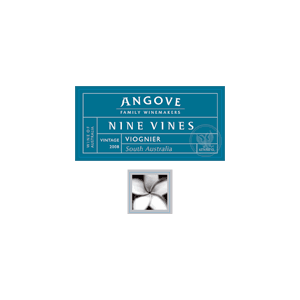
Nine Vines South Australia Viognier 2008 - Australia 1 Red 1 White; 2 Whites
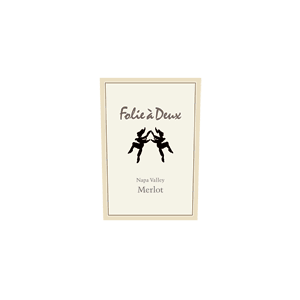
Folie à Deux Napa Valley Merlot 2007 – U.S.A. 2 Reds
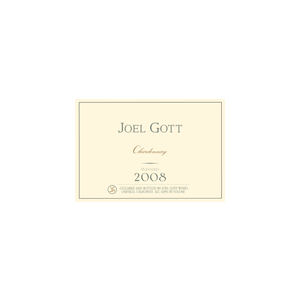
Joel Gott Monterey Chardonnay 2008 – U.S.A. 2 Whites


Master Series
Featured Wineries & Wines
Membership Type
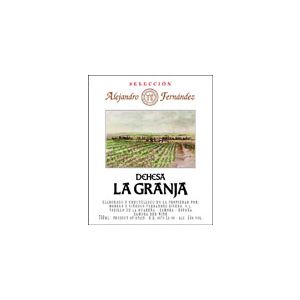
Dehesa La Granja Vadillo de la Guareña Zamora Selección 2000 – Spain 1 Red 1 White; 2 Reds
Nine Vines South Australia Viognier 2008 - Australia 1 Red 1 White
Urban Valle de Uco Mendoza Malbec 2008 – Argentina 2 Reds


Collector Series
Featured Wineries & Wines
Membership Type
Dehesa La Granja Vadillo de la Guareña Zamora Selección 2000 – Spain 1 Red 1 White; 2 Reds
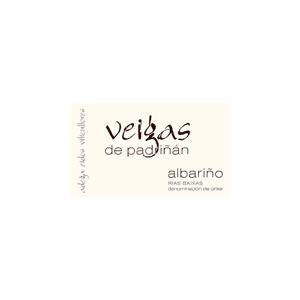
Bodega Eidos Veigas de Padriñán Rias Baixas Albariño 2008 – Spain 1 Red 1 White
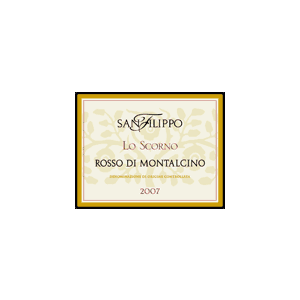
San Filippo Lo Scorno Rosso di Montalcino 2007 – Italy 2 Reds

Urban Valle de Uco Mendoza Malbec 2008 – Argentina

Urban Valle de Uco Mendoza Malbec 2008Urban is the handiwork of Bodegas y Viñedos O. Fournier, one of Argentina’s premier wine producers in Mendoza’s Valle du Uco. Begun in 2000, O. Fournier is part of international wine maker José Manuel Ortega’s recently established wine empire that includes exceptional wineries in Argentina, Chile, and Spain. Recently nominated by the Wine Enthusiast for its much coveted Innovator of the Year Award, José Manuel Ortega is responsible for raising the quality quotient and the proverbial bar wherever he makes wine. However, nowhere has his influence and wine making prowess been more significant than in Argentina, which until recently was known more for its potential than its performance.

Thanks to Ortega and a budding number of quality minded wine makers, Argentina no longer stakes its reputation on just how much wine it produces; today, Argentina is able to claim its long awaited place as a producer of exceptional wines. And although Ortega has excelled with traditional Argentine varietals such as Malbec and Torrontes, he has also achieved notable success at Urban with Tempranillo and other European grape varieties.

Grapes for Urban’s finest selections hail from Mendoza’s magical Valle de Uco, a high elevation zone (up to 4,000 ft.) where grapes ripen fully over an extended period of time. Here a difference of 50º F between day and night time temperatures during the long growing season affords the grapes the perfect combination of sugar and acid. Such conditions also lend themselves to amplifying aromatics – the calling cards of Urban wines.

Argentina: Where Quality and Quantity Abound

Argentina has long been one of the world’s leading producers and consumers of wine. Presently, this sprawling nation, which contains some of the world’s most diverse geography: tropical jungle, barren desert, towering snow-capped mountains and windswept deserted islands that herald Antarctica, is the world’s fifth largest producer of wine and the planet’s third largest consumer of the fruit of the vine, placing it just behind Italy and France. As an interesting comparison, Argentina consumes more than five times the amount of wine per capita as does the United States (10.5 gallons per capita in Argentina versus just 2.00 gallons per head in the United States). Moreover, Argentina is no longer just a source of good, plentiful, everyday plonk; it is increasingly a treasure chest of world class wines.

Since the 1980s, an infusion of international talent has transformed the Mendoza. With the likes of Paul Hobbs, Jacques and Francois Lurton, José Manuel Ortega, and most recently Marco de Grazia, Argentina and the “Mighty Mendoza” are finally coming into their own. This once sleeping giant now houses a treasure trove of fine wines, with the wonders of Malbec in the vanguard. Excellent Cabernet Sauvignon is also being fashioned here, and in recent years, Argentina has made great strides in the production of white wines, too, most notably with Chardonnay and Torrontes, the latter an Argentine specialty. Viva Argentina!

Tasting Notes: In fairy tales, toads turn into handsome princes when kissed by beautiful princesses. And in the real world of wine, downright ugly labels often hide the finest oenological treasures and the most comely of wines. If there were ever a wine label that hid its inner charms more adroitly than Urban, we have yet to come across it. Fortunately, what lies behind the stark, homely label on a bottle of 2008 Valle de Uco Malbec is knock-out gorgeous in every sense. Moreover, it confirms our mantra: No one can drink a label or a price tag. A deeply colored and hauntingly aromatic wine, the 2008 Urban Valle de Malbec over-delivers in every way. Upon opening, ripe lush berry fruit gushes from the bottle and splashes delectably into the glass. Fragrant spice tones fold seamlessly into this wine’s plush, fruit driven core to well up with delight on the nose and palate. On the finish, a hint of ripe tannin frames this wine’s down right sexy mid palate, making it hard to believe that this polished medium bodied Malbec contains 14.5% alcohol, but it does. Wow! From the first glorious sip to the last, Urban’s 2008 Valle de Uco Malbec has it going on. Enjoy this delicious Malbec at room temperature, with or without aeration.

Accompaniments: Pasta, smoked meats, and the varied delights of la cucina italiana get our nod as supreme accompaniments to the 2008 Urban Valle de Uco Malbec. Pasta Arrabiata; Penne Pesto with Mushrooms, Cherry Tomatoes and Artichokes; or better still Sciu Sciu, a simple but delicious country pasta made from warm buffalo mozzarella, fresh tomatoes, basil, and roasted garlic, are all superb choices to accompany Urban’s warm, huggable Malbec. Roasted asparagus, wrapped in prosciutto or thinly sliced mortadella; homemade pan pizzas with three types of cheese; and Eggplant Parmigiana or spicy caponata provide other exceptional choices with which to enjoy the Urban Malbec. Actually, there are few foods, with seafood as a possible exception, that wouldn’t be uplifted in the presence of this wine. Enjoy!

Nine Vines South Australia Viognier 2008 - Australia

Nine Vines South Australia Viognier 2008Nine Vines belongs to Angove’s Pty. Ltd., one of Australia’s largest privately owned wineries. This winery began with Dr. William Angove, an accomplished general practitioner and surgeon, who emigrated with his wife and young family from Cornwall in 1886 to establish a medical practice in South Australia. Although he enjoyed a distinguished medical career, Dr. Angove’s most enduring legacy survives in the viticulture of South Australia. His early experimentation with vines, winemaking and distilling led to the establishment of a proud family business. Dr. Angove’s initial plantings in the township of Tea Tree Gully in the Adelaide foothills were the forerunner of one of the largest vineyards in the southern hemisphere — the magnificent Nanya Vineyard at Renmark in South Australia’s Riverland.

Since 1950, Angove’s has steadily expanded its operations and structure. The Renmark facility has grown to become a major winemaking and distilling entity with storage capacity for more than 15 million liters of wine and spirits. In Australia, Angove’s is known not only for its fine table wines (still wines under 14% alcohol), but its exceptional line of fortified wines and spirits. Angove’s produces sherry, port, vodka, and an especially fine line of pot stilled brandies under the name of St. Agnes. The 5 Star Liqueur Brandy from St. Agnes is a gold medal winner that consistently receives the highest critical acclaim from tasters and critics.

John Angove and daughter VictoriaIn 1983, the fourth generation of the family took control of Angove’s when John Carlyon Angove succeeded his father as Managing Director of the company. John has taken up where his father left off, with increased development and investment in all aspects of the winery. In addition, Victoria, John’s eldest daughter and a member of the fifth generation, is now actively involved in ensuring ongoing growth in her role as International Business Development Manager, so much so that Angove’s wines can be found today in over 30 different countries around the globe. This is testimony to Victoria’s ability and the outstanding quality of Angove’s many critically acclaimed, award winning wines.

Like most Australian wineries, Angove’s fashions an entire portfolio of wines. Angove’s Vineyard Select offerings and the distinct Nine Vines Series are this family’s top wines. Angove’s Nine Vine Series is an exemplary line of wines. It is so named because only nine vines remain from the original 19th century Tea Tree Gully Vineyard in the Adelaide Hills that Dr. Angove planted. These ancient vines serve as a reminder of the vibrancy of a wine growing region that has played a vital role in the development of a nation as well as an integral part in the Angove family’s winemaking heritage.

Tasting Notes: The 2008 Nine Vines Viognier is classic in every way. Produced from 100% Viognier that was fermented on its lees, this partially barrel-fermented rendition of the Rhône Valley’s greatest white wine puts most other New and Old World Viogniers to shame, including several well-known Viogniers from prestigious French appellations selling for twice the price. Straw colored with an enticing glint of green and an amplifying bouquet of spring flowers, stone fruits, apricots, and pears, the 2008 Nine Vines Viognier is an absolute pleasure to sniff as well as sip, savor, and just downright gulp. Endowed with rich fruit, excellent balance, and 14.5% alcohol the wine drinks beautifully from start to finish. In short, this is no wimpy fruit bomb of a Viognier; the folks at Angove’s have put together first class Viognier for true drinking pleasure. We suggest serving the 2008 Nine Vines Viognier moderately chilled (40º- 45º F), and as often as possible. Enjoy!

Accompaniments:  Viogner has been heralded for centuries as an aperitif extraordinaire, and the 2008 Nine Vines certainly upholds the grape’s legendary status. In the Nine Vines, Angove’s has fashioned a strong, vinous, seductive Viognier that can handily hold court without a coterie of attendants. At the same time, it would be a travesty to deny this classic Viognier the delights of the kitchen. For starters, we have enjoyed this wine with a wide range of cuisines and dishes. Seafood hors d’oeuvres constitute some of our favorite parings with this wine. Thai Crab Ran Goons, Carolina Low Country Crab Cakes, Angels on Horseback (scallops wrapped in bacon and seared to perfection), and Scottish Salmon, served with onions, capers and cream cheese on toasted French rounds, have proven to be tried and true friends to this Viognier. Asian specialties, such as fresh spring rolls stuffed with vegetables, rice noodles, and fresh shrimp; and Vietnamese Noodles with a taste of lemongrass provide other excellent accompaniments. Baked, poached or sautéed white fish, especially when served in a light cream sauce or with fruit based chutney, provide other palate pleasing accompaniments. Pork Tenderloin offers another pleasing option, providing it is roasted rather than grilled, and served with a delicate, fruit based salsa. Mild cow’s milk cheeses and pâtés provide other winning combinations with the 2008 Nine Vines Viognier.

Folie à Deux Napa Valley Merlot 2007 – U.S.A.

Folie à Deux Napa Valley Merlot 2007Folie à Deux, a boutique Napa Valley estate dedicated to crafting fine wine at affordable prices, continues to turn out outstanding Napa Valley Chardonnay, Cabernet Sauvignon, Merlot, and Zinfandel. This historic property lies just north of St. Helena in the heart of Napa Valley. Folie à Deux’s vineyards and century old farmhouse lay sandwiched between Spring Mountain and Howell Mountain, at the narrowest part of Napa Valley. The estate’s location provides a unique microclimate and a special terroir, which permit cool air to roll slowly down Mount St. Helena and cool the estate vineyard during the long summer days of torrid heat. At Folie à Deux, unlike many other Napa locales, the cool air sifts its way through the vineyard the way sand passes through an hourglass. The result is great physiological ripeness in the vineyard, without a loss of aromatic or flavor profile.

Entrance to the Folie a Deux tasting room.Folie à Deux has blossomed since coming under the Trinchero family umbrella in 2004. Under Bob Trinchero, the proprietor of several renowned California wineries, the quality at Folie à Deux has skyrocketed. However, the tale of Folie à Deux is both intriguing and unique, as the winery’s name suggests. Folie à Deux was founded as a bonded winery in 1981 by two psychiatric professionals. When the couple told friends that they planned to fulfill a mutual dream by starting a winery, the friends jokingly suggested that the couple was exhibiting the classic symptoms of Folie à Deux, a psychiatric term that is defined as the sharing of fantasies by two close friends. The name stuck. To build on the theme, a local Napa Valley artist, Susan Ortega, created a drawing of twin dancers based on a Rorschach inkblot. Her inspiration for the label was the fantasy that she and her sister shared of one day becoming professional ballerinas.

Outside the Folie a Deux tasting room.Tasting Notes: A deep, rich, sophisticated wine, the 2007 Folie à Deux Napa Valley Merlot remains true to its namesake. It creates “a beautiful dance of flavors and true varietal expression,” which easily translate into a shared fantasy among serious red wine drinkers. Even the dyed in the wool Cabernet fans on the tasting panel bestowed accolades upon Folie à Deux’s 2007 Merlot (a blend of 89% Merlot and 11 % Cabernet Sauvignon) and unabashedly asked for another glass. Sporting a deep ruby robe, a heady aroma of blueberry, cassis, and cocoa this Merlot scores high on all counts. In the mouth a juicy mélange of berry fruit mingles with hints of dark chocolate, tobacco, and refined new oak. Plush, smooth, and full of flavor, the 2007 Folie à Deux captures the charm and panache of authentic Napa Valley Merlot, as it puts to shame the legion of leafy, insipid Merlots for which California has become infamous. Enjoy this charming, textured Merlot at cool room temperature (66º F), with or without breathing time.

Accompaniments: The 2007 Folie à Deux Napa Valley Merlot is in the best sense one of those go anywhere, drink anytime kind of wines. It provides fine drinking on its own and is majestic with food, even hearty beef or lamb dishes. The lush fruit, smooth texture, and soft tannins of the 2007 Folie à Deux Merlot are indeed a force to be reckoned with; they are perfect with beef stew, sirloin steaks, lamb kebobs, barbecue and herb roasted chickens, and grilled vegetables. So, light up the grill, bring on the food, and have a party! No fancy recipes are required, but we can assure you those complex sauces and fine accompaniments will not be wasted on this exceptional Merlot either. Just remember to have a second or third bottle on hand if you invite someone over; shared fantasies don’t last long when glasses are empty.

Joel Gott Monterey Chardonnay 2008 – U.S.A.

Joel Gott Monterey Chardonnay 2008Although still on the shy side of 40, Joel Gott has become a legend in wine circles. The offspring of fourth generation California winemakers, Gott was riding a tractor at his family’s farm at 4 years of age and has been involved in numerous wine and food enterprises since he was a teenager. Gott also ran the now famous Taylor’s Refresher drive-up restaurant in Napa when noted wine critic Robert Parker Jr. named this eatery as the source of one his top ten meals of 1999, and in 2006 Taylor’s was honored with a James Beard Foundation Award. But these accolades are just the tip of the iceberg, or perhaps more appropriately in Gott’s case, the skin of the grape.

Gott has been making knock-out wines for more than fifteen years. A partner in several successful and highly acclaimed wine ventures, his most notable success remains the production of bodacious wines at the Joel Gott Winery. Each year Gott produces a host of wines in small lots at his winery, with the most renowned offering being his Dillian Ranch Amador County Zinfandel from Tom Dillian’s dry-farmed 20 acre vineyard in Plymouth, California. Planted between 1920 and 1948, Dillian Ranch is a shy bearing vineyard that produces as little as three quarters of a ton of fruit per acre and one of California’s most memorable Zinfandels.

However, the Dillian Ranch Zinfandel is hardly Gott’s only claim to fame. Recently, Joel has begun fashioning a Monterey Chardonnay as impressive as his many memorable Zinfandel wines. Produced from low yield vines in a cool corner of Monterrey, Gott’s Chardonnay is one of California’s best kept secrets. To further the ante, Joel is making a name for himself among savvy consumers for a bevy of other high quality affordable California varietals, including Cabernet Sauvignon. Is there anything this guy can’t do?

Tasting Notes: Joel Gott’s 2008 Monterey Chardonnay remains a relative secret in spite of its growing reputation as one of California’s best white wine quaffs. It was a huge hit with the tasting panel, too. With seven or eight bottles of Chardonnay up on the table, the one they all wanted to finish was Gott’s Monterey offering. Bright, crisp, and oh so easy to drink, it makes us wonder why more California producers can’t make Chardonnay like this. So aromatic, cool, and long on flavor, Gott’s Monterey Chardonnay could almost be mistaken for a flamboyant French Chablis, which like Gott’s Chardonnay spends no time in oak. What shines through are crisp intense aromatics that carry the breath of spring. Citrus, green apple, orange blossom and a whole lot more dazzle the nose and follow through on the palate with intense fruit and a full, dry, balanced finish. No oak, no smoke, no mirrors, Joel Gott’s Monterey Chardonnay is just plain fun to drink, so enjoy! For optimal pleasure we suggest moderate chilling (40º-45º F).

Accompaniments: As an aspiring American classic the 2008 Joel Gott Monterey Chardonnay is the ideal companion to serve as an aperitif or with great American fare. So, why not try this racy Chardonnay with fried catfish and hush puppies; barbecued chicken with Vidalia onion rings; or sizzling fajitas accompanied by a side of guacamole and hot corn chips? However, lest we pigeon hole this Monterey beauty, it will surely provide a superb foil to more eclectic fare as well. Delicate tempura favorites such as shrimp, scallop, calamari, and octopus will shine with this wine. Artfully prepared sushi and sashimi offer more rewarding choices. Ripe cow’s milk cheeses and fresh tropical fruits such as mango and papaya won’t disappoint either. Enjoy!

Dehesa La Granja Vadillo de la Guareña Zamora Selección 2000 – Spain

Dehesa La Granja Vadillo de la Guareña Zamora Selección 2000Editor’s Note: The 2000 Dehesa La Granja Selección is a special wine, as its name implies. It is produced from 100% old vine Tempranillo. It is a natural wine that is made with a minimum of intervention or manipulation. In keeping with a course of natural winemaking, the Dehesa La Granja Selección was bottled unfiltered. Consequently, it is likely that bottles of this fine, handmade wine will precipitate some natural sediment. This harmless precipitate is not a flaw in the wine. Rather, sediment is the result of expert, natural winemaking practices. To alleviate or eliminate the sediment in this wine, the contents of the bottle may be carefully decanted after the bottle has stood upright for at least an hour.

Dehesa La Granja is one of the four jewels in the tiara of splendid wine estates that Alejandro Fernandez of Ribera del Duero fame has brought to fore. Dehesa La Granja and the three other Fernandez gems: Condado de Haza, El Vinculo, and Pesquera rank among the finest wine estates in all Spain. In the case of Dehesa La Granja, the estate is located on a 1,800 acre ranch that borders the Duero River in Zamora, just west of the Ribera del Duero. Beginning in the 17th century and for nearly two hundred years, La Granja Valdeguerena was a major wine producing estate, before it was converted to one of Spain’s greatest bull fighting ranches in the 19th century. At an enormous expense and in his usual fastidious fashion, Alejandro Fernandez resurrected and reconverted La Granja and its extensive 17th century cellar to their original vocation – the production of one of the Duero’s finest wines. 

Since the restoration, Dehesa La Granja has fashioned intense, traditional Tempranillo wines that have consistently garnered major critical acclaim. The regular bottling of Dehesa La Granja spends two years in oak barrels and is a rich, smooth wine that is ready to drink shortly after release. The Dehesa La Granja Selección is an even more complex, concentrated offering from special plots that is produced only in great vintages. It spends 30 months in French oak and gains considerable charm and complexity with age. Selección is bottled completely unfined and unfiltered, so it is likely to precipitate some harmless, natural sediment. Sediment is further indication of the natural winemaking process that prevails at Dehesa La Granja and Fernandez’s other estates.

In order to augment the current small production at Dehesa La Granja, an additional 300 acres of Tempranillo vines have been planted at La Granja on their own rootstock (due to the property’s compact sandy soil that is resistant to phylloxera), which will eventually supplement the old, un-grafted Tempranillo vines in the Guerena Valley that La Granja is presently using for the property’s full-bodied red. It is wines such as Dehesa La Granja that underscore the Renaissance in winemaking that has gripped Spain in the past decade – a rebirth that is transforming the potential of the world’s third largest producer of wine into a veritable repository of outstanding and still affordable treasures.

Tasting Notes: Deep, haunting, and perfumed, the 2000 Dehesa La Granja Selección is a lush, sophisticated wine that stands in tribute to the viticultural revolution sweeping Spain. It is also one of the finest wines ever to emerge from Zamora. The 2000 Dehesa Selección, with its deep ruby robe and entrancing bouquet, captures the senses from the moment it is poured. It offers sweet scents of blackberry and plum, dark chocolate, sandalwood, and vanilla. Exceedingly extracted and intense on the palate, this lush, highly polished wine follows through on the olfactory with a wealth of flavors: crushed black fruits, espresso, smoked meats, and oriental spices all present themselves in a lush, hedonistic format. Moreover, each sip reveals layer upon layer of fruit and additional nuances of flavor that nearly explode on the wine’s long, lengthy finish. For those willing to wait, extended aeration heightens the hedonistic pleasure inherent in this wine, so allow it an hour to breathe. Aeration will disclose the ripe voluptuous fruit that stands at the core of this supple, complex wine. As with all fine vintages of Selección (and 2000 is an outstanding vintage), additional time in bottle will further enhance this wine, but we doubt there are many disciplined enough to wait any longer to enjoy this beauty or lay down an ample supply for future gratification. After tasting the 2000 Dehesa La Granja Selección, one has to wonder if Spanish wine has ever been better, and just how much better a wine can be. For a mature, sophisticated, full-bodied wine that tantalizes the senses, you need look no further than the 2000 Dehesa La Granja Selección. For optimum enjoyment, we suggest decanting this Spanish classic and serving it at cool room temperature (62º - 66º F). Anticipated maturity 2008-2015.

Accompaniments: In Spain, it is traditional to serve full-bodied red wines with grilled meats, rich stews, and heady paellas, and we see no reason to deviate from tradition in the case of the 2000 Dehesa La Granja Selección. In fact, the 2000 Selección pairs superbly with nearly all meats. We especially recommend beef and lamb as ideal accompaniments. Yet, we also like the Dehesa La Granja with marinated pork tenderloins. A spicy bean cassoulet is another one of our favorite dishes with this wine, and we would not hesitate to serve the comely 2000 Dehesa La Granja Selección with venison tenderloin, prepared with glazed onions and topped with a rich black currant sauce. Yum! Rich winter soups, served with crusty brick oven bread and a few slices of a great Spanish cheese like Manchego, Mahon, or Roncal, provide other beautiful pairings. A garlic and herb roasted rotisserie chicken provides another excellent accompaniment to the Dehesa, as does a combination of marinated eggplant, zucchini, roasted red peppers, garlic and olive oil. One can even enjoy this beauty all by itself. Enjoy!

Bodega Eidos Veigas de Padriñán Rias Baixas Albariño 2008 – Spain

Bodega Eidos Veigas de Padriñán Rias Baixas Albariño 2008Bodega Eidos is one of the bright new stars from Spain’s Rias Baixas appellation in far flung Galicia, Spain’s cool, green region that rises from the pounding surf of the North Atlantic to the towering Pyrenees Mountains. It was founded in 2000 by Manuel Villalustre, a well respected local viticulturist with 20 acres of very old Albariño vines. In just a few short years Bodega Padriñán has established itself as one of most compelling producers of white wines in Spain. Since the completion of his modern winery in 2003 Manuel Villalustre has fashioned two persuasive Albariño wines: Eidos and Veigas. Eidos is made from 50 year old vines, while the bodega’s reserve bottling Veigas (this month’s selection) emanates from ungrafted vines that are more than 80 years of age.

Manuel Villalustre’s 100 separate parcels of vines are located at the most northern end of the Salnés Valley, among the steep hills of Padriñán from which the winery draws its name. These hand harvested vineyards are set among the gardens of the village of Sanxenxo, where they enjoy a commanding view of the sea. However, each of these parcels occupies a south facing slope that protects it from the north wind and the stiff ocean breezes that buffet this coast. Superb fruit results from this region's favorable terroir and microclimate, resulting in the most concentrated and intense wines of Rias Baixas. Little wonder then that vines have grown here since time immemorial. 

Albariño: Spain’s Most Compelling White Grape

Albariño is an indigenous Spanish grape variety whose home is Rias Baixas and the Galician hills and hinterlands of northwest Spain and neighboring Portugal. Albariño was once thought to be distantly related to Riesling, but some enologists now believe that Albariño may be more closely connected to the Petit Manseng variety of southwest France, which lies just to the north of Galicia and the towering Pyrenees Mountains. However, no dry white Petit Manseng can match the body and finesse of Spain’s finest Albariño wines.

In Portugal, Albariño goes by the name Alvarinho where it typically ends up as a light summertime quaff in the guise of Vinho Verde. Surely, nowhere could a single grape variety be more different than Albariño is in Spain and Portugal. While Portugal picks this varietal early and makes a low alcohol wine (8.5%-9% on average), Spain, under the tutelage of Manuel Villalustre and similar minded individuals in Rias Baixas, turns out a full-bodied, intense Albariño with aromatic and flavor profiles more akin to Viognier – the greatest white variety of France’s Rhône Valley.

On account of its intense flavors and adaptability to difficult climates, Albariño is now extensively planted and studied in other locales around the world, including Australia, California, and South Africa. Early reports from winemakers and consumers elsewhere appear promising for this late maturing grape, but nowhere more than in Australia where extended growing seasons are common and the grape’s firm, bright acidity is much appreciated. A debt of thanks belong to Manuel Villalustre and his Galician counterparts for helping resurrect over the past two decades the great Albariño varietal in Spain and sharing it with the world.

Tasting Notes: In the days before pretty wine labels came into vogue, with pictures of exotic animals, flowers, and the inventive wares of well-known artists to adorn the bottle, there was a saying among wine lovers: “The simpler the label, the better the wine.” In the case of both Eidos and Veigas de Padriñán, the adage still holds true. As a classic wine of Spain, the 2008 Veigas de Padriñán Albariño still sports the simplest of labels. However, what rests within is anything but simple, nor does it have anything to prove: the wine wares of Bodega Eidos speak eloquently from the glass. Made for wine drinkers who truly love dry white wine, and we mean classic dry white wine, the 2008 Veigas de Padriñán is sheer pleasure. Its aromatic profile is both fresh and profound. The enticing scents of stone fruits, mingled with a refreshing minerality, dominate the nose. Full, but not fat, the 2008 Veigas de Padriñán enlivens the palate with a charismatic concoction of vibrant fruit, liquid stones, and bracing acidity that quenches the thirst as it adds length and depth to this quintessential offering. Although thoroughly enjoyable when well chilled, the 2008 Veigas, like most top rated Albariño wines, is at its finest when served only lightly chilled. At 50º-55º F, Veigas unfolds gently in the glass and seduces those patient enough to allow the numbing chill of modern refrigeration to subside. Enjoy!

Accompaniments: In its native Galicia, tapas and seafood constitute the accompaniments of choice with Albariño. To this end the 2008 Veigas is right at home. It pairs beautifully with clams and oysters on the half shell, and almost any kind of shellfish served in a heady broth. Moreover, cod, grouper, or almost any flaky white fish steamed in parchment (or foil) with chopped onion, garlic, tomatoes, olive oil, and herbs, provides exemplary companionship to the 2008 Veigas de Padriñan Albariño. Traditional tapas, marinated olives, stuffed mushrooms caps, full-flavored Spanish cheeses, and cured meats such as prosciutto and Spanish jamon are perennial favorites, too. However, one need not travel to Rias Baixas to appreciate the delights of Veigas. Asian stir fries, sushi, sashimi, and light tempuras offer equally pleasing accompaniments. Another favorite companion to Veigas is Ahi tuna grilled medium rare, drizzled with a tangy ginger or teriyaki sauce, and then served over a bed of organic greens, shredded carrots, edamame, and broccoli. This simple offering accentuates the taste of the wine and exemplifies the art of fusing Asian-accented recipes with classic European wines the likes of the 2008 Veigas de Padriñan Albariño. Salud!

San Filippo Lo Scorno Rosso di Montalcino 2007 – Italy

San Filippo Lo Scorno Rosso di Montalcino 2007San Filippo is one of Montalcino’s rising stars. Superbly situated close to Biondi Santi’s Il Greppo, the original Brunello vineyard that launched Montalcino’s legend, San Filippo is owned and expertly run by the dynamic Robert Giannelli. Since acquiring San Filippo, Giannelli has completely restored the vineyards, renovated the old winery, and transformed San Filippo into one of Brunello’s most exciting estates. With the assistance of renowned oenologist Paolo Caciorgna, Giannelli fashions small quantities of Brunello and Rosso di Montalcino from 25 acres of estate vines. In true Tuscan fashion San Filippo also produces superb olive oil from the property’s olive grove.

Giannelli’s production of Brunello and Rosso typically amounts to less than 3,300 cases, all of which is aged in Slovenian and Allier oak barrels and casks. He makes two Brunellos from separate vineyards: Lo Scorno and Le Lucere. Le Lucere is an intense, dark, traditional potion that begs for some extra time in the bottle, while Lo Scorno wears its welcome from the very beginning. The estate’s Lo Scorno Rosso di Montalcino is even more ingratiating and is currently enjoying its status as one of the great Rossos produced in Montalcino. The 2007 vintage proved to be ideal for this wine. Like the estate’s Brunello, Giannelli’s Rosso di Montalcino is made entirely from 100 % Sangiovese grapes grown on the estate’s high, northeast facing slopes.

Montalcino

Montalcino is the most renowned hill town in all Tuscany, and its wines the most expensive and sought after in all Italy. The village’s Brunello di Montalcino has an illustrious and politically charged history dating back to the 19th century, and until recently it has been the appellation’s traditional Brunello di Montalcino – a wine that requires extensive barrel aging and often many years to evolve into legendary status – that has received the lion share of the press. However, in the past decade the best Montalcino estates have decided to devote more of their time and talent to producing outstanding Rosso di Montalcino, Brunellos’s more affable, forthright, and immediately engaging sibling. Many critics have even gone so far as to declare Montalcino’s delicious Rossos to be superior to many of the more expensive and age worthy Brunellos, and we are apt to agree. This summation is especially true in 2007, a near perfect vintage that produced some of the most compelling Rosso di Montalcinos of recent memory.

Tasting Notes: The 2007 San Filippo Lo Scorno Rosso di Montalcino is everything one can expect from Rosso di Montalcino, and more. What first strikes the eye is this wine’s brilliant ruby robe, which prepares the beholder for Lo Scorno’s abundance of sensual pleasure. This medium bodied Rosso offers up a gorgeous nose that alone is worth the price of admission, but then follows its aromatic fireworks with an abundance of bright juicy berry flavors that coat the tongue and fill the palate. Woven into the wine’s polished silky red and black fruit flavored core are touches of chocolate, mocha, cedar, and subtle earth tones that speak of Montalcino’s hallowed terroir. For optimal pleasure, allow this gifted Rosso di Montalcino to breathe for thirty minutes or more before consuming at cool room temperature (62º- 66º F).

Accompaniments: Montecastro fashions a quintessential dinner party wine that will rise to the heights of the finest cuisine, so first and foremost we suggest planning an elegant dinner party around the 2005 Montecastro Ribera del Duero. Although charming, elegant, and plenty satisfying on its own, this aristocratic red positively shines in the company of well prepared dishes. We have found that the more savory the fare, the greater the reward with this wine. Rack of Lamb, served with a savory stuffing; Filets of Beef Tenderloin, covered with an herb infused medley of mushroom and accompanied by pearl onions; Venison Stew; Spit Roasted Quail, prepared with a wild rice risotto; and Crown Roast of Pork, served with onion and sage stuffing are just a few of the more tempting dishes we suggest with the 2005 Montecastro Ribera del Duero. Chicken, veal, and ham provide additional opportunities for gastronomic pleasure with the ebullient 2005 Montecastro. Enjoy!

I'm ready toPlace My Order Button


logo for wine club
Since 1994
Home
Join Our Wine Club
Gift Memberships

Membership Renewals
Reorder Your Favorites
Wine of the Month Club
More Information
Current Selections
Past Selections
Testimonials
Other Gourmet Gifts
Corporate Gifts
Wedding Gift Ideas
All About Wine
Website Tools
Who We Are
Contact Us

1 - 800 - 625 - 8238
(Outside US call: 949-206-1904)
P.O. Box 1627, Lake Forest, CA 92609