Past Newsletters - November 2009

Premier Series
Featured Wineries & Wines
Membership Type
Gouguenheim Valle Escondido Malbec 2008 – Argentina 1 Red 1 White; 2 Reds
Folie à Deux Napa Valley Chardonnay 2008 – U.S.A. 1 Red 1 White; 2 Whites
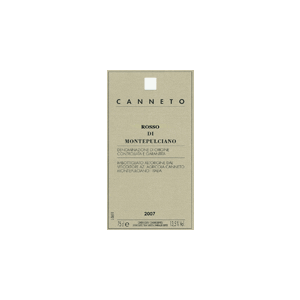
Canneto Rosso di Montepulciano 2007 – Italy 2 Reds
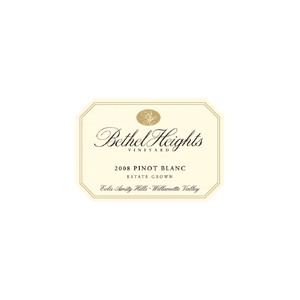
Bethel Heights Estate Grown Eola Amity Hills Willamette Valley Pinot Blanc 2008 – U.S.A. 2 Whites


Master Series
Featured Wineries & Wines
Membership Type
Cavallotto Bricco Boschis Barolo D.O.C.G. 2003 – Italy 1 Red 1 White; 2 Reds
Folie à Deux Napa Valley Chardonnay 2008 – U.S.A. 1 Red 1 White
Gouguenheim Valle Escondido Malbec 2008 – Argentina 2 Reds


Collector Series
Featured Wineries & Wines
Membership Type
Cavallotto Bricco Boschis Barolo D.O.C.G. 2003 – Italy 1 Red 1 White; 2 Reds
Grongnet Blanc de Blancs Champagne N.V. – France 1 Red 1 White
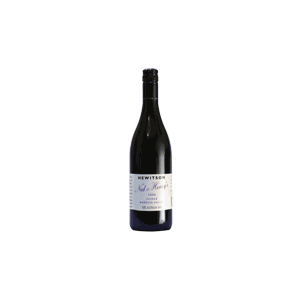
Hewitson Ned & Henry’s Barossa Shiraz 2006 – Australia 2 Reds

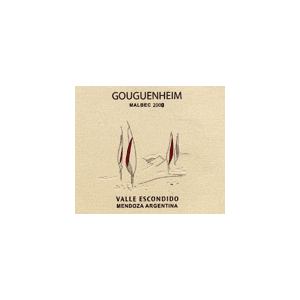
Gouguenheim Valle Escondido Malbec 2008 – Argentina

Gouguenheim Valle Escondido MalbecThe Gouguenheim name conjures up visions of magnificent museums and fabulous works of art. Although Patricio Gouguenheim, owner and winemaker of one of Argentina’s fastest growing wineries, appears to have no apparent connection to the more famous artistic namesake, he is an outstanding, internationally recognized artist whose masterworks are his wines. We have been watching Patricio’s winery over the past five years, tasting the wines each vintage, and are thrilled to be able to bring you one of Patricio's finest works to date: a limited production of Valle Escondido Malbec.

Patricio GouguenheimThe winery has a magic allocation in the highly sought after Tupungato Valley that lays some seventy kilometers to the southwest of Argentina’s wine capital of Mendoza. Tupungato Valley and nearby Valle Escondido (meaning Hidden Valley) are higher than Mendoza. They are situated in the shadows of the towering snow capped Andes from where melted snow is sluiced into irrigation aqueducts to be drawn as needed to water the nearby vines. At more than 3,000 feet above sea level, Gouguenheim’s vineyards enjoy the perfect balance of sunshine and water from snow melt, which results in beautifully ripe, healthy fruit that can be picked when it has reached perfect phenolic maturity. Unlike in many regions of the world, where the fear of rain and moisture forces the picking date or actual rain wreaks havoc with grapes that are ripe and close to ready for picking, rain is almost non-existent in this part of Mendoza and sunshine is guaranteed 300 or more days each year. With sun bathed days and cool nights the grapes of this magical valley can linger longer on the vine developing fuller, rounder, more mature flavors, which get translated into wines of generous fruit, soft ripe tannins, and refreshing acidity. There is hardly a more perfect place in the world to grow grapes than Patricio Gouguenheim’s hidden corner of Mendoza!

Gouguenheim near the AndesThe world has awakened to Argentina’s preeminence in wine, resulting in the past five years in a wave of exports to the United States and Europe. The reason for this surge is the quality of wine flowing from Argentina represents today some of the best value in the world of wine. Malbec in particular has captured the attention of the wine drinking public and is universally acclaimed as Argentina's flagship wine. Argentine Malbec, a grape whose origin is Cahors in France, yields a deep, dark potion similar in color to the “Black Wine” of Cahors, but Argentine Malbec is thankfully more endearing and less abrasive in tannin than its French counterpart, especially when young. Moreover, in its new found home among the mountain valleys of Mendoza, Malbec has blossomed into a wine that can deliver extraordinary flavor, value, and even finesse.

Tasting Notes: Gouguenheim’s 2008 Valle Escondido Malbec benefits from a high altitude terroir, meaning the wine is more refined than rustic Although neither bold, nor muscular, it rather discreetly, but generously, offers its charms to the beholder. It is deeply colored, medium-bodied, and less overtly tannic than most of its compatriots. However, this is no wimp of a wine: Patricio Gouguenheim’s Valle Escondido Malbec provides the imbiber plenty of upfront charm, both in aroma and flavor. On the palate it offers a generous wave of blackberry, plum, toast and vanilla, cardamomand spice, which translates into a succulent mouthful of elegantly balanced wine. Furthermore, the 2008 Valle Escondido Malbec blossoms in the glass with each successive sip to the point where one quickly wonders if a second bottle lay at hand. This wine is ready to please straight out of the bottle. However, we suggest for optimal drinking pleasure that it be afforded at least 20-30 minutes of aeration prior to consumption. Enjoy!

Accompaniments: The 2008 Gouguenheim Valle Escondido Malbec is an ideal party time wine. It is equally at home with food as it is being sipped all night long. And when it comes to accompaniments, one need not wonder what to serve. Patricio Gouguenheim’s 2008 Malbec is happy and ready to please, whether it is paired with hamburger, steak, chicken wings, pasta or pizza. It also makes a nice presentation with cured meats: pepperoni, prosciutto, salami, and the like. One of the panel’s favorite selections with this wine is a simple Panini, made with brick oven bread, fresh Buffalo Mozzarella, juicy ripe tomatoes, basil, and extra virgin olive oil. Other Panini specialties shine equally well with the company of this wine, so as you like!

For the Love of Cheese: In consideration of the sensual fruit and soft, savory spice of the 2008 Gouguenheim Valle Escondido Malbec, it would be a travesty, at least for cheese lovers, not to pair such a tasty Malbec with a variety of cow and sheep’s milk cheeses. Consequently, we highly suggest you reserve at least a glass of the Valle Escondido Malbec to consume with a hunk of Parmesan style cheese from Argentina or to pair it with a first rate Italian Pecorino or Provolone. Milder cheeses such as Gouda, Edam, Manchego, and Mahon all get our nod with this wine, too. For other gratifying cheese accompaniments or to learn more about the wonderful world of gourmet cheeses, please contact us at www.cheesemonthclub.com, and enjoy the best of all worlds.

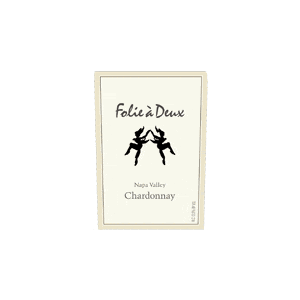
Folie à Deux Napa Valley Chardonnay 2008 – U.S.A.

Folie à Deux Napa Valley Chardonnay 2008Folie à Deux, a boutique Napa Valley estate dedicated to crafting fine wine at affordable prices, continues to turn out outstanding Napa Valley Chardonnay, Cabernet Sauvignon, and Zinfandel. This historic property lies just north of St. Helena in the heart of Napa Valley. Folie à Deux’s vineyards and century old farmhouse lay sandwiched between Spring Mountain and Howell Mountain, at the narrowest part of Napa Valley. The estate’s location provides a unique microclimate and a special terroir, which permit cool air to roll slowly down Mount St. Helena and cool the estate vineyard during the long summer days of torrid heat. At Folie à Deux, unlike many other Napa locales, the cool air sifts its way through the vineyard the way sand passes through an hourglass. The result is great physiological ripeness in the vineyard, without a loss of aromatic or flavor profile.

Entrace to Folie à Deux in NapaFolie à Deux has truly come into its own since coming under the Trinchero family umbrella in 2004. Under Bob Trinchero, the proprietor of several renowned California wineries, the quality at Folie à Deux has skyrocketed. However, the tale of Folie à Deux is both intriguing and unique, as the winery’s name suggests. Folie à Deux was founded as a bonded winery in 1981 by two psychiatric professionals. When the couple told their friends that they planned to fulfill a mutual dream by starting a winery, the friends jokingly suggested that the couple was exhibiting the classic symptoms of folie à deux, a psychiatric term that is defined as the sharing of fantasies by two close friends. The name stuck. To build on the theme, a local Napa Valley artist, Susan Ortega, created a drawing of twin dancers based on a Rorschach inkblot. Her inspiration for the label was the fantasy that she and her sister shared of one day becoming professional ballerinas.

At the Folie à Deux Tasting RoomHowever, there is more to this amusing story, which leads one to wonder if our subconscious minds do not comprehend more than we think and indeed play a greater role in events than we imagine. During the 1930’s Folie à Deux’s farmhouse and surrounding property were owned by Spanish prizefighter Luis Santa Maria, who had retired with his family to St. Helena to tend sheep and make wine. The Santa Maria family lived in the farmhouse that now serves as the winery’s offices and tasting room and they used the same old stone shed to store wine that Folie à Deux now utilizes for storing wine. Curiously, Bob Trinchero, the present owner, and Santa Maria’s daughter sang together in the school choir in high school. One could presume that the young Trinchero’s subconscious was somehow at work here. However, what is even more serendipitous is the connection between Trinchero and Scott Harvey, Folie à Deux’s long time winemaker, who for years Bob used to kid by telling him he was “watching,” and perhaps he was. Bob’s home looks down on the Folie à Deux property, which he so wisely purchased in 2004. Apparently, he liked what he saw and tasted, and so do we.

Whether life’s coincidences and connections are the result of random chance, a great master plan, or the result of our subconscious fantasies, are matters open to debate. However, what is not in question today is the quality of the wine produced by Folie à Deux. Folie à Deux fashions distinctive wines, at several price levels.

Inside the Folie à Deux Tasting RoomTasting Notes: The folks at Folie à Deux have once again fashioned a classic Napa Valley Chardonnay in 2008. The 2008 Folie à Deux Chardonnay offers up a beautiful, sunshiny robe, an amplifying nose, and a cornucopia of flavors. Pure Chardonnay fruit redolent with the scents of acacia blossoms, golden apples, pears, butter, toasted oak, vanilla, and spice underscore the aromatic profile of this delicious, easy to drink Napa Valley Chardonnay. Imbued with ample fruit, a smooth creamy texture, and a patina of new French oak, the 2008 Folie à Deux Chardonnay never wears on the palate or goes over the top. It retains impeccable balance and freshness along with a wealth of flavor from start to finish, which few other California Chardonnays can claim. For maximum enjoyment, we suggest only moderate chilling (40º-45º F) of Folie à Deux’s pure, elegantly wrought 2008 Napa Valley Chardonnay. Allow it a few minutes of aeration before consuming. Enjoy!

Accompaniments: The 2008 Folie à Deux Chardonnay is a wine made with good old-fashioned drinking in mind. Yet, Chardonnay of this stature is nearly always at its best with food, so we suggest you try this elegant, flavorful Chardonnay with steamed blue crabs or Alaskan king crab legs, along with plenty of drawn butter. Crab Imperial, lobster bisque, Prince Edward Island mussels in a creamy broth, or almost any seafood dish that relies upon butter or cream in its sauce will complement this wine and provide ample reason to pour a second or third glass. Prosciutto wrapped Alaskan halibut, served with a roasted red pepper relish, offers another, even more intense treat with the Folie à Deux Napa Valley Chardonnay. For landlubbers, we suggest poultry, pork, or ham as amiable companions. Chicken Cordon Bleu and Chicken Fricassee provide especially fine choices with this wine, too. In addition, a selection of soft goat cheeses or un-crusted cow’s milk cheeses that includes Cheddar, Caerphilly, or Gruyere offers a tasty alternative to fish or meat in the company of the 2008 Folie à Deux Napa Valley Chardonnay. Carefully selected cheeses also afford a mouthwatering way to finish an evening and enjoy a bottle of this fine Chardonnay.

Canneto Rosso di Montepulciano 2007 – Italy

Canneto Rosso di Montepulciano 2007The Azienda Agricola Canneto stretches across the western slopes of the striking Tuscan hill town of Montepulciano, in full view of the renaissance church of Madonna di San Biagio. This renowned estate has enjoyed a long tradition of wine making. However, since its purchase in 1987 by the current Swiss owners, the Canneto property has been completely restored, and more importantly the Vino Nobile and Rosso di Montepulciano that now flow from its barrels are authentic, traditional wines that reflect the greatness of Montepulciano’s terroir. The quality quotient at this winery should come as no surprise as everything at Canneto is done with great respect for tradition and with the utmost attention afforded to producing exceptional Vino Nobile and Rosso di Montepulciano in the classic style. And as one would expect, Canneto’s vineyards and facilities are meticulously maintained; the new wine cellar is kept scrupulously clean and each vine and olive tree is pruned to perfection – the clearest reflections of the noble elixirs that bear the Canneto name.

The Canneto estate encompasses some 106 acres, of which only 44 acres are planted with vines. Approximately 33 acres are registered for Vino Nobile. The vines are grown on moderately heavy, pebbly marl between 1,100 and 1,300 feet above sea level. Moreover, nearly all the vines are raised on southwest facing slopes, which affords them great sun exposure and full ripening. A sizeable portion of the rest of Azienda Agricola Canneto is devoted to the cultivation of olives for extra virgin olive oil.

Today, Canneto’s wines are available to only a select few as supply is very limited and demand great.

Tasting Notes: The 2007 Canneto Rosso di Montepulciano is traditional Rosso di Montepulciano: it is deep purple in appearance and from all indications a wine produced for the discriminating palate. Earthy, flamboyant, juicy, and highly scented, Canneto’s 2007 Rosso di Montepulciano qualifies as hedonism in a glass. However, like all fine, young Tuscan reds, this wine begs for time to breathe. Allow it thirty minutes or more to open and gather its forces. With time to repose in the glass, the 2007 Canneto Rosso di Montepulciano provides the modern world a rare glimpse at noble Rosso di Montepulciano – a wine with a profound aroma of scented woodlands, violets, and roses. And on the palate, this wine sings of mature red and black fruits, ripe for picking. Fold in hints of truffle and chocolate in a velvety format and the 2007 Canneto Rosso di Montepulciano is hard to put down. In fact, several panel members nearly excommunicated another when he attempted to drain a bottle, without offering to share its contents with the rest of the panel. Sacrilege! Shame, shame, shame!

Accompaniments: If nothing else, we highly suggest that you share the 2007 Canneto Rosso di Montepulciano with other oenophiles. So phone a friend or two, and serve this classic beauty with traditional Tuscan specialties – a time honored cuisine that so deftly marries elegance to rusticity. Canneto’s Rosso is the perfect match for Ribollita, the hearty, country bread and bean soup that remains a staple in rural Tuscany. Tortellini, stuffed with veal, herbs, Porcini mushrooms, and the finest hard Parmesan or Pecorino cheese provides another excellent companion to this wine. Veal or lamb Osso Bucco, served over creamy polenta; and roasted chicken or game birds, accompanied by roasted potatoes infused with garlic, onion, and herbs, offer excellent accompaniments to this classic Tuscan red, too. Enjoy the 2007 Canneto Rosso at cool room temperature now and for the next several years. Buon Appetito!

Bethel Heights Estate Grown Eola Amity Hills Willamette Valley Pinot Blanc 2008 – U.S.A.

Bethel Heights Pinot BlancOne glance out the back door of the Bethel Heights Winery and it is easy to see why twin brothers Terry and Ted Casteel and their partners Marilyn Webb and Pat Dudley fell madly in love with the Eola Hills and the breathtaking scenery that unfolds before them. From a series of vine covered hills that spill from the winery door to the soaring majesty of snow covered peaks that frame the luminous horizon, all that is fertile and awe inspiring about Oregon can be found at Bethel Heights.

Bethel Heights Winery TeamFounded in 1977, Bethel Heights is one of the oldest wineries in Oregon and in our estimation still one of the best. The estate’s Pinot Noirs are among the finest in the state and co-owner Marilyn Webb knows how to make visitors feel at home. Her soft spoken manner and straightforward approach leaves one with the impression that the folks at Bethel Heights truly love what they do and do it well. Moreover, the second generation at Bethel Heights (Terry, Marilyn, Ted, and Pat’s kids) has come of age and by all accounts the wines at Bethel Heights are better than ever. In short, there is something for everyone here, whether it be red, white, rosé, or some of the grandest scenery in all Willamette Valley.

Old Vines at Bethel HeightsAlthough the current rage is for Pinot Noir from Oregon (and Bethel Heights produces a delicious estate grown Pinot Noir and several awe inspiring single vineyard Pinot selections), Terry and Ben Casteel fashion an equally intriguing array of outstanding white wines. Leading this estate’s white wine portfolio is a whole cluster pressed Pinot Blanc that is sold primarily at the winery, followed by first rate Chardonnay and Pinot Gris. All are balanced, flavorful wines that bear a mark of distinction. And for good health and added enjoyment the Bethel Heights estate vineyard has been certified sustainable by both LIVE and Salmon Safe since 1999. Taste and see all that this estate has to offer!

Tasting Notes: A crowd pleaser and one of the most complete white wines we tasted on a recent trip to Oregon, the 2008 Bethel Heights Eola Amity Hills Pinot Blanc offers outstanding aromatics along with a deep draught of flavor. The delectable scents of ripe golden apples, peach, minerals, spice, and wet stones all come to fore. On the palate, the wine is lively, fresh, and spicy. It possesses long rich fruit flavors, without a hint of sweetness. And with a good dose of acidity and alcohol to balance out the fruit, the Bethel Heights Pinot Blanc finishes with a flourish. We suggest you give it a moderate chill (40º-50º F) before consuming. Better still, let it breathe a few minutes in the glass before knocking it down; with a little restraint this wine will more than repay the patient taster. Enjoy!

Accompaniments: Pinot Blanc is one of the most food friendly, versatile wines around, and the 2008 Bethel Heights Pinot Blanc more than proves the point. It accompanies tried and true seafood specialties such as steamed mussels, crab cakes, and Lobster Fra Diavolo with aplomb. Yet, it won’t fade in front of foods often considered too difficult to pair such as Caesar Salad, asparagus salads, or even stuffed artichokes. Chinese Chicken and Broccoli, Hunan Chicken, and stir fried vegetables pair nicely with this wine as well. Vietnamese spring rolls, served with either a sweet and sour sauce or a mild peanut and garlic sauce won’t threaten this wine either. And let’s not overlook garden salads and soft cheeses as accompaniments: they provide simple, easy to prepare complements that highlight Bethel Heights Pinot Blanc’s extroverted personality and wealth of complementary flavors. Salut!

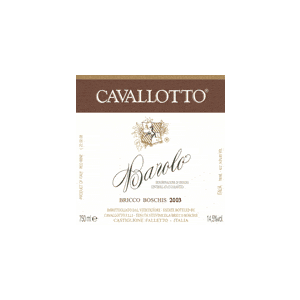
Cavallotto Bricco Boschis Barolo D.O.C.G. 2003 – Italy

Cavallotto Bricco Boschis BaroloAlfio Cavallotto is one of the bright new stars to emerge in Italy’s Piedmont. However, Cavallotto is neither new to the scene, nor are his wines indicative of the light, modern style of Barolo. Cavallotto is a real traditionalist, and his wines make few concessions to the contemporary predilection for technology over technique. Rather, it is this house’s penchant for making authentic, muscular, cask aged Barolos that reflect the great terroir of Castiglione Falletto that have caused Alfio Cavallotto’s star to rise. In short, the Cavallotto’s Bricco Boschis Barolo is one of the finest in the zone.

The Cavallotto estate uses only indigenous yeasts and long macerations to extract the fullest representation from each vineyard and wine it produces, and the results are sublime – age worthy Piedmontese treasures that are both structured and ultimately decadent. Cavallotto’s most compelling offerings emanate from his premier 10 acre vineyard known as Bricco Boschis. Both Barbera and Barolo emerge from this little gem. Production from this single vineyard cru is predictably small, rarely more than 2,100 cases.

Barolo: The King of Wines, and the Wine of Kings

Barolo has affectionately and appropriately been referred to as the “king of wines, and the wine of kings.” In a fine vintage such as 2003 and in the hands of a great winemaker, Barolo is unquestionably Italy’s most profound red wine, richly deserving of the many accolades that have been bestowed upon it.

Barolo is born on the Langhe Hills of Italy’s Piedmont, on steep craggy Alpine foothills that tumble out of nearby France and Switzerland. Barolo is the most masculine of Piedmont’s three great Nebbiolo based wines and the focal point in the region’s viticultural tiara. Gattinara and Barbaresco are the other two crown jewels. Although Gattinara, typically the lightest and most feminine of Piedmont’s great reds, and Barbaresco, sometimes referred to as a baby Barolo for its propensity for being lighter and easier to drink in its youth than its more stalwart neighbor, share the same noble Nebbiolo vine as Barolo, it is Barolo that possesses the pedigree to rule the viticultural roost. Barolo’s lineage dates back to the Middle Ages and by the mid 18th century Barolo had begun to evolve into its present form in the vicinity of Alba, a distinct Old World city that serves as the white truffle capital of Italy as well as Piedmont’s premier wine town.

Today, the limited production of Barolo generates from the huddled hills of two valleys, Serralunga and Barolo, and their five principal communities, all of which lie to the southwest of the city of Alba and are reputed to impart distinctive characteristics and traits to their respective progeny. The townships of Serralunga, Castiglione Falletto, and Monforte are situated in the Serralunga Valley and are reputed to produce the region’s most masculine, longest-lived Barolos. Meanwhile, Barolo and La Morra, from which the more “delicate” wines of the zone are said to flow, are part of the Barolo Valley. However, there are many exceptions and innumerable variations in Barolo on the same theme, and this does not even take into account the decades old debate in Barolo over the relative merits of the modern versus traditional styles of Barolo, which have as much to do with individual winemaking techniques as they do the amount and kind of barrel aging the wines receive. Happily, in the end, there is great Barolo fashioned in all five of the major townships, in both modern and traditional styles.

Tasting Notes: As a traditionalist, Alfio Cavallotto’s Bricco Boschis Barolo nearly always offers Barolo aficionados one of the truest reflections of the muscular, deep down, traditional style of Barolo for which the village of Castiglione Falletto is renowned, and thankfully the 2003 Cavallotto Bricco Boschis does not disappoint; it lives up to its well-deserved reputation and more. Always one of the deepest hued wines of Barolo, the 2003 Bricco Boschis is nearly black in color and packed with flavor. Animalistic, flamboyant, almost wild when first opened, the 2003 Bricco Boschis morphs with requisite aeration into a majestic Barolo, offering up delicious scents of black cherry fruit, grilled herbs, menthol, spice, violets, and tar, all of which flow delectably from the wine’s heady aroma into its lush, deep down palate. In the mouth, one can feel the power and weight of Castiglione Falletto as the Bricco Boschis fills the senses and consumes the palate. Tannins woven with layers of fruit and subtle, complex flavors explode on the finish and linger in the mind as well as on the tongue to offer the promise of a long life and years of pleasurable drinking. However, make no mistake, the 2003 Bricco Boschis is already a masterpiece, but like all great Barolo it remains in its youth only a shadow of what it will ultimately become, if allowed to rest quietly in bottle for several more years. If opened now or over the next year or so, we suggest extended aeration. We recommend at least two hours in a decanter prior to consuming. Better still, open the wine in the morning and let it air until dinner for optimal enjoyment. Anticipated maturity: 2009-2015.

Accompaniments: The complex, nuanced flavors and powerful structure of the 2003 Cavallotto Bricco Boschis Barolo, and all fine Barolo wines for that matter, make the case for serving “the wine of kings” with grand cuisine. Rarely does one sit around sipping Barolo, but consumed at table with traditional Piedmontese cooking replete with a wealth of savory sauces, one comes to easily appreciate the royal nature of Barolo. Risottos, made with authentic Arbio rice, are nearly always some of our favorite choices with Barolo. A whole chicken, mushroom, and truffle risotto, cooked very slowly and dashed with authentic balsamic vinegar from Modena makes for a heavenly match. Milk fed veal medallions, sautéed to perfection with butter and herbs, pair nicely, too, and offer excellent counterpoint to the wine’s strength and vigor. Less regional dishes also complement this wine. Crown Roast of pork, stuffed with bread, onion, and herb farce provides a savory treat. Marinated steaks and pork tenderloins offer tasty uncomplicated alternatives, too. In addition, Cavallotto’s Barolo offers one of the finest accompaniments to hard cheeses. Hunks of authentic Italian Parmesan or Provolone cheese pose no threat to this wine and offer a great way to finish a meal fit for a king.

Grongnet Blanc de Blancs Champagne N.V. – France

Grongnet Blanc de Blancs ChampagneEditor’s Note: Champagne is a wine that is under pressure. It should always be well chilled before opening. Always exercise caution when opening a bottle of sparkling wine. Never use a corkscrew. Point the bottle away from people and objects. Use a clean towel or cloth to firmly grip the bottle. Gently remove the wire stopper while firmly holding the cork in place. Then with thumb and forefinger, remove the cork slowly from the bottle. Do not let the cork fly. Enjoy!

Cécile Grongnet is a modest woman with high ideals. Her name is not a household word, nor does she ever expect to be famous. Rather than seek celebrity status, Cécile Grongnet aspires only to produce the finest wines of Champagne from her family’s diminutive, but superlative domain. Grongnet is a fifth generation grower and producer of authentic Champagnes. She works a mere 3 hectares or roughly 8 acres of Champagne vineyards in the regions’ fabled Valley of the Marne from which she fashions several exceptional offerings: among them an outstanding Blanc de Blancs, an equally impressive Rosé, and one of only a hand full of vintage dated Special Club Champagnes. Grongnet grows all three of the legal Champagne grape varieties: Chardonnay, Pinot Meunier, and Pinot Noir. However, it is Grongnet’s Blanc de Blancs, made exclusively from Chardonnay vines, that shines brightest at this tiny estate and garners accolades from the most demanding of wine critics.

Blanc de Blancs

A French wine labeled Blanc de Blancs signifies that the white wine in the bottle has been made exclusively from white grapes. However, Blanc de Blancs on a bottle of Champagne guarantees more than the basic assumption that only white grapes have found their way into the cuvee or blend: it guarantees that only Chardonnay grapes from Champagne were used to produce this unique sparkling Champagne. As Champagne is typically a blend of two or more grape varieties, at least one of which is red or black, Blanc de Blancs Champagne remains relatively rare. In addition, Champagne Blanc de Blancs is by nature delicate, creamy, and downright sensual. Yet, the finest vintage examples of Blanc de Blancs can be deep, rich, flavorful wines that are capable of aging quite well in bottle for up to a decade or longer.

Tasting Notes: Cécile Grongnet’s Blanc de Blancs is soft, gentle, aromatic Champagne, a wine that emanates elegance and style – the very hallmarks of the finest sparkling wines of Champagne. Sporting a bright, cheerful champagne-colored robe and exhibiting a very tiny, delicate perle or bubble, the Grongnet Blanc de Blancs radiates charm and sophistication. The wine’s cachet is light and lovely, an infusion of white fruits and freshly baked bread that is hard to resist. However, it is on the palate that this blithe Blanc de Blancs truly works its magic. It offers a wealth of delicate flavors, a creamy texture, and a supple, long finish that lingers in the mouth and begs the taster for more. Never biting or acidic the Grongnet Blanc de Blancs finishes with a sensual wave. Enjoy this premium Champagne moderately chilled (40º-50º F).

Accompaniments: In Champagne, there is a wine for nearly every dish and morsel one can imagine, and the Champenois are not shy about pairing their still or sparkling wines with all kinds of foods to well deserved acclaim. However, no single Champagne provides the perfect match for all dishes. That having been said, the Grongnet Blanc de Blancs provides extraordinary pleasure with or without food, and it certainly will not disappoint those looking for the perfect aperitif. Cécile Grongnet’s Blanc de Blancs does indeed sparkle as the entrée to a special evening or festivity. Nevertheless, it would be a shame to relegate this charming lady’s bubbly to a single role. Consequently, we suggest you serve the convivial Grongnet Blanc de Blancs with salmon mousse; smoked salmon, with a thin layer of cream cheese, capers and shaved onion; or sautéed scallops, prepared with a light cream sauce. Delicate fish or poultry dishes provide other favorite accompaniments. One tried and true classic with Blanc de Blancs Champagne is Suprême de Volailles aux Champignons (Chicken Breasts with Mushrooms and Cream). Bon Appétit!

Hewitson Ned & Henry’s Barossa Shiraz 2006 – Australia

Barossa Shiraz 2006Hewitson has been the source of many of South Australia’s finest Shiraz and Rhône style wines, ever since Dean Hewitson launched his now famous winery in 1996. A graduate of Roseworthy, Australia’s premier School of Enology, Dean worked at Petaluma, one of Australia’s finest wineries, spent a couple of years at UC Davis where he completed his Masters, and experienced fifteen vintages worldwide before settling down to his own venture.

Dean Hewitson in the Ned & Henry's VineyardPresently, Hewitson’s specialty is crafting wines for pure drinking pleasure, and this he does by procuring the finest old vine fruit from the best vineyards in South Australia and turning that fruit into magic in the bottle. In short, Dean Hewitson produces a formidable array of fine wines from pre-phylloxera vines, which means the vines all grow on their own original rootstock. The result is there is no other wine on earth that more closely resembles its original European ancestors than Hewitson’s.

Hewitson’s top two Shiraz offerings are Ned & Henry’s and Mad Hatter selections from the Barossa and McLaren Vale areas of South Australia respectively. Both are outstanding and produced in limited quantities. In addition to crafting two of the most compelling old vine Shiraz offerings in all South Australia, Dean Hewitson also fashions a majestic old vines Mourvedre called Mourvedre Old Garden from a vineyard planted in 1853. If this be madness, please give us more.

Tasting Notes: A big, stunning wine for sure, the 2006 Hewitson Ned & Henry’s Barossa Shiraz (92% Shiraz/ 8% Mourvedre) reminds us of young Hermitage – the Rhône Valley’s greatest red. Although this rich, polished Barossa beauty has already begun to strut her stuff, she remains a sleeping giant. The 2006 Hewitson Ned & Henry’s Shiraz is packed with character, flavor, style, and plenty of ripe tannins, which most assuredly will pay added dividends if one can allow her a little extra time in bottle. Black fruits, cassis, smoke, licorice, and polished wood are just a few of the scents and savors that pour from the 2006 Ned & Henry’s Shiraz. And on the palate, this deep purple potion already possesses considerable complexity, depth, and hedonistic pleasure. Rich, but never sweet or over the top, this three-year old beauty exudes concentration and power as well as layers of ripe fruit. More reminiscent of the great Syrah based wines of southern France than so many of its jammy, overblown Barossa counterparts, the 2006 Hewitson Ned & Henry’s Shiraz is nothing short of a tour de force in winemaking. It can be drunk happily now by those who positively cannot wait. However, this wine will almost certainly continue to evolve and grow in depth and complexity if allowed to rest longer in bottle. We suggest giving this wine two more years in bottle before consuming it at cool room temperature or better still at cellar temperature (55º-60º F) after an hour or more of aeration….and remember this is only the beginning of a long and illustrious life for the 2006 Ned & Henry’s Shiraz, so why not stock up and enjoy!

Accompaniments: It would be a shame to drink the 2006 Ned & Henry’s Shiraz with just any old meal. Consequently, we highly recommend dishes that are consummate with the rich quality and flavor of this special Shiraz. Hewitson’s great Shiraz based wines merit the highest grades of beef, lamb, and pork one can afford. An onion and manioc encrusted rack of lamb is one perennial favorite that gets our collective nod. Beef tenderloin, rubbed with fresh garlic and herbs, or a rich cassoulet, served alongside a splendid ratatouille, provide superb accompaniments to Hewitson’s tasty old vine Shiraz. As the Ned & Henry’s matures, it will complement an even greater array of foods, including stuffed veal chops and roast duck, so why not start planning the menu?

I'm ready toPlace My Order Button


logo for wine club
Since 1994
Home
Join Our Wine Club
Gift Memberships

Membership Renewals
Reorder Your Favorites
More Information
Wine of the Month Club
Current Selections
Past Selections
Testimonials
Other Gourmet Gifts
Corporate Gifts
Wedding Gift Ideas
All About Wine
Website Tools
Who We Are
Contact Us

1 - 800 - 625 - 8238
(Outside US call: 949-206-1904)
P.O. Box 1627, Lake Forest, CA 92609