Welcome to The International wine of the Month Club

Featured Wines

March 2008

Premier Series
Featured Wineries & Wines
Membership Type
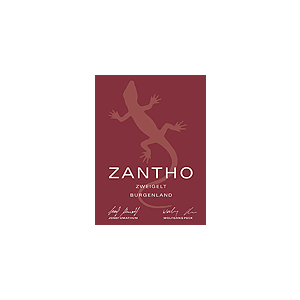
Zantho Burgenland Zweigelt 1 Red 1 White; 2 Reds
Napa Cellars Napa Valley Sauvignon Blanc 1 Red 1 White; 2 Whites
Fattoria Montellori Moro 2 Reds
Château Thieuley Bordeaux Blanc 2 Whites


Master Series
Featured Wineries & Wines
Membership Type
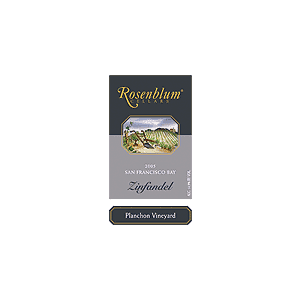
Rosenblum Cellars San Francisco Bay Planchon Vineyard Zinfandel 1 Red 1 White; 2 Reds
Napa Cellars Napa Valley Sauvignon Blanc 1 Red 1 White
Zantho Burgenland Zweigelt 2 Reds


Collector Series
Featured Wineries & Wines
Membership Type
Rosenblum Cellars San Francisco Bay Planchon Vineyard Zinfandel 1 Red 1 White; 2 Reds
Domaine des Baumard Côteaux-du-Layon Carte d’Or 1 Red 1 White
Château Gloria St. Julien 2 Reds

Zantho Burgenland Zweigelt 2006 – Austria

Zontho Burgenland Zqeigelt 2006 - AustriaDeep within the Austrian province of Burgenland lies the tiny village of Andau, which was first known as Zantho as far back as 1488. The region's gravelly soil, rich in iron and minerals, is ideal for producing premium red wine, especially the area's two most important red varieties: St. Laurent and Zweigelt. Zantho is home to a rare genus of woodland lizard, too, and now the name of one of Austria's hottest new wineries.

Zantho is a fledgling venture, starring Josef Umathum, Austria's undisputed master of the rare but difficult to cultivate St. Laurent varietal and his equally astute partner Wolfang Peck, a specialist with Zweigelt. Both men are regarded as two of Burgenland's finest winemakers and they started Zantho in conjunction with the Andau winegrower's cooperative. They founded Zantho in 2001, christening their enterprise with Andau's original name. They placed an image of the village's other main attraction, a rare woodland lizard that has become synonymous with the village as well as the winery, solidly on the label. Yet, what may be scarcer these days than the Zantho lizard is the availability of Zantho's Zweigelt and St. Laurent wines. Recently, several highly complimentary reviews have caused a wellspring of interest in Zantho's wines and strained allocation for this budding winery. However, we were fortunate to procure just enough of Zantho's delicious 2006 Zweigelt to slake the thirst of our membership. We trust you will enjoy this gregarious Zweigelt as much as we do.

Zweigelt and St. Laurent

Zweigelt (pronounced TSVYE-gelt) is an indigenous Austrian varietal. However, its appearance in the world of wine is relatively recent. Zweigelt was created only in 1922 by an Austrian scientist named Fritz Zweigelt. The grape is a cross between two indigenous Austrian varietals, Blaufränkisch and St. Laurent. Zweigelt was originally referred to as rotburger, but its name was changed to honor its creator – and for that we are all thankful. Today, Zweigelt is the most highly cultivated and sort after red grape variety in Austria. And by nearly all accounts, Zweigelt produces the finest red wine in Austria as well. In excellent vintages such as 2006, Zweigelt shines with juicy, ripe fruit and a warm, huggable structure that other indigenous varietals struggle to match.

St. Laurent is another indigenous Austrian grape variety, even though it is likely a far distant relative to Pinot Noir of Burgundy fame and fortune. Interestingly, Umathum's single vineyard St. Laurent, which hails from his own 45-acre estate, has been compared to Chambertin, the great Grand Cru red Burgundy that remains one of France's most treasured viticultural legacies. However, St. Laurent does not always reach its pinnacle of quality in every vineyard because it is so difficult to grow. It requires special attention in the winery – something Umathum and Peck know something about – in order to extract the utmost from the vine's persnickety temperament. However, in the right hands and when all goes well, St. Laurent furnishes a rare treat.

Tasting Notes: The 2006 Zantho Zweigelt provides more than ample testimony to the much heralded quality of the 2006 vintage in Austria. It, also, pays tribute to the enological acumen of Umathum and Peck. In short, Zantho's 2006 Zweigelt captures all the juicy red fruit, subtle spice, and lively refreshment that well-bred Zweigelt has to offer. Although somewhat reminiscent of Grand Cru Morgon or a serious village Burgundy, the 2006 Zantho Zweigelt offers plenty of its own unique character, too. Up front, it is loaded with gorgeous cherry fruit in both aroma and flavor, which nearly bursts from the glass with just a few minutes of aeration. If pleasure is what you are after in wine, Zantho's Zweigelt is up to the task and ready to deliver. Mouth filling flavors caress the mouth; cinnamon, sassafras, vanilla, and of course layer upon layer of beautiful, juicy red fruit come to fore. Dressed in a regal purple robe and bringing all the good cheer one can ask for, this medium-bodied Zweigelt shines like the sun. From the first sniff through to this Zweigelt's balanced and refreshing finish, the 2006 Zantho will put a smile on your face. For optimal enjoyment, we suggest serving this delightful wine between cool room temperature and cellar temperature (56° - 66° F). Prost!

Accompaniments: The 2006 Zantho Zweigelt is a wonderful tableside companion. It is equally at home with bistro food as it is with an eclectic assortment of Mediterranean fare. Austria's Burgenland is surprisingly warm, so its climate bears more resemblance to that of Italy than it does the rest of Austria. Correspondingly, pizza, pasta, and many authentic regional Italian specialties provide Zantho with ideal accompaniments. Pork Bracciole from the Marches or even Bracciole Florentine, made with beef and mushrooms, provides a hedonistic feast to match the Zantho Zweigelt. Pasta with a genuine Alfredo sauce is a good bet, too. We can also recommend white fish, especially when prepared in the Livornese style with black olives, capers, herbs, and fresh tomato sauce. Peppercorn-Crusted Tuna Steaks, served with Parmesan Risotto, is another superb rendering with the Zantho Zweigelt. And certainly, dumplings, schnitzels, and other dishes that are commonly thought of as typical of Austrian cooking offer superb companionship to Zantho's flagship wine, too. And if it's simply a burger or barbecue night, Zantho's Zweigelt will surely add some panache to an otherwise mundane meal.

Napa Cellars Napa Valley Sauvignon Blanc 2006 – U.S.A.

Napa Cellars Napa Valley Sauvignon Blanc 2006 – U.S.A.Napa Cellars is a Napa Valley landmark. It lies just north of the now famous Mustard's Restaurant, on the west side of California Highway 29. Napa Cellars' Oakville address is about as close to the heart of Napa Valley as one can be. However, in the world of wine location means very little, until the vineyard's terroir yields results and the winery's good stewards know what to do with the bounty the land surrenders. At Napa Cellars, the past and present proprietors have been just stewards, and the consumer has consistently reaped the gustatory benefits. At this historic property one need not have any doubts about the quality of wine that flows from its barrels. In fact, this overachieving enterprise could serve as a model for other less serious-minded Napa Valley estates. Napa Cellars is a well-funded, solidly run property that fashions a fine array of good, old-fashioned Napa Valley wines.

Napa Cellars was born in 1992, when Rich Frank, Chairman of Walt Disney Television and Communications, and Koerner Rombauer, proprietor of Rombauer Vineyards (one of Napa Valley's finest producers of Chardonnay and Cabernet Sauvignon) teamed up to form Frank-Rombauer. They later changed the estate's name to Frank Family Vineyards. Almost since its inception, the celebrated Napa Valley winemaker Todd Graff was the man behind the barrel and the reason for the outstanding quality at this landmark estate. He is, also, the person responsible for the current vintages and present releases at Napa Cellars.

In 2006, Napa Cellars was sold to Trinchero Family Vineyards, one of the most quality-minded, environmentally friendly family enterprises in Napa Valley. However, Napa Cellars continues to operate as an independent winery and it will be home to Folie à Deux – another flagship Napa Valley wine within the Trinchero Family's growing portfolio of sustainably run wineries. If past performances on the part of the Trinchero Family at their home estate and the quality of Folie à Deux are any indicators of what the consumer can expect from this group, Napa Cellars will only continue its meteoric rise.

Tasting Notes: Napa Cellars has in recent years emerged as one of the top purveyors of Napa Valley Sauvignon Blanc. Bold and beautiful, the 2006 Napa Cellars Sauvignon Blanc embodies a thrilling cornucopia of appealing flavors. And this most recent Sauvignon Blanc from Napa Cellars is simply chocked full of the scents and savors: melon, fig, quince, tropical fruit, and fresh citrus gush from the glass. Actually, it is hard to imagine a better California Sauvignon Blanc than this offering from Napa Cellars. Rich in fruit but still crisp and supremely dry, the 2006 Napa Cellars Sauvignon Blanc is a joy to drink from the first sip to the last. No heavy oak tones mar the wine's depth of fruit and wealth of flavor. Moreover, this Sauvignon Blanc finishes with a long burst of flavor and crisp acidity that assure its further development. For optimal drinking we suggest putting a good chill on the 2006 Napa Cellars Sauvignon Blanc (about 40° F) and then allowing it to open as you sip or guzzle as the case may be. However, as much as we wanted to sip and savor this wine, we found it so appealing straight away that it disappeared down our throats with a hushed silence and a collective nod of approval. Enjoy!

Accompaniments: Although it may still be true that "summer and Sauvignon Blanc were made for one another" and that Sauvignon Blanc is "the quintessential wine of summer," recent tastes in food along with the advent of fuller, richer, more complex styles of Sauvignon Blanc have rendered the noble Sauvignon Blanc a wine for all seasons. With this in mind, the 2006 Napa Cellars Sauvignon Blanc cuts a handsome figure with all kinds of salads, seafood, poultry, pork, smoked meats, and many of the worlds most exquisite cheeses. Smoked crab cakes, roasted oysters, tuna steaks with piquant fruit salsas, and ham (especially prosciutto) all offer complementary accompaniments to Napa Cellars' outstanding 2006 Sauvignon Blanc. Fresh honeydew melon wrapped in prosciutto and a Panini, with melted chèvre, fig preserve, and prosciutto are two of our favorite appetizer choices with this wine. Homemade red pepper humus provides another fine choice of appetizer with this wine. For more elaborate fare, why not try an Asian stir fry? The 2006 Napa Cellars Sauvignon Blanc accompanies all kinds of traditional Chinese, Thai, and Vietnamese dishes from the simple to the elaborate. Noodles, served with chicken, shrimp, tofu or vegetables, all provide a fine palette on which to pair the Napa Cellars Sauvignon Blanc. Yet, this flavorful wine will rise to such Thai specialties as Grao Prao (Stir fried fresh chili, onion, green bean, pepper, and hot basil) and Ma Kua (Stir fried eggplant, with salted soya bean and sweet basil), so no need to be bashful with the Napa Cellars or your menu. However, you may just want to have a second bottle on hand because the 2006 Napa Cellars is so easy to drink on its own that you may find you have finished the first bottle, even before you have had a chance to sit down at table.

Fattoria Montellori Moro 2004 – Italy

A couple of years ago, we discovered Fattoria Montellori and the estate's enthusiastic, serious-minded proprietor Alessandro Nieri. Not long afterwards, we met Dr. Marco Razzauti, Montellori's exuberant 30 year old viticulturist and oenologist, and it quickly became clear to us just how committed this estate is to making world class Chianti and Super Tuscan reds. What is happening at Montellori is nothing short of enthralling. And instead of smoke and mirrors leading the way, as is sometimes the case in the world of wine, it is a solemn revitalization of the estate's vineyards and a complete dedication to natural, sustainable agronomy that has pushed the quality quotient at Montellori to ever higher levels. This estate's total makeover is due to the vast improvements in viticultural practices that Dr. Razzauti instituted several years ago, and Montellori's decision to limit production. Needless to say, the results speak volumes, loudly and clearly.

Fattoria Montellori is located off the beaten track, away from the glitz and glamour of the well-worn wine road that winds its way from Florence to Siena. Instead, Montellori is tucked away in the Montalbano zone of Chianti to the west of Florence, near the stately Tuscan town of San Miniato. San Miniato is renowned for its wealth of beautifully preserved Romanesque and Renaissance churches, which thrust their many spires skyward. This pretty town is equally celebrated for its savory truffles and heavenly wines. The latter treasures constitute some of Tuscany's most hedonistic pleasures.

Thanks to the foresight of Alessandro Nieri's father Giuseppe, Fattoria Montellori owns six distinct vineyards, all of which possess a unique soil, microclimate, exposure, and altitude. Red wine is king at Montellori, as it is throughout Tuscany. Not surprisingly, Chianti is the estate's most important wine, at least in terms of production. And what a Chianti it is! However, in recent years, Montellori has fashioned three outstanding Super Tuscan offerings: Moro, Dicatum, and Salamartano. Moro is the single vineyard offering that is the most accessible and seductive of the three, particularly in its youth. Moro is a blend of primarily Sangiovese to which small amounts of Cabernet Sauvignon and Malvasia Nera are added. Meanwhile, Dicatum is the most traditional of this estate's offerings. It is 100% Sangiovese from the hillside vineyard Cerreto Guidi, the last vineyard that Giuseppe Nieri personally planted. Salamartano on the other hand is a classic Bordeaux blend of Cabernet Sauvignon and Merlot that has been aged in small barriques. In addition, Alessandro Nieri and Marco Razzauti craft several excellent white wines, including Mandorlo, an artful non-traditional blend of Chardonnay, Viognier, Marsanne, Roussanne, and Clairette.

Tasting Notes: A lush, hedonistic Super Tuscan, the 2004 Moro is a tribute to Marco Razzauti's talent and testimony to the bounty of the outstanding 2004 vintage throughout Italy. Ripe, round, and packed with flavor, the 2004 Moro is the finest rendition of this outstanding offering to date. It is filled with a heady perfume of violets, black cherry, cocoa, and more. And in the mouth Moro is all plush fruit, married to ripe tannins and the feel and texture of the finest Florentine leather. No ordinary Tuscan red, the 2004 Moro is more akin to fine Pomerol, the most accessible and charming of Bordeaux's red wines. Indeed, the 2004 Moro is seductive in its tantalizing fruit and forward charm, but it is by no means a light or frivolous wine. Furthermore, the 2004 Moro will continue to improve for several more years in bottle, if you can exercise enough restraint to keep a bottle around for that long. We recommend serving the 2004 Moro cool (59° F-65° F) straight from the bottle, or better still allow it an hour or more to breathe: it will unfold in the glass and delight the senses for as long as you can resist.

Accompaniments: An exquisite Tuscan red such as the 2004 Montellori Moro provides the ideal complement to foods of similar style and sophistication. A myriad of meats and vegetables take on whole new dimension when paired with the 2004 Moro. Pheasant, stuffed with braised vegetables, porcini mushrooms and a hint of truffle, makes a memorable meal and a marriage that could last forever. However, poultry, fine cuts of beef and pork, even game, provide other worthy suitors. Classic Tuscan white bean dishes, served with crusty Italian bread and a few slices of hard cheese, offer other traditional accompaniments that will thrill tried and true carnivores as well as vegetarians. And for a simple mid week treat, you may want to open a bottle of the 2004 Moro to accompany a grilled chicken breast, served with grilled onions and peppers, melted Havarti cheese, and basil aioli on toasted focaccia. Parmigiano Reggiano, Pecorino Romano, and other hard cheeses in the company of this fine Super Tuscan offer uncomplicated choices, too, especially as the finale to a splendid meal. But whether it is simple elegance or sophisticated fare you seek, you are sure to find a friend in the 2004 Moro. Buon Appetito!

Château Thieuley Bordeaux Blanc 2006 – France

Château Thieuley is one of a growing number of fine petits châteaux in the vast Bordeaux appellation that is fashioning exemplary red and white Bordeaux. Located in the commune of La Sauve, amidst the picturesque hills of the historical Entre-Deux-Mers, Château Thieuley lies midway between the city of Bordeaux and the river port of Libourne. It is owned and run by Francis Courselle whose parents bought the property in 1950. Under the care of Francis the quality of the wine at Château Thieuley has skyrocketed. Upon taking over the direction of the château in the 1970's Francis began transforming this relatively large 135-acre property into the benchmark estate it is today.

A trained oenologist, Francis Courselle gave up a career teaching oenology to work the family's vineyards (75 acres of Sauvignon Blanc, Sauvignon Gris, and Semillon for white wines and 60 acres of Merlot, Cabernet Sauvignon and Cabernet Franc for red wines) and fashion what critics are now calling some of the most compelling AC Bordeaux wines. Over the years, Château Thieuley has won numerous medals for both its white and red wines and Robert Parker Jr. has recently named the 2005 Château Thieuley Rouge one of the" Sleepers" of the outstanding 2005 vintage.

Francis Courselle uses a combination of new and old oak barrels for his wines, which allows him to fashion deliciously light, but highly aromatic white Bordeaux with good concentration and length. He also crafts a small amount of Cuvée Francis Courselle, a barrel fermented white that spends an additional six months ageing in cask. Meanwhile, the estate's red Bordeaux is a suave, succulent wine that exhibits both purity and complexity. It spends a full year in barrel – a rarity in Bordeaux, except for classified growths and the finest crus bourgeois and petits châteaux.

Tasting Notes: The 2006 Château Thieuley Bordeaux Blanc is an excellent example of what dedicated growers in Entre-Deux-Mers and the surrounding Bordeaux appellation can fashion from the region's three traditional grape varieties. In the case of the 2006 Château Thieuley Blanc, Francis Courselle has created a bright, cheerful white wine that slips down the gullet with ultimate ease. Concentrated, but not thick or heavy, and 2006 Château Thieuley is both scented and satisfying. It offers up a subtle, pleasing bouquet of gooseberry, grapefruit, pineapple and additional tropical fruits that hint of exotica. On the palate the wine expands into a soft, satiny glow, revealing the supple, seductive side of Semillon. And thanks to the sparing use of oak, the 2006 Château Thieuley finishes cleanly with just a twist of citrus and spice. Although neither complex nor complicated, this white wine is easy to like and fun to drink. As it matures, it will no doubt put on some weight (Don't we all?), but we doubt we can keep a bottle around long enough to find out. Initially, we suggest serving the 2006 Château Thieuley well chilled (35°-40° F) and then allowing the wine to slowly open as it reaches for ambient temperature.

Accompaniments: White Bordeaux is one of the most versatile of white wines, so that one will have little difficulty finding worthy companions for the 2006 Château Thieuley Bordeaux Blanc. In Bordeaux, which lies so close to both the sea and the rich farmland of ancient Aquitaine, seafood and salads are ubiquitous choices with Château Thieuley and other similar minded white Bordeaux. Consequently, at the top of our list is a cold seafood salad, consisting of shrimp, scallops, and lobster. Oysters, prepared almost any way one can imagine, are a good bet, too. However, we have other perennial favorites: So why not consider serving a hearty salad of smoked turkey and goat cheese that is served on a bed of mesculin greens and topped with a creamy fresh basil and herb dressing? Furthermore, what may still be one of the wine world's best kept secrets is the affinity white Bordeaux and various Asian cuisines share. Pad Thai, sushi, sashimi, and Vietnamese noodles are just a few of the dishes we have found that pair superbly with the Château Thieuley Bordeaux Blanc, so we suggest you be daring and enjoy! Bon appétit!

Rosenblum Cellars San Francisco Bay Planchon Vineyard Zinfandel 2005 – U.S.A.

Rosenblum Cellars San Francisco Bay Planchon Vineyard Zinfandel 2005 – U.S.A.Rosenblum Cellars is one of a just a few dozen California wineries that are internationally known. Located in Alameda, California, Rosenblum Cellars fashions 40 different wines in any given vintage – almost all in small lots from California's finest vineyards. Begun in 1978 by veterinarian Dr. Kent Rosenblum, this remarkable winery began as a basement operation. In Rosenblum's own words, "Winemaking was a hobby gone wild." And aren't we glad it did. Rosenblum Cellars has evolved into a world class winery whose specialties include many award winning Zinfandels and a bevy of delicious Rhône style wines from single vineyards.

In 1978 after years of making wine out of his home, Kent Rosenblum and several close friends took the great leap of faith and passion: they bought property next to the infamous Dead End Bar in Oakland, once a prohibition speakeasy, and began their own winery, Rosenblum Cellars. The winery's first great success was with Zinfandel, which Rosenblum and his cohorts made fashionable by turning out a dozen or more top notch wines from the mercurial Zinfandel grape. From the beginning Kent focused on fashioning exceptional vineyard designate wines from mountainside dry farmed, head pruned, old vines. And the public response was sensational. In 1986, Rosenblum Cellars won the sweepstakes at the San Francisco Fair Wine Competition with its George Hendry Reserve Zinfandel. The winery promptly moved into its present location in Alameda and has never looked back. Under Kent's watchful eye Rosenblum Cellars has fashioned some of California's most compelling wines. Once considered unworthy of critical acclaim, vineyard designate Zinfandels have become the rage and the darling of connoisseurs and critics alike – thanks in large part to Kent Rosenblum and his team.

Although Zinfandel and Rosenblum Cellars are nearly synonymous, this world-class winery also crafts award-winning Cabernet Sauvignon, Merlot, Chardonnay, and most recently Rhône varietals such as Syrah, Petite Sirah, Mourvèdre, Viognier, Marsanne, and a truly outstanding Roussanne from the Fess Parker Vineyard in Santa Barbara County.

Tasting Notes: A sensuous, downright sumptuous wine from the hills just west of the historic town of Oakley in Contra Costa County, the 2005 Rosenblum Cellars Planchon Vineyard Zinfandel is a tour de force in winemaking. Derived from head pruned, dry farmed vines up to a century old, this hedonistic Zinfandel is about as good as it gets. Exotic, almost mesmeric scents of berry, bramble, currant, and smoke caress the nose, but the wine's amplifying olfactory is merely a prelude to the symphonic flavors that follow to tantalize the palate. Gobs of black cherry, currant, cocoa, plum, vanilla and spice fill the mouth with hedonistic delight and then linger on long past the wine's explosive crescendo. Yet, never once does this opulent Zinfandel lose its form, balance, or sophisticated feel. Smooth and charming from beginning to end, one would hardly recognize the nearly 15% alcohol that keeps this masterpiece together. In short, the 2005 Rosenblum Cellars Planchon Vineyard Zinfandel is not to be missed. And for those souls for whom patience is not yet a virtue, they can simply pop the cork on this superb Zinfandel and know that the party has already begun. After just a few minutes in the glass, the 2005 Rosenblum Cellars Planchon Vineyard Zinfandel is ready to reveal every bit of it exuberant charm. As always, cool room temperature (no more than 66° F) will do the utmost justice to this outstanding Zinfandel as well as one's ability to taste and enjoy it.

Accompaniments: What we like best about the 2005 Rosenblum Planchon Vineyard Zinfandel, after its great flavor of course, is how well it pairs with food, or not. In the ideal world, one has a bottle of the 2005 Planchon Zinfandel to share with dinner and a second to while the night away. Rosenblum's Planchon Vineyard Zinfandel provides an outstanding complement to roast turkey and all the trimmings, steaks, pork roasts, spare ribs, and game. However, it may be most at home with traditional Mediterranean delights straight out of the brick oven. Southern Italian favorites such as baked ziti, eggplant or zucchini Parmigiana, lasagna, and manicotti provide great complements to this wine. After all, Zinfandel, or more accurately its ancestor Primitivo, thrives in southern Italy, where it marries perfectly with the tomato rich sauces of Italy's Mezzogiorno. Moreover, Zinfandel became the grape of choice in the United States among many Italian immigrant winemakers, and with good reason: They were able to mold Zinfandel in the last century and half into an American classic that paired beautifully with their food. However, we should not lose sight of the fact that Rosenblum's Zinfandels are made with good old-fashioned, hedonistic pleasure in mind, so they will complement both simple and sophisticated dinner party fare as well as provide a solitary respite from life's drudgery, with nothing but a glass to speak its praises. Nonetheless, we would be remiss not to call attention to the affinity this ripe, succulent Zinfandel has for handcrafted chocolates, especially dark chocolate truffles. In our experience no other wine pairs better with fine chocolate than great Zinfandel, so while you are finishing off that second bottle of the 2005 Planchon after dinner with family and friends, why not sneak in a piece or two of great chocolate from Lake Champlain or Leonidas Chocolatiers? To discover additional chocolate pairings or to learn more about one of life's other great pleasures, please visit our In Pursuit of Chocolate website at www.chocolatemonthclub.com, and enjoy more of the best that life has to offer.

Domaine des Baumard Côteaux-du-Layon Carte d'Or 2004 – France

Domaine des Baumard lays tucked away in the tiny village of Rochefort-sur-Loire, just south of Savennières, in the very heart of the ancient Duchy of Anjou. This property is an impeccably run estate that has been fashioning outstanding Loire valley wines since 1634. The historical Baumards are viticulturists who specialize in the great but now nearly forgotten Chenin Blanc variety. However, under the recent guardianship of Jean and Florent Baumard, Domaine des Baumard has soared to new heights, even as many of Baumard's neighbors have struggled to maintain their marginal vineyards.

Although Domaine des Baumard has played a key role in producing great Loire Valley wines for centuries, much of the modern day lore can be attributed to Jean Baumard, Florent's father, who resurrected this family property in the 1950s and 1960s after decades of decline due to phyloxerra, economic depression, and the ever shifting tastes of the wine drinking public. For decades the Baumards, like many of their neighbors were forced to concentrate their efforts on their nursery business and the cultivation of vines rather than wine making. That is until the 1950s when Jean began acquiring several of the greatest vineyards in Côteaux-du-Layon and Quarts de Chaume and refocused the family's effort into the crafting of the greatest of all Loire Valley wines.

In the past decade Florent Baumard, a brilliant winemaker in his own right, has continued the great renaissance at Domaine des Baumard. Today, Florent may in fact be the region's finest winemaker. The Wine Advocate has stated that "Baumard quietly fashions some the world's most complex dry and sweet wines . . . and if he had been born a Californian, Burgundian, or Bordelais, wealthy vineyard owners would be standing in line to employ his services as a consultant," which is high praise indeed.

Presently, Domaine des Baumard has one of the most extensive portfolios of Anjou wines, including outstanding dry Savennières offerings, sweet treasures from Côteaux-du-Layon and Quarts de Chaume, a host of artful cuvées and at least three of the Loire Valleys most enjoyable sparkling wines. There are also a number of single vineyard offerings. All of Baumard's Savennières and Côteaux-du-Layon wines are produced from low yields (1.5-2.5 tons per acre). Moreover, all of Baumard's wines are hand harvested and each of the estate's wines is made in small, individual lots.

Savennières, Côteaux-du-Layon, and Quarts de Chaume

The Loire is France's longest and most scenic river. Moreover, it gives rise to some of the world's most distinguished white wines. The Upper Loire, above Orléans, is famous for a myriad of Sauvignon Blanc wines in the guise of Sancerre, Pouilly-Fumé, and assorted other place names such as Quincy and Menetou-Salon. However, as one moves downriver towards Touraine and Anjou, other grape varieties come to fore. And by the time one gets to Côteaux-du-Layon and Savennières, Chenin Blanc reigns supreme and no more glorious and immortal white wines are produced in France than those of the finest vineyards of Savennières and Côteaux-du-Layon.

Savennières: Situated west of Angers, Savennières produces small quantities of powerful, long lived white wines of outstanding quality from Chenin Blanc. Nearly all of its meager 12,000 case production is made dry. This splendid appellation includes two Grand Cru vineyards, Roche aux Moines and Coulée de Serrant.

Côteaux-du-Layon: Situated to the south of Angers, Côteaux-du-Layon is the largest appellation for quality Chenin Blanc in Anjou. Most of its wines reflect the decadent, hedonistic side of Chenin Blanc, ranging from soft and fruity to full blown dessert wines that can improve in bottle for decades. Côteaux-du-Layon contains two outstanding Grand Cru offerings in Quarts de Chaume and Bonnezeaux.

Quarts de Chaume: A 112 acre Grand Cru of Côteaux-du-Layon, Quarts de Chaume is reputed to produce the world's finest Chenin Blanc, particularly in splendid vintages with plenty of sun and a dose of botrytis. From a great vintage and in the hands of Baumard and a few other outstanding producers, Quarts de Chaume can be sublime and nearly immortal.

Tasting Notes: A classic Côteaux-du-Layon, the 2004 Domaine des Baumard Carte d'Or shines from the glass like the morning sun. Already, it glints of gold and the nectar within, but time will deepen this hue and bring forth a true elixir. Yet, the 2004 Baumard Carte d'Or is already brimming with flavor and is beautiful to drink now. It offers up a beguiling floral scent that smacks of clover, quince, spring flowers, and honey, but hang on for the real treat. In the mouth, the 2004 Carte d'Or truly intrigues, as it reveals an elegant, ever mounting array of flavors that dance across the palate. Marzipan, quince, sweet clover, tree nuts, and honey all line up to seduce the unsuspecting, but with only a minimum of residual sugar. Subtle like a good confection, Baumard's 2004 Carte d'Or caresses the palate and adds new meaning to the word "sweet." Some will find this wine immediately appealing, while others may remain a bit more reticent. Regardless of one's inclination, we suggest consuming the Baumard Carte d'Or with food and then only lightly chilled (50°-57° F) in order to highlight every bit of the subtle charm that Baumard and the lovely land of Anjou have to offer. In addition, we highly recommend that one allow this classic Chenin Blanc to breathe for awhile in the glass, as the great wines of Anjou tend to open slowly in the glass and reveal themselves fully only with time. And for the more patient among us, they may want to hold this bottle in the cellar for several more years: the white wines of Côteaux-du-Layon are some of the longest lived white wines in the world. Anticipated maturity: 2008- 2016. Saluté!

Accompaniments: One could consider the usual white wine accompaniments: fish, poultry, and other demure, self effacing fare with the 2004 Baumard Carte d'Or, but that would not be our first choice. Instead, we suggest serving the Carte d'Or with a variety of cheeses, fruits, confections and nuts, especially when the wine is young. Almond or pistachio cookies, biscotti, and nuts offer ideal ways to finish a meal in the company of a glass of Baumard's 2004 Carte d'Or. Add some cheese to that confection or hand full of nuts and you double the pleasure. One of our favorite cheeses with this wine is Mimolette, a creamy, hard, cow's milk cheese from Normandy and Brittany. Lastly, for members who opt to savor this wine earlier in a meal, we suggest serving the Carte d'Or with a salad of organic greens, sprinkled with a mild goat cheese such as the Loire Valley Sainte-Maure de Touraine, almonds, walnuts, and perhaps even blood oranges or apricots. One could also consider Lobster Croquettes with a pineapple salsa or even mild Chinese, Thai, or Vietnamese appetizers. And as this classic Chenin Blanc ages and takes on additional flavor and weight, it will complement pâté and fuller fare, too. Enjoy!

Château Gloria St. Julien 2004 – France

Château Gloria owes its existence to the late Henri Martin, one of Bordeaux's leading post war personalities. A gregarious, enormously popular figure, Martin was not only one of Bordeaux's leading vignerons, he spent forty years as the mayor of St. Julien and was for years the President of the Conseil Interprofessionnel des Vins de Bordeaux, the premier trade and marketing organization of Bordeaux growers. Henri Martin also co-founded Commanderie de Bordeaux, another leading professional organization. However, Martin's greatest accomplishment was creating one of St. Julien and Bordeaux's leading château from scratch.

Bordeaux is a very traditional wine region, whose wines have been codified and classified for centuries. Major properties called châteaux have closely defined vineyards based upon tradition and terroir. This is especially true of the so called classified growths: these are the châteaux that were deemed in the last Bordeaux Classification of 1855 to be the finest in Bordeaux. Typically, these classified Bordeaux châteaux are passed down from one generation to the next or purchased intact and in their entirety by a single, very wealthy buyer. Consequently, it is extremely difficult to start a new property or château in Bordeaux. In Henri Martin's case, he never inherited property nor could he afford to buy a classified growth, but as the son of a Bordeaux cooper and old time Bordelais winemaking family he had a dream. He dreamed of owning a Bordeaux château and making his own classified St. Julien.

In 1942 during the darkest days of World War II, Henri Martin did the unthinkable. He purchased 6 hectares (roughly 13 acres) of a St. Julien vineyard that belonged to Château Beychevelle and began Château Gloria. After the war, he augmented Château Gloria, one parcel at a time, through purchases of vineyards from other St. Julien classified growths, most notably, Ducru-Beaucaillou, Gruaud-Larose, Lagrange, Léoville-Baron, and Leoville-Poyferré. Henri Martin, also, acquired a small parcel of the outstanding classified Pauillac château of Duhart-Milon that actually lay in St. Julien. Under the expert direction of Henri Martin, Château Gloria became one of the most widely admired and recognizable names in all Bordeaux. Although Château Gloria never achieved classified growth status because no new classification of Bordeaux was permitted, consumers, critics, and most Bordelais now agree that Château Gloria has for decades deserved to rank among the top Bordeaux châteaux. Moreover, Château Gloria has become one of the top selling château bottled Bordeaux wines of all time, a position it still enjoys today under the auspices of Henri Martin's family.

Tasting Notes: The style of wine produced at Château Gloria has as much to do with the gregarious nature of its late proprietor as it does the patchwork of St. Julien vineyards from whence it comes. In fact, Martin's focus on charm, forward fruit and the classic tenderness of St. Julien helped revolutionize Bordeaux and how consumers view top red wines from the world's largest and most renowned wine region. At a time when many St. Julien producers were content to emulate the harder, longer lived wines of neighboring Pauillac, Martin chose instead to focus on the ebullient, gracious side of St. Julien and to fashion wines that both serious wine drinkers and neophytes alike could understand and enjoy young. Not surprising then, The 2004 Château Gloria St. Julien is classic Gloria. It is adorned with a wonderfully rich purple robe and endowed with the savory scent of black current, cassis, cedar, and just enough of the tender terroir of St. Julien to be intriguing. Soft, flavorful, generous, and round, the 2004 Château Gloria is an easy to drink claret from the moment the cork exits the bottle. Nevertheless, an hour or more of aeration reveals an even fuller, richer, more fulfilling red Bordeaux. Although always ready to please from a tender young age, Gloria does have the ability as well as the propensity to age. Consequently, allowing the 2004 Château Gloria to rest in the cellar for four or five years will only double the pleasure. The 2004 Château Gloria is a blend of four classic Bordeaux varieties: Cabernet Sauvignon (65%), Merlot (25%), Cabernet Franc (5%) and Petit Verdot (5%). Saluté!

Accompaniments: The 2004 Château Gloria St. Julien is classic claret, which means it is exemplary red Bordeaux wine that has been made for the table and the delights of the cupboard. Indeed, Henri Martin would be proud. Many would even go so far as to say that the 2004 Château Gloria carries itself as the ultimate dinner party wine, as it embodies all the finest characteristics of mature St. Julien. The 2004 Château Gloria possesses charm, elegance, fruit, and plenty of flavors, with nary an edge. Duck, grouse, pheasant, quail, and other small game birds provide excellent choices with this wine. Chicken, veal, and fine cuts of beef offer equally fine accompaniments. Pot roast, beef stew, veal or pork-pot-pie, and even tender cuts of lamb will reward the gourmand. However, nearly any food or nothing at all will complement the supple, sophisticated 2004 Château Gloria. Enjoy.


logo for wine club
Since 1994
Home Page
Join Our Club
Gift Memberships

Membership Renewals
Reorder Your Favorites
More Information
Current Selections
Past Selections
Testimonials
Other Gourmet Gifts
Corporate Gifts
Wedding Gift Ideas
Wine of the Month Club
How It's Selected
Grape Types
Food Pairings
Upcoming Events
Industry Resources
Making Wine
Print a Gift Card
Refer a Friend
Send a Hint
E-Promos
Send a Virtual Wine
Who We Are
Contact Us
Link to Us

1 - 800 - 625 - 8238
(Outside US call: 949-206-1904)
P.O. Box 1627, Lake Forest, CA 92609