Welcome to The International wine of the Month Club

Featured Wines

November 2007

Premier Series
Featured Wineries & Wines
Membership Type
Pedroncelli Bench Vineyard Merlot 1 Red 1 White; 2 Reds
Avinyó Cava Brut NV 1 Red 1 White; 2 Whites
Dominio Dostares Estay Léon 2005 2 Reds
Celestin Blondeau Menetou-Salon 2 Whites


Master Series
Featured Wineries & Wines
Membership Type
Domaine Raspail-Ay Gigondas 1 Red 1 White; 2 Reds
Avinyó Cava Brut NV 1 Red 1 White
Pedroncelli Bench Vineyard Merlot 2 Reds


Collector Series
Featured Wineries & Wines
Membership Type
Domaine Raspail-Ay Gigondas 1 Red 1 White; 2 Reds
Laurent Perrier Champagne Brut 1 Red 1 White
Fattoria Montellori Salamartano 2 Reds

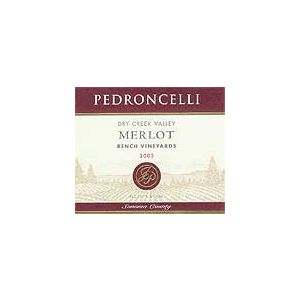
Pedroncelli Dry Creek Valley Bench Vineyards 2003 Merlot – U.S.A.

Pedroncelli Dry Creek Valley Bench Vineyards 2003 Merlot – U.S.A.Since 1927, two constants at the Pedroncelli estate in Sonoma County's Dry Creek Valley have been family and wine. Started by Italian immigrant John Pedroncelli, Sr., the Pedroncelli estate vineyards are located 25 miles from the Pacific where the grapes from this pre- Prohibition property ripen fully and produce full fruit flavors because of Dry Creek Valley's ideal climate of warm days and cool nights.

John, Sr.'s namesake, son John, grew up on the property and has been principal winemaker at Pedroncelli since 1948. John's brother Jim was actually born in the winery's offices, which were formerly the family's home. Jim has overseen marketing and sales at the winery since 1957. Jim only half jokingly tells visitors "I was born in this office and I will probably die here as well." Jim and John's children and children-in-laws work in various capacities at the winery, and the family happily watches a fourth generation buzz about the property. In short, Pedroncelli remains an authentic family-owned and run winery. Rare as it may now be, this is one California family that has not yet traded in its name or its soul to a corporate conglomerate.

Obviously, stability and tradition play an important role for the Pedroncelli family as it collectively pursues its shared passion for producing quality wines. Yet, Pedroncelli's vineyards have only gently expanded to 105 acres from the property's original 90 acres, and the brothers continue to seek innovative means of improving production and quality, without rapid expansion or compromising family tradition. Highlighting specific vineyards in the winery's Vineyard Selection Series (i.e. Dry Creek Valley's Bench Vineyard) provides one example of the family's commitment to quality. It, also provides a glimpse of the guided, practical approach that this family has to marketing

Lovingly made, Pedroncelli wines are known for their consistent quality from vintage to vintage: they always seem to exhibit rich fruit flavors, layered balance, and a readiness to drink upon release. Above enjoying the quality of their wines, however, partaking in a glass of Pedroncelli is like becoming a member of the family and sharing in their love of wine. Sauvignon Blanc, Merlot, and Zinfandel are just a few of Pedroncelli's finest Sonoma County offerings.

Merlot: Always a Bridesmaid, Never the Bride No More

Until the 1970's Merlot lived in the shadow of its younger, more robust sibling Cabernet Sauvignon. Both Merlot and Cabernet Sauvignon are traditional French varietals whose origins are attributed to Bordeaux. However, after the 19th century phylloxera scourge in France, Merlot lost some of its prominence in Bordeaux and elsewhere in favor of the thicker skinned, more age worthy Cabernet Sauvignon. This phenomenon has occurred in spite of the fact that many of Bordeaux's greatest red wines are still produced primarily from Merlot. The great Château Petrus, Bordeaux's most expensive red, and nearly all of the finest wines of St. Émilion are based upon Merlot.

However, Bordeaux is not the only wine region today where Merlot thrives. From its native France, Merlot has traveled the world. It is now cultivated on six continents and has over the last two decades become a staple in California, Australia, South Africa, and South America, not to mention its recent proliferation in southern France and the rest of Europe. Moreover, Merlot is a very prolific grape variety when left to its own devices. Consequently, nearly everywhere it is cultivated, severe pruning is the key to the quality quotient with this varietal. Merlot suffers from a susceptibility to spring frosts and a very thin skin, too, which leave it open to rot. However, where conditions are right and the soil is well drained Merlot thrives. So, no more is the venerable Merlot vine the perennial bridesmaid.

Tasting Notes: The 2003 Pedroncelli Dry Creek Valley Merlot Bench Vineyards bursts with flavor and easily distinguishes itself among its brother Merlot. When afforded just a few minutes of aeration, an elegant, smooth aromatic profile promises richness in the glass. Loaded up front with fruit flavors, such as black cherry and blueberry, the Bench Vineyards Merlot smoothly layers on a distinct patina of oak that adds to the wine's hedonistic feel. A spicy finish lingers and completes the lush, pleasure seeking side of this Merlot. We suggest serving Pedroncelli's 2003 Bench Vineyards Merlot at cool room temperature (but no more than 66°F).

Accompaniments: Pair the 2003 Pedroncelli Dry Creek Valley Bench Vineyards Merlot with medium to full-flavored entrÉes to allow the wine's fruity, yet well balanced profile to add sophistication to a meal. Rotisserie Chicken with sage and rosemary, Veal Milanese, and Cashew Crusted Pork Chops offer easy to prepare, yet dinner-party worthy options with the Bench Vineyards Merlot. However, even a simple dish of pasta with grilled vegetables will provide a good accompaniment to this tasty Merlot. In fact, nearly any well-prepared meat or cheese dish will shine in the company of a bottle of Pedroncelli's 2003 Bench Vineyards Merlot.

Avinyó Cava Brut NV – Spain

Avinyó Cava Brut NV – SpainEditor's Note: Cava is a wine that is under pressure. It should always be well chilled before opening. Always exercise caution when opening a bottle of sparkling wine. Point the bottle away from people and objects. Use a clean towel or clothe to firmly grip the bottle. Gently remove the wire stopper while firmly holding the cork in place. Then with thumb and forefinger, remove the cork slowly from the bottle. Do not let the cork fly. Enjoy!

Avinyó is the most highly acclaimed boutique Cava producer in all Spain. This outstanding little cellar consistently fashions a pearl of a wine, a rare bubbly that exhibits delicacy and finesse as well as a true artisan purity for which Catalonia is renowned. The Esteve Nadal family of Avinyonet del PenedÉs produces Avinyó at the family owned winery. The winery is located at CAN FONTANALS, the family's home, in the heart of the PenedÉs region of Catalonia, near Barcelona. The Nadal family's delicious sparkling wine, known locally as Cava, is crafted in the same painstaking way as Champagne. Until quite recently, it was the only wine the family made for sale, preferring to concentrate its talents on perfecting just one wine – the finest Cava in Spain.

More than three decades ago, Juan Esteve, the patriarch of Avinyó, planted three varieties of traditional Catalan vines: Parellada, Xarel-lo and Macabeo, so that he could have a fine sparkling wine for family, friends, and the cadre of distinguished guests who were arriving daily to visit his wife – a celebrated ceramic artist. Today Juan Esteve's two sons and a daughter carry on the tradition of Avinyó, providing only small quantities of exquisite bubbly for export.

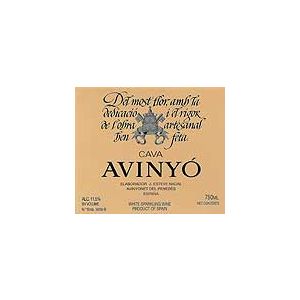
On the Avinyó label, there is an inscription in Catalan that aptly represents the philosophy of the Esteve Nadal family. The inscription roughly translates into the following: "From the must of the flower or free run juice and with the rigor of a work well crafted." This symbolizes the family's artisan values and the commitment to the ultimate quality of its wine. There also appears on the label a tiara from the church of the local village. Indeed, the Esteve Nadal family has crafted a jewel that many in the wine trade have rightly called "other worldly."

The masio or farmhouse that originally housed Avinyó's winery is also the workshop of Fina Via, the wife of Juan Esteve; her work is legendary in Catalonia. Her ceramic art appears throughout the region and each and every piece is done according to the same traditional methods that were used in Catalonia during the seventeenth century, Spain's Golden Age.

On the subject of Avinyó's beautiful wine, one well-known wine critic so appropriately stated. "How much more beautiful the world would be with a little more art, a little more love and a few more wines like Avinyó Cava." And indeed, we all owe a debt of gratitude to the Esteve Nadal family for doing its part to preserve the traditions of Catalonia, in both art and wine. And as one long-time member of our tasting panel once reminded us: "It is obvious that this family's pearls are not hidden, they shine forth in my glass."

Cava: Spanish Bubbly

It has been said that Cava is Spain's answer to Champagne. Others would argue that is more of a rebuke. However, Cava and Champagne have much in common, including their taste and method of production. Both are produced by the traditional champagne method of fermenting the wine in the bottle. More fine champagne method sparkling wine flows out of Spain's region of Catalonia than anywhere else on earth, including Champagne. And like Champagne, Cava is primarily a non-vintage wine that is made in a consistent distinct house style that does not vary. Moreover, the limestone hills beyond Barcelona provide the ideal soil condition, nearly identical to that of Champagne, for the cultivation of the native Xarelo-lo, Parellada, Viura, and Macabeo grapes for sparkling wine. With the addition of champagne yeasts during the fermentation, the high-acid musts of Catalonia yield sparkling wines of rich flavor, softness and finesse to rival those of Champagne itself. Where Cava may actually have the "edge" is in its soft, round, lingering finish – the antithesis of French Champagne which can often possess just a bit too much nerve and acidity in its aftertaste or finish.

Although Cava can be made in many areas of Spain, it is the Catalan versions from PenedÉs that have formed the bulwark of quality and captured the world's attention. Centered near the town of San Sadurni de Noya, 20 miles west of Barcelona, the production of Cava has taken the world by storm. In the past thirty years, the export of Cava has grown from a relative trickle to Spain's leading wine export; Cava is presently the world's number one selling champagne method sparkling wine.

Tasting Notes: Produced in the actual bottle in the same painstaking way as French Champagne, the Avinyó Brut is consistently Cava at its finest. A lovely pearl of a bubble beads to the top of the glass: soft scents of apple, pear, and fresh bread delight the nose. In the mouth, creamed fruit and the faintest hint of cinnamon caress the palate. Fun, flavorful and easy to drink, the Avinyó Brut remains one of the tasting panel's favorite sparkling wines. We are truly grateful to the Esteve Nadal family for producing such charming, well-balanced "Champagne" or should we say Cava, whose beguiling aftertaste lingers for nearly a minute. Exhibiting neither an acidic bite nor a flat, flabby finish, the Avinyó Cava will convert many a mind and palate to sparkling wine and make other so called connoisseurs wonder why they spend exorbitant sums on "luxury brands" of French Champagne. We suggest serving the Avinyó Brut chilled (about 40° F).

Accompaniments: It is nice to know some things don't change. Hors d'oeuvres, smoked salmon with capers and onions, and even that special someone remain some of our favorite accompaniments to the Avinyó Brut. And like all fine sparkling wines, less is usually more. Neither "heady" nor heavy fare accentuates the subtle delicacy of sparkling wine, especially Cava, so our preference is to consume the Avinyó Brut as an aperitif with family and friends. However, we also enjoy how it accompanies lightly grilled or sautÉed fish, and the fact that it will stand up to an herb-roasted chicken, with asparagus, attests to its subtle complexity. You may also want to try this delightful Cava with veal or turkey. And for those few diehards who still insist upon saving the bubbly for after dinner (not our recommendation), we propose serving the Avinyó Brut with fruit and cheese, rather than a sweet dessert. Enjoy!

Dominio Dostares Estay LÉon 2005 – Spain

Dominio Dostares (Doe-mean-yo Doe-star-ace) was founded in 2004 by the highly-respected Dominio de Tares (Doe-mean-yo Day-tar-ace) estate of Bierzo with the objective of reviving León's Prieto Picudo variety. Prieto Picudo (Pre-ate-o Pee-cue-doe) is a rare indigenous red variety that has been reduced to a few hundred acres of old vines, which in the hands of small local cooperatives were being used to make first-rate rosÉ, despite the vines' ancient age, high level of color, extract, and alcohol. Dominio de Tares acquired 75% of these great old Prieto Picudo vines, many in excess of 100 years of age, and began Dominio Dostares by applying production methods they had perfected in the Bierzo DO with that region's indigenous Mencia variety. The results have been nothing short of spectacular as Dominio Dostares has received tremendous accolades from critics and wine publications upon release of Estay and Cumal, its two old vine offerings of Prieto Picudo.

Domino Dostares introduced Estay and the estate's luxury brand of Prieto Picudo, Cumal, in 2007. While the two wines share many similar characteristics, Estay is presently the more accessible version of the indigenous Prieto Picudo variety. Cumal spends more time in oak and it reflects a more massive style of wine that will benefit from time in the bottle. Both wines are rare and unique. More importantly, they taste great.

Tasting Notes: The 2005 Dominio Dostares Estay is an excellent example of the rare indigenous grape variety by the name of Prieto Picudo. It's imbued with a deep, deep purple color and a knockout nose that one taster respectfully referred to as "both lush and mysterious." A totally captivating wine, the 2005 Estay is indeed unique, probably because old vine Prieto Picudo is unique. Moreover, there is nothing ordinary about Estay. She has the style and hedonistic appeal of a great Rhône wine, such as Châteauneuf-du-Pape. Yet, it is sleeker, softer, and more seductive. Pure September fruit, violets, and spice, and all things nice! How else does one tell someone about something for which there is no other frame of reference? Perhaps, the 2005 Estay can be best described in the words of one normally sedate tasting panel member, who after several minutes of tasting Estay looked up from his glass and uttered: "This wine is a seductress"! There it is. The 2005 Estay is the Mrs. Robinson of wine. For optimum enjoyment, phone a friend and enjoy this "mysterious" wine after a little aeration. Serve it between cellar and cool room temperature (55°-66°F).

Accompaniments: The 2005 Dominio Dostares Estay provides an exemplary partner for a host of simple and sophisticated dishes. The wine's full flavor and seamless structure make it easy to pair with nearly all types of meats. Tender young veal, grilled chicken, or even a juicy sirloin steak will complement Estay with aplomb. Serve the main dish with an artfully prepared orzo salad, with garbanzo beans, fresh tomatoes, red onion, and mint and you have a simple feast with which to accompany the flavorful 2005 Dominio Dostares Estay. A chicken and shrimp paella provides another lovely accompaniment, especially when just enough saffron is added for panache. In fact, almost any rice and bean dish, even moderately spicy black bean versions served with Cuban pork, will not overwhelm this unique wine. So whether you are planning a formal dinner party or an impromptu get together, the 2005 Estay is ready to please. Enjoy!

Celestin Blondeau Menetou-Salon 2005 – France

Celestin Blondeau is owned by the Fournier family, long time growers and producers of Sancerre. Like many of the better growers in Sancerre, the Fourniers have expanded their holdings to include Menetou-Salon because of the quality of the appellation's outstanding terroir and proven track record for fashioning exceptional Sauvignon Blanc. Begun in 1950 with just over 10 acres in Sancerre, the Fournier holdings have grown to more than 66 acres and now include prime vineyards in nearby Pouilly-FumÉ as well as Sancerre and Menetou-Salon. The emphasis is on quality and producing the area's finest Sauvignon Blanc.

Menetou-Salon

Menetou-Salon is an ancient vineyard area along the south bank of the upper reaches of the Loire River in central France. This small appellation of just over 1000 acres was once the personal vineyard of Jacques Coeur, the erudite 15th century banker, councilor and treasurer to King Charles VII of France. Since the 19th century Menetou-Salon has had its own syndicate, and more recently the appellation has expanded and undergone a renaissance in quality.

Today, Menetou-Salon is best known for its fragrant, sophisticated white wines, which resemble those of the nearby appellations of Sancerre and Pouilly-FumÉ. Sauvignon Blanc is the most important grape variety in the appellation. As an appellation Menetou-Salon encompasses ten tiny communes, including Menetou-Salon itself. The best vineyards sit upon a bed of limestone that dates to the Upper Jurassaic Period. This unique terroir is known as kimmeridgien.

Although most renowned for its white wines, Menetou-Salon devotes as much as 40% of its production to red wines, most notably Pinot Noir. Quality is uniformly high, due in no small part to the limestone rich soil of the region and a legion of dedicated growers and winemakers who insist upon pushing the envelope on quality.

Tasting Notes: A match for the best of Sancerre and Pouilly-FumÉ, the 2005 Blondeau Menetou-Salon sings a sensual, sophisticated ode to Sauvignon Blanc. The pleasure begins with the wine's sunny glow and continues through to a long satisfying finish. Moreover, in scent and savor the wine captures all the sensual, grassy, herbal goodness that Loire Valley Sauvignon Blanc is famous for. This Menetou-Salon has it all: a pinch of gooseberry, a slice of grapefruit, some melon, a touch of herb, fresh mown grass, and a dollop of quince – all of which are nicely integrated and imbued with a smooth, sophisticated feel. In short, one can find the best of Sauvignon Blanc in this very fine Menetou-Salon. We suggest giving this racy white wine a good chill (40°-45°) and then enjoying it with a few good friends.

Accompaniments: When confronted with soy sauce, wasabi, and ginger, most dry wines turn to water or worse – steel. However, the 2005 Celestin Blondeau Menetou-Salon is the perfect foil for such condiments, which makes it our first choice with sushi, California and Dragon Rolls, and other assorted Asian delicacies. Although some would say that summer and Sauvignon Blanc were made for each other, one can easily re-create the halcyon days of summer by the shore at any time of the year with some fresh seafood and a bottle of the 2005 Blondeau Menetou-Salon. Clams, crab, lobster, mussels, oysters, and shrimp, prepared just about anyway you can image; and thick filets of halibut or tuna, grilled to perfection over a charcoal fire, provide memorable accompaniments to the Celestin Blondeau Menetou-Salon. We have immensely enjoyed this wine, too, as an aperitif or as the opening act to a fine dinner with family and friends. SalutÉ!

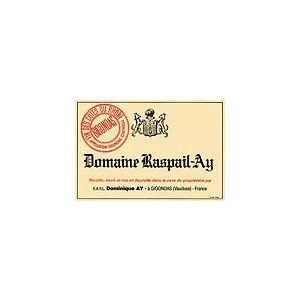
Domaine Raspail-Ay Gigondas 2004 – France

Domaine Raspail-Ay Gigondas 2004 – FranceDominique Ay, the affable but serious minded proprietor of Domaine Raspail-Ay, makes a warm, charming, seductive Gigondas at his 40 acre domaine. Located on the terraces of the rugged Gigondas appellation, the last outcropping of the mighty alpine chain with the imposing rock formation of the Dentelles de Montmirail looming as a backdrop, this classic southern Rhône estate makes only about 8,000 cases of a single wine – a superb Gigondas. Although rich and full-flavored, Dominique Ay's Gigondas is a more elegant and fruit driven style of wine than what many of his neighbors favor, and it is better for it.

The Gigondas of Domaine Raspail-Ay is an artful blend of 80% Grenache, 15% Syrah and 5% Mourvèdre that is always ripe, generous, and rich on the palate. One can always count on this estate to fashion a wine with a mouthful of ripe, dark fruits – black cherries, cassis, and raspberries – with notes of licorice and black pepper in the background. Curiously, the tannins of this domaine's ethereal Gigondas always appear ripe and supple, too, mellowed no doubt by a hiatus of 20 months or more in large, ancient oak foudres. In addition, Monsieur Ay ages his wine several more months in old demi-muids in his refreshingly cool chais. The result is a wine with ripe, dark fruit aromas and a supple, rich texture that belie its 14% plus alcohol content. Miraculously, the fruit lasts all the way from beginning to end, before exploding in a long, ripe, satisfying finish.

Gigondas: A Sleepy Little Town with a Big Beautiful Wine

Gigondas, along with the neighboring villages of Vacqueyras and Châteauneuf-du-Pape, produces the finest red wines of the southern Rhône. Relying upon old vines of Grenache, married to lesser quantities of Syrah, Mourvèdre, and Cinsault, Gigondas turns out a startling array of big, beautiful, tasty reds from nearly 2,500 acres of vineyards. Spanning a combination of soils, from the gravelly clay of the flat plains at the base of the craggy Dentelles de Montmirail, to the sheer bedrock of the Dentelles themselves, Gigondas is testament to the belief that in this enchanted corner of Provence one can even extract blood from stones, in the form of deeply colored Gigondas.

Originally the premier village in the sprawling Côtes du Rhône-Villages appellation, Gigondas was elevated to its own appellation in 1971. Quickly, Gigondas made a name for itself; and after several decades of notoriety the wine that bears the name of Gigondas has taken the world of wine by storm. Yet, the village of Gigondas itself remains one of the prettiest and least spoiled of the comely hilltop villages in this corner of Provence known as the Vaucluse. Nevertheless, Gigondas is a wine that has captured the palate of critics and savvy consumers alike. Today, the wines of Gigondas are highly sought after in fine wine shops around the world and they are increasingly well represented at upscale restaurants, whose clientele can appreciate the bold, extroverted, savory nature of this appellation's red wine. For the record, tiny quantities if white and rosÉ wine are also made in Gigondas, but only the red wine of this endearing appellation is entitled to the name Gigondas.

Tasting Notes: The 2004 Domaine Raspail-Ay Gigondas is another unequivocal success from one of the appellation's finest and most consistent producers. Once again, Dominque Ay has fashioned a sexy, seductive Gigondas that is both elegant and powerful. While most domaine bottled Gigondas can muster plenty of alcohol and brawn, they often fall short on charm, but not so with Dominque Ay's wines. Not only will his lovely 2004 Gigondas ward off the chill of a cold winter night, it will dazzle the senses with its heavenly scent: a combination of black fruits, roses and violets, pepper and spice. The 2004 Domaine Raspail-Ay Gigondas is warm and generous on the palate, yet caressing and smooth right through to the finish. What Dominique Ay does so very well is capture in every glass of his Gigondas the glory and vibrancy of the Provençal landscape – the glorious sun, the pulsating sky, and the freshness of the evening breeze as it carries the singing voices of a chorus of cicadas. And as one would expect, Domaine Raspail's 2004 Gigondas offers up plenty of flavors to savor, too, including black fruits, oriental spice, and more, all if which are set in a silky smooth body and a sea of soft tannin. Moreover, the medium to full-bodied 2004 Raspail-Ay Gigondas is already a pleasure to drink. It will, however, continue to develop in the bottle for several more years. Allow this hedonistic Gigondas a few minutes of aeration before serving, and then put on a fire, take off your shoes, and relax with a glass in hand. Enjoy this charming wine at cool room temperature (60°-66° F), alone or better still with a friend. SantÉ!

Accompaniments: The fine red wines of the southern Rhône and especially the 2004 Domaine Raspail-Ay provide superb accompaniments to grilled meats, especially lamb and chicken that are flavored with rosemary, garlic and black pepper. With such a glorious combination of food and wine, we guarantee you will soon be picturing the rocky terrain of the "garrigue" of the southern Rhône, inhaling the scents of rosemary, lavender, and wild flowers that infuse the summer air, and feeling the refreshing shade of a hot summer's day – Provence in a glass. What more can one ask? If you can't make a trip to the south of France, a glass of this Gigondas is most assuredly the next best thing. However, with all this talk about Provence, let us not forget the surfeit of culinary delights that await the intrepid gastronome, dishes like Ravioli Stuffed Lobster, Roast Quail, and sumptuous Ratatouilles. Traditional Italian favorites, such as Lasagna, Manicotti, and almost anything else with fresh tomato sauce, garlic, or olive oil, marry well with Dominique Ay's superb Gigondas as well, so set the table and let the good times roll. Enjoy!

Laurent-Perrier L-P Brut Champagne – France

Editor's Note: Champagne is a wine that is under pressure. It should always be well chilled before opening. Always exercise caution when opening a bottle of sparkling wine. Point the bottle away from people and objects. Use a clean towel or clothe to firmly grip the bottle. Gently remove the wire stopper while firmly holding the cork in place. Then with thumb and forefinger, remove the cork slowly from the bottle. Do not let the cork fly. Enjoy!

Laurent-Perrier is one of the top ten Champagne houses. Founded in the picturesque village of Tours-sur-Marne in 1812 by Alphonse Pierlot, a former cooper and bottler of Champagne, the house quickly gained recognition for outstanding quality and innovation. Moreover, all of Tours-sur-Marne's Champagne vineyards are classified as Grand Cru. Bequeathed upon Pierlot's death to his longtime cellar master Eugène Laurent and Laurent's wife Mathilde-Emilie Perrier, the Champagne house of Laurent-Perrier acquired its present name and garnered international acclaim, along with many famous clients.

Upon the death of Mathilde-Emilie Perrier in 1925, Laurent-Perrier was purchased by Marie-Louise Lanson de Nonancourt, who saved the house from extinction during World War II by hiding 10,000 cases of Laurent-Perrier Champagne behind a false wall, while her two sons were fighting the Nazis under Generals De Gaulle and Leclerc. Sadly, only Bernard de Nonancourt survived the war. His older brother Maurice died in a Nazi concentration camp.

Bernard de Nonancourt assumed control of Laurent-Perrier in 1949 and remains to this day the Director of the house. Under his passionate leadership Laurent-Perrier has thrived. Moreover, Laurent Perrier remains one of the few remaining independent and family owned and run Champagne houses among the major producers. However, Bernard's philosophy, which is roughly translated as "The quality of the wines is equal to the quality of the people" sheds some light upon his achievement and the success of Laurent-Perrier. Unlike many other sons and daughters of Champagne producers, Bernard worked in every facet of the Champagne business for neighboring houses to gain experience and understanding, before assuming control of Laurent-Perrier. He is assisted by his perfectionist cellar master Alain Terrier, who has helped him guide the firm since 1975.

The flagship wine of Laurent-Perrier is the house non-vintage Brut Champagne, referred to simply as L-P. A blend of Chardonnay, Pinot Noir, and Pinot Meunier from several vintages and up to 55 different crus, L-P is one of the world's preeminent non-vintage Champagnes. Laurent-Perrier, also, fashions Ultra Brut, a non-vintage Brut without any dosage; Demi-Sec; Vintage Brut; RosÉ Brut; Alexandra RosÉ, a special vintage rosÉ Champagne first released in 1987 to celebrate the marriage of Bernard de Nonancourt's eldest daughter Alexandra; and Grand Siècle, the firm's exquisite luxury brand of Champagne that is second to none.

Since 1996, Laurent-Perrier has been the official Champagne of The Motion Picture Academy of Arts and Sciences and it is the only Champagne served at the Oscars. Laurent-Perrier is, also, a partner with the prestigious Relais et Châteaux group, an organization of many of the finest independently owned restaurants and inns around the world – all renowned for their outstanding cuisine and service. Cheers!

Champagne: More Than a Wine

Champagne is an ancient province of France, a pastoral land of meadows and streams and most importantly chalk hills upon which some of the world's choicest grapes are grown. Champagne's boundaries are delimited by law and its wines strictly regulated by the laws of Appellation ContrôlÉe as to permitted grape varieties (Chardonnay, Pinot Noir, and Pinot Meunier), yield, production, and quality. Yet, Champagne is more than a place; it is also a wine. In fact, Champagne is several different wines – only the most recognizable of which is white and bubbly.

Although Champagne can be still or sparkling, white or red, and even rosÉ, the wine the world has come to know as Champagne is always sparkling. So synonymous now is the name Champagne with sparkling wine that the nomenclature has been applied generically and indiscriminately to any wine that bubbles, much to the regret of the Champagne producers themselves. Authentic Champagne comes only from the Champagne district of France and meets all the approved legal requirements and standards of production, including absolute adherence to the painstaking Methode Champenoise, which requires that secondary fermentation take place in the bottle for sparkling Champagne.

Since the 17th century several historical personages have contributed to the development of Champagne. However, none is more renowned than Dom Perignon, the legendary blind monk and cellar master of the Champagne Abbey of Hautviller. Although Dom Perignon is often credited with the development of sparkling Champagne itself, the truth is he probably learned the rudimentary technique in southern France from the Benedictine monks at the Abbey at St. Hilaire. However, Dom Perignon was renowned as a master blender and he is credited with capturing the bubbling magic of Champagne by his introduction of wire wrapped cork stoppers and heavier, specially made bottles that contained the pressure of Champagne. Until his improvements were instituted, sparkling Champagne was known as vin diable (the devil's wine) because of its propensity for exploding its container – a potentially lethal proposition that surely rendered more than one monk blind. Moët Chandon's luxury brand of Champagne, Dom Perignon, is named in honor of the legendary monk.

Thanks to centuries of improvements and some of the first true brand name marketing, Champagne enjoys today a special place in western culture. Champagne has been called the "Belle of the Ball," and it has come to symbolize conviviality, hope, and all that is good in life and love. What would a wedding or any other festivity be without Champagne? But why wait for an occasion? Champagne is the perfect way to start an evening, so what are you waiting for? Pop the cork and join in the fun!

Tasting Notes: A soft, gentle, fulfilling Champagne, the non-vintage Laurent-Perrier L-P Brut is justly renowned for it elegance as well as its flavor. Wearing an authentic champagne colored robe and exhibiting a very tiny, delicate perle or bubble, the L-P Brut appears as the epitome of elegance and sophistication. But wait, the best is yet to come! L-P's aroma carries the seductive scents of white fruits and freshly baked bread. And on the palate, L-P really works its magic. It is fresh, round and supple, offering up a multitude of delicate flavors and a creamy texture to tantalize the senses. Never biting or acidic, Laurent-Perrier's L-P Brut finishes round and lovely with a sensual wave. Enjoy this premium Champagne moderately chilled (40°-50° F).

Accompaniments: Given the finesse and balance of Laurent-Perrier's L-P Brut, it offers to all those who are fortunate enough to partake a remarkable aperitif. Some might even say it constitutes the perfect aperitif, and we could only nod our heads in agreement. Alone, L-P shines as the entrÉe to a great evening or festivity. However, it would be a shame to relegate Laurent Perrier's flagship wine to a singular role. Consequently, we suggest you, also, serve the convivial L-P with food, especially fish and delicately seasoned shellfish, or even poultry. Salmon mousse offers an exquisite accompaniment to L-P as does poached or grilled sole, flounder, or trout. Cheese based canapÉs offer other glorious choices. Meanwhile, poultry is a particular favorite with L-P Brut at Laurent-Perrier, so may we suggest Suprême de Volailles aux Champignons (Chicken Breasts with Mushrooms and Cream) or other favorite poultry recipe. SalutÉ!

Fattoria Montellori Salamartano 2001 – Italy

A couple of years ago, we discovered Fattoria Montellori and the estate's enthusiastic, serious-minded proprietor Alessandro Nieri. Shortly afterwards, we met Dr. Marco Razzauti, Montellori's exuberant 30 year old viticulturist and oenologist, and it quickly became clear to us just how committed this estate is to making world class Chianti and Super Tuscan reds. What is happening at Montellori is nothing short of enthralling. And instead of smoke and mirrors leading the way, as is sometimes the case in the world of wine, it is a solemn revitalization of the estate's vineyards and a complete dedication to natural, sustainable agronomy that has pushed the quality quotient at Montellori to ever higher levels. This estate's total makeover is due to the vast improvements in viticultural practices that Dr. Razzauti instituted several years ago, and Montellori's decision to limit production. Needless to say, the results speak volumes, loudly and clearly.

Fattoria Montellori is located off the beaten track, away from the glitz and glamour of the well-worn wine road that winds its way from Florence to Siena. Instead, Montellori is tucked away in the Montalbano zone of Chianti to the west of Florence, near the stately Tuscan town of San Miniato. San Miniato is renowned for its wealth of beautifully preserved Romanesque and Renaissance churches, which thrust their many spires skyward. This pretty town is equally celebrated for its savory truffles and heavenly wines. The latter treasures constitute some of Tuscany's most hedonistic pleasures.

Thanks to the foresight of Alessandro Nieri's father Giuseppe, Fattoria Montellori owns six distinct vineyards, all of which possess a unique soil, microclimate, exposure, and altitude. Red wine is king at Montellori, as it is throughout Tuscany. Not surprisingly, Chianti is the estate's most important wine, at least in terms of production. And what a Chianti it is! However, in recent years, Montellori has fashioned three outstanding Super Tuscan offerings: Moro, Dicatum, and Salamartano. Moro is a single vineyard offering that is closest to Chianti in style. It is a blend of primarily Sangiovese to which small amounts of Cabernet Sauvignon and Malvasia Nera are added. Meanwhile, Dicatum is the most traditional of this estate's offerings. It is 100% Sangiovese from the hillside vineyard Cerreto Guidi, the last vineyard that Giuseppe Nieri personally planted. Salamartano on the other hand is a classic Bordeaux blend of Cabernet Sauvignon and Merlot that has been aged in small barriques. It is Montellori's most expensive and age worthy wine. In addition, Alessandro Nieri and Marco Razzauti craft several excellent white wines, including Mandorlo, an artful non-traditional blend of Chardonnay, Viognier, Marsanne, Roussanne, and Clairette.

Tasting Notes: The 2001 Montellori Salamartano is a titan of a wine that captures all the glory of Cabernet Sauvignon and Merlot as well as the scintillating Tuscan landscape. Named for the ancient room (Salamartanto) in which Etruscan warriors from rival villages were locked to fight for their respective clans, Montellori's 2001 Salamartano possesses a rich Bordeaux style robe, an aromatic bouquet, complex, nuanced flavors, and plenty of strength and vigor. With six years of ageing under its belt, the Cabernet and Merlot in this Salamartano have come to magnificent terms. Blueberry and cassis scents and savors fold deftly into muted complex earth tones, and a long, textured mid palate unfolds for hours to reveal the hidden secrets of this wine's soul. However, if you want to capture all that this magnificent Super Tuscan has to offer, we strongly suggest you allow the 2001 Salamartano ample time to collect itself by airing in a decanter for at least an hour before serving. You will be glad you did. The patient will inherit the rich center, silky texture, and explosive finish of Salamartano. We also recommend consuming this splendid Super Tuscan at no more than 60° F-66° F.

Accompaniments: Although we have thoroughly enjoyed the 2001 Fattoria Montellori Salamartano on its own, we heartily recommend serving it with food, especially grilled meats and vegetable ragouts. Certainly, Salamartano offers the perfect excuse to run to the kitchen and re-create the delights of the Tuscan table. Some irresistible Tuscan classics to consider with this wine include a myriad of thinly slices smoked meats; white bean dishes, served with flat Tuscan onion bread and a few slices of hard cheese; and herb roasted chicken or pheasant, stuffed with braised vegetables, porcini mushrooms and a hint of truffle. Duck, game hens, and most especially Florentine Steak offer other memorable choices that will showcase the complexity and strength of this remarkable wine. Our only caveat would be to avoid heavy tomatoes sauces with this wine as they can sometimes dim the complexity and dull the luster of the finest Tuscan reds. Buon Appetito!


logo for wine club
Since 1994
Home
Join Our Wine Club
Gift Memberships

Membership Renewals
Reorder Your Favorites
Wine of the Month Club
More Information
Current Selections
Past Selections
Testimonials
Other Gourmet Gifts
Corporate Gifts
Wedding Gift Ideas
All About Wine
Website Tools
Who We Are
Contact Us

1 - 800 - 625 - 8238
(Outside US call: 949-206-1904)
P.O. Box 1627, Lake Forest, CA 92609