Vol. 9 No. 4
Premier Series |
|
Featured Wineries & Wines |
Membership Type |
| Zantho St. Laurent | 1 Red 1 White; 2 Reds |
| Domaine de la Collonge Pouilly-Fuisse | 1 Red 1 White; 2 Whites |
| Macaw Creek Preservative Free Shiraz | 2 Reds |
| Lorinon Rioja Blanco | 2 Whites |
Master Series |
|
Featured Wineries & Wines |
Membership Type |
| Valenciso Rioja Reserva | 1 Red 1 White; 2 Reds |
| Domaine de la Collonge Pouilly-Fuisse | 1 Red 1 White |
| Zantho St. Laurent | 2 Reds |
Collector Series
|
|
Featured Wineries & Wines
|
Membership Type
|
| Valenciso Rioja Reserva | 1 Red 1 White; 2 Reds |
| Ca dei Frati Brolettino Lugana | 1 Red 1 White |
| Domaine Alfred Pinot Noir | 2 Reds |
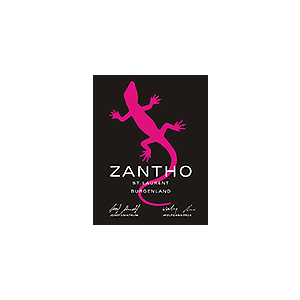
Zantho Burgenland St. Laurent 2004 – Austria
“Now here’s a wine I bet you’ve never had,” stated the smiling face that offered the tasting panel our first glass of wine with a lizard on the label. Frankly, some of us were a bit skeptical. Not only had most of the panel never tasted a St. Laurent wine and with good reason: it accounts for less than 1% of Austria’s wine production, but then there was the unexplainable lizard on the label. At a time like this, the panel’s mantra: You can’t drink a label or a price tag surely comes into play, so we sniffed and sniffed again…. and well, the next thing we knew the bottle was gone – a very good sign. It just goes to show you: one should never drink a label or a price tag. You never know what is in the bottle until you try it. Appearances are, indeed, deceiving. Besides, we actually think the label is both intriguing and attractive, and the story behind it even more interesting. So, let’s go onto the story behind the label.
Zantho is a relatively new venture that stars Josef Umathum, Austria’s undisputed master of the rare but difficult to grow St. Laurent varietal, and his equally astute partner in wine Wolfang Peck. Both men are regarded as two of Burgenland’s finest winemakers and they have begun Zantho in conjunction with the Andau winegrower’s cooperative. They founded Zantho in 2001, naming their enterprise after a rare genus of woodland lizard. Yet, what is even scarcer than the Zantho lizard is the delicious St. Laurent varietal these two gentlemen produce and aim to promote domestically and internationally through the Zantho label.
St. Laurent is considered an indigenous Austrian grape variety even though it is likely a distant relative to Pinot Noir of Burgundy fame and fortune. Interestingly, Umathum’s single vineyard St. Laurent, which hails from his own 45 acre estate, has been compared to Chambertin, the great red Burgundy that remains one of France’s greatest viticultural legacies. However, most St. Laurent does not reach this pinnacle of quality because it is so difficult to grow successfully and it requires special attention in the winery – something Umathum and Peck know more than a little something about. Enter Zantho to introduce to us how wonderful and interesting one of the world’s least known premium varietals can be.
Tasting Notes: Reminiscent of an outstanding Grand Cru Morgon or a serious village Burgundy, the 2004 Zantho St. Laurent is a crowd pleasing kind of wine. Its ruby red robe and fruit driven nose are complemented by a smooth rich palate that speaks of subtle spice and hints at the wine’s long beautifully balanced finish. And in the end, it is the Zantho’s individuality and gentle minerality that shine through. These traits come from northern Burgenland’s gravelly soil and unique climate and they are part of what vine growers generally refer to as terroir. Fortunately, Zantho’s pretty St. Laurent contains plenty of terroir to complement its charming round fruit. Each attribute adds to the wine’s considerable personality and makes it just plain easy and fun to drink from the moment it is opened. We suggest you enjoy the Zantho St. Laurent from the outstanding 2004 vintage between cool room temperature and cellar temperature (56º - 66º F). Prost!
Accompaniments: The 2004 Zantho St. Laurent is perfectly at home with bistro food as well as a whole assortment of Mediterranean fare. Austria’s Burgenland is surprisingly warm and its climate bears more resemblance to that of Italy than it does the rest of Austria. Correspondingly, it should then come as no surprise that pastas and pizzas and more authentic regional Italian cooking provide a great resource for Zantho’s St. Laurent. Hence, we highly recommend it with just about any dish made with a genuine Alfredo sauce. It also complements most white fish that are prepared in the Livornese style with black olives, capers, herbs, and fresh tomato sauce. Salmon and tuna bring a whole host of other fine choices to accompany the Zantho as well. Atlantic Salmon with an herbed sauce and cucumbers or a charcoal grilled Pacific Swordfish over a bed of lentils in a light balsamic vinaigrette brings new meaning to red wine with fish. And certainly, dumplings, schnitzels, and other dishes that are commonly thought of as typical of Austrian cooking offer superb companionship to Zantho’s 2004 St. Laurent, too. And if it’s simply a burger or barbecue night, Zantho’s St. Laurent can surely add some panache to an otherwise mundane meal.
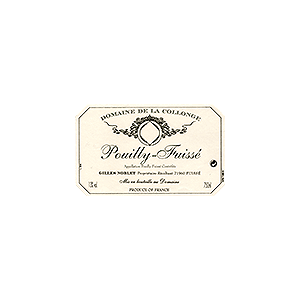
Domaine de la Collonge Pouilly-Fuissé 2004 – France
Editor’s Note: Since our inception, Domaine de la Collonge Pouilly-Fuissé has been one of only a hand full of white wines that we have featured more than once in the past five years, and that is on account of the accolades we have received from our vociferous membership. First and foremost, members have raved about Gilles Noblet’s exquisite Pouilly-Fuissé and asked for it repeatedly. Not surprisingly, Noblet’s Pouilly-Fuissé is one of the most consistently fine wines made in the Pouilly-Fuissé appellation. Moreover, Noblet’s 2004 rendition is a veritable masterpiece; it may even be Gilles Noblet’s finest estate bottling of Pouilly-Fuissé to date. Enjoy!
Gilles Noblet’s Domaine de la Collonge is a small family owned and run domain of only 22 acres. Gilles is the fourth generation member of his family to make wine at this prized property. For the record, Gilles’ wife, also, comes from a renowned winemaking family. Madame Noblet is the sister of Jacky Janodet, the present dean of Grand Cru Beaujolais, so wine and winemaking run deep in the heart and soul of this estate as well as in the terroir of Domaine de la Collonge’s well-tended vineyards.
The name Domaine de la Collonge derives from the sector or area (known as an aire) of the Fuissé commune that is called Collonge. Most of Gilles Noblet’s estate is spread along the hills of la Collonge, which yield on average only a little more than six thousand cases of Pouilly-Fuissé each year. However, Monsieur Noblet also fashions small quantities of Macon- Fuissé, Pouilly-Loché, and St. Véran – all elegant Chardonnay based wines similar to Pouilly-Fuissé – which emanate from neighboring appellations just outside the boundary of Pouilly-Fuissé.
Although not certified organic, Domaine Gilles Noblet practices sustainable agriculture and uses non-interventionist methods almost exclusively. No artificial fertilizers or insecticides are employed, and only natural yeast is used in fermentation. Moreover, the average age of the vines at Domaine de la Collonge averages more than forty years of age, while many vines are considerably older. These old vines and reduced yields result in wines that are more generous and concentrated than the average Pouilly-Fuissé – a wine as well as an appellation that is notorious for more than its share of pleasant but uninspiring offerings due to overproduction.
In an appellation that turns out large quantities of wine, Gilles Noblet decided a long time ago to dance to a different beat. Rather, the Domaine de la Collonge style of Pouilly-Fuissé is one of concentration, purity, and the honest expression of the appellation’s terroir. Noblet’s Pouilly-Fuissé features a real balance between flesh and bone or fruit and minerality, if you will. In addition, Noblet uses traditional wooden foudres (large wooden tanks) with temperature control elements for fermentation to insure texture and a gentle roundness in his wine. He also ages his wine in a combination of foudres and small oak barriques, only 20% or less are new each year. The limited use of new oak is practiced expressly, so that the oak barrels impart roundness and texture to the wine without an overwhelming taste of oak that would destroy the natural delicacy of Pouilly-Fuissé. In essence, this is classic white Burgundy as well as outstanding Pouilly-Fuissé.
Tasting Notes: A bright sunny elixir with golden highlights, the 2004 Domaine de la Collonge Pouilly-Fuissé dazzles and shimmers like the noonday sun. With every glance and sip of this fulfilling wine, one sees and tastes the golden clusters of Chardonnay grapes that mature gently and slowly under the Maconnais sun. What's more, the 2004 Domaine de la Collonge Pouilly-Fuissé exhibits Noblet’s telltale ripe, round, seductive signature, a profile that appears to grow more scintillating with each successive vintage. On the nose, this lovely Pouilly-Fuissé offers up plenty of heavenly scents to recall the first blooms of spring, soft breezes, and the beckoning of freshly baked bread. Besides, Noblet’s 2004 Pouilly-Fuissé possesses pinpoint purity and elegant minerality, all of which add to its overt charm. On the palate, the 2004 Domaine de la Collonge follows through with a truly beguiling array of flavors: rich, apple fruit and an ethereal creaminess that capture the very essence of the Chardonnay grape. Moreover, Gilles Noblet’s noble Pouilly-Fuissé possesses plenty of breed and charm along with flavor and nuance. In Noblet’s Pouilly-Fuissé, all is revealed with a little patience, so we suggest you stop to smell and taste the goodness of this kindly wine, before you gulp it. And like most fine Pouilly-Fuissé, the 2004 Domaine de la Collonge is initially best served well chilled (40° F) and then allowed to evolve slowly in the glass as it warms. Salut!
Accompaniments: The 2004 Domaine de la Collonge Pouilly-Fuissé is an easy wine to enjoy au naturel, without a morsel of food to accompany it. It is, also one of the easiest white wines to pair with food because it provides understated elegance to complement a wide variety of foods, especially fish and other fine fruits de mer. Scallop and crab dishes constitute some of our favorite offerings to accompany the Domaine de la Collonge Pouilly-Fuissé. Scallops and pistachio nuts, sautéed in a light cream sauce, is a perennial favorite. A simple crab cocktail or dip offers another memorable pairing to Gilles Noblet’s elegant Pouilly-Fuissé. Flounder, stuffed with crabmeat, makes a wonderful partner, too. In fact, sole, sea bass, and grouper, prepared a myriad of ways, offer many fine choices with this wine. And for those not beholden to seafood, roast chicken, light pastas, and healthy salads present other excellent alternatives. Short of great French Champagne, we cannot think of a better way to kick off a relaxing evening or a pleasant interlude, free from the weather stained cares of life, than with a bottle of the 2004 Domaine de la Collonge Pouilly-Fuissé. Consequently, we suggest you keep on hand at least a few bottles of this delightful wine to wash away those cares.
Macaw Creek Yoolang Preservative Free Shiraz 2003 – Australia
Macaw Creek is located in the picturesque Gilbert Valley of South Australia. South Australia’s earliest settlers named the area where the winery stands Macaw Creek for the colorful native parrots they mistakenly thought to be Macaws. Among the first free settlers to South Australia in the early 19th century were the pioneering ancestors of Rod Hooper, the present owner and winemaker extraordinaire of Macaw Creek.
One could easily miss the turn off down the dirt lane to Rod Hooper’s charming 19th century winery, with the undistinguishable look of the Wild West about it. However, once you finally find the low stone structure that constitutes Macaw Creek, a tiny, neatly kept winery, replete with an attached storage shed and a cozy antique tasting room, which is normally aglow with a fire in winter months to ward off the chill of the clear cold mistral-like wind that scours the sweeping expanse of the Gilbert Valley, you know you have come to the right place. This is Macaw Creek Winery, and Rod’s home.
Rod Hooper is more or less a one-man show at Macaw Creek. Nearly single handedly, he has resurrected the family homestead and winery and become the voice for the burgeoning number of wine growers and fledgling wineries popping up astride the low South Australia hills of the Gilbert Valley, about an hour an half north of Adelaide. He is a pioneer, much as his ancestors were more than a century and half ago. Rod is, also, a professor of oenology and one of Australia’s most sought after consultant winemakers. Not surprisingly, his specialties are Shiraz, Grenache, and Cabernet Sauvignon, and you will soon discover why.
Tasting Notes: Lush, plush, and ever so easy to drink the 2003 Macaw Creek Yoolang Preservative Free Shiraz is as wonderful as it is rare. How difficult is it to make a clean delicious entirely preservative free, no sulfite wine any where in the world? Very difficult! However, such an undertaking in Australia, where extremely high summer and harvest time temperatures typically result in low natural acidity levels, is even more death defying. In fact, at most wineries hot weather and low acidity levels translate into additional inoculations with sulfites and or other preservatives, but not at Rod Hooper’s Macaw Creek. Taste and see! The Yoolang Preservative Free Shiraz is regally robed and bursting with intense blackberry fruit, with hints of vanilla bean and mocha thrown in. A balanced underpinning of gentle ripe tannins simply add to the drinking pleasure of this wine and make it easy to see how the Yoolang’s natural scents, savors, and structure underscore its kid glove treatment. Enjoy this rare wine cool (60-66 degrees Fahrenheit) after just a few minutes of aeration. However, you need not be in a hurry, the Yoolang Shiraz will continue to improve naturally in bottle for at least a couple of more years
Accompaniments: All of Rod Hooper’s red wines seem to exhibit an extroverted, friendly, pure, up front appeal that has become over the years Macaw Creek’s calling card, but the 2003 Yoolang Preservative Free Shiraz may actually have all the others beat. Such a gregarious wine as this deserves many unpretentious like-minded companions. Consequently, simple foods with bold flavors, such as grilled lamb or sausage, a three meat meatloaf, homemade pasta with a fresh savory plum tomato marinara, grilled eggplant with buffalo Mozzarella and fresh picked herbs, all constitute some of our favorite picks with Macaw Creek’s 2003 Preservative Free Shiraz. Chevre, Mahon, Manchego, and many other fine gourmet cheeses provide beautiful accompaniments to Rod Hooper’s natural easy drinking Shiraz as well. Enjoy!
Bodegas Breton Loriñon Rioja Blanco 2004 – Spain
Bodegas Breton is a small world-renowned estate in the Rioja Alta, the most beautiful and prestigious of Rioja’s wine regions. Founded in 1983, Bodegas Breton is a partnership that includes the famous 100-acre Viña Loriñon property, which lies at the heart of the Rioja along the south bank of the Ebro River, just outside the city of Logrono. Bodegas Breton also includes the legendary Dominio de Conté site, whose average vineyard age is the oldest in the Rioja. Both Breton vineyards specialize in the cultivation of the indigenous Rioja varietals: Tempranillo, Mazuelo, Graciano, and Garnacha for the estate’s red Rioja and Viura and Malvasia for the estate’s white wines. Here, winemaking for both red and white wines is very much in the traditional Rioja style – only Spanish grape varieties are utilized and the emphasis is on Crianza and Reserva style wines (meaning extended barrel aging and pronounced wood flavors) that have come to define not only Breton’s own traditional bent but Rioja’s distinctive flavor profile as well.
Tasting Notes: Given the American association of Rioja with red wines, it may come as a shock, at least to some, that Rioja is both a red and a white wine as are Bordeaux and Burgundy. However, the production of distinctive traditional white wines runs as deep in Rioja as any world-class appellation. The 2004 Bodegas Breton Loriñon Rioja Blanco is an exceptional white Rioja that marries the best of the traditional style of the Rioja to the freshness of modern equipment and contemporary taste. Barrel fermented and produced from 100% Viura grapes, the 2004 Loriñon Blanco is redolent with the scent of spring flowers, vanilla, and fresh picked apples. Long and textured on the palate, this young white Rioja offers up plenty of fruit driven charm to complement its plush oak and balanced tannic under girding. Moreover, the 2004 Loriñon Blanco finishes pleasantly dry and noble, with nary an edge. Although striking in its youth, the excellent 2004 Loriñon Blanco can age another five years or more during which it will develop additional character and, perhaps, even acquire a whole other dimension to its flavor profile. We suggest serving this delicious white Rioja between 40°-45° F when young and considerably less chilled after several additional years of bottle age.
Accompaniments: Tapas, Spain’s hearty appetizers, provide all the reason one needs to open a bottle of the 2004 Loriñon Rioja Blanco. Well-made traditional white Rioja can more than stand up to smoked fish, cured meats, and olive oil and herb infused starters. However, white fish and the more refined delicacies that inhabit the sea also get our nod with the Loriñon Blanco. Broiled or sautéed sea scallops and salmon, prepared just about any which way, are two of our perennial seafood favorites. Light meats in cream based sauces fare well with this wine, too. Also, whether it is from the cow, ewe, or goat, cheese makes a splendid companion to Loriñon’s first rate white Rioja. Indeed, what makes this white Rioja so interesting is its ability as well as its versatility, so enjoy!
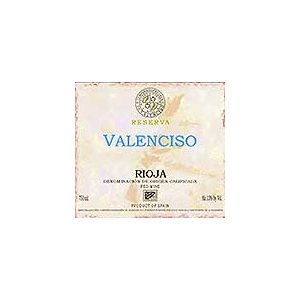
Valenciso Rioja Reserva 2001 – Spain
The Compania Bodeguera de Valenciso was born when Luis Valentin and Carmen Enciso left their respective positions at one of Rioja’s oldest and most prestigious bodegas. Together they shared a vision of creating their own cellar, replete with only the finest and most seductive of Rioja wines. Their dream has come to life in the outstanding offerings that now flow harmoniously and joyfully from their bodega to our glasses.
The secret to the nearly instantaneous success of Valenciso is the criteria Luis and Carmen apply to their wines. All of Valenciso’s wines are made in small lots or cuvees. Each relies upon the greatness of old vine Tempranillo, the grape varietal that steals the heart and defines the soul of Rioja. Yields in the vineyard are kept draconically small in order to fashion wines of finesse, flavor, and symphonic harmony. In addition, only small barriques are used for aging, a third of which are renewed annually. French oak predominates and all of it is of cork “flor” quality, the highest level possible. Yet, without expert winemaking, all of these measures would be of marginal value at best. With the glorious 2001 vintage in Rioja and all other bases covered, Luis and Carmen have come to realize their dream. Taste and see.
La Rioja: A Special WineLike most of the great viticultural regions of Europe, the face of modern Rioja was cast during the 19th century. With the hope of escaping the dreaded phylloxera, the deadly vine louse in Bordeaux, many successful Bordeaux growers began moving south across the Pyrenees to La Rioja in the 1870's. With them flowed the capital and the expertise to enrich and improve the already splendid wines of La Rioja. They instituted extended barrel ageing, which remains the signature of fine Rioja wines. Even today, modern Rioja spends more time in small oak barrels than almost any other contemporary wine. And, like Bordeaux, the wine of La Rioja is a blend of up to four premium grapes: Tempranillo, Mazuelo, Graciano, and Grenache. Tempranillo is, however, the primary player. Nonetheless, this unique blend of grapes, coupled with a long lavish hiatus in small oak barrels called barriques, produces a warm, very dry, but richly fruity wine of great finesse and perfume that in great vintages such as 2001 can be nearly immortal.
Tasting Notes: The Valenciso Rioja 2001 Reserva sings a glorious song. Imitative of the finest choral ensembles, a glass of Valenciso Rioja Reserva 2001 resonates with perfectly harmonious notes. The nose of this beautifully balanced Rioja releases aromas of earth and dark fruits; blackberry comes to mind, and astride this fruity richness wafts the scent of a fine woodworking shop. On the palate, the Valenciso distinguishes itself by a lush overt fruit flavor that is perfectly pitched, yet long and ever evolving. A pleasing smokiness, even a faint hint of tobacco, mixes beneath the distinct, hedonistic fruit. Complexity and interest derive from an evident and appropriate spiciness sprinkled with cinnamon and pepper. As the wine moves across the mouth, a formidable structure wells up to support the opening notes. Yet, the tannic element introduces itself with a velvety smooth entrance that swells the bass line and never overwhelms. Here the wine hits the perfect note. The wine and flavor remain full on the mouth and ever so gracefully depart with a creamy, satisfying finish. An aftertaste laden with familiar spices forms a perfect coda to one’s first sip. Fortunately, a first sip can be reprised, so revel in the concert offered by the Valenciso Rioja 2001 Reserva. We suggest serving this lovely Rioja Reserva at cool room temperature, after a half hour or more of aeration.
Accompaniments: Since the Valenciso Rioja 2001 Reserva is such a finely wrought Rioja, duty requires us to pay homage to the straight forward, earthy, and satisfying fare typical of the Ebro River region of Spain. One will never go astray with an appetizer of wild mushrooms sautéed in olive oil and garlic followed by an entrée of grilled lamb chops. Yet, we also recommend a stew a la riojana. Although the availability of small game in the Rioja suggests roasted quail, the accompanying stew recipe substitutes chicken while incorporating traditional white beans, chorizo sausage, peppers, and tomatoes. Adding Spanish paprika to our recipe adds a smoky note to the stew that marries well with the voluptuousness of the Valenciso. Serve with a simple, fresh green salad and a fresh loaf of crusty bread and allow the distinct flavors of the stew to carry on a sensuous duet with the Valenciso Rioja 2001 Reserva. If by chance a quick meal, a comfortable chair by the fire, and a great book are simultaneously calling your name, simply fry an egg with some chorizo in olive oil or whip together a potato, garlic, and onion omelet and lose your senses in an astounding glass of Valenciso Reserva. Salud!Ca dei Frati Brolettino Lugana 2003 - Italy
The hills above Lake Garda are nearly as pretty as the comely white wine that flows from its sunny southern slopes: an aromatic, charming flavorful wine that goes by the name of Lugana. Ca dei Frati is the quintessential property in this stunningly beautiful region of the Italian Alps that poets and popes have likened to Eden, and then there is Ca dei Frati’s remarkable Lugana wines – Brolettino and I Frati – the most seductive and delightful of Lombardy’s white wines.
For four generations the Dal Cero family has grown premium grapes and fashioned wines of legendary status from their modest 44-acre estate in northern Italy that lies nestled in the stunningly beautiful hills above Lake Garda’s Sirmione Peninsula. From these sunny shores, Igino, Franco, and Ana Maria Dal Cero run their impeccable azienda agricola. They combine the joys of tradition with the benefits of modern viticulture. Recently, the family has modernized the old cellar and introduced new equipment. They have also developed a new trellis system for their grapes, which has further improved the estate’s impeccably tended vineyards. Moreover, the present Dal Cero trio has consented to selling a small portion of their outstanding Lugana outside of Italy, which happily allows us to offer club members one of the wine world’s most unique and venerable white wines.
Ca dei Frati, like most Lugana producers, makes small amounts of a charming red wine and a tiny bit of Chardonnay and Sauvignon Blanc, too, along with its more famous Lugana offerings. Nevertheless, it is the estate’s legendary Brolettino and I Frati, made from low yields of the Lugana grape (the local name for the region’s particular clone of Trebbiano) that have bestowed nearly cult status upon this otherwise modest family run winery. So enamored are the local cognoscenti and now the growing number of international clientele that rarely is there even a bottle of I Frati or the estate’s most elite offering Brolettino available at the cellar door: the estate’s Lugana wines are sold out immediately upon release. In order not to totally disappoint visiting hopefuls, the Dal Cero family has frescoed the cellar walls, with the idea that if visitors cannot revel in the beauty of the family’s wine, at least they can enjoy the artwork – a small consolation until the next vintage of Lugana is ready to exit the cellar door.
Although I Frati and Brolettino are both outstanding examples of Lugana wine, they are quite different in nature. I Frati is light and lively: it is made to shine in the first three years of its life. It receives no aging in oak barriques. On the other hand, the very rare Brolettino is fashioned for the long haul. And unlike the I Frati, the cru Brolettino is aged in small 225 liter oak barrels, which gives the wine a creamy, almost Burgundian character. Brolettino is fully mature upon release, but will retain its rich intense flavor for many years. Not surprisingly, it is produced in miniscule quantities.
Tasting Notes: The 2003 Ca dei Frati Brolettino Lugana marries all of the ethereal, highly sensual attributes that make fine Lugana so compelling to creamy rich fruit – all of which give the 2003 Brolettino the weight and sophistication of a premier cru white Burgundy. Consequently, the 2003 Brolettino possesses the typical breed, elegance, and tremendous visual appeal of Lugana, along with plenty of plush fruit. It sports a luminescent yellow robe and an aromatic and flavor profile that is reminiscent of the fresh heady scents of early spring, a mélange of flower blossoms, and the first fruits of an awakening land. To this one adds subtle complexity and eminent texture, which are wrought from 10 months in small oak barrels, and a star is born. Subtle, yet rich, the soft sophisticated 2003 Brolettino finishes with a long, lingering finish that coats the mouth and amplifies the senses. We suggest serving this rare Lugana at no more than 40° F, and as often as you can.
Accompaniments: The 2003 Ca dei Frati Brolettino Lugana is a highly versatile white wine, in spite of or, perhaps, on account of its extended stay in oak. Whereas, I Frati and other more typical Luganas are cut out to be exemplary aperitifs or to accompany the most delicate of fresh water fish such as trout, the 2003 Ca dei Frati Brolettino can espouse similar roles or be called upon to handle bolder, more complex fare with aplomb. Poached salmon, lobster, and even classic chicken recipes that call for cream, herbs, and a giblet stuffing will not overpower the 2003 Brolettino. A potato encrusted sea bass or pan seared halibut steak, served over spinach and accompanied by creamy risotto, poses no gastronomic overload either. In an ideal world, one would have at table at least two bottles of Ca dei Frati’s brilliant Luganas: a bottle of the most recent release of I Frati to serve as an aperitif, followed by a bottle of two of the 2003 Brolettino to accompany the gustatory delights of a sophisticated kitchen. Nonetheless, whether you decide to serve food with the Brolettino or not, you are in for a treat. Enjoy!
Domaine Alfred Edna Valley Chamisal Vineyard Pinot Noir 2003 – USA
The first time we tasted Terry Speizer’s Domaine Alfred Pinot Noir, we knew it was special. Moreover, we realized that Domaine Alfred would not remain under the critic’s radar for long, and we were right. Nonetheless, in spite of the great demand for Domaine Alfred’s wines, we have been able to secure a small amount of Speizer’s splendid 2003 Edna Valley Pinot Noir.
Located in the cool Edna Valley of San Luis Obispo, Domaine Alfred is blessed by the wonders of the Central California coast environment, which include a long growing cycle, idyllic soil, and a perfect climate. Moreover, all of Domaine Alfred’s wines are made and estate bottled by Terry Speizer with grapes from the winery’s historic Chamisal Vineyard.
Chamisal, the first vineyard in Edna Valley, was originally planted in 1972. Purchased by the ingenious Terry Speizer in 1994, Chamisal, a then dormant vineyard, was replanted with six clones of Pinot Noir and five clones of Chardonnay on a total of 60 acres. Subsequently, an additional Chardonnay clone was added, followed by four clones of Syrah planted on an additional 14 acres. In 2000, Grenache and Pinot Gris were introduced into Chamisal and an additional 8 acres of Pinot Noir were planted. The original Chamisal clone of Chardonnay has also been reintroduced into this historic vineyard.
An innovative fellow, Terry Speizer is a consummate perfectionist and a great Pinot Noir winemaker. And as is the case with most exceptional winemakers, Speizer’s philosophy is quite simple. “The grapes are the soul of our wine,” Speizer states emphatically. “If we do an exceptional job on the soul, then all we have to do is give it heart.” And what a heart Speizer has put into each of the six vintages he has released to date, beginning with the winery’s inaugural 1998 vintage. The Tin Man and all other inhabitants of Oz would be proud.
Tasting Notes: The 2003 Domaine Alfred Chamisal Pinot Noir possesses not only a heart and a soul, but a great Burgundian feel and texture as well. To put it bluntly, the 2003 Domaine Alfred Chamisal Vineyards Pinot Noir is not just another light, fruity, quaffable California Pinto Noir; it is the real deal, a deeply colored Pinot that sports a regal robe of crimson and purple, and displays in every way a noble bearing. Most convincing and enticing are the wine’s deep broad berry aromas that are tinged with the scent of sizzling bacon and laced with oriental spice – the calling cards of great Pinot Noir. In the mouth, the wine has a velvet texture and loads of flavor, with raspberry, black cherry, and cola flavors coming to fore. A subtle complex woodlands flavor and a touch of exotica emerge on the palate as well. Bottled unfiltered and unfined, the 2003 Domaine Alfred Chamisal Pinot Noir begins to reveal its many charms and flavors from the minute it is opened; yet, it continues unfold in the glass for hours. This Pinot Noir is easily a match for most Premier Cru offerings from Burgundy. We suggest it be served at cool room temperature (no more than 66º F).
Accompaniments: The 2003 Domaine Alfred Chamisal Pinot Noir could be a meal in itself, but given this Pinot Noir’s myriad of complex charms it would be a shame to deny it the ultimate opportunity to shine as it accompanies a wealth of well prepared dishes with real aplomb. In short, this is a wine to enhance a fine meal. We recommend it heartily with a tender Rack of Baby Lamb or a Saddle of Veal. A lightly grilled Sashimi grade Tuna Steak, served with root vegetables, provides another outstanding accompaniment. Hibachi Grilled Salmon, prepared with a mild ginger sauce, provides another fine dining experience in the company of Terry Speizer’s most noble Pinot Noir. Yet, a simple quiche or cheese pie provides a nice mid week interlude, too. And if you are a real meat and potatoes person, Domaine Alfred’s 2003 Chamisal Pinot Noir can more than stand up to a grilled Filet Mignon, even when smothered in a savory red wine and Portabella Mushroom sauce. Enjoy!