Welcome to The International wine of the Month Club

Featured Wines

Vol. 9 No. 3

Premier Series
Featured Wineries & Wines
Membership Type
Salentein Malbec 1 Red 1 White; 2 Reds
Dopff Pinot Blanc 1 Red 1 White; 2 Whites
Tenuta di Calcinaie Colli Senesi Chianti 2 Reds
De Angelis Lacrima Christi Bianco 2 Whites


Master Series
Featured Wineries & Wines
Membership Type
R (Runquist) Petite Sirah 1 Red 1 White; 2 Reds
Dopff Pinot Blanc 1 Red 1 White
Salentein Malbec 2 Reds


Collector Series
Featured Wineries & Wines
Membership Type
R (Runquist) Petite Sirah 1 Red 1 White; 2 Reds
Gustave Lorentz Grand Cru Altenberg de Bergheim Riesling 1 Red 1 White
Canneto Vino Nobile Riserva 2 Reds

Salentein Mendoza Malbec 2003 – Argentina

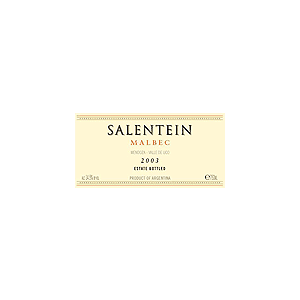
Salentein Mendoza MalbecBodegas Salentein shares a rich history that parallels the settlement of Argentina by Spanish and Italian immigrants.  By the 17th century, Salentein was part of an estancia called De Arriba that belonged to the Jesuits, who were the first to successfully cultivate the vine in Mendoza.  The ruins of the original Jesuit farmhouse called Casa Grande are still part of Salentein’s property.  They lay surrounded by a grove of trees that were planted by the early missionaries, at nearly 5,000 feet upon sea level.

Salentein is a well endowed, privately held estate whose wines are as impressive as its modern winery.  In addition to employing Michel Rolland, France’s most sought after enologist; Salentein occupies a prime location in the foothills of the towering Andes.  Its vines soar to 5,600 feet, which makes them some of the loftiest vineyards in the world, The winery itself is built in a shape of a cross and is surrounded by the estate’s four fincas or properties.  Each of the four wings of the winery contains its own small winery with two distinct sections:  the first at ground level houses stainless steel tanks, while the second lies 8 meters underground and is used for maturing the estate’s wine in oak casks. The four wineries meet in a central chamber that resembles an amphitheater where they share a common bottling facility.  Pretty smart thinking we would say.

Bodegas Salentein specializes in the cultivation and production of Cabernet Sauvignon, Pinot Noir, and Malbec – Argentina’s specialty.  Unlike most other Argentine wineries, Salentein is devoted entirely to premium production, which is evident in the estate’s wines.

Los Andes

The Andes are the tallest mountains in the Western Hemisphere, dwarfing the Rockies and the Sierras with their sheer magnitude.  However, the Andes are more than a geologic mass, they are a mystical experience.  They cast their shadows and mysteries upon the present day population of South America as they did the ancient Pre-Columbian peoples who inhabited their lower reaches.

Without the towering Andes, there would be no cultivation of the vine in Mendoza and no real agriculture as we know it, nor would viticulture thrive in the river valleys of central Chile, which lie just across the Andean spine or Cordillera from Mendoza – a mere one hundred miles as the condor flies, but still a torturous eight hour adventure by car.  Simply, it is the Andes that give life to the desert like Mendoza and the arid rift valleys of Chile.  Specifically, it is Andean snows that accumulate upon the higher elevations of the Andes that give life and sustenance to these parched parcels of South America that yield the continent’s finest wines.

In order to make the desert bloom, the inhabitants of the Andes have come to rely on their mighty mountains for water.  By sluicing off the Andean snow melt and directing its waters into canals, much of Argentina and Chile are now productive farmland and especially suited to the cultivation of the vine.  Since the Italian migration to Argentina in the 19th century and subsequent settlement in the Illinois size province of Mendoza, the Mighty Mendoza has become the largest wine producing area in South America, leading Argentina to fifth among the world’s leading wine producing nations just behind the United States.  Without the Andes, there would be no wine or much else to speak of from Mendoza.  Viva Los Andes!

Tasting Notes:  At last, a Malbec with charm, personality, and style along with the usual Malbec might.  Make no mistake about it; the 2003 Salentein Malbec has plenty of up front flavor and grip, but it, also, possesses Bordeaux like finesse.  Deep, dark, and foreboding in color, one could easily mistake the 2003 Salentein Malbec for just another well made tannic Malbec – at first glance.  However, the 2003 Salentein Malbec is worth more than a mere second look.  In fact, this wine is more than good; it’s Malbec at its best.  As one panel member so aptly stated:  “The 2003 Salentein Malbec is rich, ripe, and assertive but also well mannered.”  Indeed, fourteen months in French oak barrels have lent a Rioja like nose of sweet oak and subtle nutlike aromas to this wine, which complement the smooth ripe blackcurrant and plum fruit that saturate its center.  On the finish, soft well integrated tannins lend zip and the promise of even better things to come with bottle age, but with nary a searing bite or even a trace of hardness.  Kudos to the folks at Salentein for a noble effort!  For optimal enjoyment, we suggest decanting the 2003 Salentein Malbec for an hour before consuming it or better still give it just five minutes on Vinatron’s Accella Breathe and enjoy!

Accompaniments:  As at home at an elegant dinner party as it is at a barbecue, the 2003 Salentein Malbec shines at the table in a multitude of settings.  Whether the evening fare is Châteaubriand or Bacon and Cheddar Cheese Burgers Salentein’s 2003 Malbec provides good company.  Also, we recommend grilled Italian sausages, either the cheese, fennel, or moderately hot versions, with a glass or two of this Malbec.  And if you want to perk up a mid week meal, serve the sausages over creamy polenta or grits.   Lamb Stew and Grilled Lamb Kebobs with roasted peppers, onions and root vegetables do justice to this wine as well.  Last but by no means least, Eggplant Rollini and Zuccchini Parmigiana offer excellent accompaniments, too.  Buon Appetito or should we say Buen Provecho!

Dopff au Moulin Pinot Blanc d’Alsace 2004 – France

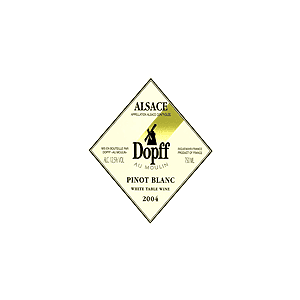
Dopff au Moulin Pinot BlancFor five centuries, the name Dopff and the majestic medieval town of Riquewihr have been synonymous.  Since 1574, the Dopffs, from father to son, have dedicated themselves to the art of producing great Alsace wines from vineyards in and around picturesque Riquewihr.  The present Dopff progeny constitute the eleventh generation of the Dopff family to cultivate the vine and make wine in Alsace.  And as one might imagine, there is hardly a dearth of interesting and remarkable personages among this great family.

One could rightly claim that it was Jean-Daniel Dopff, a minister’s son, master baker, and innkeeper extraordinaire, who began the Dopff family’s viticultural rise to prominence in the mid 17th century with the service of the family’s excellent Alsatian wines at the local inn.  Subsequently, Jean-Daniel’s son, Balthazard-Georges, a master cooper, succeeded his father and further enhanced the family’s reputation among the local cognoscenti. Several successive generations of the Doff family then built the domain into its present form, but not without a few bumps and inventions along the way.

Around the time of the International Exhibition in Paris in 1900 and under the guidance of Julien Dopff, the Dopff family is credited with the invention of Crémant d’Alsace – the Alsatian version of sparkling Champagne.  At first, Julien’s invention met with considerable skepticism, but a daring wager by the owner himself; namely, that his sparkling wine would withstand the long sea voyage to Australia earned Domaine Dopff international acclaim.  With success came considerable demand for the domain’s wines. Dopff quickly became a prime supplier to all the great steamships and long distance mail boats that plied the seas.  Moreover, forever light, creamy, and utterly refreshing, Crémant d’Alsace still enjoys considerable approbation and remains one the world’s finest method champenoise wines.  It is, also, one of the province’s leading exports.

However, the most colorful and influential of the recent Dopff scion is, perhaps, René Dopff, who distinguished himself in the French Resistance during World War II.  A long time friend of the French writer André Malraux, René Dopff was, also, the first grower in Alsace to formally extol the virtues of terroir, which led to dividing the estate into separate vineyards, based upon the most suitable grape variety.

Today, three generations of the Dopff family manage the estate.  Not surprisingly, all of the traditional Alsace grape varieties are represented:  Sylvaner, Pinot Blanc, Riesling, Muscat d’Alsace, Tokay d’Alsace, Gewurztraminer, and Pinot Noir.  And of course, Crémant d’Alsace, whose primary ingredient is Pinot Blanc, remains a specialty of the house.

Pinot Blanc

Pinot Blanc was introduced into Alsace at the beginning of the 18th century under the name of Klevner.  The grape, also, goes by the name Weissburgunder in German speaking wine regions of France as well as in Austria and Germany.  Pinot Blanc is cultivated in Burgundy and Champagne, where it is thought to have originated as a mutation or albino version of Pinot Noir.  Its virtues are a firm natural acidity and a pretty floral aroma and flavor that make it perfect as a still dry aperitif or the primary ingredient in Crémant d’Alsace.  Not surprisingly, Pinot Blanc still figures in the cepage of many French Champagnes, and in the best sparkling wines of California, too.  As a still varietal offering, Pinot Blanc frequently contains a good percentage of Pinot Auxerrois, a native Lorraine grape varietal that adds softness and spice to an otherwise stalwart 100 % Pinot Blanc.  Dopff au Moulin’s Pinot Blanc typically contains some Auxerrois.

Tasting Notes:  Light, bright, and refreshingly clean, the 2004 Dopff au Moulin Pinot Blanc woos with its ultimate balance and charm.  In the nose and on the palate, subtle creamy fruit wends its way through an underpinning of crisp refreshing acidity.  This allows Dopff’s Pinot Blanc to remain forever light, lovely, and eminently quaffable.  It is on account of this carefree quality that the tasting panel preferred it to the host of Pinot Blanc pretenders we tried, many of which seemed to be imitating Chardonnay or, otherwise, be trying too hard to be something they were not.  In short, the 2004 Dopff au Moulin is one honest, good drinking Pinot Blanc.  We suggest you begin by serving it well chilled (40° F); then, sip the 2004 Dopff Pinot Blanc slowly.  This will allow the wine to caress the palate and leisurely unfold in the glass.  Salut!     

Accompaniments:  The 2004 Dopff Pinot Blanc is ideal with seafood.  It is, also, wonderful at a buffet or party, where it imparts a sense of conviviality. A natural companion to quiche, onion tarts, leek pies, and hot and cold hors d’ oeuvres, Dopff’s Pinot Blanc provides an excellent start to a long evening of eating and drinking.  In addition, it works wells with pork dishes and assorted meat pies that are served as main courses.  Traditional Choucroute Garnie à l’Alsacienne is a great way to share a bottle of Dopff au Moulin’s Pinot Blanc.  Nevertheless, we must confess to enjoying Dopff’s quintessential Pinot Blanc straight away as an aperitif, so as you like it.

Tenuta Le Calcinaie Colli Senesi Chianti 2004 – Italy

The tiny Tenuta Le Calcinaie estate is situated within the confines of San Gimignano, the medieval Tuscan hill town, made famous by its many towers.  Considering the location and attention to quality at Le Calcinaie, this little jewel of a property has become quite renowned for its rare and exceptional Vernaccia di San Gimignano for which the town is justly famous.  Considering the dearth of fine Tuscan whites, it should come then as no surprise that Tenuta Le Calcinaie has been so keenly identified with Tuscany’s finest white wine.  However, what the world has not yet discovered is just how wonderful this brilliant estate’s red wines are, most notably Le Calcinaie’s Colli Senesi Chianti and its proprietary Super Tuscan red Teodoro.

Behind the success of Tenuta Le Calcinaie is the affable and witty Simone Santini, known near and far as the Great Santini!  Simone is gifted with an archetypal Tuscan sense of humor; he possesses a vibrant wit and an acute sense of irony.  He is also a very fine winemaker.  His Vernaccia di San Gimignano is classically wrought, exceptionally focused, and bursting with flavor.  Meanwhile, the true irony lies in Simone’s reds; they are as magnificent as his whites and, perhaps, even better.  Yet, few people outside of San Gimignano have ever tasted one of his delicious red wines.  Come to think of it, how many people outside of Tuscany have ever tasted Colli Senesi Chianti, the friendliest of all Tuscan reds in the hands of a fine craftsman the likes of the Great Santini?

Tasting Notes:  Juicy and supple, the 2004 Tenuta Le Calcinaie Colli Senesi Chianti ranks as one of the most forward and disarming of all Chiantis, a novelty for a wine known more for its elegance and style than its warmth and charm.  Le Calcinaie’s 2004 Colli Senesi is already quite forward and aromatic; its ripe friendly scents recall a visit to the strawberry patch or a walk through northern woodlands.  Pure and very easy to drink, Simone’s Chianti possesses a light dollop of fruit, just a hint of spice, and a friendly finish. This is the kind of Chianti one always hopes to encounter in a good Tuscan trattoria.  Unquestionably, Tenuta Le Calcinaie’s Colli Senesi brings out the most amicable and engaging side of Sangiovese, Chianti’s primary grape variety.  We highly recommend consuming this wine at cool room temperature (about 65º F) in order to capture all of its charm.

Accompaniments:  The Tuscan table contains many culinary delights – simple flavorful dishes that beg for a wine like Tenuta Le Calcinaie’s 2004 Colli Senesi Chianti.  Sienese crepes, filled with smoked Tuscan meats and pecorino cheese; fennel pie with melted cheese and vegetables; or homemade semolina pasta with a mushroom or truffle sauce are just a few such Tuscan treats that provide first rate accompaniments to Simone Santini’s Chianti.  Ribollita, Tuscany’s quintessential country cooking, which consists mainly of bread and vegetables, and what ever else is left in the kitchen from the night before, is another excellent choice with Le Calcinaie.   In fact, almost any fresh pasta, light meat, or intriguing bean dish will prove a successful partner to the Great Santini’s best kept secret – at least until now.  Enjoy!

De Angelis Bianco Lacrima Christi del Vesuvio 2004 – Italy

The De Angelis brothers have quickly become the leading purveyors of excellent Lacrima Christi wines, and with good reason.  They are one of a mere handful of Lacrima Christi producers whose wines actually match their breathtaking location.  Located on the foothills of Mount Vesuvius, bordering majestic Sorrento Bay, the Azienda Agricola De Angelis overlooks the prettiest part of the Campania.  The Campania Felix, meaning the “joyous country” or the “face with an open smile,” is the ancient province of the Roman Empire that sits just south of Rome and neighboring Latium.  Like its name implies, this region produces friendly, gregarious wines, and none is more exemplary of the good nature and open character of the land and people of the Campania than the Lacrima Christi wines from De Angelis

The estate’s owners, the DeAngelis Brothers, typify the unparalleled character of their enchanted region.   From barely twenty acres of hillside vineyards they produce, with the help of Oenologist Angelo Valentino, the two mythical wines of Sorrento:  Bianco Lacrima Christi and Rosso Lacrima Christi.  Lacrima Christi means “tears of Christ,” and as legend has it the wines of this area of Vesuvius were so named because here, it is said, that Lucifer was cast out of heaven, causing Christ to weep. 

The De Angelis Bianco Lacrima Christi is the product of two native varietals, Coda di Volpe and Falanghina, which produce a fine, fragrant white wine that is prized as much for its full, rich savor as it is for its uncanny facility to accompany the delightful fish dishes of Sorrento and nearby Amalfi.  Meanwhile, the Bianco’s fraternal twin is the result of the marriage of the local Piedirosso grape to the legendary Aglianico, one of the ancient grape varietals that the Greeks brought to southern Italy more than 2500 years ago.

Tasting Notes:  The 2004 De Angelis Bianco Lacrima Christi captures every bit of the flavor and complex tones that volcanic soil can impart to a dry white wine.  Consequently, there is nothing wimpy about this zesty full flavored wine that springs from the volcanic ash of Mount Vesuvius.  From its bright golden color to its long lusty finish, the 2004 De Angelis Bianco Lacrima Christi beams with vitality as well as a touch of exotica.  In the bouquet, a heady perfume of springtime flowers, crushed mineral, and lemon zest meld with the scent of the sea.  On the palate, bold ripe flavors underscore the wine’s bouquet and carry through to a long, dry refreshing finish that both cleanses the palate and restores the senses.  We suggest serving the 2004 De Angelis Bianco Lacrima Christi moderately chilled (40°-50° F).  Enjoy!

Accompaniments:  Seafood specialties and traditional Campanian fare are perennial favorites with the 2004 De Angelis Bianco Lacrima Christi del Vesuvio.  Spicy fish stews, fried calamari, mozzarella sticks, and thick rockfish filets that have been smothered in a savory tomato sauce all provide exceptional accompaniments to this fine Lacrima Christi.   Mussels marinara, fried or steamed clams, and sautéed oysters offer other fine accompaniments to the exotic 2004 De Angelis Bianco Lacrima Christi del Vesuvio.  Caesar Salad; heavy hors d’ oeuvres, especially those that make liberal use of mushrooms, olive oil, garlic, or traditional Mediterranean herbs; baked eggplant or zucchini; and traditional Spanish tapas all offer other excellent choices to accompany the flamboyant 2004 De Angelis Bianco Lacrima Christi.  In addition, De Angelis’ extroverted 2004 Bianco Lacrima Christi makes for a lovely aperitif.  And when accompanied by a spring breeze or the sound of the sea, there is nothing better this side of Paradise.

R Petite Sirah Enver Salman Vineyard 2004 – U.S.A.

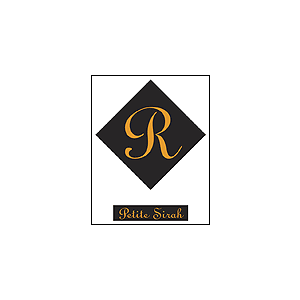
R Petite SirahR is Jeff Runquist’s own label.  It is his passion, pride, and joy.  R is, also, the envy of the legion of California winemakers who stay up nights dreaming of making wine their own way and being critically and financially successful in the process.  Jeff Runquist is unequivocally one of California’s finest and most consistent winemakers.  He is the sole proprietor and winemaker for R and he is the driving force and successful suit behind a number of other premium California wineries, including the McManis Family Vineyards.

“I just want to play the game my way,” has always been Jeff Runquist’s mantra. By this statement he means dedicating himself entirely to the art of winemaking, the way he wants to make wine.  With R, Runquist specializes in ultra premium, single vineyard designated, 100% varietal red wines.  Petite Sirah, Syrah, and Zinfandel are Runquist’s specialties and most renowned wines, but he, also, fashions small quantities of outstanding Cabernet Sauvignon, Pinot Noir, Barbera, Sangiovese, and Primitivo – the forerunner of Zinfandel.

Runquist has been making wine for more than twenty-five years and the now legendary R since 1995.  Since inception, R wines have consistently won gold medals in major wine competitions.  Each has sold out promptly, leaving the cellar devoid of even a single bottle shortly after release.  Critics complain they haven’t even had a chance to taste the R wines before they are sold out.  In addition, Runquist spends little time selling wines and even less time marketing them, unlike most of his peers.  This scenario is certainly not the norm, but then again Jeff Runquist is not an ordinary winemaker.

Neither R nor Runquist himself own even a single vine.  Runquist has no written contracts with any of the great growers and vineyards he sources year after year.  Nonetheless, they always provide him with outstanding raw material with which to practice his art and work his magic.  And to his credit and the utter amazement of the California wine establishment, Jeff Runquist does not even maintain a tasting room – an omission and unforgivable offense to the large commercial establishments that prey upon the accidental connoisseur and the casual wine tourist alike.  Moreover, Runquist refuses to expand his annual production of R wines for fear of compromising their quality.  In fact, his overriding objective is to produce all of his wines in tiny lots.  This means producing only 700-1000 cases of each of his main varietals (Petite Sirah, Syrah, and Zinfandel) and only 100-300 cases of each of his other red varieties.  Routinely, this process involves declassifying a third or more of his production each vintage simply because Runquist declares: “If I am not happy with a wine, I don’t bottle it … if I don’t get as big an economic reward, that’s okay.  I am happy with the wines made under my label.” Sadly, this is hardly the prevailing philosophy elsewhere in today’s world of wine. However, far be it from us to complain; we are the beneficiaries of such arcane practices.  We are the chosen few who actually get to taste a bona fide R wine, and enjoy it – the fruit of Jeff Runquist’s refreshing philosophy.

Tasting Notes:  With an intensely purple robe the color of a perfectly ripe plum, a knock out nose, and oodles of flavor, it is easy to see why the 2004 R Enver Salman Vineyard Petite Sirah is simply the finest Petite Sirah we have ever tasted.  Likewise, it takes no great acumen to comprehend why each of the last four vintages of Jeff Runquist’s Salman Vineyard Petite Sirah have garnered so many top honors at California’s most prestigious wine fairs, including “Best Varietal Petite Sirah” at the 2004 California State Fair.  For the record, the 2004 R Enver Salman Vineyard Petite Sirah is a staggering statement.  It offers up entrancing aromas of blackberry jam, ripe blueberries and spicy oak.  Considering the formidable nose and considerable natural alcohol, one might expect a dense astringent monster.  Instead, the 2004 R Enver Salman Vineyard Petite Sirah cajoles the senses with a beautifully balanced format and a cornucopia of flavors.  Rich black fruits, mocha, chocolate, and forest woodlands all sing their seductive song within a deft framework of aromatic oak.  From this wine’s auspicious start to its amazingly long finish, there is neither a beat nor a chord even remotely out of sync.  In short, the 2004 R Enver Salman Vineyard Petite Sirah is a tour de force for the Petite Sirah variety and one of the most distinctive and enjoyable California wines we have had the privilege to taste.   We suggest serving it at cool room temperature (64°-66° F). 

Accompaniments:  “You can serve this wine with whatever you want, but I’m drinking mine plain,” croaked one senior member of the panel.  “I’m not going to let anything stand in the way of my idolizing this wine,” he added.  Several other panel members agreed and eschewed accompaniments to the otherworldly 2004 R Enver Salman Vineyard Petite Sirah.  However, the majority extolled this audacious wine’s innate ability to accompany hearty fare, but even more importantly to make well-chosen dishes shine.  Consequently, given this formidable Petite Sirah’s great balance and overt personality, we highly recommend it with a thick meaty cassoulet; an herb roasted leg of lamb, Penne a la Siciliana (penne pasta in a very thick fresh tomato sauce, with roasted garlic, eggplant, and herbs), an authentic Piedmontese risotto, or any other full-flavored culinary delight.  Enjoy!

Gustave Lorentz Altenberg de Bergheim Riesling Grand Cru d’Alsace 2001 – France

Gustave Lorentz is a family owned and operated winery that dates to 1836.  Today, this fine estate rests in the very capable hands of Georges Lorentz, who fashions a bevy of delicious white wines with some assistance from his “retired” father, Charles.  Indeed, it must be true that old winemakers never die; instead, they age to perfection and impart wisdom and knowledge to their children, before gracefully fading away.

The Lorentz winery is one of the largest family owned facilities in Alsace.  It encompasses nearly sixty-six acres of premium vineyards in Bergheim, including nearly half of the great Grand Cru vineyard of Altenberg de Bergheim, famous for its extraordinary Riesling, and all of Kanzlerberg, the smallest Grand Cru in Alsace.  Bergheim is located along the famous Route de Vin in the very finest section of Alsace, a mere 3 kilometers from Ribeauville and just 5 kilometers from Riquwihr.  This is the heart and soul o f Alsace wine country.  All Lorentz wines come from the Bergheim area, also known as the Haut Rhin, and express the unique terroir of the region.  Lorentz’s top wine is his single vineyard Grand Cru Altenberg de Bergheim Riesling.

Like most Alsace producers, Gustave Lorentz features several levels of wine from a wide variety of traditional Alsace grapes.  The ubiquitous Pinot Blanc provides a steady income and a solid foundation upon which Lorentz has built his domain, as have most other family growers in Alsace.  As one would expect, Riesling, Tokay Pinot Gris, and Gewürztraminer constitute the pinnacle of this estate’s achievement, as they do throughout Alsace. In addition, Lorentz’s wines are featured in many of the Michelin-starred restaurants in Alsace and some of the finest restaurants around the world.  From simple vintage cuvees to Reserve and Grand Cru bottlings to the rare late harvest wines known as Vendanges Tardives, Lorentz is dedicated to the fashioning of the highest quality Alsace wines.  Vive la différence!

Alsace

Alsace is quite possibly the most picturesque wine region in all France.  It is an enchanted land of beautifully restored half-timbered houses, flower bedecked balconies and carved window boxes, and of course vineyards.  It is bounded by the Vosges Mountains to the west, which block out the dreary maritime weather that plagues much of the rest of northern France, and the Rhine River and Germany to the east.  On account of its favored climate and position, Alsace is the sunniest province in northern France. This extra sunshine makes Alsace an ideal spot for the cultivation of the vine and the production of premium wines, especially Riesling and Pinot Gris.

In Alsace, white wine reigns supreme.  Pinot Blanc is the stable of Alsace, where it makes a fresh, sprightly wine of considerable merit.  Nonetheless, the greatness of Alsace lies more typically in the crafting of some of the world’s finest wines from Riesling, Gewürztraminer, and Pinot Gris – the vast majority of which are made dry rather than sweet.  The relative dryness of most Alsatian wines may come as a surprise to many, especially to those for whom German sounding names and tall thin green bottles are synonymous with sweetness.  However, Alsatian wines are unique unto themselves and rarely do they resemble their German counterparts in style, flavor, or level of residual sugar.  Robert Parker Jr. has called the wines of Alsace “some of the greatest white wines produced on the planet,” and some of the most pleasurable and hedonistic, too, we might add.

Tasting Notes:  Put aside all pre-conceived notions of Riesling, and prepare yourself for the glory of Alsace and the essence of a noble varietal in the 2001 Gustave Lorentz Altenberg de Bergheim Riesling Grand Cru.  First, this is not a sweet wine.  Secondly, it bears very little relation to its German counterparts that flourish just across the border.  Thirdly, it is complex, long, and downright racy.  Fourthly, with wines like this, why have Americans taken so long to discover the glories of Alsace, France’s most renowned, almost exclusively white wine producing region?  Just one sip of the 2001 Altenberg de Bergheim Riesling should be enough to convince the uninitiated as well as the most ardent of Riesling detractors, of this noble variety’s greatness.  Bright, clear, and dressed to please in a pale yellow robe that is reminiscent of the first rays of the morning sun, this Grand Cru Riesling dazzles with its enchanting perfume, a blend of citrus oils, liquefied minerals, and a subtle unctuous quality that seems to define the very best examples of the Riesling varietal.  It almost defies description.  Long and flavorful, the 2001 Altenberg de Bergheim is one well-endowed Riesling that finishes dry.  It exhibits on the palate all the same charm and intensity as its enchanting nose, so what is there not to like?  We suggest serving the 2001 Altenberg de Bergheim fairly well chilled, at least initially, and then allowing it to creep slowly towards cool room temperature.  This way you are sure not to miss all that this wonderful Riesling has to offer, including the wine’s long racy finish that persists on the palate for a full minute before disappearing.  Enjoy!

Accompaniments:  The 2001 Gustave Lorentz Altenberg de Bergheim Grand Cru Riesling provides the perfect complement to seafood as well as traditional Alsace favorites.  Crab or prawns with avocado, grilled white fish, or an old-fashioned onion or leek tart offer plenty of complement to Lorentz’s flagship offering.  Lobster salad, sautéed oysters served in a savory cream based broth, and veal roast provide other tasty treats to highlight this exquisite Alsace Riesling.  Duck, goose, sweetbreads, and even pork pair well with the Lorentz 2001 Altenberg de Bergheim Grand Cru.  And for Riesling purists, all that is called for is a clean glass and a special occasion, like tonight, to enjoy this wonderful dry Riesling.  Santé!

Canneto Vino Nobile di Montepulciano Riserva 1999 – Italy

The Azienda Agricola Canneto stretches across the western slopes of the striking Tuscan hill town of Montepulciano, near the beautiful church of Madonna di San Biagio.  This renowned estate has enjoyed a long tradition of wine making. However, ever since its purchase in 1987 by the current Swiss owners, the property has been completely restored; and more importantly the Vino Nobile that now flows from its barrels is utterly sublime.  The quality quotient should come as no surprise as everything at Canneto is done with great respect for tradition and with the utmost attention afforded to producing Montepulciano’s finest Vino Nobile.  And as one would expect, Canneto’s vineyards and facilities are meticulously maintained; the new wine cellar is kept scrupulously clean and each vine and olive tree is pruned to perfection – the clearest reflections of the noble elixirs that bear the Canneto name.

The Canneto estate encompasses some 106 acres, of which only 44 acres are planted with vines. Approximately 33 acres are registered for Vino Nobile. The vines are grown on moderately heavy, pebbly marl soil between 1,100 and 1,300 feet above sea level. Moreover, nearly all the vines are raised on southwest facing slopes, which affords them great sun exposure and full ripening.  A sizeable portion of the rest of Azienda Agricola Canneto is devoted to the cultivation of olives for extra virgin olive oil. 

Today, Canneto’s wines are only available to a select few clients.  Consequently, they enjoy a certain exclusivity, simply because there is never enough to go around.  This is particularly the case for Canneto’s flagship offerings, Vino Nobile and Vino Nobile Riserva.  The latter is produced only in superior vintages like 1999.  In order to enjoy the "Riserva" title, Canneto’s finest Vino Nobile is matured in wooden casks for three years, starting from January 1 following the harvest.

Tasting Notes:  The 1999 Canneto Vino Nobile di Montepulciano Riserva is testimony to just how great the 1999 vintage is for Vino Nobile.  “A stunning Tuscan treat,” was how one member of the panel described this wine.  And just for the record, this particular offering received unanimous approval from the panel.  We only wish there was more of it to go around.  From its deep purple robe that bears the glint of precious garnet to its long, rich, flavor-packed finish, the 1999 Canneto Vino Nobile di Montepulciano Riserva is a tour de force for the Vino Nobile DOCG.  In between, there lies a luxuriant nose that bears the scent of rose petal, dark chocolate, hot fudge, and roasted coffee all folded into one staggering statement.  Even more impressive is the Canneto Riserva’s profound center – a huge core of pure fruit that bespeaks complexity and emanates a litany of wonderful flavors.  Smooth, rich, and beautifully balanced to the finish, the 1999 Canneto Vino Nobile di Montepulciano Riserva is every serious Tuscan wine lover’s dream.  Enjoy this “Tuscan treat” at cool room temperature (no more than 66° F), after at a little aeration. 

Accompaniments:  The 1999 Canneto Vino Nobile di Montepulciano Riserva is the perfect red wine to accompany most classic Tuscan dishes, which so deftly marry elegance to hearty rusticity.  So whether it is a thick, mouthwatering Florentine Steak that has been slathered with olive oil and herbs or it is the hearty, country bean soup that Tuscan natives have fondly dubbed Ribollita (meaning re-boiled), the 1999 Canneto Vino Nobile di Montepulciano Riserva is a sublime choice.  Certainly, it is rich enough to hold its own with any traditional Tuscan meal.  We also like it with homemade Tortellini, especially when the Tortellini has been stuffed with veal, herbs, Porcini mushrooms, and the finest hard cheeses Italy has to offer.  In fact, this great Vino Nobile will elevate almost any well-prepared meat or pasta dish with which it comes in contact.  So whether it is a Braised Lamb Shank, served over creamy polenta, or a Grain Fed Breast of Chicken in the company of walnut, onion, and Jalepeno pepper infused mashed potatoes, we highly recommend that the remarkable Canneto Riserva accompany it.  Enjoy this wine now and over the next five years.


logo for wine club
Since 1994
Home
Join Our Wine Club
Gift Memberships

Membership Renewals
Reorder Your Favorites
Wine of the Month Club
More Information
Current Selections
Past Selections
Testimonials
Other Gourmet Gifts
Corporate Gifts
Wedding Gift Ideas
All About Wine
Website Tools
Who We Are
Contact Us

1 - 800 - 625 - 8238
(Outside US call: 949-206-1904)
P.O. Box 1627, Lake Forest, CA 92609