Past Newsletters - June 2009

Premier Series
Featured Wineries & Wines
Membership Type
Bodegas Viticultores de Barros Ribera del Guadiana 2006 – Spain 1 Red 1 White; 2 Reds
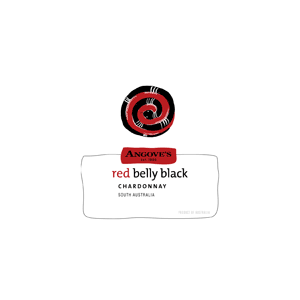
Red Belly Black South Australia Chardonnay 2006 – Australia 1 Red 1 White; 2 Whites
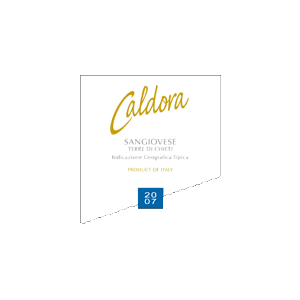
Caldora Sangiovese 2007 – Italy 2 Reds
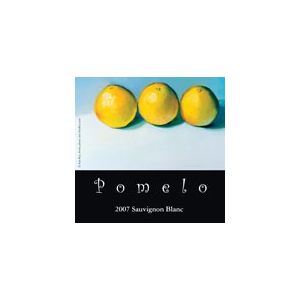
Pomelo Lake County Sauvignon Blanc 2007 – U.S.A. 2 Whites


Master Series
Featured Wineries & Wines
Membership Type
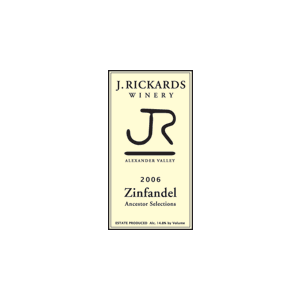
J. Rickards Alexander Valley Zinfandel 2006 – U.S.A. 1 Red 1 White; 2 Reds
Red Belly Black South Australia Chardonnay 2006 – Australia 1 Red 1 White
Bodegas Viticultores de Barros Ribera del Guadiana 2006 – Spain 2 Reds


Collector Series
Featured Wineries & Wines
Membership Type
J. Rickards Alexander Valley Zinfandel 2006 – U.S.A. 1 Red 1 White; 2 Reds
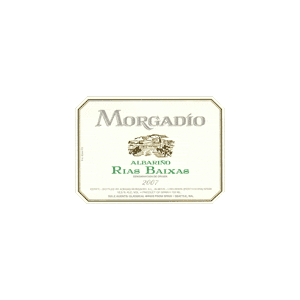
Morgadío Albariño Rías Baixas 2007 – Spain 1 Red 1 White
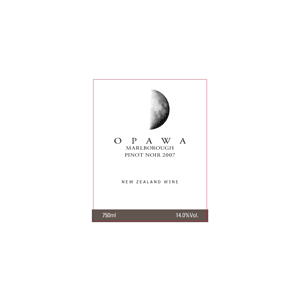
Opawa Marlborough Pinot Noir 2007 – New Zealand 2 Reds

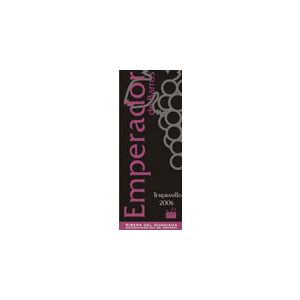
Bodegas Viticultores de Barros Emperador de Barros Ribera del Guadiana 2006 – Spain

Emperador de Barros Ribera del Guadiana 2006The Bodegas Viticultores de Barros was founded in 1983 by 35 quality growers from Extremadura's Tierra de Barros region. They pooled their resources to launch the venture. Their aim was to revitalize viticulture in the Tierra de Barros, which had long languished in the shadow of the Rioja and other more celebrated appellations to the north, and develop the full potential of their vineyards and winemaking. Thus, the Bodegas Viticultores de Barros was at the forefront of the vitcultural renaissance in Spain that began more than two decades ago.

Today, Bodegas Viticultores de Barros encompasses 1,250 acres of vines. All of the bodegas’ vineyards are grown in the typically deep red clay/chalk soils of the region, which retain the needed moisture for producing balanced fruit in one of Spain's most arid climates. Vintage consistency is nearly a given in the Tierra de Barros and viticulture is organic out of necessity as well as tradition. The dry continental climate of the Barros area of Extremadura and the vineyards’ relatively high altitudes (ranging from 1000 and 1700 feet) help to assure structure and elegance in the wines and limit the need for any chemical intervention.

Bodegas Viticultores’ specialty is fashioning wines to be drunk within the first few years of life by using the latest technology and following precise and selective harvesting techniques. Macabeo (also known as Viura) is the preferred varietal for white wines here; while Tempranillo is the varietal of choice for all of the bodegas’ reds. Under the expert guidance of the Bodegas Viticultores de Barros winemaking team, this winery fashions only two wines, a white and a red, both of which are rich in flavor and freshly aromatic. Although juicy and delicious when first released, the bodegas’ Tempranillo improves considerably with an additional year or more in bottle, which renders it one of the finest red wine values on the market today.

Extremadura

Extremadura, once part of the ancient Roman Province of Lusitania, is the most rural and least populated wine region of Spain. Located in the far west of the country along Spain’s border with Portugal, Extremadura is an autonomous region that has traditionally been known more for its National Parks (Monfragűe and the Tagus River Natural Park) and its long list of famous sons than for wine. Extremadura sired many of Spain’s most famous conquistadores: Vasco Nunez de Balboa, Hernán Cortés, Francisco Pizarro, and scores of others. Consequently, the region’s administrative capital Merida has lent its name to numerous towns and cities in North and South America. Nonetheless, wine has been an important part of Extremadura’s economy for centuries. Since the 1980’s fine wine production has soared in the region, due largely to the viticultural renaissance sweeping Spain. Ribera del Guadiana (DO) is Extremadura’s most important appellation for fine wine production.

Tasting Notes: An intense young red from 100% Tempranillo vines the 2006 Emperador de Barros provides a mouthful of wine, and more. For starters, this purple potion offers luscious scents of red currant, kirsch, and plum that literally pour from the glass. With patience and a little aeration, these heady scents seep inextricably into the center of the wine and emerge full throttle on the palate. Aromatic, heady, and vibrant, the 2006 Emperador de Barros epitomizes the quality that has emerged from heretofore unsung wine producing regions such as the Ribera del Guadiana. The metamorphoses or in some cases the total transformation of Spain’s country wines into exciting, internationally appealing wines is no more evident than in Bodegas Viticultores’s 2006 Emperador Tempranillo. The only caveat is this: let it breath, let it breathe. The 2006 Emperador is charming from the outset, but by affording it thirty minutes to unfold in a decanter or glass before drinking it will repay more than its share of dividends and be well worth the wait. Furthermore, as good as the 2006 Emperador Tempranillo is now, it will only get better. Enjoy this forceful, personality filled red as often as you can, but don’t forget to lay at least an extra bottle or two away for next year.

Accompaniments: The 2006 Emperador Tempranillo is built for good old-fashioned drinking, so hearty, stick to your ribs kind of foods are its best mates. Besides, Emperador is not your typical “sit around sipping” kind of wine, so fire up the grill and stir the pot. Beef and pork barbecue, thick country stews, and rotisserie cooked chickens with plenty of herbs and seasoning get our nod, but then so do traditional southern Italian specialties like grilled Italian sausage with peppers and cheese and prosciutto stuffed calzones. We can also recommend this wine with marinated flank steak, meatloaf, pork chops, and almost any young, cow or sheep’s milk cheese: the youthful 2006 Emperador Tempranillo has enough fruit and tannic backbone to cut through the fat in meat and cheese and offer a bit of heart assurance. Furthermore, it carries a good bit of flavor and a touch of class, so it can go high brow when the occasion arises. So, if fancy fare or complex sauces are in the offering, the 2006 Emperador will not let you down. Enjoy!

For the Love of Cheese: Youthful Spanish reds such as the 2006 Emperador Tempranillo make ideal accompaniments to the world’s finest gourmet cheeses. Full flavored cheeses such as Roncal from Spain’s Navarra region or Mahon from the Balearic island of Minorca offer plenty of flavor and the ideal texture to complement the Emperador Tempranillo. Roncal’s rich olive like flavor provides an excellent companion to Tempranillo, and Mahon, one of the world’s finest cheeses, is always a crowd pleaser with young Spanish wines. For more information on outstanding gourmet cheese and wine selections or to order a monthly subscription to In Pursuit of Cheese, contact us at www.cheesemonthclub.com and enjoy the best of both worlds.

Red Belly Black South Australia Chardonnay 2006 – Australia

Red Belly Black South Australia Chardonnay 2006Red Belly Black wines are named for the Red Belly Black snake that is indigenous to South Australia’s bush land areas where the Angove family has crafted wines for five generations. The Angoves fashion Red Belly Black, Nine Vines, and other premium Australian wines from the finest viticultural areas of South Australia.

Angove’s Pty. Ltd. is one of Australia’s largest privately owned wineries. It began with Dr. William Angove, an accomplished general practitioner and surgeon, who emigrated with his wife and young family from Cornwall in 1886 to establish a medical practice in South Australia.

Although he enjoyed a distinguished medical career, Dr. Angove’s most enduring legacy survives in the viticulture of South Australia. His early experimentation with vines, winemaking and distilling led to the establishment of a proud family business. Dr. Angove’s initial plantings at the township of Tea Tree Gully in the Adelaide foothills were the forerunner of one of the largest vineyards in the southern hemisphere — the magnificent Nanya Vineyard at Renmark in the Riverland of South Australia.

John Carlyon Angove and Daughter VictoriaSince 1950, Angove’s has steadily expanded its operations and structure. The Renmark facility has grown to become a major winemaking and distilling entity with storage capacity for more than 15 million liters of wine and spirits. In Australia, Angove’s is known not only for its fine table wines (still wines under 14% alcohol), but its exceptional line of fortified wines and spirits. Angove’s produces sherry, port, vodka, and an especially fine line of pot stilled brandies under the name of St. Agnes. The 5 Star Liqueur Brandy from St, Agnes is a gold medal winner that consistently receives the highest critical acclaim from tasters and critics.

In 1983, the fourth generation of the family took control of Angove’s when John Carlyon Angove succeeded his father as Managing Director of the company. John has taken up where his father left off, with increased development and investment in all aspects of the winery. In addition, Victoria, John’s eldest daughter and a member of the fifth generation, is now actively involved in ensuring ongoing growth in her role as International Business Development Manager, so much so that Angove’s wines can be found today in over 30 different countries around the globe. This is testimony to Victoria’s ability and the outstanding quality of Angove’s many critically acclaimed, award winning wines. This month’ feature, the 2006 Red Belly Black Chardonnay, has garnered high acclaim from Wine Spectator and other highly touted wine publications.

Nanya Vineyard South AustraliaTasting Notes: The 2006 Red Belly Black Chardonnay is a 100% Chardonnay that is sourced from several sites that lay atop an ancient limestone sea bed near Padthaway, Australia’s most renowned appellation for Chardonnay, as well as the Chardonnay friendly limestone cliffs above the Murray River. Together, these sites endow the 2006 Red Belly Black Chardonnay with a set of complex aromatics and a myriad of flavors that are nearly as indicative of French Chablis as they are of Australian Chardonnay. Partially aged “sur lie” (on the skins and yeast) in small American and French oak barrels, the 2006 Red Belly Black Chardonnay exhibits a flamboyant, fruit driven nose, a rich, creamy texture, and a wealth of citrus flavors that explode on the finish . Lemon, lime, nectarine, and melon all come front and center in this delightfully dry, easy to drink Chardonnay. We suggest serving the 2006 Red Belly Black Chardonnay fairly cool (40º - 45º F), but not ice cold. Enjoy!

Accompaniments: Considering the wine’s soft, up front fruit and its long, dry, citrus finish, Angove’s 2006 Red Belly Black Chardonnay could serve as the model, food friendly Chardonnay to pair with simple and exotic fare. Maryland style Crab Cakes; Sautéed Oysters; Crispy Tender Shrimp, lightly fried and served with a spicy sweet Thai sauce; Steamed or Friend Pot Stickers, stuffed with minced pork and spices; or Tilapia, lightly grilled and served with a tangy mango chutney, all provide excellent accompaniments to Angove’s 2006 Red Belly Black Chardonnay. Grilled Chicken and Bowtie Pasta, tossed with extra virgin olive oil, roasted garlic, and plenty of fresh basil, offers another favorite complement to this delicious Chardonnay. Tapas and moderately spicy starters pair nicely with the Red Belly Black Chardonnay, too, but why stop there? Given this wine’s up front appeal, we highly recommend a little experimentation; we doubt you will be disappointed. Enjoy!

Caldora Sangiovese 2007 – Italy

Caldora Sangiovese 2007Caldora is a new venture that began in 2003, as a partnership between Valentino Sciotti and renowned Italian winemaker Mario Ercolino. This dynamic duo launched Caldora when they rented one of the largest cooperative wineries in the Abruzzo. They outfitted the winery with new custom made technology specified by Ercolino, a winemaker obsessed with attaining the maximum expression of fruit in his wines, and began promptly fashioning the region’s most prodigious wines from autochthonous varietals.

To push Caldora’s wines to an even higher level of quality, Sciotti and Ercolino have established an avant-garde vineyard management system that compensates grape growers who agree to adhere to rigidly specified agricultural standards. This includes paying a set amount of money according to the size of the vineyard under production, rather than according to the quantity of grapes produced. The combination of excellent grapes and outstanding wine making have yielded exceptional results at Caldora that speak volumes. In just five years, Ercolino's taste for intense, deep fruit in his wines has won many friends and transformed how the wine drinking world views the wines of the Abruzzo as well as the indigenous vines of the region.

The Caldora production area is located in primarily around Ortona in the splendid Moro River Valley. Here a unique ribbon of land lies between the gleaming Adriatic and a precipitous 10,000 foot ridge of the Apennine Mountains. This special land possesses a microclimate that is ideal for Montepulciano, Pecorino, Sangiovese, and the region’s other indigenous grape varieties, which explains why winemaking has been prized in this region since the 3rd century AD and why consumers have quickly gobbled up Caldora’s wines.

Tasting Notes: Opening a bottle of Caldora wine is always a gratifying experience. In the case of the 2007 Caldora Sangiovese, the pleasure begins in the eye: ruby red and dressed to kill, the robe on this wine elicits a hedonistic stare. In fact, the 2007 Caldora Sangiovese is utterly enticing and nearly impossible to resist. Moreover, the wine’s visual allure is matched in the olfactory by a generous dollop of pure Sangiovese fruit, which is ever so deftly laced with scents of spice and sandalwood. And what follows on the palate is a supple, seductive blend of ripe cherry, plum, and cedar flavors that winemaker Mario Ercolino has wrapped ever so adeptly around a vinous, well-toned core. Although neither weighty, nor complex, the 2007 Caldora Sangiovese beguiles by being completely satisfying, preferring to dazzle with seductive charm, elegance and flavor, rather than sheer body. Kudos to Mario Ercolino, who has once again furnished an extremely tasty, easy to drink, in your face red wine that offers great all year round drinking pleasure, and more! We suggest serving the delicious 2007 Caldora Sangiovese at cool room temperature or even slightly cooler (55º-65º F) on a hot day.

Accompaniments: All of Caldora’s wines possess a purity and hedonistic appeal that are hard to resist, with or without food. However, Caldora’s 2007 Sangiovese is a clear standout. It earns our nod as the quintessential house wine, for home and restaurants. The wine’s pure fruit and soft, spicy flavors make it popular with a crowd and able to complement a wide variety of foods, without overpowering them. So, fire up the grill, bring on the burgers, barbecue chicken, and all the ribs you can muster. Make some pasta, with fresh tomato sauce and plenty of herbs of course, or order out for a really good pizza! And don’t forget the staples of a simple southern Italian meal: garlic bread, antipasto, and fresh buffalo mozzarella, drizzled with olive oil and served with fully ripened plum tomatoes. But why limit yourself? With Caldora’s Sangiovese, there is no need to stand on ceremony. Just open the bottle and pour a glass or two with whatever you are preparing; it is the Abruzzi way. Enjoy!

Pomelo Lake County Sauvignon Blanc 2007 – U.S.A.

Pomelo Lake County Sauvignon Blanc 2007Randy Mason is one of California’s consummate producers of Sauvignon Blanc. After working two decades for some of the most prestigious Napa Valley wineries, including, Chappellet, Lakespring, and the Napa Valley Wine Company, Randy and his wife launched their own family owned and operated winery in 1993. Mason Cellars’ first Sauvignon Blanc appeared in 1996, and not surprisingly Sauvignon Blanc quickly became Mason Cellars’ flagship varietal as well as Randy Mason’s personal claim to fame.

In addition to crafting delicious Sauvignon Blanc under the Mason Cellars label, Randy is the artist and winemaker behind Pomelo, a crispy, dry New Zealand style of Sauvignon Blanc he crafts from Lake County fruit. Pomelo is named for a South East Asian fruit. The Pomelo is the largest of all citrus fruits. It is, also, sometimes referred to as Chinese grapefruit. This past year Randy added a third Sauvignon Blanc to the portfolio in Mason Reserve Sauvignon Blanc. Although known almost exclusively as a Sauvignon Blanc house, Mason Cellars and its chief architect also fashion very fine Merlot and Cabernet Sauvignon.

Tasting Notes: Fresh and snappy, the 2007 Pomelo Sauvignon Blanc provides an excellent introduction to Randy Mason’s exciting world of Sauvignon Blanc. More importantly, this juicy, complex Sauvignon Blanc offers a good dollop of drinking pleasure. Scents of ripe grapefruit, fig, pineapple, and herb tantalize the nose and then all joyfully re-present themselves in the mid palate of this racy, medium bodied Sauvignon Blanc. Creamy in texture and mighty easy to drink, the 2007 Pomelo Sauvignon Blanc is testimony to Randy Mason’s deft hand with the mercurial Sauvignon Blanc varietal. This is also a white wine that makes a person want to come back for a second or third glass, a sign we have always found to be the true test of a wine as well as our drinking pleasure. For optimal enjoyment of the Pomelo Sauvignon Blanc, we suggest moderate chilling (40º- 45º F).

Accompaniments: Die hard Sauvignon Blanc aficionados will want to drink the 2007 Pomelo Sauvignon Blanc with nary a morsel, and many on the panel would happily follow suit. However, Randy Mason’s 2007 Pomelo is a veritable crowd pleaser with just about anything that comes out of the sea. Moreover, it has a natural affinity for shellfish, especially clams and oysters. For those brave enough to eat clams and oysters on the half shell, Pomelo Sauvignon Blanc is the wine to serve. The wine’s overt fruit, pinpoint flavors, and subtle minerality blend perfectly with the briny, clean flavors of mollusks that come fresh from the sea. Potato Crusted Tilapia, served with a crispy zucchini pie, portabella mushrooms, and a spot of crab and artichoke mousse provides another memorable pairing with this wine. Asian stir fries, Vietnamese noodles with shrimp or scallops, and almost any dish with just a touch of curry or lemongrass will pair beautifully with Randy Mason’s Pomelo, too. No wonder Robert Parker Jr. has so emphatically stated: “I have long admired Randy Mason’s Sauvignon Blanc . . .” And so have we. Enjoy!

J. Rickards Ancestor Selections Vineyard Alexander Valley Zinfandel 2006 – U.S.A.

Alexander Valley Zinfandel 2006The discovery of a new, boutique winery and the tasting of that winery’s premier releases are some of the most exciting and rewarding tasks in the world of wine, especially when the wines are as good as what Alex Holman has fashioned in the past two vintages at J. Rickards. Holman, a graduate of California State University and an accomplished enologist who once worked for the iconic Paul Hobbs, has teamed up with Jim and Eliza Rickards, long time Sonoma County grape growers to launch J. Rickards. The 2005 vintage was J. Rickard’s first commercial release, an auspicious entrance by all accounts, but the winery’s 2006 offerings have managed to best that propitious debut.

This month’s feature, Ancestor Selections Vineyard Zinfandel, hails from a tiny vineyard near the winery. Jim Rickards planted it in honor of Alexander Valley’s ancestors in wine grape growing. Cuttings were taken from the old Zinfandel vines originally belonging to the Pastori, Brignoli, Nervo, Vasconi, Mazzoni, Pachetti, and Osborn families. The vine grafting was done to best represent the old style of planting in the early 1900's, and what a lovely portrait of yesteryear this vineyard and its seductive wines paint.

Sustainable methods of agriculture prevail at J. Rickards. Furthermore, no insecticides have been used on the property in over two decades. Natural predators are used in place of chemicals to control insects. Moreover, composting and respectful land management techniques throughout the ranch help preserve the natural environment and enhance the quality and purity of J. Rickards’ wines.

Alex Holman of J Rickards WineryIt is becoming increasingly apparent that boutique operations such as J. Rickards are fashioning many of California’s most compelling wines – flavorful, natural tasting wines that are both intriguing and just plain fun to drink. These wines are being made by a coterie of small boutique wineries that are dedicated to quality and individuality. Some are from long time growers of superlative fruit who have decided to take a turn at winemaking, while others emanate from well-established winemakers and enologists who have simply had enough of commercial formulas. J. Rickards combines the best of both those worlds in Rickards and Holman. The result is a dynamic portfolio of two excellent Zinfandels (Ancestor Selections and Voigt Vineyard), a lusty Petit Sirah from the winery’s Brown Barn Vineyard, a succulent meritage offering called Sisters, and more – all in limited quantities. If these past two releases are any indication of what we can expect from this winery, it is hard to imagine that any J. Rickards wines will remain available for very long. So, let us drink up while we can!

For more information on JR Rickards Winery, visit their web site at http://www.jrwinery.com/.

On the Grounds of J Rickards WineryTasting Notes: The 2006 J. Rickards Ancestor Selections Vineyard reminds us of why we love good, old-fashioned California Zinfandel and why prime examples of this varietal (such as Rickards’ Ancestor Selections) sell out nearly overnight. Kudos to both Rickards and Holman for giving us a taste of our forbearers and an exuberant, gratifying Zinfandel to enjoy now and for years to come! A fleshy, flamboyant, and just plain fun to drink wine, the 2006 J. Rickards Ancestor Selections Vineyard Zinfandelremains true to the estate’s commitment to fashion plush, hedonistic, sustainably made wines that offer nothing but complete and utter pleasure from start to finish. Richly colored and laden with the tantalizing aromas of America’s own grape: blackberry, blueberry, bramble, hints of herb and spice, and just enough toasted oak to make you want to hug this wine all appear front and center. Isn’t this what great California Zinfandel is all about? And let’s not forget Ancestor Selections’ flavor, a heady combination of rich fruit, subtle spice, and toasted barrel. Yum! For optimum enjoyment we suggest serving this superb Zinfandel at cool room temperature (60°-66° F), after 15-20 minutes of aeration. Zinfandel is one of the few young red wines that can be optimally enjoyed without extensive breathing. Anticipated maturity: 2009-2014.

Accompaniments: What we like best about Zinfandel and the 2006 J. Rickards Ancestor Selections Vineyard in particular is how well it pairs with food, or not. Ancestor Selections Vineyard Zinfandel is indeed a sit around and sip, or should we say drink, kind of wine, and to that end we can add more than ample testimony. Nevertheless, it would be shameful not to pair this beautiful Zinfandel with traditional American or Mediterranean fare and enjoy it as many of our ancestors did. For nearly two centuries Zinfandel has been a staple at California winemakers’ tables and in the homes of humble immigrants and connoisseurs alike. So, let’s pay homage to them by firing up the grill and putting on the chops and steaks, the ribs and homemade sausages. J. Rickards’ favorite recipe for Braised Ribs makes our list of preferred complements with this wine, even though these Braised Ribs are most often paired with the winery’s Brown Barn Petit Sirah. We suggest you try them with this Zinfandel, too. Mediterranean delights straight out of the oven provide other superb accompaniments. Southern Italian classics such as Calzones, Eggplant or Zucchini Parmigiana, Lasagne, and Manicotti offer tried and true pairings to this wine. After all, Zinfandel, or more accurately its ancestor Primitivo, thrives in southern Italy, where it marries perfectly with the tomato rich sauces of Italy’s Mezzogiorno. For an altogether different but equally satisfying treat, we suggest pairing dark chocolate or artfully crafted chocolate truffles with this Zinfandel. However, one should not lose sight of the fact that Ancestor Selections Vineyard is made with good old-fashioned drinking in mind, so it will complement both simple and sophisticated dinner party fare as well as provide a solitary respite from life’s drudgery, with nothing but a clean glass to speak its praises. Enjoy!

Morgadío Albariño Rías Baixas 2007 – Spain

Morgadío Albariño Rías Baixas 2007Morgadío is a unique farm and winery in Galicia’s Rías Baixas appellation. Meaning “only son” in Gallego, the Spanish dialect of Spain’s Galician coast, Morgadío specializes in Spain’s most expensive and important white grape variety: Albariño. Within the Rías Baixas are three separate districts, but none are as great as the Condado do Tea around Morgadío. Located on the banks of the Miñho River in a sunny amphitheater, reminiscent of Germany’s famous Rheingau, Morgadío enjoys a benign climate, southern exposure, and a superb terroir of reflective granite that allows it to fashion Spain’s fullest and most notable Albariño.

Morgadío came to life with the recent resurrection of the legendary Albariño varietal in the early 1980’s. Owned by the Méndez family of nearby Orense, this old farm is planted entirely to Albariño and is considered to be the driving force in restoring Albariño to its exalted status as Spain’s foremost white wine. And not only does Morgadío possess one of the largest plantings of the varietal (50 hectares or 110 acres); it has cultivated the technology and techniques that have transformed Albariño from a local legend to an international celebrity.

Until the late 1980’s Galicia’s legendary Albariño grape remained just that – a legend. Often thought to be a distant cousin or even an immediate ancestor to Riesling, Albariño’s high quality and extreme rarity assured its position as Spain’s (and one of Europe’s) most expensive wine grapes. However, the high cost involved in making Albariño caused many to overproduce the varietal or stretch its production with less expensive grapes, resulting in inevitable disappointment on the part of adventurous tasters in search of the wine world’s Holy Grail. Formerly, authentic Albariño was produced inconsistently and only in miniscule lots. Fortunately, the establishment of the Rías Baixas appellation in 1988 and an ongoing movement led by Morgadío to recuperate and assure the authenticity of Albariño has rectified the situation.

Albariño: Spain’s Most Compelling White Grape

Albariño is an indigenous Spanish grape variety whose home is Rías Baixas and the Galician hinterlands of northwest Spain and Portugal. Albariño was once thought to be distantly related to Riesling, but some enologists now believe that Albariño may be more closely connected to the Petit Manseng variety of southwest France, just on the other side of the towering Pyrenees Mountains from Rías Baixas. However, no dry white Petit Manseng can match the body and finesse of Spain’s finest Albariño wines.

In Portugal, Albariño goes by the name Alvarinho where it usually ends up as a light summertime quaff in the guise of Vinho Verde. Surely, nowhere could a single grape variety be more different than Albariño is in Spain and Portugal. While Portugal picks this varietal early and makes a low alcohol wine (8.5%-9% on average), Spain, under the tutelage of the Méndez family and similar minded individuals in Rías Baixas, turns out a full-bodied, intense Albariño with aromatic and flavor profiles more akin to Viognier, the greatest white variety of France’s Rhône Valley.

Albariño is now being extensively studied and planted in other locales around the world; including Australia, California, and South Africa. Early reports from winemakers and consumers appear especially promising in Australia for the late maturing Albariño, where extended growing seasons are common and the grape’s firm, bright acidity is much appreciated. A debt of thanks belongs to the folks at Morgadío for helping resurrect the great Albariño varietal in Spain and sharing it with the world.

Tasting Notes: Brilliant and precise, the 2007 Morgadío Albariño Rías Baixas provides grand testimony to the inherent greatness of Albariño and Morgadio’s high level of expertise with Spain’s must illustrious white varietal. Dry, pure, and beautifully scented, this remarkable white wine exhibits fresh apple and pear aromas, pinpoint minerality, and a crisp, long finish. This is a white wine for people who appreciate a truly dry, white wine. In no way does the 2007 Morgadío Albariño resemble the fruity, oak infused confections that many New World producers call dry, nor is it one of those eviscerated, tasteless white wines that some Old World producers still refer to as “classics” rather than expose them as the moribund relics they truly are. Instead, Morgadío has crafted a statuesque white wine of breed, flavor, and noble bearing that defies ordinary descriptors. We suggest serving this delicious Albariño moderately chilled (40°-45° F).

Accompaniments: With the sea so close and playing such an important part in the lives of the people of Galicia, the preference in Rías Baixas is to pair the region’s fine seafood with a bottle or two of Albariño, and who are we to argue? The 2007 Morgadío Albariño Rías Baixas is, indeed, the perfect foil to sautéed scallops, grilled snapper, crabmeat salad, and most everything else that once inhabited the sea. Pan seared halibut, accompanied by pork and shrimp stuffed tacos and fried broccoli with black beans and corn, makes for a tasty treat. We also like the Morgadío Albariño with poultry and cheese, especially a well made Manchego. Fresh or fried Thai-style spring rolls also provide superb complements. And for a simple vegetarian accompaniment we recommend pairing the 2007 Morgadío Albariño with tips of asparagus, served over a bed of saffron and leek rice. Enjoy!

Opawa Marlborough Pinot Noir 2007 – New Zealand

Opawa Marlborough Pinot Noir 2007Opawa is Maori for ‘Smoking River’ as the Opawa domain sits along the old Opawa River flood plain in Marlborough. Here, the Rapaura gravels from the ancient river bed absorb the sun’s warmth during the day, reflecting it back onto the grapes by moonlight, to create the highly aromatic flavors for which Marlborough on New Zealand’s South Island has become justly renowned.

Clive Jones, a graduate of Charles Sturt University and consummate Pinot Noir specialist, is the visionary winemaker behind Opawa. He has worked making world class Pinot Noir in New Zealand, Oregon, and Burgundy. In 2004, Clive even worked the Burgundy vintage at Domaine Dujac, one of Burgundy’s greatest domains. Clive joined Opawa in 1998 and opened the winery in 2000. Opawa is dedicated completely to the production of Pinot Noir, the first specialty Pinot Noir winery in the Southern Hemisphere.

At Opawa modern technology is deftly combined with traditional techniques. Grapes are harvested completely by hand and drawn from four separate vineyards in Marlborough’s Wairau and Awatere Valleys. The combination of terroirs and distinct Pinot Noir clones adds further to the complexity of Opawa’s wines. In addition, all equipment is used exclusively for Pinot Noir production and is designed to handle the fruit as gently as possible in order to allow the natural aromas and intense flavors of perfectly ripe Marlborough Pinot Noir to come to the fore. During fermentation and maturation French oak is employed exclusively. The result is stylish and individual Pinot Noir that overshadows the vast majority of Opawa’s New and Old World rivals.

Tasting Notes: A jewel of a wine, the 2007 Opawa Pinot Noir is one of the prettiest Pinot Noirs we’ve tasted in quite some time. Reminiscent of Premier Cru red Burgundy from Beaune, the bright, ruby red 2007 Opawa Pinot Noir seduces with its knockout nose, soft charm, and sensual flavor profile. This delectable Pinot Noir exhibits a fragrant aroma of old fashioned roses, plums, red cherries, and a waft of oriental spices – the very hallmarks it seems of the finest New and Old World Pinot Noirs. Silky and textured, this medium bodied seductress offers up plenty of soft juicy flavors straight away. However, with extended aeration (of thirty minutes or more) a wellspring of complex, deep down Pinot flavors emerges to flood the mid palate. Add silky tannins, subtle oak undertones, and a smooth, lingering finish and the 2007 Opawa becomes hard to beat. Enjoy!

Accompaniments: What does the 2007 Opawa Pinot Noir need to shine, other than the appropriate glass? “Nothing,” was the tasting panel’s immediate response. However, that didn’t stop us from doubling the pleasure of the Opawa Pinot Noir by serving it with Wild Sockeye Salmon, marinated in a light ginger teriyaki sauce. Halibut, tuna and other full flavored, deep sea fish get our nod with this wine as well. For land lubbers, we suggest chicken, veal, or pork specialties, served with a bit of stuffing or savory, herb infused risotto. A Panko Crusted Pork Tenderloin, stuffed with corn and spinach and served over a wild mushroom manicotti also offers a feast of flavors to marry with the juicy, complex tones that emerge from this comely Marlborough Pinot Noir. The 2007 Opawa Pinot Noir is more than capable of standing up to superbly prepared cuisine. Traditional French classics such as Coq au Vin provide other splendid opportunities to double the pleasure of this exceptional Pinot Noir, so why not plan a dinner party around Opawa? Bon Appétit!

I'm ready toPlace My Order Button


logo for wine club
Since 1994
Home
Join Our Wine Club
Gift Memberships

Membership Renewals
Reorder Your Favorites
More Information
Wine of the Month Club
Current Selections
Past Selections
Testimonials
Other Gourmet Gifts
Corporate Gifts
Wedding Gift Ideas
All About Wine
Website Tools
Who We Are
Contact Us

1 - 800 - 625 - 8238
(Outside US call: 949-206-1904)
P.O. Box 1627, Lake Forest, CA 92609