Past Newsletters - October 2009
Premier Series |
|
Featured Wineries & Wines |
Membership Type |
| Friends.Red Sonoma County Red 2007 – USA | 1 Red 1 White; 2 Reds |
| Château Lamothe de Haux Bordeaux Blanc 2008 – France | 1 Red 1 White; 2 Whites |
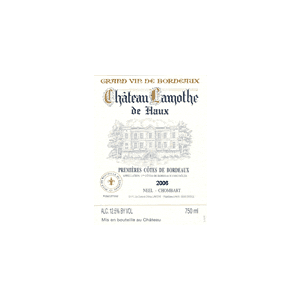
| Château Lamothe de Haux Premières Côtes de Bordeaux 2006 – France | 2 Reds |
| Rockbare McLaren Vale Chardonnay 2007 – Australia | 2 Whites |
Master Series |
|
Featured Wineries & Wines |
Membership Type |
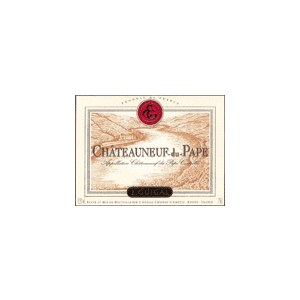
| Guigal Châteauneuf-du-Pape 2005 – France | 1 Red 1 White; 2 Reds |
| Château Lamothe de Haux Bordeaux Blanc 2008 – France | 1 Red 1 White |
| Friends.Red Sonoma County Red 2007 – USA | 2 Reds |
Collector Series |
|
Featured Wineries & Wines |
Membership Type |
| Guigal Châteauneuf-du-Pape 2005 – France | 1 Red 1 White; 2 Reds |
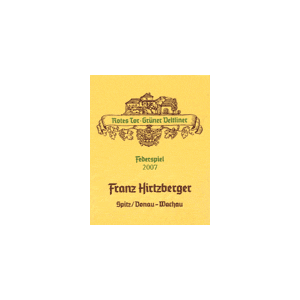
| Franz Hirtzberger Rotes Tor Federspiel Gruner Veltliner 2007 – Austria | 1 Red 1 White |
| Guigal Gigondas 2005 – France | 2 Reds |
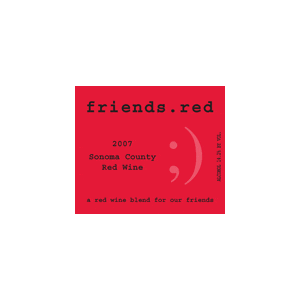
Friends.Red Sonoma County Red 2007 – USA
Friends.Red is more than a wine: it is a tribute to good friends.Friends was created to pay homage to Giovanni Pedroncelli, the founder of Pedroncelli winery, and his many friends.Friends.Red grew out of the friendships the Pedroncelli family shared with their Sonoma County neighbors, namely the Murphys, Goodes, and other local grape growers and farmers. “Our friends often recall the days when our father welcomed them to the cellar,” recount Jim and John Pedroncelli.“They’d share stories over a smooth drinking glass of red wine.More important than the varietal were the friendships.In honor of this tradition, we’ve created this blend we call Friends to share with our friends and yours.”
The Friends venture was first launched in 2001 when it debuted at various charity auctions.Friends.Red is a proprietary blend that always includes some Zinfandel.The grapes for Friends come from Pedroncelli’s own estate, with not surprisingly some additions from friend’s vineyards.The current 2007 release is an artful blend of Merlot, Zinfandel, and Cabernet Franc that has been aged 16 months in French and American oak.
The original label for Friends featured a friendship bracelet as a symbol of peace and good will. Native Americans often used handcrafted artifacts like the friendship bracelet as a sign of their friendship and fidelity to others. Today, a friendship bracelet is often exchanged between best friends as a reminder to each that their friendship is meant to endure forever. Not surprisingly, the friendships between the Pedroncelli family and their many neighbors and friends have endured for decades, all of which give testimony to the Pedroncellis’ good faith as well as their commitment to producing authentic, smooth tasting Sonoma County wines.
Tasting Notes: A unique blend of Sonoma County Merlot, Zinfandel, and Cabernet Franc, the 2007 Friends.Red Zinfandel is a plush, smooth, almost huggable red wine. Rich in color and pleasantly aromatic, this medium bodied wine offers up an enticing bouquet of berry fruits, bramble, and forest woodlands. In the mouth, all that is appealing in each of the varietals in Friends.Red comes to fore and blends harmoniously together as one. In doing so, they offer the palate an array of tasty blueberry, blackberry, and chocolate flavors, which are infused with smooth oak and vanilla tones. Best of all, this “Friend” exits without a bark or a bite – a fitting tribute to Giovanni Pedroncelli and his family’s many friends. The 2007 Friends.Red makes one appreciate the gift of friendship and wish for a bottle of this special wine for every night of the week… then just think of how many new friends you could make! Enjoy the 2007 Friends.Red at cool cellar temperature (55-60 degrees Fahrenheit). Although immediately gratifying, this fine red is at its best after at least 15-20 minutes of aeration.
Accompaniments: As smooth and flavorful as the 2007 Friends.Red is, it provides the perfect go-anywhere, pour-anytime kind of wine. It is an ideal party wine as it pleases the initiated and uninitiated palate alike. Furthermore, we see it as the ultimate midweek respite from the trials and tribulations of those who are less than amiable. In other words, at the end of a long day, we like to open a bottle of Friends.Red to share with friends as well as some hearty, home cooking. We find this wine especially enjoyable with the delights of an Italian kitchen. Eggplant Parmigiana, Parmesan infused risottos, Beef Braciole, and homemade pastas, served with plenty of fresh, herb infused tomato sauce are just a few of our favorites. A hearty Pasta Primavera or Spaghetti Bolognese makes another fine accompaniment. Ravioli, stuffed with ricotta, spinach, zucchini, and Parmesan cheese and topped with chopped fresh tomatoes, mushrooms, garlic, and capers pairs beautifully with Friends.Red as well. However, as fine as these Italian specialties are with this wine, Friends.Red pairs equally well with other foods, too, including pork barbecue, meatloaf, and even moderately spicy Middle Eastern specialties such as tabouli. In fact, we enjoy the Friends.Red with almost everything, or nothing at all, because it is one smooth, good old-fashioned drinking wine. Enjoy!
For the Love of Cheese: For one of life’s great treats, we suggest you invite a friend or two over, open a bottle or more of the 2007 Friends.Red, and serve some ripe artisanal cheeses to accompany that very smooth glass of red wine. Farmer’s cheese, Monterrey Jack, Gorgonzola, and Muenster are just a few well made cheeses that pair nicely with the 2007 Friends.Red. For additional suggestions or to find out how to acquire perfectly aged cheeses, please contact us at www.cheesemonthclub.com.
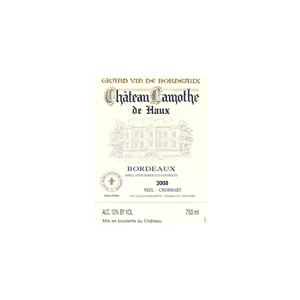
Château Lamothe de Haux Bordeaux Blanc 2008 – France
Château Lamothe de Haux is a splendid wine estate and country manor whose origins date to the 17th century. It is one of the most impressive, poetic pieces of the picturesque Premières Côtes of Bordeaux. Château Lamothe was renovated in the 19th century and is now the charming home of the Néel-Chombard family who own and manage this property along with neighboring Château Sauvage and nearby Château Manos.
The splendor of Château Lamothe de Haux begins with its imposing position. It sits atop a rocky spur that is surrounded by vines. When viewed from the vineyard, the Château and nearly two hundred acres of surrounding vines appear as a ship, plying the open waters of the sea. Situated in an undulating sea of vines, Château Lamothe is caressed by the light of the rising and setting sun – the perfect Bordeaux terroir for the cultivation of the vine.
Although Château Lamothe itself dates only to the 17th century, the vine and the spirit of wine have thrived in the picturesque part of the Premières Côtes de Bordeaux where Château Lamothe now sits since Gallo-Roman times. This area was also once an important stop-over for the annual throng of pilgrims on their way to Santiago de Compostella, one of medieval Christendom’s greatest pilgrimage sites. Today, the fusion of sun and earth produce the alchemy that draws visitors to its caves and render the wines of Château Lamothe so endearing.
The Néel-Chombard family and their trained winegrowers and enologists, Anne, Fabrice, Maria, and Damien, fashion wonderful white and red Bordeaux at Château Lamothe. As with many family owned Bordeaux estates, there is equal attention paid to white and red wine here and both are made in considerable quantity. The Château Lamothe Blanc is a traditional blend of three white Bordeaux grape varieties: Sauvignon Blanc (40%), Sémillon (40%), and Muscadelle (20%). The latter varietal is an authentic Bordeaux variety from which dry white wine is fashioned; it bears no relation to Moscatel, the sweet insipid wine of old. Similarly, the Château Lamothe Rouge combines the three long-established red Bordeaux varietals into an artful blend. In a normal vintage, the traditional red cuvee is comprised of Merlot (60%), Cabernet Sauvignon (30%), and Cabernet Franc (10%).
As impressive as Château Lamothe is above ground, it is even more remarkable from below. From hidden entrances carved into solid rock, the cellars of this château descend nearly two hundred feet beneath the ground. Originally excavated in the 17th century, the stone from this enormous cellar was used to construct many of the classic elegant buildings that today render the nearby city of Bordeaux so attractive. In the place where rock alone once resided, there now rests the elegant and generous wines of Château Lamothe. The Néel-Chombard family best captures this transformation in the last line of an ode composed by the family:
“Every bottle of our wine perpetuates a long love story
Between sky, earth, and men…”
Tasting Notes: Ethereal, flavorful, and delightfully uncomplicated, the 2008 Château Lamothe de Haux Bordeaux Blanc embodies all the attributes of the finest white Bordeaux. A glint of the sun and a pale yellow hue capture in each glass of this wine the radiance of summer, and then set the table for more sprightly pleasure to come. Although always consistent in quality from vintage to vintage, the 2008 Château Lamothe appears to be this estate’s finest Bordeaux Blanc to date. For starters, this wine’s seductive aroma is worth the price of admission. It offers up a delightful mélange of grapefruit, melon, pineapple, aromatic herbs, and freshly mown grass. Elegant, round, and immediately ingratiating, the 2008 Château Lamothe Blanc slips ever so easily down the thirsty throat and begs the unresisting arm to bend in order to have the pleasure of another quaff. In short, the 2008 Château Lamothe is simply irresistible, from its enticing olfactory to its gratifying finish. For optimum enjoyment, we suggest serving the 2008 Château Lamothe Blanc fairly well chilled (about 40° F). However, we must confess to enjoying this classy white Bordeaux equally at a more ambient temperature, so as you like it!
Accompaniments: The 2008 Château Lamothe Bordeaux Blanc needs only a clean glass to shine; it could easily compete for top billing as the perfect aperitif. In an ideal world, we would place a glass of the 2008 Château Lamothe Blanc in every hand to start the evening’s festivities, refill that glass, and then set a second bottle at table to be consumed after dinner with soft, creamy cow’s milk cheeses such as Brie, Camembert, or Comté. On second thought, why wait until so late in the evening to re-serve this seductive white Bordeaux? It pairs beautifully with smoked salmon, sautéed oysters, grilled shrimp or scallops, and most other seafood specialties as well. Heartier fare won’t cause it to fade either. We are especially fond of the Lamothe Blanc in the company of a baked breast of chicken, stuffed with a breadcrumb, herb, and Parmesan dressing, so as you like it. Bon appétit!
Château Lamothe de Haux Premières Côtes de Bordeaux 2006 – France
Château Lamothe de Haux is a splendid wine estate and country manor whose origins date to the 17th century. It is one of the most impressive, poetic pieces of the picturesque Premières Côtes of Bordeaux. Château Lamothe was renovated in the 19th century and is now the charming home of the Néel-Chombard family who own and manage this property along with neighboring Château Sauvage and nearby Château Manos.
The splendor of Château Lamothe de Haux begins with its imposing position. It sits atop a rocky spur that is surrounded by vines. When viewed from the vineyard, the Château and nearly two hundred acres of surrounding vines appear as a ship, plying the open waters of the sea. Situated in an undulating sea of vines, Château Lamothe is caressed by the light of the rising and setting sun – the perfect Bordeaux terroir for the cultivation of the vine.
Although Château Lamothe itself dates only to the 17th century, the vine and the spirit of wine have thrived in the picturesque part of the Premières Côtes de Bordeaux where Château Lamothe now sits since Gallo-Roman times. This area was also once an important stop-over for the annual throng of pilgrims on their way to Santiago de Compostella, one of medieval Christendom’s greatest pilgrimage sites. Today, the fusion of sun and earth produce the alchemy that draws visitors to its caves and render the wines of Château Lamothe so endearing.
The Néel-Chombard family and their trained winegrowers and enologists fashion wonderful white and red Bordeaux at Château Lamothe. As with many family owned Bordeaux estates, there is equal attention paid to white and red wine here and both are made in considerable quantity. The Château Lamothe Blanc is a traditional blend of three white Bordeaux grape varieties: Sauvignon Blanc (40%), Sémillon (40%), and Muscadelle (20%). The latter varietal is an authentic Bordeaux variety from which dry white wine is fashioned; it bears no relation to Moscatel, the sweet insipid wine of old. Similarly, the Château Lamothe Rouge combines the three long-established red Bordeaux grape varieties into an artful meritage. The red Bordeaux is a traditional cuvee comprised of 60% Merlot, 30% Cabernet Sauvignon, and 10% Cabernet Franc.
Tasting Notes: The 2006 Château Lamothe de Haux Premières Côtes de Bordeaux sports a bright ruby robe, soft scented bouquet, and friendly up front flavors, which make it one very pleasing, easy drinking claret for here and now. If you are expecting a tannic monster whose attributes lie in the distant future, you would do well to look elsewhere. Instead, the 2006 Château Lamothe de Haux Premières Côtes de Bordeaux is all about fine, every day drinking – right now. This is the style of red Bordeaux that the Néel-Chombard family and the best châteaux of the Premières Côtes de Bordeaux do best. It offers a pleasing aromatic profile of crushed berries, cedar, loam, and mulberry. Is this the kind of red wine that made Bordeaux famous centuries ago for good old-fashioned drinking? We suggest serving this claret at cool room temperature (at no more than 60º -65º F), after just a few minutes of aeration.
Accompaniments: Light, savory dishes of chicken, pork, or veal accompanied by a medley of finely diced carrots, celery, haricots verts, olive oil, and spices offer superb accompaniments to the 2006 Château Lamothe de Haux Premières Côtes de Bordeaux. A plain or lightly grilled veal chop provides another excellent complement to the sprightly Château Lamothe de Haux Premières Côtes de Bordeaux. Spit or rotisserie roasted chicken makes for good company as well. Fusilli pasta, topped with grilled chicken or tuna, fresh cherry tomatoes, and a light cream sauce, highlights the attributes of this classy claret, too. Light to medium flavored cow’s milk cheeses will also provide satisfying company, so sit back, pop the cork, pour a glass, and enjoy authentic claret. Salut!
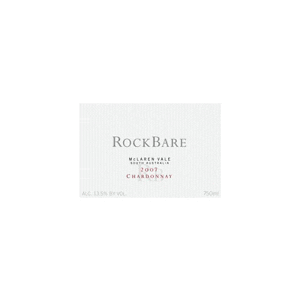
Rockbare McLaren Vale Chardonnay 2007 – Australia
Rockbare is one of the most consistent Australian producers of Chardonnay and Shiraz. The handiwork of Tim Burvill, Australian winemaker extraordinaire, Rockbare fashions outstanding McLaren Vale wines. McLaren Vale is a relatively small viticultural area of South Australia that is known for its premium grapes and its abundance of meticulously tended, family owned vineyards, which not surprisingly turn out some of the very finest wines Australia has to offer.
Tim Burvill has run the gamut in Australian viticulture. He gained extensive winemaking experience working at Southcorp, one of Australia’s leading wine conglomerates, where he was responsible for making what many consider to be Australia’s most exciting and expensive premium Chardonnay Yattarna. Equally well versed with red and white wines, as well as the merits of technical razzle-dazzle, Tim made a conscious effort when he created the Rockbare label in 2000 to eschew technical homogeneity along with the smoke and mirrors employed by so many other Australian winemakers. Instead, he employs winemaking techniques at Rockbare that were more in vogue a century or more ago. Using minimal filtering, or even a no filtration approach, and very little oak, Tim does not obscure or obliterate the great McLaren fruit he sources from the region’s premier vineyards. Instead, Rockbare’s wines are filled with complex flavors driven by outstanding fruit and natural acidity, not some wine technocrat’s rendition of the Molotov cocktail.
Rockbare puts all of its attention into producing just two outstanding McLaren Vale offerings: Shiraz and Chardonnay. Both varietal offerings are produced from 100% McLaren Vale fruit, much of it from old vines that are dry-farmed. Taste and see why critics continuously rate Rockbare wines in the top echelon!
Tasting Notes: Once again Tim Burvill has fashioned an exceptional wine in Rockbare’s 2007 McLaren Vale Chardonnay. Pale yellow with a glint of sunlight, the vibrant 2007 Rockbare Chardonnay appears radiant and even regal in the glass. Even more exciting is the aroma this wine exudes – a delicate yet seductive bouquet of freshly baked bread, caramel and mountain apples. However, the best is yet to come: the 2007 Rockbare Chardonnay offers a complex, refreshing mouthful of pure elegant Chardonnay fruit, pinpoint minerality, and delicious finely integrated oak tones that complement the rest of the wine, rather than dominate it. In short, Rockbare has fashioned another seamless, European style Chardonnay in McLaren Vale that is both complex and dry. But no surprise here, Tim Burvill has been working his magic with Chardonnay at Rockbare from day one. And certainly the flamboyant, medium-bodied 2007 Rockbare Chardonnay can stand with the best New and Old World Chardonnays. For optimal enjoyment, we suggest you serve this elegant, flavorful Chardonnay only lightly chilled (about 50º F), in the manner of the best white wines of Burgundy. In this case the lesser the chill, the greater the thrill. Indeed, it would be a shame to miss any of the subtle charm and complexity that the 2007 Rockbare McLaren Vale Chardonnay has to offer by over chilling.
Accompaniments: The 2007 Rockbare McLaren Vale Chardonnay provides the ideal complement to all kinds of shellfish, white fish, and poultry. It shines at a dinner party, especially in the company of Alaskan king crab claws, lobster, or steamed oysters in a creamy garlic sauce. Clams, shrimp, and scallops provide equally fine accompaniments. But rest assured fruits de mer are not the only noteworthy complements to the 2007 Rockbare Chardonnay. A simple Parmesan crusted chicken breast or crispy chicken fritters with a honey Dijon glaze pair well with this wine, too, as does a vegetable and feta cheese stuffed acorn squash. Freshly cut apples and pears that are served with a soft cheese such as Bel Paese, Cheddar or Gruyere provide another wonderful accompaniment as Chardonnay is truly one of the ideal complements to cheese. Enjoy!
Guigal Châteauneuf-du-Pape 2005 – France
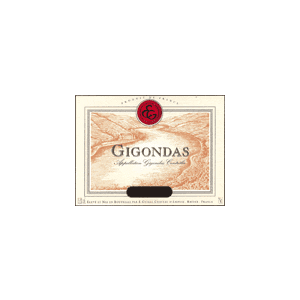
You may have heard us say this before, but it is worth repeating: Marcel Guigal and his son Philippe have once again raised the bar in the southern Rhône with a string of outstanding wines in 2005, not the least of which is their formidable 2005 Gigondas. With the release of their 2005 Gigondas, Guigal has demonstrated why this family owned domain receives so much praise and adulation. Marcel has also demonstrated that he is as equally adept at producing point-of-reference wines in the southern Rhône Valley as he is in Côte Rôite, Hermitage, and St, Joseph to the north. It is no wonder then that Marcel Guigal has been called everything from “the man with the Midas touch” to “the planet’s greatest living winemaker.” Unquestionably, Guigal has earned the reputation for fashioning many of southern France’s most exciting wines, as the flood of favorable reviews and critical acclaims of his wines will attest. Yet, perhaps, even more impressive is Guigal’s knack for consistency. Without fail, Guigal’s wines, whether they are red, white, or rosé, top the charts in both good years and bad. Moreover, Guigal’s many outstanding wines have become the benchmarks by which all others are judged in their respective appellations.
Gigondas: One Small Town With One Big Beautiful Wine
Gigondas and the neighboring villages of Vacqueyras and Châteauneuf-du-Pape produce the finest red wines of the southern Rhône. Relying upon old vines of Grenache, married to lesser quantities of Syrah, Mourvèdre, and Cinsault, the sleepy little village of Gigondas turns out a startling array of big, beautiful, and tasty reds from nearly 2,500 acres of vineyards. Spanning a combination of soils, from the gravelly clay of the flat plains at the base of the craggy Dentelles de Montmirail, to the sheer bedrock of the Dentelles themselves, Gigondas is testament to the belief that in this enchanted corner of Provence one can even extract blood from stones, in the form of deeply colored wine known as Gigondas.
Originally the premier village in the sprawling Côtes du Rhône-Villages appellation, Gigondas was awarded its own appellation in 1971. Quickly, Gigondas made a name for itself, and after several decades of notoriety, the wine that bears the name of Gigondas has become a staple on astute restaurant wine lists the world over. Yet, the village of Gigondas itself remains one of the prettiest and least spoiled of the comely hilltop villages in this corner of Provence known as the Vaucluse. Nevertheless, Gigondas is a wine that has captured the palate of critics and savvy consumers alike. Today, the wines of Gigondas are highly sought after in fine wine shops around the world and they are increasingly well represented at upscale restaurants, whose clientele can appreciate the bold, extroverted, savory nature of this appellation’s red wine. For the record, tiny quantities of white and rosé wine are also made in Gigondas, but only the red wine of this endearing appellation is entitled to the name Gigondas.
Tasting Notes: A deeply colored, full-bodied red wine, the 2005 Guigal Gigondas exhibits as much charm as vigor. Built along the lines of Marcel Guigal’s now legendary Châteauneuf-du-Papes, this Gigondas possesses a rich ruby/purple robe and a flamboyant bouquet that offers a cachet of rose petals, violets, and the deep down scents of kirsch and crème de cassis to tantalize the olfactory. In the mouth, this Gigondas is broad and expansive, with a core of black fruits and spice neatly wrapped around silky tannins. Although big and powerful, Guigal’s 2005 Gigondas retains charm and elegance and exhibits far more polish than most other Gigondas. In short, Guigal’s 2005 Gigondas is happily devoid of the overt rusticity that dominates some of the more “traditional” wines of Gigondas. However, this wine will continue to mature for at least several more years in bottle. It also unfolds beautifully in the glass with just 15-20 minutes of aeration. As with all quality Rhône offerings, we suggest serving this wine cool, somewhere between cellar and room temperature, but certainly no more than 66° F.
Accompaniments: One of the delights of high quality Rhône wine is its versatility with food, and Guigal’s 2005 Gigondas is no exception. Whether it is served with red meat or white, a flavorful stew or a rich lentil or bean dish, you can count on this wine to add to the occasion. One of our favorite pairings with this Gigondas is roast chicken, basted with cream and Provencal herbs, and served with giblet gravy and a savory bread stuffing. Cassoulet, sausage and peppers, steak au poivre, and a carefully prepared roast leg of lamb that has been rubbed with fresh garlic and thyme provide other memorable moments with Guigal’s outstanding 2005 Gigondas. We also think classic Italian favorites shine equally well with Guigal’s Gigondas and that includes everything from painstaking Piedmontese risottos to the tomato laden classics of southern Italy, so enjoy the 2005 Guigal Gigondas as you like it!
Franz Hirtzberger Rotes Tor Federspiel Gruner Veltliner 2007 – Austria
Franz Hirtzberger and his family live in a 600 year old house at the base of the legendary Singerriedl Vineyard in Austria’s storybook Wachau Valley. Hirtzberger’s winery is located in the village of Spitz, at the far western end of the Wachau where the mighty Danube falls down out of the nearby mountains and flows broadly below the steep green walls of the valley. All of Franz Hirtzberger’s vineyards are steep hillside affairs, exposed to the wind and sun, and each reflects a unique terroir and the dignified, experienced hand of a master at work.
It is rarely accurate and often senseless to categorize one estate as the very best in any locale, as always there are a half dozen or more superior winemakers in any sizable appellation whose wines stand above the crowd. Great wine is always about great vineyards that produce grapes of unique quality and physiological ripeness. Great winemaking is also about respecting the vintage and the special attributes of the grapes one has to work with. These simple truths constitute brilliant winemaking, so if we measure winemakers by these standards there is no finer winemaker in the entire Wachau than Franz Hirtzberger.
Franz Hirtzberger can attribute at least some of his expertise in winemaking to his father, the founder and current President of Vinea Wachau Nobilis Districtus, the organization that preserves the quality of Wachau wines. The Hirztbergers produce all of the classic Wachau styles of wine from traditional Austrian varietals that include Gruner Veltliner, Riesling, Weissburgunder, and Grauburgunder. They use only natural, wild yeasts from their vineyards and are as meticulous in the cellar as they are in the vineyard, and therein lies the difference. Hirtzberger’s Honivogl, Rotes Tor, and Singerriedl are the single vineyard jewels in the Hirtzberger crown.
Wachau (va-cow)
Along the flow of the Danube, as it passes out of the mountains and courses towards Vienna and the East, lies a fortunate and idyllic set of curves in the river. Here the Danube widens and slows, passing smoothly and calmly by the small villages and mighty terraced hillsides that are known as the Wachau Valley. Renowned for centuries as a prime location for the growing of many vine and tree fruits as the slopes at this enchanted place along the river provide access to long days of sunlight and the fresh cool breezes from the forests just to the north, this small region has vaulted in the past two decades to the forefront of quality in the production of Austrian wines.
It is in the Wachau that a group of growers founded 25 years ago the Vinea Wachau Nobilis Districtus, a growers’ association to protect and promote the unique character of the valley’s wines. Within the range are allowed three categories: Steinfeder (meaning the lightest or “feather light”) – which are easy drink wines that are mostly consumed locally; Federspiel (named for the instrument used in the call and tether aspect of falconry) – exemplary of a house style, these are the classic wines of the middle harvest that can be enjoyed young or after several years of aging; and Smaragd (“Emerald” for the small green lizards that live on the stone terraces of the vineyards) – the reserves, the “jewels” of the region, typically single vineyard designated wines of more than 12.5% alcohol that are capable of long term aging and development. They are typically higher in alcohol than Federspiel and often contain a hint of residual sugar as well, making Federspiel wines the more sought after on this side of the Atlantic.
Gruner Veltliner: An Austrian Icon
Gruner Veltliner is Austria’s most important white grape variety. Moreover, it has recently garnered iconic status as the magical varietal behind one of the world’s most unique wines. Grown in nearly all of the major wine producing regions of Austria, Gruner Veltliner is at its best around Vienna and atop the steep hillsides above the Danube to the north and west of the capital. In the hands of a fine winemaker, Gruner Veltliner yields a concentrated, complex wine that is capable of long maturation. It offers tremendous flavor, rich fruit, spicy accents, and a citrus like freshness that make it a perfect match for many difficult to pair dishes. So, whether dinner includes traditional Viennese fare, a scrumptious pâté, Asian stir fry, or just a plain old persnickety vegetable such as asparagus, Gruner Veltliner is the perfect wine to serve.
Tasting Notes: Wines often express not only the personality of the vineyard but also the character of the winemaker. And this is certainly true of Hirtzberger. The 2007 Hirtzberger Rotes Tor Federspiel Gruner Veltliner is as focused, elegant, and refined as its creator, but its most defining attribute is that its greatness is understated. Franz Hirtzberger’s 2007 Rotes Tor Gruner Veltliner is a polished, dignified Gruner Veltliner. It exhibits an amplifying bouquet, redolent with the soft scents of spring flowers and subtle spices. Rich in flavor, long in the mouth, and perfectly balanced, this wine need not scream for attention. Its greatness lay in what it does not say. It dazzles with a harmony of sophisticated flavors and a long lingering finish that made us beg for more. Enjoy!
Accompaniments: With a wine as accessible and profoundly easy to drink as the 2007 Hirtzberger Rotes Tor Federspiel Gruner Veltliner, a clean glass is all one needs to empty a bottle, but alas . . . that would be greedy. So, why not phone friends, set the table, and prepare a special meal. Sea Scallops, sautéed in a delicate cream sauce with roasted pecans or pistachios; Stir Fried Vegetables with cashews; Poached Sea Bass, served with white asparagus and thinly shaved prosciutto; and Thai Chicken and Basil, served with a medley of lightly spiced vegetables are just a few of our favorite pairings with Franz Hirtzberger’s delectable Gruner Veltliner. Veal Medallions, sautéed in butter and white wine, provides another excellent accompaniment. Most soft cheeses and light meats offer winning combinations with the Hirtzberger Gruner Veltliner as well. Prost!
You may have heard us say this before, but it is worth repeating: Marcel Guigal and his son Philippe have once again raised the bar in the southern Rhône with a string of outstanding wines in 2005, not the least of which is their formidable 2005 Gigondas. With the release of their 2005 Gigondas, Guigal has demonstrated why this family owned domain receives so much praise and adulation. Marcel has also demonstrated that he is as equally adept at producing point-of-reference wines in the southern Rhône Valley as he is in Côte Rôite, Hermitage, and St, Joseph to the north. It is no wonder then that Marcel Guigal has been called everything from “the man with the Midas touch” to “the planet’s greatest living winemaker.” Unquestionably, Guigal has earned the reputation for fashioning many of southern France’s most exciting wines, as the flood of favorable reviews and critical acclaims of his wines will attest. Yet, perhaps, even more impressive is Guigal’s knack for consistency. Without fail, Guigal’s wines, whether they are red, white, or rosé, top the charts in both good years and bad. Moreover, Guigal’s many outstanding wines have become the benchmarks by which all others are judged in their respective appellations.
Gigondas: One Small Town With One Big Beautiful Wine
Gigondas and the neighboring villages of Vacqueyras and Châteauneuf-du-Pape produce the finest red wines of the southern Rhône. Relying upon old vines of Grenache, married to lesser quantities of Syrah, Mourvèdre, and Cinsault, the sleepy little village of Gigondas turns out a startling array of big, beautiful, and tasty reds from nearly 2,500 acres of vineyards. Spanning a combination of soils, from the gravelly clay of the flat plains at the base of the craggy Dentelles de Montmirail, to the sheer bedrock of the Dentelles themselves, Gigondas is testament to the belief that in this enchanted corner of Provence one can even extract blood from stones, in the form of deeply colored wine known as Gigondas.
Originally the premier village in the sprawling Côtes du Rhône-Villages appellation, Gigondas was awarded its own appellation in 1971. Quickly, Gigondas made a name for itself, and after several decades of notoriety, the wine that bears the name of Gigondas has become a staple on astute restaurant wine lists the world over. Yet, the village of Gigondas itself remains one of the prettiest and least spoiled of the comely hilltop villages in this corner of Provence known as the Vaucluse. Nevertheless, Gigondas is a wine that has captured the palate of critics and savvy consumers alike. Today, the wines of Gigondas are highly sought after in fine wine shops around the world and they are increasingly well represented at upscale restaurants, whose clientele can appreciate the bold, extroverted, savory nature of this appellation’s red wine. For the record, tiny quantities of white and rosé wine are also made in Gigondas, but only the red wine of this endearing appellation is entitled to the name Gigondas.
Tasting Notes: A deeply colored, full-bodied red wine, the 2005 Guigal Gigondas exhibits as much charm as vigor. Built along the lines of Marcel Guigal’s now legendary Châteauneuf-du-Papes, this Gigondas possesses a rich ruby/purple robe and a flamboyant bouquet that offers a cachet of rose petals, violets, and the deep down scents of kirsch and crème de cassis to tantalize the olfactory. In the mouth, this Gigondas is broad and expansive, with a core of black fruits and spice neatly wrapped around silky tannins. Although big and powerful, Guigal’s 2005 Gigondas retains charm and elegance and exhibits far more polish than most other Gigondas. In short, Guigal’s 2005 Gigondas is happily devoid of the overt rusticity that dominates some of the more “traditional” wines of Gigondas. However, this wine will continue to mature for at least several more years in bottle. It also unfolds beautifully in the glass with just 15-20 minutes of aeration. As with all quality Rhône offerings, we suggest serving this wine cool, somewhere between cellar and room temperature, but certainly no more than 66° F.
Accompaniments: One of the delights of high quality Rhône wine is its versatility with food, and Guigal’s 2005 Gigondas is no exception. Whether it is served with red meat or white, a flavorful stew or a rich lentil or bean dish, you can count on this wine to add to the occasion. One of our favorite pairings with this Gigondas is roast chicken, basted with cream and Provencal herbs, and served with giblet gravy and a savory bread stuffing. Cassoulet, sausage and peppers, steak au poivre, and a carefully prepared roast leg of lamb that has been rubbed with fresh garlic and thyme provide other memorable moments with Guigal’s outstanding 2005 Gigondas. We also think classic Italian favorites shine equally well with Guigal’s Gigondas and that includes everything from painstaking Piedmontese risottos to the tomato laden classics of southern Italy, so enjoy the 2005 Guigal Gigondas as you like it!