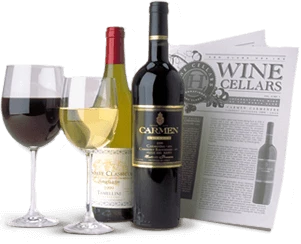
Welcome to The International wine of the Month Club

Featured Wines

February 2008

Premier Series
Featured Wineries & Wines
Membership Type
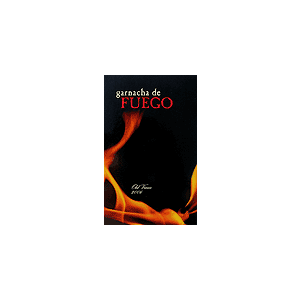
Bodegas Ateca Garnacha de Fuego Old Vines 1 Red 1 White; 2 Reds
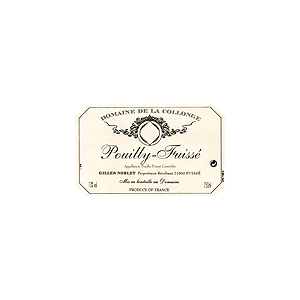
Domaine de la Collonge Pouilly-Fuissé 1 Red 1 White; 2 Whites
Château Thieuley Bordeaux Rouge 2 Reds
Kracher Illmitz Pinot Gris 2 Whites


Master Series
Featured Wineries & Wines
Membership Type
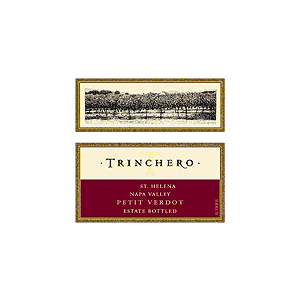
Trinchero St. Helena Napa Valley Estate Petit Verdot 1 Red 1 White; 2 Reds
Domaine de la Collonge Pouilly-Fuissé 1 Red 1 White
Bodegas Ateca Garnacha de Fuego Old Vines 2 Reds


Collector Series
Featured Wineries & Wines
Membership Type
Trinchero St. Helena Napa Valley Estate Petit Verdot 1 Red 1 White; 2 Reds
Loimer Estate Steinmassl Riesling 1 Red 1 White
Fattoria Le Caselle Tuttosole 2004 Syrah 2 Reds

Bodegas Ateca Garnacha de Fuego Old Vines 2006 – Spain

Bodegas Ateca Garnacha de Fuego Old Vines 2006 – SpainBodegas Ateca is a collaborative effort on the part of Jorge Ordonez, the renowned importer of Spanish wines, and Miguel Gil of Bodegas Juan Gil. Together, they craft the 2006 Garnacha de Fuego Old Vines. The bodega, named after the village of Ateca in the municipality of Calatayud, Spain, focuses on bringing the quality of old vine Garnacha (also known Grenache) to the table. This premium venture debuted with the 2005 vintage, but already it has earned tremendous critical acclaim.

The secret to Garnacha de Fuego is the old, shy bearing, tree-like vines of Garnacha that Ordonez and Gil use to make their magical wine. Many of Garnacha de Fuego's vines are approaching 100 years of age, with no grapes from vines less than 55 years of age allowed in the blend. The decision to tap the region's ancient Garnacha vines contributes immensely to the rich quality and intensity of Ateca's Garnacha de Fuego. In addition, the venerable old vines of Garnacha de Fuego are all situated in the full sun on the south facing slopes of the Sierra de la Virgen range. On these slopes, at an elevation of 3,000 feet, the grapes develop physiological ripeness and full, round flavors. A combination of old vines, superb terroir, and the well-honed winemaking skills of Miguel Gil add up to a boon for savvy consumers.

Both Jorge Ordonez and Miguel Gil are familiar names to those seeking high quality and great value in Spanish wine. These gentlemen are responsible for bringing a treasure trove of great tasting high quality Spanish wines to American tables. One such example is Gil's Wrongo Dongo, a 100% Monastrell (aka. Mourvèdre) that has garnered considerable critical notice and ample affirmation from consumers, too. Jorge Ordonez, an advocate for Spanish wines, has similarly done much to promote Spain's wines in America and to modernize and bring consistency to the wine-making practices of many Spanish grape growers and wine makers. In the case of the 2006 Garnacha de Fuego Old Vines, we are especially grateful.

Garnacha

Garnacha, Spanish for the varietal commonly known by its French name Grenache, is Spain's most planted grape variety. Although ubiquitous, Garnacha is most often blended by Spanish winemakers with other varietals, so much so that it rarely stands alone as a 100% varietal. Because of its thin skin and ability to tolerate extremely hot conditions, the grape ripens slowly to develop high sugar content. The result is that Garnacha produces a fruity profile complemented by a spicy quality that makes it a perfect palette upon which to paint. It can either mellow out highly tannic varietals with its fruit, or add character to thinly structured varietals. In addition, its thin skin carries relatively little pigment, so it doesn't drastically affect the coloring of a wine when it's blended. Yet, from ancient vines grown in an ideal terroir Garnacha can be majestic on its own, as the great Château Rayas and a bevy of other Grenache based, old vine Châteauneuf-du-Papes can attest.

Thanks to Jorge Ordonez who has promoted Spanish Garnacha as a stand-alone 100% varietal, the wine market is now enjoying pure varietal examples of Grenache such as the 2006 Garnacha de Fuego. Blessed by optimal growing conditions in Calatayud, mature old vines, and modern wine-making techniques, the Bodegas Ateca is proving that Garnacha is more than worthy of standing on its own two legs. After a strong start, we're also predicting that Bodegas Ateca will continue to produce quality Garnacha at a reasonable cost. For this, we are extremely grateful.

Tasting Notes: The 2006 Garnacha de Fuego Old Vines stands apart as an amazingly good value and a fine example of the wine maker's art. Following an extremely well received 2005 vintage, which garnered high praise indeed from The Wine Spectator, the 2006 edition offers a remarkable reprise. A clean aroma of black cherry overlaying a hint of old saddle leather lets us know that this is no ordinary wine. Once on the tongue, the clean and tightly wound character of the 2006 Garnacha de Fuego Old Vines impresses. The dark cherry note from the nose reveals itself, too, in the mid palate, where it mingles with a cornucopia of red fruits and subtle earth tones, before sliding gracefully across the palate on the wings of a wonderfully composed, spicy structure. A tight finish characterized by oriental spice and white pepper completes the experience of this dry, medium-bodied 100% Garnacha wine. Wines such as the 2006 Garnacha de Fuego Old Vines make us smile for two reasons. At its price, it affirms the democratic ideal–that quality wine is accessible to all. And it reconfirms the adage that one can't drink a price tag or a label. The contents of the bottle are what matter, and here we have a winner!

Accompaniments: The 2006 Garnacha de Fuego Old Vines combines well with easy-to-make dinners, so don't wait until the weekend to uncork a bottle. Appetizers, such as grilled mushrooms or prosciutto with melon (honeydew or cantaloupe) complement the fruit and earth qualities of the Garnacha de Fuego. Served with steak, grilled tuna, or other meaty fish–even a gourmet burger–the wine will round out a filling meal. Pleasing sauce and spice flavors include cranberry and sage for those of you on the hunt for your own recipes. For pasta and cheese lovers, a quick and simple gnocchi with gorgonzola–our feature recipe–always makes us pause and smile in the middle of a bustling work week. Enjoy!

Domaine de la Collonge Pouilly-Fuissé 2006 – France

Domaine de la Collonge Pouilly-Fuissé 2006 – FranceGilles Noblet at Domaine de la Collonge continues to fashion some of the Macon's (the area of southern Burgundy that is known for its elegant Chardonnay wines) finest and most enjoyable white wines from several renowned appellations. Noblet's Domaine de la Collonge is a small family owned and run domain of only 22 acres. Gilles is the fourth generation member of his family to make wine at this prized property. For the record, Gilles' wife also comes from a traditional winemaking family. Madame Noblet is the sister of Jacky Janodet, the present dean of Grand Cru Beaujolais, so wine and winemaking run deep in the heart and soul of this couple as well as in the terroir of the domaine's well-tended vineyards.

The name Domaine de la Collonge derives from the sector or area (known as an aire) of the Fuissé commune that is called Collonge. Most of Gilles Noblet's estate is spread along the hills of la Collonge, which yield on average only a little more than six thousand cases of Pouilly-Fuissé each year. However, Monsieur Noblet also fashions small quantities of exceptional Macon-Fuissé, Pouilly-Loché, and St. Véran – all elegant Chardonnay based wines similar to Pouilly-Fuissé.

Although not certified organic, Gilles Noblet practices sustainable agriculture and uses non-interventionist methods almost exclusively at Domaine de la Collonge. No artificial fertilizers or insecticides are employed, and only natural yeast is used in fermentation. Moreover, the average age of the vines for Domaine de la Collonge is more than forty years, while many vines are considerably older. Noblet's old vines and reduced yields result in wines that are more generous and concentrated than the average Maconnais white.

In appellations that traditionally turn out large quantities of wine, Gilles Noblet decided a long time ago to dance to a different beat. Rather, the Noblet style of Chardonnay is one of elegance, purity, and the honest expression of each appellation's terroir. Noblet's Pouilly-Fuissé features a real balance between flesh and bone, fruit and minerality, if you will. In addition, Noblet uses traditional wooden foudres (large wooden tanks) with temperature control elements for fermentation to ensure texture and a gentle roundness in his wine. He also ages his wine in a combination of foudres and small oak barriques; only 20% or less are new each year. The limited use of new oak is practiced expressly, so that the oak barrels impart roundness and texture to the wine, rather than the overwhelming taste of oak that destroys the natural delicacy of Pouilly-Fuissé and its siblings. In essence, the wines of Domaine de la Collonge are classic white Burgundies as well as some of the most compelling wines of the Maconnais.

Tasting Notes: Excellence and consistency go hand in hand at Domaine de la Collonge. Gilles Noblet's 2006 Pouilly-Fuissé is a bright, sunny elixir that dazzles and shimmers like the noonday sun. With every glance and sip of this fulfilling wine, one sees and tastes the golden clusters of Chardonnay grapes that mature gently and slowly under the Maconnais sun. What's more, the 2006 Domaine de la Collonge Pouilly-Fuissé exhibits Noblet's telltale ripe, round, seductive signature, a profile that appears to grow more scintillating with each successive vintage. On the nose, this lovely Pouilly-Fuissé offers up plenty of heavenly scents to recall the first blooms of spring, soft breezes, and the beckoning of freshly baked bread. Furthermore, Noblet's 2006 Pouilly-Fuissé possesses pinpoint purity and elegant minerality, all of which add to its overt charm. On the palate, the 2006 Domaine de la Collonge follows through with a truly beguiling array of flavors: rich apple fruit and an ethereal creaminess that capture the very essence of the Chardonnay grape. Moreover, Gilles Noblet's noble Pouilly-Fuissé possesses plenty of breed and charm along with nuance of flavor. In Gilles Noblet's wines, all is revealed with a little patience, so we suggest you stop to smell and taste the goodness of this kindly wine before you gulp it. And like most fine Pouilly-Fuissé, the 2006 Domaine de la Collonge is initially best served well chilled (40° F) and then allowed to evolve slowly in the glass as it approaches ambient temperature. Saluté!

Accompaniments: The 2006 Domaine de la Collonge Pouilly-Fuissé is an easy wine to drink, both as an aperitif and with food. It is, also, an easy white wine to pair with many types of foods because it provides understated elegance to complement a wide variety of dishes, especially those made with fish and other fine fruits of the sea. Scallop and crab dishes constitute some of our favorite offerings with Gilles Noblet's Pouilly-Fuissé. Scallops, sautéed in a light cream sauce with pistachio nuts, are a perennial favorite. A simple crab cocktail or dip offers another memorable pairing to Gilles Noblet's elegant 2006 Pouilly-Fuissé. Flounder, stuffed with crabmeat, makes a wonderful partner, too. In addition, baked or grilled sole, sea bass, and grouper offer other fine choices with this wine. And for those not beholden to the sea for sustenance, roast chicken, light pastas, and healthy salads present other excellent alternatives to share with this beautiful Macon Chardonnay. Moreover, short of great French Champagne, we cannot think of a better way to kick off a relaxing evening or a pleasant interlude than with a bottle of the 2006 Domaine de la Collonge Pouilly-Fuissé. It complements creamy, cow's milk cheeses with aplomb, too, so we suggest you keep an extra bottle or two on hand to share after dinner with friends to wash away the weather stained cares of life. Enjoy!

Château Thieuley Bordeaux Rouge 2005 – France

Château Thieuley is one of a growing number of fine petits châteaux in the vast Bordeaux appellation that is fashioning exemplary red and white Bordeaux. Located in the commune of La Sauve, amidst the picturesque hills of the historical Entre-Deux-Mers, Château Thieuley lies midway between the city of Bordeaux and the river port of Libourne. It is owned and run by Francis Courselle whose parents bought the property in 1950. Under the care of Francis the quality of the wine at Château Thieuley has skyrocketed. Upon taking over the direction of the château in the 1970's, Francis began transforming this relatively large 135-acre property into the benchmark estate it is today.

A trained oenologist, Francis Courselle gave up a career teaching oenology to work the family's vineyards (75 acres of Sauvignon Blanc, Sauvignon Gris, and Semillon for white wines and 60 acres of Merlot, Cabernet Sauvignon and Cabernet Franc for red wines) and fashion what critics are now calling some of the most compelling AC Bordeaux wines. Over the years, Château Thieuley has won numerous medals for both its white and red wines; and Robert Parker Jr. has recently named the 2005 Château Thieuley Rouge one of the" Sleepers" of the outstanding 2005 vintage.

Francis Courselle uses a combination of new and old oak barrels for his wines, which allows him to fashion deliciously light, but highly aromatic white Bordeaux with good concentration and length. He also crafts a small amount of Cuvée Francis Courselle, a barrel fermented white that spends an additional six months ageing in cask. Meanwhile, the estate's red Bordeaux is a suave, succulent wine that exhibits both purity and complexity. It spends a full year in barrel – a rarity in Bordeaux, except for classified growths and the very finest crus bourgeois and petits châteaux.

Tasting Notes: The 2005 Château Thieuley Bordeaux Rouge is one more example of how fine the much touted 2005 vintage is in Bordeaux and just how good the best petits châteaux Bordeaux have become in recent years. Deeply colored, round, and generous, the 2005 Château Thieuley Rouge drinks more like classified Bordeaux and is in fact a better wine than many more famous and expensive classified Bordeaux growths we have tasted. An artful blend of 70% Merlot and 30% Cabernet Sauvignon, this amiable 2005 claret offers up a haunting bouquet of blackberry, cassis, graphite, and clean forest woodlands. In the mouth the medium-bodied Château Thieuley unfolds gently, revealing plenty of juicy, up front flavors and lengthy soft, ripe tannins that will amply provide for future evolution. In fact, this wine will most assuredly be even better in a few years and afford the patient consumer upwards of 8-10 years of supreme drinking pleasure. As with all fine red Bordeaux wines, we suggest allowing the 2005 Château Thieuley at least a half hour of aeration prior to consumption. Salut!

Accompaniments: Although young claret or red Bordeaux is not normally a wine that most people sit around sipping, the 2005 Château Thieuley may provide a notable exception. This wine's disarming charm, elegance, and subtle complexity make it easy to consume on its own. However, we have found that simple meals enhance the Château Thieuley Rouge, as they do nearly all fine red Bordeaux. In particular, roasted meats provide a nice venue in which to enjoy the succulent 2005 Château Thieuley. Roast veal, pork tenderloin, chicken, and duck are all good choices with this wine, especially when they are served with light, savory gravies. For the more culinary adept, we heartily recommend a traditional French dish, Chicken Barigoule, a rôtisserie fried chicken breast with braised artichokes, garlic, pearl onions, carrots, asparagus, and tomatoes – a simple but elegant meal that showcases the finesse and subtlety of this beautifully wrought red Bordeaux. Soft cheeses offer another good bet, especially when served to cap a fine meal and finish a bottle of the Château Thieuley. Bon appétit!

Kracher Illmitz Pinot Gris 2006 – Austria

As one drives south from Vienna into what was once the Austrian-Hungarian Empire and the very heart of the Old World, one still encounters the very same quaint farms, charming villages, and the great shallow lake that forms Austria's border with Hungary – Neusiedler See. Neusiedler See or the Sea of the Viennese as it is more commonly called is a favorite vacation spot for Austrians on holiday and for Viennese looking for a simple weekend respite from the weather stained cares of life in the big city. Neusiedler See is also the only steppe lake in central Europe. Moreover, the lake's moderating effect on climate makes it a natural location for the cultivation of the vine, a practice that dates back to the early Middle Ages and, perhaps, even into antiquity.

The area around Neusiedler See is more commonly referred to today as Burgenland. It is the warmest and most prolific of Austria's wine regions, due in part to the Neusiedler See's tempering influence but also to the mixture of the area's soils: black earth, fine sand, and loose gravel that allow for the cultivation of a wide variety of grapes. Around the shallow shores of the lake, which are conducive to noble rot, the production of great sweet wines predominates. However, as one moves away from the more humid shoreline, the preponderance of noble red and white grapes for the production of some of Austria's finest dry wines begin to dominate. Here, Alois Kracher Sr. and his son Alois Kracher Jr. produce several of Austria's most compelling dry and sweet wines from Austria's extensive assortment of grapes.

The production at Kracher is small and the allocation list long, as is the case at nearly every good Austrian winery today. The situation at Alois Kracher is a microcosm of wine making in Austria; Kracher is both a family affair (father and son fashion the wine) and an expertly run facility that routinely sells out of all of its wine. Typically, Alois the Elder (now a septuagenarian) spends most of his time in the vineyard; while Alois Jr. tends the cellar. And what emanates from this wonderful winery is nothing short of mind boggling. The Krachers fashion a dozen or more distinctive wines every year, including a rare and delicious Pinot Gris, another dry white wine that they refer to as "Days of Wine and Roses," at least two traditional red wines, and a bevy of sweet dessert wines. All of the Kracher wines bear the unmistakable energy of their architects as well as a distinctive freshness and purity that are rarely seen in other producers' wines.

Tasting Notes: All Kracher wines make a forceful statement, and the 2006 Illmitz Pinot Gris is no exception. It is a lively, expressive wine that bursts with energy. In the aroma one senses the marvelous purity of fruit that the Krachers extract from their grapes, but that's not all. The 2006 Illmitz Pinot Gris contains more than a hint of minerality and a pleasant underpinning of spice, too, in the form of clove, nutmeg, and the entrancing perfume of the Levant. Moreover, this wine becomes especially expressive after a little aeration. On the palate, the 2006 Illmitz Pinot Gris exhibits pure fruit, a racy, textured feel, and a long, bright, satisfying finish. We suggest chilling the Kracher Illmitz Pinot Gris to 35°-40° F before serving, and then tasting it at various temperatures as it warms in the glass. The wine undergoes several enjoyable and intriguing metamorphoses as it approaches room temperature, which you will surely not want to miss. Enjoy!

Accompaniments: Although bright and beautiful on its own, the 2006 Kracher Illmitz Pinot Gris is a natural companion to food and an especially fine partner to typically hard to match dishes. Austrian schnitzels, white asparagus in a creamy rich Hollandaise Sauce, and just about any grilled fish that is served with a sauce containing cilantro or other singularly distinctive spice are all good bets with the Kracher Pinot Gris. A wide range of Asian specialties provide splendid companions to Kracher's Pinot Gris, too. Some of our favorites are Mango Chicken, Kung Pao Scallops or Shrimp, and Sichuan-Style Pork. Fresh spring rolls and Vietnamese style noodles provide additional complements. A spread of soft or crusted cow's milk cheeses offers another superb companion. The latter is an especially fine way to end a splendid meal.

Trinchero St. Helena Napa Valley Estate Petit Verdot 2005 – U.S.A.

Trinchero St. Helena Napa Valley Estate Petit Verdot 2005 – U.S.A.Trinchero is an historic name in Napa Valley. The Trinchero family immigrated to the United States from Italy in the 1920's during Prohibition. After World War II they purchased the abandoned 19th century Sutter Home Winery that lay fallow for decades. They revived the winery and the brand, and by 1960 the Trinchero family had garnered an enviable reputation for quality wines, most notably single vineyard Zinfandels from Amador County. In the early 1960's Sutter Home was at the forefront of fine wine production in California.

By the late 1960's, the demand for Zinfandel and other traditional California varieties was on the wane in favor of Chardonnay, Cabernet Sauvignon, and other French grape varieties. White wine became the craze throughout the 1970's, which sent red Zinfandel to the proverbial backburner among consumers. The Trincheros responded by creating the world's first white Zinfandel in 1972 as an outlet for their award winning Zinfandel grapes. White Zinfandel was an immediate sensation, and most other Napa Valley producers followed suit. The rest is history. However, the Trincheros' quest has always been to produce only the finest premium California wines – a dream the family revived with the Trinchero Family Estate and a host of family vineyards.

The Trinchero family owns 200 acres of the some of the finest vineyard land in Napa Valley. Trinchero's Reserve wines (of which the St. Helena Petit Verdot is a part) all come from the family's own home Napa Valley estate, which includes vineyards in Calistoga, St. Helena, Rutherford, and southern Napa Valley along San Pablo Bay. In addition to the family's elite Napa Valley vineyards, the Trincheros own 200 acres of vines in nearby Lake County and an additional 525 acres in Santa Barbara County. The Napa Valley Folie à Deux winery and vineyards are also part of the Trinchero family portfolio. All of Trinchero's estate bottled wines are produced using sustainable methods of agriculture and with the utmost care for the environment.

As of 2007 Trinchero opened a brand new 22,000 square foot winery in St Helena, which replaces the old Folie à Deux Winery that served the Trincheros for many years. In addition to housing a state of the art winemaking facility, Trinchero's new winery is also home to a stunning Tuscan style Culinary Center that will serve as the headquarters for Trinchero's internationally recognized Vine to Dine (a registered trademark) wine and culinary education program. However, what is most impressive about Trinchero Family Estates is the high quality wine they fashion, with the least amount of environmental impact.

Trinchero Family Estates and Environmental Leadership

Trinchero Family Estates (TFE) is a leader in the employment of sustainable methods of agriculture, recycling, and green land management. Trinchero Family Estates employs only sustainable, organic, and biodynamic practices in their estate vineyards. They eschew the use of potentially harmful chemicals and work with the state of California and other vineyards to develop healthy, natural alternatives to harsh chemicals. No chemical pesticides or herbicides are used at TFE and natural ground covers such as barley and clover prevail throughout all the estate vineyards. Furthermore, botanical oils and natural predators take the place of potentially hazardous chemicals. TFE also recycles 50 million gallons of water annually and recycles 20 tons of office paper, 850 tons of cardboard, and 100 tons of plastic each year. All proceeds from recycling revert to TFE's employees in the form of an employee-in-need fund. In addition, Trinchero has planted over 3,000 oak trees near their vineyards and created extensive greenbelts and lakes to improve the natural environment. Not surprisingly, Trinchero Family Estates has received California's Waste Reduction Awards Programs (W.R.A.P.) Award for seven consecutive years.

Tasting Notes: The 2005 Trinchero St. Helena Napa Valley Petit Verdot hails from a tiny plot of just three acres in Trinchero's Main Street Vineyard, which is located just behind the winery. Only 400 cases of this stunning red make it into the bottle each year as St. Helena Petit Verdot; the rest goes into Trinchero's Reserve Meritage offering for extra color, elegance, and grip. As this Trinchero Reserve Petit Verdot is inky purple in color and nearly opaque, one could easily get the impression that this wine is just another California anomaly, but wait until you smell this wine and then taste it. Wow! Trinchero's rendition of one of Bordeaux's most important, but under appreciated grape varieties is pure pleasure, elegance, and style. On the nose it comes across like classified Bordeaux, much like fine Pauillac. Scents of blueberry, crushed blackberry, lead pencil, violet, vanilla, and spice fill the nose and slide gently across the palate. In the mouth, the Trinchero St. Helena Napa Valley Petit Verdot is smooth, ripe, and complex. Moreover, this wine finishes with just enough grip to frame its complex, sophisticated flavors and supple texture. Indeed, this bright, aristocratic red is far more than a superb blending agent for Cabernet Sauvignon and Merlot; it is testimony to what the Bordelais have known for centuries: In a fine vintage such as 2005, well-tended Petit Verdot is the key to the success of many classified Bordeaux. Moreover, the 2005 Trinchero St. Helena Napa Petit Verdot is now another California triumph in its own right. For optimum enjoyment, we suggest at least thirty minutes of aeration before consuming.

Accompaniments: The rich, complex flavors and supreme elegance of the 2005 Trinchero St. Helena Napa Valley Petit Verdot truly come to the fore when paired with foods of equal stature and sophistication. Traditionally, fine cuts of beef and lamb are winemakers' preferred choices to accompany Petit Verdot, especially when the meats are prepared with complex sauces. Curiously, Petit Verdot has the uncanny ability to cut through the fat of red meat at the same time that it brings out both the flavor and delicacy of aged meat. Consequently, one of our favorite recipes with this wine comes from Trinchero's own chef. It is a pan seared filet mignon, wrapped in applewood bacon and topped with a Stilton Cheese crust, accompanied by roasted fingerling potatoes (roasted in duck fat, of course) and lightly sautéed morel mushrooms. Poultry, game, and almost any soft, cow's milk cheese will provide plenty of pleasure with the superb 2005 Trinchero Reserve Petit Verdot, too. However, no matter your choice of accompaniment, this rare Petit Verdot is sure to shine. Enjoy!

Loimer Estate Steinmassl Riesling 2006 – Austria

Fred Loimer's ultra modern, minimalist looking winery commands a breathtaking view of the mountains surrounding the Kamptal, a green gem of a valley that sits just northeast of the Wachau and the swift moving Danube River. In contrast to the modern edifice where he prefers to make his wine, Loimer's cellars and aging facility occupy an old Baroque cellar, as traditional as anyone could find. Perhaps these contrasts offer just a glimpse of the man as well as the wine?

Fred Loimer has been called "a cheerful epicure who thirsts for life, constantly burning with curiosity. . . a tireless worker, a quality fanatic obsessed with details; someone who doesn't let chance play a role, but instead plans out each and every step." All this is true, and more, as Fred Loimer is a man with many facets. Further evidence of Loimer's obsession is his decision to farm all of his vineyards biodynamically – the most rigorous method and approach to sustainable agriculture that extends organic farming to the ultimate. Indeed, Fred Loimer is fanatical about his wines and their ultimate quality, which is why he is one of Austria's greatest and most heralded winemakers.

As is the case with most Austrian producers, Fred Loimer fashions a larger number of wines (more than a dozen at last count) from his nearly 62 acres of vines. White wine comprises more than 95 % of the estate's production, with Gruner Veltliner and Riesling leading the charge. And as one would expect, Loimer's single vineyard estate offerings, Seeberg and Steinmassl for Riesling and Kaeferburg and Spiegel for Gruner Veltliner, are his most illustrious and expensive offerings. He is also working assiduously on producing world class Pinot Noir.

Happily, all of Loimer's efforts are reflected in his wines. Whether it is a simple regional offering or one of his award winning single vineyard Gruner Veltliners or Rieslings, Fred Loimer's wines always provide plenty of pure, natural flavors, a youthful zest, and uncomplicated drinking pleasure. Ultimately, Fred Loimer's wines reflect his credo: "My wines are to give people pleasure, not a headache." In the opinion of the international press, which happens to mirror our own in this case, the fanatical and iconic Fred Loimer has more than succeeded in his quest. Prost!

Tasting Notes: A stunning wine in all respects, the 2006 Loimer Steinmassl Riesling captures the essence of great Riesling, but without the sweetness or residual sugar. So, put aside all preconceived notions you may harbor about Riesling, German Riesling in particular. The single vineyard Loimer Steinmassl is an Austrian icon. Moreover, it is a dry wine of tremendous character, flavor, and depth in its own right. From the outset, this extraordinary Riesling displays a knockout nose that one panel member described as the "aroma of heaven." Indeed, the perfume of the Loimer Steinmassl Riesling is one to remember: the intensity of budding forsythia, spring flowers, crushed stone, and all kinds of citrus zest rush from the glass to fill the senses. What follows is, perhaps, even more enthralling. The Loimer Steinmassl explodes on the mid palate with intense flavors of acacia, ripe summer peaches, mineral, stone, and much, much more. And best of all, there is little residual sugar to mar the finish or cloy at the palate. A prettier, more intense young Riesling would be hard to find. However, what may be the best news yet is that this just released offering from Loimer is less than a year and a half old, so we are looking at the very infancy of this Austrian beauty. Already enthralling, it may be difficult to imagine a more exciting young potion than Loimer's single vineyard Steinmassl Riesling, but just wait another year or two. For optimum enjoyment, we suggest a moderate chill (40°-45° F), followed by a little time to unfold in the glass. With just a bit of patience, Loimer's 2006 Steinmassl Riesling will reveal all of its charms – none of which will be sugar coated. In fact, this powerful Riesling weighs in at more than 13 % alcohol, yet it never seems weighty. Prost!

Accompaniments: Indeed, one could make a case for the 2006 Loimer Steinmassl Riesling as the ultimate "sit around and sip" kind of white wine, especially among Riesling lovers. However, where the finest Austrian Rieslings, such as the Loimer Steinmassl, shine is with complex, varied cuisine. The body, balance, and bright racy fruit of great Riesling rise to the delights of both traditional continental cuisines as well as to the specialties of the ethnic kitchen. Poached fish, light creamy sauces, poultry, and pork all provide excellent backdrops with which to display the attributes of Loimer's flagship Riesling. Grilled Jerk Grouper, with a black bean and mango salsa; Bacon Crusted Swordfish, served with garlic mashed potatoes and grilled mushrooms; and Salmon Stuffed Rainbow Trout, with sautéed mushrooms and herbs are just a few dishes we like with this wine. Sautéed, thinly pounded pork cutlets provide another simple, but tasty treat with the 2006 Loimer Steinmassl. Yet, one could and probably should get more daring because the more spice and complexity one brings to the table, the brighter this wine will shine. Consequently, Hunan and Szechuan style chicken, shrimp, or scallops offer the 2006 Loimer Steinmassl Riesling a chance to really strut its stuff. Curried chicken or seafood may provide the ultimate challenge, and the greatest reward, too. However, for those still seeking the "sit around and sip" venue, why not try the 2006 Loimer Steinmassl Riesling with soft, creamy cheeses such as Port Salut or Cantal? Cut up some crisp apples, juicy pears, or fresh peaches, too, and just enjoy this beautiful wine – the quintessence of Austrian Riesling!

Fattoria Le Caselle Tuttosole 2004 Syrah – Italy

Le Caselle is a small wine estate in the Tuscan hills around San Miniato, a town renowned nearly as much for its truffles and fine leather as its exquisite wines. The property consists of a large olive orchard and just 18 acres of prime vineyard, all owned by Alessandro Nieri of Fattoria Montellori. The grapes cultivated at Le Caselle are primarily Sangiovese, with small amounts of Malvasia Nero and Syrah. The Syrah is harvested from a special plot that was planted decades ago by Alessandro's father; it is used to produce the estate's cru Tuttosole.

Several years ago, we discovered Le Caselle and Montellori and met the estates' enthusiastic, serious-minded proprietor Alessandro Nieri. Shortly afterwards, we had the pleasure of meeting Dr. Marco Razzauti, Le Caselle's exuberant 30-year-old viticulturist and oenologist, and it quickly became clear to us just how serious these two gentlemen are about making world class Chianti and Super Tuscan reds. What is happening at Le Caselle and Montellori is nothing short of enthralling. And instead of smoke and mirrors leading the way, as is sometimes the case in the world of wine, it is a solemn revitalization of each estate's vineyards and a complete dedication to natural, sustainable agronomy that has pushed the quality quotient at these two properties to ever higher levels. Each estate's total makeover is due to the vast improvements in viticultural practices that Dr. Razzauti instituted several years ago, along with Nieri's decision to limit production. Needless to say, the results speak for themselves.

Le Caselle is located off the beaten track, away from the glitz and glamour of the well-worn wine road that winds its way from Florence to Siena. Like Montellori it is tucked away in the Montalbano zone of Chianti to the west of Florence, near the stately Tuscan town of San Miniato. San Miniato is renowned for its wealth of beautifully preserved Romanesque and Renaissance churches, which thrust their many spires skyward. This pretty town is also revered for its savory truffles as well as its heavenly wines. The latter treasures constitute some of Tuscany's most hedonistic pleasures.

Tasting Notes: In the 2004 Tuttosole, Marco Razzauti has captured the warmth and power of the previous release of Tuttosole (from the torridly hot 2003 vintage) and imbued it with added complexity, depth, and finesse. Deep, brooding, and massive in body as well as flavor, the 2004 Tuttosole Syrah lingers in the mind and haunts the senses, even long after it has been consumed. As one taster so eloquently stated, "Tuttosole embodies the very essence of Syrah. It offers up a boatload of blackberry and cassis fruit, a bazaar full of spice, and enough refined leather tones to befit the finest glove shop – all of which are woven together majestically in the finest liquor ever brewed." In short, this wine has to be tasted to be believed. After three days open, it is still delicious and continues to evolve in the glass. So much for the critics who complain that Italian Syrah doesn't quite reach the same level as its finest French counterparts. Indeed, they are right. Sometimes, it's better, and the 2004 Tuttosole is a fine case in point. For optimum enjoyment we suggest opening the 2004 Tuttosole Syrah at least a couple hours ahead of serving. Better still, lay this monumental wine down for a few years and enjoy the aromatic and gustatory fireworks of a mature 2004 Tuttosole. Anticipated maturity: 2009-2018.

Accompaniments: Given the size and stature of the 2004 Tuttosole Syrah, we suggest serving this monolithic wine with full-flavored, artfully crafted dishes. We have particularly enjoyed beef and pork entrées with this wine. Horseradish Crusted Beef Tenderloin, served over twice fried pommes frites; and Grilled Marinated Pork Tenderloin, prepared with sautéed vegetables and Havarti laced Arborio rice, are two of our favorite accompaniments to the Tuttosole. A Buttermilk Crusted Chicken Breast, served with fresh ricotta cheese stuffed shells and a sublime ratatouille, provides another memorable culinary complement. Hard full-flavored Italian cheeses such as authentic provolone also offer expert pairings with the Tuttosole. Va bene!


logo for wine club
Since 1994
Home
Join Our Wine Club
Gift Memberships

Membership Renewals
Reorder Your Favorites
Wine of the Month Club
More Information
Current Selections
Past Selections
Testimonials
Other Gourmet Gifts
Corporate Gifts
Wedding Gift Ideas
All About Wine
Website Tools
Who We Are
Contact Us

1 - 800 - 625 - 8238
(Outside US call: 949-206-1904)
P.O. Box 1627, Lake Forest, CA 92609