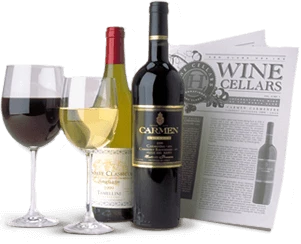
Featured Wines

July 2007

Premier Series
Featured Wineries & Wines
Membership Type
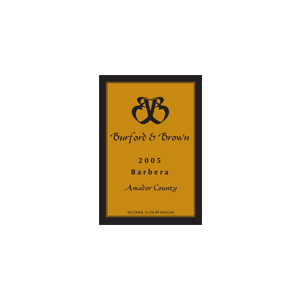
Burford & Brown Amador County Barbera 1 Red 1 White; 2 Reds
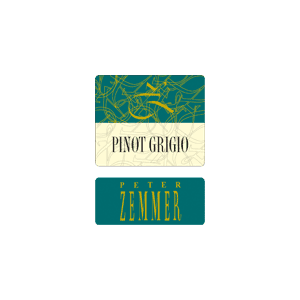
Peter Zemmer Alto Adige Pinot Grigio 1 Red 1 White; 2 Whites
Alta Vista "Premium" Mendoza Malbec 2 Reds
Von Othegraven Maria v. O. Saar Riesling Kabinett 2 Whites


Master Series
Featured Wineries & Wines
Membership Type
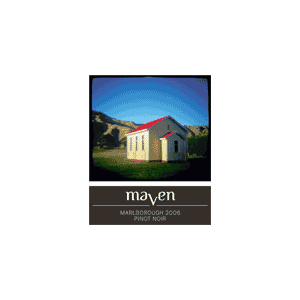
Maven Marlborough Pinot Noir 1 Red 1 White; 2 Reds
Peter Zemmer Alto Adige Pinot Grigio 1 Red 1 White
Burford & Brown Amador County Barbera 2 Reds


Collector Series
Featured Wineries & Wines
Membership Type
Maven Marlborough Pinot Noir 1 Red 1 White; 2 Reds
Lusco Do Miño Rias Baixas Albarino 1 Red 1 White
Cavallotto Bricco Boschis Barolo 2 Reds
Dominio de Tares Tares Pago 3 Bierzo (Additional Secondary Red) 2 Reds

Burford & Brown Amador County Barbera 2005 – U.S.A.

Burford & Brown Amador County Barbera 2005 – U.S.A.Burford & Brown is a bodacious venture starring Peter Burford and Adam Brown. Peter Burford, an Australian graduate of Roseworthy, Australia's premier School of Oenology, is perhaps best known as the recent impetus behind the renaissance and the rising consumer popularity enjoyed by Alexander Valley Vineyards. He has also been the vitality and driving force behind many of California's premier Zinfandel producers, including the world renowned Renwood Winery. The other half of this equation is Adam Brown, the former Sales and Marketing Manager extraordinaire for Alexander Valley Vineyards.

Burford and Brown are characters, but two very talented and fun loving characters. Their venture was really born the first night they met. Burford, on hiatus from the great D'Arenberg Estate Winery in South Australia, had just finished his first California crush at Alexander Valley Vineyards when Adam Brown spotted him alongside Highway 101 in Healdsburg, California puffing a cigar – a very fine cigar at that. Earlier, Burford had attended the company Christmas Party and was out "relaxing." Adam Brown spotted Peter and decided to stop and pick up the poor bloke he had eyed at the edge of the road. He figured that anyone out at 1:00 A.M. in Peter's condition needed a ride home, so he stopped and picked him up (it wouldn't be the last time, we're told), and after a late night of talking, a friendship was born. That was in 1995. Both "boys" have grown up since then, but they still enjoy a good glass of wine.

Soon after arriving at Alexander Valley Vineyards, Peter was appointed winemaker at this well-established Sonoma County estate and the fortune of this outstanding property was on the upswing. Its offerings went from strength to strength as Burford perfected his craft working with the very same varieties he had mastered in Australia: Chardonnay, Cabernet Sauvignon, Merlot, and Syrah (Shiraz). But at Alexander Valley Vineyards, Burford also had the opportunity to work with Pinot Noir and Zinfandel, with which he became enamored. He eventually left Alexander Valley Vineyards and went to the Renwood Winery where he was able to work exclusively with Zinfandel. Not long after, Barbera, the great Northern Italian varietal, became his next love.

Subsequently, in typical Australian fashion, Peter was soon up for a new challenge and a taste of exotica, so by 1999 he found himself literally in the hot spot of winemaking – Thailand. Yes, Thailand. It was there in ancient Siam that Peter gained worldwide renown. There, he was able to harvest two crops a year, without traveling, one in the spring and another in the fall, not the customary single harvest that occurs in the fall everywhere in temperate climates. Although he had worked at prestigious wineries in both Australia and California, it was his work in Thailand that landed Peter as the feature of a three-page article in the Wine Spectator, and brought him ultimately to the attention of the wine world. And all this time, judging by the proximity of Thailand to Australia, we all thought Peter had just gone out on one of his famous walkabouts and got a little lost.

Upon Peter's return to California, he re-united with Adam Brown and the topic of "doing their own thing" was re-visited. Their first endeavor was in 2001 when they produced a three hundred case lot of a knockout Barbera. In 2002 they crushed another small lot of superb Barbera, with the help of their wives and Adam's three children, and followed that with an excellent North Coast Zinfandel that they made from grapes they snatched from Ravenswood, completing the hat trick. In November 2003, the first bottle of Burford & Brown inched along the bottling line, and we are happy to say that we procured nearly all of the 2002 Burford & Brown Private Selection Zinfandel and we are still receiving requests for more, but as Mom were so fond of saying: "you can't have your wine and drink it." Alas, that first Burford and Brown Private Selection Zinfandel is now history, but wait until you try this dynamic duo's 2005 Amador County Barbera! We think your thirst will be assuaged, at least until your last bottle runs out.

Tasting Notes: The 2005 Burford & Brown Amador County Barbera continues the great success these two guys have had with Barbera. This recent offering from Burford & Brown is a bacchanalian delight; it is a plush, juicy Barbera that highlights the rich fruit of the very fine but sometimes persnickety Barbera varietal. Red fruits, soft vanilla tones, and oodles of seductive flavor are the keys to this wine's success. One panel member aptly described the Burford & Brown Barbera as "possessing an abundance of riches." And we would add that if ever a wine could be called sexy or possess a certain je ne sais quoi as the French are fond of saying, it would most certainly be the 2005 Burford & Brown Barbera. It is almost a sin to drink this wine, it tastes so good. Moreover, Peter Burford's latest creation is sure to improve further in bottle, so no need to drink it up in a hurry: rich fruit, good acidity, and supple tannins add zip to its finish and years to its life. Enjoy it at cool room temperature straight away out of the bottle or after a half hour of aeration!

Accompaniments: When you have that certain je ne sais quoi, you don't have to put on airs or rely on fancy props to be a star, and so it is with the 2005 Burford & Brown Amador County Barbera. It shines on its own and in the company of good down home cooking – American or Italian. So fire up the grill and put on some burgers or steaks, and no need to forego the fried or caramelized onions either, they won't detract from this wine's gig. And what about all those favorite pizzeria specialties such as Calzones, Strombolis, Spaghetti Bolognese, and Veal Marsala, the plain, delicious extra cheese pizza or better still the classic pepperoni pizza, accompanied by none other than a bottle of 2005 Burford & Brown Amador County Barbera? And why stop there? Ribs, hickory smoked pork barbecue, and just plain old-fashioned fried chicken work well, too.

Peter Zemmer Alto Adige Pinot Grigio 2005 – Italy

Peter Zemmer Alto Adige Pinot Grigio 2005 – ItalyIn Cortina amidst the alpine hills and valleys of the South Tyrol (Alto Adige) nestles the Zemmer family winery. Founded in 1928 by Peter Zemmer, this family owned and run operation has recently emerged as one of the zone's leading producers of both white and red wines, thanks to the visionary leadership of Helmuth Zemmer – the firm's current guardian.

Helmuth Zemmer credits much of his success as a winemaker to the legendary Friulian producer, Vittorio Puitti, even though Zemmer's wines are more readily accessible when young than Puiatti's and often exhibit a different initial set of aromatic characteristics as well. Nevertheless, the overall style of both men's wines – pure and full throttle – has not gone unnoticed by critics and consumers alike who admire the consummate attention to quality that one finds in the wines from these estates.

The hallmark of Zemmer's wines is always a pure, precise, highly focused aroma that defines the essence of the varietal or varietals from which the wine is made. In addition, the aroma of a Zemmer wine is merely the prelude to the rich flavors that lie within. Zemmer's wines are consistently gratifying libations that appeal to the purist taster; they are completely unmanipulated expressions of their cepage and terroir. In other words, no smoke or mirrors are employed here. The annual harvest comes only from Zemmer's own vineyards and from those that are bound by tradition to the Zemmer property. White wines, most notably Chardonnay, Pinot Bianco, Pinot Grigio, and a luxury blend labeled Cortinie Bianco dominate this producer's outstanding portfolio, but Zemmer also fashions fine, full-bodied red wines that merit serious attention.

Alto Adige or Sud Tirol?

In Italian, Alto Adige refers to the high or upper reaches of the Adige, the stony, swift flowing river that Ernest Hemingway immortalized in A Farewell to Arms. However, most of the world knows this stunning country as the Sud Tirol or the South Tyrol. The dual name illuminates this region's splintered history and highlights its continuing split personality. Presently, Alto Adige is officially an autonomous region of Italy, but the Alto Adige or South Tyrol remains primarily German speaking, which underscores the fact that throughout most of its tortured history this beautiful alpine land of lederhosen and loden caps was an integral part of Austria. In fact, it was not until after World War I that the South Tyrol was ceded begrudgingly to Italy.

In spite of or, perhaps, on account of the South Tyrol's plurality, ethnic diversity, and historical factional violence, the present generation of winemakers in Alto Adige of both Austrian and Italian heritage have banded together in the common pursuit of happiness and prosperity. In doing so, the winemakers of the Alto Adige/ Sud Tirol have fashioned some of the highest standards for winemaking in all Italy. Consequently, more than 50% of the zone's wines are DOC designated, while a substantial portion of the area's non-DOC offerings constitute Alto Adige's most expensive and illustrious offerings (Zemmer Cortinie Bianco for example) simply because DOC regulations do not yet provide for imaginative, luxury blends.

While it may be true that white wine is the calling card of Alto Adige and that many of Italy's finest white wines do indeed flow from the pretty hills and valleys of the Sud Tirol, this industrious, forward thinking region is also renowned for its production of light to medium bodied red wines of supreme bouquet, finesse and style. So whether it be an outstanding Chardonnay, Pinot Bianco or Pinot Grigio or one of Alto Adige's little know reds in the guise of Santa Maddalena, Teroldego, or even Lagrein, quality remains the region's unifying common denominator.

Tasting Notes: The 2005 Zemmer Alto Adige Pinot Grigio is a bright, clean, full-bodied Pinot Grigio that amplifies both the grape varietal and the style of wine for which Alto Adige is justly renowned. In other words, Zemmer has once again hit the mark with his 2005 Pinot Grigio and demonstrated why Alto Adige remains Italy's premier DOC for Pinot Grigio. Wrapped in a sunny yellow robe, Zemmer's exemplary 2005 Alto Adige Pinot Grigio exudes a beguiling bouquet of spring flowers, stone fruits, and minerals. And unlike many other Pinot Grigio's, this offering won't wilt in the glass. It remains full and rich on the palate, and it finishes completely dry with a long, lemon drop finish that continues on long after the wine has found its way home. Simply put, Zemmer's Pinot Grigio combines eminent drink ability with real flavor and panache. Consequently, we found this wine to be nearly irresistible. It is no wonder that many a commentator has referred to Zemmer's wines as "sexy." Enjoy this noble Pinot Grigio well chilled (35°-40° F) or only slightly cool (50° F) . . . as you like it. We think you will enjoy it just about any way you can get it.

Accompaniments: Well made Pinot Grigio is one of the world's consummate aperitifs. It, also, renders a great service to food, especially when food accompaniments involve seafood, light pasta dishes, and salads. The 2005 Zemmer Alto Adige Pinot Grigio more than rises to the aforementioned challenge and it goes a step further. Because it possesses a highly aromatic profile and plenty of body and flavor to back up its initial appeal, we have served it at elegant dinner parties; with Zemmer's wines there is no need to worry that guests will grow bored of his Pinot Grigio's crisp, mouth filling flavors or that the wine will tire before the salad. The 2005 Zemmer Alto Adige Pinot Grigio pairs especially well with a variety of hors d'oeuvres, including tapas. It is a natural with sushi, sashimi, California rolls, and tempura, too. Some other favorite accompaniments include grilled shrimp, served with a light Dijon mustard and dill sauce; real lump crabmeat mixed with a chive cream and served over a Parmesan tuile; oysters sautéed in butter, cream, and fresh herbs; and grilled trout with almonds. Pasta Primavera provides another successful marriage. However, regardless of what you choose to serve with the Zemmer Pinot Grigio, we suggest you invite someone special over to enjoy it with you for the true wine lover is never stingy.

Alta Vista "Premium" Mendoza Malbec 2005 – Argentina

Alta Vista is a family owned winery in the sprawling province of Mendoza, Argentina's largest and most important region of viticulture. In fact, winemaking is the Mendoza's only important industry. Here in the mighty Mendoza, in the foothills of the towering Andes at an elevation in excess of 3,500 feet, the D'Aulan family cultivates the finest and most traditional of Argentina's grape varieties: Malbec and Torrontes.

From the D'Aulan's pristine vineyards, many of which date from the 1940's, flow some of Argentina's most interesting and individual wines. And like all of the best hillside vineyards in the Mendoza, Alta Vista uses only the pure melting snows of the Andes to water its vineyards. In the Mendoza, rainfall is all but non-existent, but then again so are rot, mildew and the multitude of insects and vine diseases that afflict most other wine regions worldwide. At Alta Vista, which means high view, the grapes ripen slowly but completely due to the highest elevation and the sunniest weather of any viticultural area on earth. Given the quality of the wines that Alta Vista has been fashioning in the last half dozen years, we have much to enjoy now from this winery and a great deal more to look forward to in the future.

Tasting Notes: The 2005 Alta Vista "Premium" Malbec is a beautiful, medium-bodied Malbec that drinks smooth and claret like, even at the tender age of two. Young Malbec is not always the tenderest of young reds in its youth, but the Alta Vista "Premium" is a welcome respite from the multitude of harsher, less expensive versions of the mercurial Malbec variety, many of which have flooded the wine market in recent years. In this Alta Vista offering, plum and assorted black fruits mingle with smooth wood tones in the nose and on the palate: These scents and savors provide the ideal framework for the deft touches of bark and spice that filter through the wine and add zest to an otherwise easy drinking style of Malbec. We suggest serving this enjoyable Bordeaux style Malbec at cool room temperature (no more than 68° F) and allowing it at least 30 minutes of aeration before consumption.

Accompaniments: Malbec is a wonderful companion to nearly all kinds of meats, especially beef, and the 2005 Alta Vista "Premium" Malbec is no exception. Braised beef, Texas Barbecue, and thick T-bone steaks provide true companionship to good Malbec and to the Alta Vista in particular. Other gutsy, stick to your ribs kind of fare like Brunswick Stew and wild game provide excellent accompaniments to the Alta Vista "Premium" Malbec, too. Duck, grouse, venison, and ostrich are some of our favorite game choices. Full-flavored pasta dishes with either cream or tomato based sauces work well with this wine as well. Rigatoni à la Vodka and Fettuccine Alfredo are two commendable suggestions. Good, old-fashioned brick oven pizzas are great, too. Whether it is a simple Neapolitan cheese pizza, a deep dish Chicago pie, or a Pepperoni Delight with mushrooms, green pepper and black olives, the 2005 Alta Vista "Premium" Malbec provides great drinking pleasure, so enjoy!

Von Othegraven Maria v. O. Saar Riesling Kabinett 2005 – Germany

The Maximilian von Othegraven estate dates back to 1804. However, intensive high quality viticulture in Kanzem, the present site of this domain, can be traced back even further to 1500. Today, Dr. Heidi Kekel, the niece and goddaughter of Maximilian von Othegraven, owns and runs this extraordinary property. With the passing of Maximilian and Maria, his widow, Kekel is the heir to the throne, and what a job she has done. Moreover, the glorious 2005 vintage has provided Kekel with all the material she needs to craft extraordinary wines.

In Germany, it is widely acknowledged that there are two great wine regions for the noble Riesling varietal, the Mosel and the Rhine. However, in sunny vintages such as 2005, the Saar is acknowledged to be the best part of the Mosel. At Kekel's von Othegraven estate the electric, stately elegance of the Mosel reaches its apogee. From one of the steepest and few great south-facing slopes above the Saar that is protected from the cold north wind, Heidi Kekel produces wines of supreme elegance, finesse and flavor. Possessing 13 of the 50 acres of the great Altenberg vineyard, Kekel is unquestionably the region's leading grower.

Von Othegraven's Maria v. O. is named for Heidi Kekel's aunt Maria, and if the wine that bears her name even slightly resembles that grand lady, what a winsome, scintillating, crowd pleaser she must have been. In addition to the delicious Maria v. O. Riesling, Kekel also fashions several other show stopping wines from the ancestral Altenberg estate as well as fine Ockfener Bockstein and Wiltinger Scharzberg Rieslings from nearby sites.

Tasting Notes: Classical elegance, pure ripe fruit, and subtle minerality are the watchwords of von Othegraven's lovely Saar offerings. The 2005 Maria v. O. Riesling Kabinett possesses all of the Saar's finest attributes, including an amplifying nose that is redolent with the essences of ripe apple, pear, and quince. Add a nice balance of acidity and a touch of mineral from the estate's noble terroir, and the bouquet of the 2005 Maria v. O. reflects the complexity as well as the charm of the greatest Saar Rieslings. On the palate, the same stony, pinpoint essence of the Saar meets soft, natural fruit. All of this luscious goodness continues to unfold for hours after opening. The charming 2005 Maria v. O. finishes just off dry with a caress and an easy hand, which lend themselves to another glass, and another glass, and . . . How sweet it is! Enjoy the 2005 Maria v. O. moderately chilled about 45° F.

Accompaniments: As an off dry Riesling, the 2005 Maria v. O. provides the perfect pairing for an eclectic group of foods. Aside from the many traditional tried and true Riesling pairings, such as grilled fresh water fish or light charcuterie, we also endorse the Maria v. O. with tapas and more complex seafood dishes with a twist. Green Tipped New Zealand Mussels in a Tamatillo sauce are just one such example. We are, also, fond of the Maria v. O with stir fries and delicate tempuras. Prosciutto, served with either sweet cantaloupe or honeydew melon provides another opportunity for this wine to shine. An assortment of soft cheeses makes for a most pleasant evening with Maria v. O. as well. And of course, a Riesling as fine as the 2005 Maria v. O. makes for an outstanding aperitif. This Riesling exhibits plenty of flavor and subtle nuance to hold our attention, unlike many New World Rieslings, which seem to need food by virtue of their flab or jarring acidic edge. Enjoy!

Maven Marlborough Pinot Noir 2006 – New Zealand

Maven Marlborough Pinot Noir 2006 – New ZealandEditor's Note: The 2006 Maven Marlborough Pinot Noir is a very limited production wine from a single Marlborough vineyard. Nevertheless, it sports eight different label images, each with a different picture from New Zealand photographer John Crawford. Each label image represents a slice of Marlborough. All of the wine under the 8 labels is the same – only the labels are unique. Maven, like nearly all New Zealand producers, now employs the Stelvin cap to insure ultimate freshness and consistency.

Maven was conceived in 2005. It is the latest venture from Mike Just, the iconic Marlborough winemaker who is responsible for many of New Zealand's finest Pinot Noir and Sauvignon Blanc wines. After many years of fashioning fine wine for well-known Marlborough producers, Mike has ventured out on his own. Maven is Mike Just's own brand, and he has spared no expense in bringing his skill to fore. In short, Mike knows how to transfer his love of wine and viticulture into each and every bottle that bears his name.

Mike Just: Not Just Another Winemaker

Mike Just is not just another winemaker: he is one of New Zealand's premier producers of Sauvignon Blanc and Pinot Noir and a national icon. Descending from royalty (tracing back to England's King Edward III) Mike is also a Pinot Noir maven and a very astute collector of medieval artifacts.

Although born a New Zealander, Mike learned his craft in Germany where he spent several years working in various wineries. In Germany, Mike picked up the skill as well as the feel for producing premium wines in a cool climate. With centuries of experimentation and tradition, Germany afforded Mike the perfect perspective and experience to carry back to Marlborough, the center of cool climate viticulture in New Zealand.

However, we believe that it is more than training and experience that make Mike Just such an accomplished winemaker. It is, also, his philosophy and firm promise to customers to deliver "serious wines that are fun to share." Mike fulfills his pledge through a combination of hard work, intuition, and daring. Consequently, all of Maven's wines are handpicked from the finest clones and possess a tasty, natural feel that reflects the terroir of Marlborough and the consummate skill of Mike Just.

Marlborough: A Noble Land

Marlborough is situated on the northern tip of New Zealand's mystical South Island, where it enjoys a unique dry maritime climate. High mountains isolate this enchanted land from the cold alpine interior of the rest of the South Island, while the spectacular Marlborough Sound to the north provides a conduit to the sea as well as the planet's most majestic view of New Zealand's North Island as it soars skyward across the swells of Wellington Straits – a sight that ranks as one of the world's most stunning vistas. Moreover, Marlborough is about as close to viticultural paradise as one can find, especially for Chardonnay, Sauvignon Blanc, and Pinot Noir.

Marlborough's long, sunny, but not excessively hot growing season provides nearly ideal conditions for grape growing. The average summer daytime temperature hovers between 24° C and 28° C (72° - 80° F) depending upon one's altitude and proximity to the sea. The air is crystal clear and the light luminous; with nary an overcast day let alone much rain during the long growing season. Cool nights keep acid levels high in the grapes, even as sugar levels rise abruptly. Such conditions lend themselves to an extended growing season, which provide slow even ripening and extended hang time for the grapes. The result is ripe healthy fruit, with fresh vibrant flavors and a crisp herbaceous zing.

In addition to its superb summer climate, Marlborough also boasts excellent soil for grapes. Most of Marlborough consists of silty, free draining alluvial loams over gravelly sub-soils. In addition, river stones lie scattered throughout Marlborough, remnants of the many rivers that once coursed through the pretty valleys of Marlborough. These river stones store heat from the warm sunny days and radiate that heat back into the vineyards at night, thereby providing a unique microclimate and terroir that has been likened to Châteauneuf-du-Pape. Moreover, most Marlborough growers are committed to sustainable agricultural practices in order to preserve the region's noble terroir.

Tasting Notes: The 2006 Maven Pinot Noir is a stunning example of just how far the Marlborough appellation has come in thirty years. The product of a single, handpicked vineyard from the prized Rapaura area of Marlborough, the 2006 Maven Pinot Noir is a tour de force in winemaking. Mike Just's latest success is a sleek, textured Pinot that can outshine many a fine Premier Cru from Burgundy. This wine is positively loaded with scent and savor. Moreover, it possesses supreme finesse and all the deep down fruit flavor that New World Pinot can muster. Regally clothed in a ruby robe, the 2006 Maven Marlborough Pinot Noir offers up plenty to relish in the form of wild cherry, cola, and savory forest floor flavors. Long, lovely, and lingering on the palate, one could hardly ask for more in a wine. And what makes the 2006 Maven Marlborough Pinot Noir even more impressive is the fact that it is still so very young; this outstanding effort has several more years before it reaches its apogee. And given New Zealand's commitment to the Stelvin cap, this Pinot is fresh and ready to drink the moment it reaches the glass. Nonetheless, those who are patient enough to allow the 2006 Maven Pinot Noir a chance to breathe for twenty or thirty minutes will be amply rewarded. We suggest serving this Pinot Noir cool (at no more than 66° F). Anticipated maturity: 2007-2012.

Accompaniments: Wine as tasty, textured, and complex as the 2006 Maven Marlborough Pinot Noir needs very little in the way of accompaniment. However, one of the glories of premium Pinot Noir is its complex set of aromatics and intense flavors, which lend themselves ever so hedonistically to the splendors of the table. And what New Zealand does so adeptly is pair its fresh, natural ingredients with its ever increasing array of fine wines. Consequently, the Maven Marlborough Pinot Noir provides a natural accompaniment to both fish and meat. Salmon, tuna, chicken, ham, pork, and tender New Zealand lamb all provide the Maven Pinot Noir with superb partners in culinary delight. Two of our favorite pairings with this wine are grilled tuna, marinated in garlic, ginger, and lime juice; and braised pork tenderloins, with apples and cream. Both accentuate the savory aspects of this exciting Pinot Noir. Enjoy!

Lusco Do Miño Rias Baixas Albarino 2005 – Spain

Lusco is the passion of José Antonio Lopez, the most important figure in the Rias Baixas. For more than two decades, Jose Antonio has been the "Superman" behind the resurrection of the once nearly extinct Albarino varietal and the leading champion of the entire Rias Baixas appellation of Galicia – a verdant, sea swept region which lies upon the lofty ridges of Spain's northwest corner.

José Antonio began the revival of Galicia's fabled Albarino varietal more than two decades ago as founder and managing partner of the Morgadio estate. There he succeeded in recalling an obscure viticultural region to worldwide attention by creating dry, fully ripe Albarino wines, which critics have likened to Viognier, southern France's most expensive and compelling white wine.

In order to create the ultimate Albarino – very dry, exotic, intense and wholly unique – José Antonio struck out on his own in 1996 with the acquisition of the renowned, mature twelve-acre, southeast-facing Albarino vineyard of Pazo Pineiro. Along with the acquisition of the region's most notable vineyard, José Antonio, also, purchased the nearby 16th century manor house (Pazo), whose meter-thick walls provide ideal insulation against temperature extremes, to serve as his winery. Lusco, from the Galician word for the pensive moments of anticipation and reflection just before dawn and dusk, fashions presently the most riveting of all Albarino wines.

Albarino: Spain's Most Compelling White Wine

Albarino is an indigenous Spanish varietal whose home is Rias Baixas and the Galician wine regions of northwest Spain and Portugal. Some enologists believe Albarino is related to the Petit Manseng variety of southwest France, just on the other side of the towering Pyrenees Mountains, but no dry white Petit Manseng can match the body and finesse of Spain's finest Albarino wines. Meanwhile, in Portugal Albarino goes by the name Alvarinho, where it usually ends up as a light summertime quaff in the guise of Vinho Verde. Surely, nowhere could the same varietal be so different as in Spain and Portugal. While Portugal picks this varietal early and makes a low alcohol wine (8.5%-9% on average), Spain, under the tutelage of José Antonio Lopez and similar minded individuals in Rias Baixas, turns out a full-bodied, intense Albarino with aromatic and flavor profiles akin to Viognier – the greatest white variety of France's Rhône Valley.

Albarino is now being extensively studied and planted in other locales around the world, including Australia, California, and South Africa. Early reports from winemakers and consumers in Australia appear especially promising for the late maturing Albarino, as a long hang time is rarely a problem in Australia and the firm, bright acidity of Albarino is much appreciated. A debt of thanks belongs to José Antonio Lopez for resurrecting the great Albarino varietal and offering it to the world at lodge.

Tasting Notes: The 2005 Lusco do Miño Albarino is a serious white wine: bone dry, full-bodied, and naturally made. In short, there is no wimp in this wine. The 2005 Lusco Albarino sports a bright sun struck robe, which emits hints of pale green and a golden gleam. In the wine's expressive perfume, scents of apricot, pear, honeysuckle, and slate issue from the wine's deep stone fruit and mineral core. A classic Albarino, the 2005 Lusco recalls the essence of spring, when the first breath of warm vernal air begins to dispel winter's chill. Indeed, the scent of this beguiling Albarino is as seductive as its flavor, that of the icy waters of a mountain spring unto which flower petals and citrus blossoms have secretly fallen. However, what is, perhaps, most impressive about the 2005 Lusco Albarino is its great length on the palate. Moreover, the wine possesses a long, dry, lingering finish, not unlike the finest Viognier from France's Condrieu appellation. Once again, José Antonio Lopez has fashioned an Albarino that should dispel the outmoded notion that Spain only makes great red wines. We suggest you consume this tasty, sophisticated Albarino only moderately chilled (about 45°F) in order to revel fully in the viticultural glory of Spain. Anticipated maturity: 2007-2009.

Accompaniments: With the sea at its doorstep, Galicia is as renowned for its seafood as it is for its white wine. And Albarino is quickly becoming Spain's most sophisticated and flavorful, dry white wine – the perfect match for seafood. Thus, fresh fish and the finest fruits de mer provide excellent accompaniments to the 2005 Lusco Albarino. Given Lusco's strong personality and considerable underpinning, we highly recommend it as an accompaniment to spicy fish stoups, bouillabaisse, cioppino, and other tomato based Mediterranean style fish stews. Sautéed shrimp in a fresh, moderately spiced tomato sauce tops our list of prime companions to the 2005 Lusco Albarino, too. However, most baked, grilled, or sautéed white fish, seafood kebobs or chowders offer considerable enjoyment in the company of the well bred 2005 Lusco Albarino. This is a wine that begs for interesting and intriguing dishes to truly shine. In fact, Albarino is rarely relied upon as a sit around and sip kind of wine. It is at its best with robust foods, even spicy hard to match selections, because it is difficult to overshadow. Asian stir fries, eclectic cuisine, and fusion fare provide equally exciting complements. So, be bold, be daring and enjoy the gustatory adventure that José Antonio Lopez provides in Lusco Albarino. Enjoy!

Cavallotto Bricco Boschis Barolo 2001 – Italy

Alfio Cavallotto is one of the new bright stars to emerge in Barolo. However, Cavallotto is neither new to the scene nor are his wines indicative of the light, modern style of Barolo. Cavallotto is a real traditionalist, and his wines make few concessions to the contemporary penchant for technology over technique. Rather, it is this house's penchant for making authentic, muscular, cask aged Barolos that reflect the great terroir of Castiglione Falletto that have caused Alfio Cavallotto's star to rise. The Cavallotto estate uses only indigenous yeasts and long macerations to extract the fullest representation from each vineyard and wine it produces, and the results are sublime – age worthy Barolos that are both structured and decadent. Cavallotto's most compelling offerings emanate from his premier 10 acre vineyard known as Bricco Boschis. Production from this single vineyard cru is predictably small, rarely more than 2,100 cases.

Barolo: The King of Wines, and the Wine of Kings

Barolo has affectionately and appropriately been referred to as the "king of wines, and the wine of kings." In a fine vintage such as 2001and in the hands of a great winemaker like Alfio Cavallotto Barolo is unquestionably Italy's most profound red wine, richly deserving of the many accolades that have been bestowed upon it.

Barolo is born on the Langhe Hills of Italy's Piedmont, on steep craggy Alpine foothills that tumble out of nearby France and Switzerland. Barolo is the most masculine of Piedmont's three great Nebbiolo based wines and the focal point in the region's viticultural tiara. Gattinara and Barbaresco are the other two crown jewels. Although Gattinara, typically the lightest and most feminine of Piedmont's great reds, and Barbaresco, sometimes referred to as a baby Barolo for its propensity for being lighter and easier to drink in its youth than its more stalwart neighbor, share the same noble Nebbiolo vine as Barolo, it is Barolo that possesses the pedigree to rule the viticultural roost. Barolo's lineage dates back to the Middle Ages and by the mid 18th century Barolo had begun to evolve into its present form in the vicinity of Alba, a distinct Old World city that serves as the white truffle capital of Italy as well as Piedmont's premier wine town.

Today, the limited production of Barolo generates from the huddled hills of two valleys, Serralunga and Barolo, and their five principal communities, all of which lie to the southwest of the city of Alba and are reputed to impart distinctive characteristics and traits to their respective progeny. The townships of Serralunga, Castiglione Falletto, and Monforte are situated in the Serralunga Valley and are reputed to produce the region's most masculine, longest-lived Barolos. Meanwhile, Barolo and La Morra, from which the more "delicate" wines of the zone are said to flow, are part of the Barolo Valley. However, there are many exceptions and innumerable variations in Barolo on the same theme, and this does not even take into account the decades old debate in Barolo over the relative merits of the modern versus traditional styles of Barolo, which have as much to do with individual winemaking techniques as they do the amount and kind of barrel aging the wines receive. Happily, in the end, there is great Barolo fashioned in all five of the major townships, in both modern and traditional styles.

Tasting Notes: If ever there were a poster child for the muscular, deep down Barolo wines of Castiglione Falletto, it would be the 2001 Cavallotto Bricco Boschis. Deeply robed and packed with flavor, this majestic Barolo offers up layer upon layer of black cherry fruit, menthol, spice, and tar, all of which flow seamlessly from the aroma into the wine's palate profile. And in the mouth, one can feel the power and weight of the glorious 2001 vintage as the wine fills the senses and consumes the palate, yet, this wine embodies a fleshy tenderness, too, that promises even more hedonistic pleasure to those who can wait. Given the lush luxurious fruit, firm ripe tannins, and long lingering finish of the 2001 Cavallotto Bricco Boschis, there is little doubt that what we experience today is only the beginning to a long, illustrious life. As with all authentic Barolo, the 2001 Cavallotto Bricco Boschis just begs for aeration. Consequently, we suggest at least a two hour hiatus in decanter before consuming. Better still, open the wine in the morning and let it air until dinner for optimal enjoyment. Anticipated maturity: 2009-2020.

Accompaniments: The complex, nuance of flavors that define the 2001 Cavallotto Bricco Boschis Barolo and all fine Barolo wines for that matter, plead for foods of equal stature. Rarely does one sit around sipping Barolo, but consumed at table with traditional Piedmontese cooking and savory sauces, one comes to easily appreciate the royal nature of this wine. Risottos, made with authentic Arbio rice, constitute many of our favorite choices with this Barolo. A whole chicken, mushroom, and truffle risotto, cooked very slowly and dashed with a first rate balsamic vinegar from Modena makes for a heavenly match. Less regional dishes do well, too. Roast loin of pork, stuffed with a bread, onion, and herb farce provides a savory treat. Marinated steaks and pork tenderloins offer tasty uncomplicated alternatives, too. In addition, Cavallotto's Barolo offers one of the finest accompaniments to hard cheeses. Hunks of authentic Italian Parmesan or Provolone cheese pose no threat to this wine and offer a great way to finish a meal fit for a king.

Dominio de Tares Tares Pago 3 Bierzo 2003 – Spain

All of a sudden Bierzo is Spain's hottest wine region, and Dominio de Tares is its brightest star. Bierzo is situated in the extreme northwest of Castilla in the province of Leon, which lies on the frontier of Galicia and nearby Portugal. In other words, El Bierzo is deep in the middle of nowhere, but in the case of Bierzo "nowhere" harbors one of Europe's most interesting grape varietals and its land comprises one of the finest terroir for grapes in all Europe. This isolated, wildly beautiful region sits on the bed of an ancient lake, which the Romans drained in their quest for the area's mineral resources – namely gold. Today the Bierzo produces liquid gold in the form Mencia, an indigenous red gape variety that is presently taking Spain and the rest of the wine drinking world by storm.

The Mencia varietal is considered by enologists to be the direct ancestor and precursor of modern Cabernet Franc. This vine hails from the plantings of the earliest Roman settlers in Bierzo, who planted this variety two thousand years ago in what remains one of Europe's most isolated wine regions. Certainly, it is the very isolation of the Bierzo that has allowed Mencia to survive and even thrive. Moreover, the average age of the vines in the Bierzo is quite old, which lends itself to the production of high quality wines. Many of Dominio de Tares' Mencia vines from the tiny plot known as Pago 3 are 120 years old.

The wonderfully fruity, spicy, and wholly intriguing Mencia grape has only recently been discovered or rather re-discovered by modern legions of wine drinkers. They are undoubtedly charmed and intrigued by this unique viticultural entity called Mencia, whose attributes are consummate with both modern Merlot and Cabernet but with a softer, lusher, more exotic tone that bears comparison to the greatest Cabernet Franc from St.Emilion and Pomerol in Bordeaux. It is Mencia's re-birth and the contemporary emphasis on quality versus quantity in Bierzo that led to the formation of Dominio de Tares.

Tasting Notes: The 2003 Dominio de Tares Tares Pago 3 is the paragon example of the ancient and venerable Menica grape variety and the finest wine in all Bierzo. From octogenarian vines Dominio de Tares fashions a stunning red that is every bit a match for the very best wines of St.Emilion and Pomerol. Deep, plush, and velvety, the full bodied Tares Pago 3 offers up copious quantities of black cherry fruit and smooth spicy oak. In addition, there is plenty of structure and underpinning to gird the voluptuous fruit and complex center of this gorgeous wine. Moreover, this wine's superb balance bodes well for both near term consumption and extensive ageing. The wine is long and lush to the finish, and it continues to open in the glass for hours. The 2003 Dominio de Tares Tares Pago 3 is one of the finest examples of the present Spanish viticutural renaissance and the preeminence of Spanish wines. The 2003 Dominio de Tares Tares Pago 3 is a veritable masterpiece. Allow it plenty of time to breathe and enjoy it. Anticipated maturity: 2007-2014.

Accompaniments: There is not a lot that the 2003 Dominio de Tares Tares Pago 3 needs to shine, except a clean, thin, well-made glass. This wine drinks beautifully on its own, but it is even more impressive when brought to table to accompany the delights of the kitchen. Lamb, beef, and pork all get our nod to accompany this magnificent red. An oak fired Angus Filet Mignon, served with a black peppercorn and onion sauce, provides wonderful companionship to this wine. A slow roasted Pork Shank with caramelized rosemary apples and polenta offers another great accompaniment. For a simple but no less wonderful accompaniment, we suggest Tetilla cheese. Tetilla is perhaps Spain's finest cheese. It is creamy, rich, and downright sumptuous – the perfect accompaniment to a great wine.


logo for wine club
Since 1994
Home
Join Our Wine Club
Gift Memberships

Membership Renewals
Reorder Your Favorites
More Information
Wine of the Month Club
Current Selections
Past Selections
Testimonials
Other Gourmet Gifts
Corporate Gifts
Wedding Gift Ideas
All About Wine
Website Tools
Who We Are
Contact Us

1 - 800 - 625 - 8238
(Outside US call: 949-206-1904)
P.O. Box 1627, Lake Forest, CA 92609