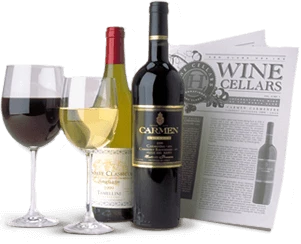
Featured Wines
December 2007
Premier Series |
|
Featured Wineries & Wines |
Membership Type |
| Casa Silva Gran Reserva Carmenère | 1 Red 1 White; 2 Reds |
| Vignerons Réunis de Buxy Bourgogne Chardonnay | 1 Red 1 White; 2 Whites |
| Big Mouth Red Shiraz-Viognier | 2 Reds |
| Bodegas Angel Rodriguez Martinsancho Rueda Verdejo | 2 Whites |
Master Series |
|
Featured Wineries & Wines |
Membership Type |
| Grand Tinel Cuvée Alexis Establet Châteauneuf-du-Pape | 1 Red 1 White; 2 Reds |
| Vignerons Réunis de Buxy Bourgogne Chardonnay | 1 Red 1 White |
| Casa Silva Gran Reserva Carmenère | 2 Reds |
Collector Series |
|
Featured Wineries & Wines |
Membership Type |
| Grand Tinel Cuvée Alexis Establet Châteauneuf-du-Pape | 1 Red 1 White; 2 Reds |
| Domaine Alfred Chamisal Vineyard Chardonnay | 1 Red 1 White |
| Joseph Drouhin Chorey-les-Beaune | 2 Reds |
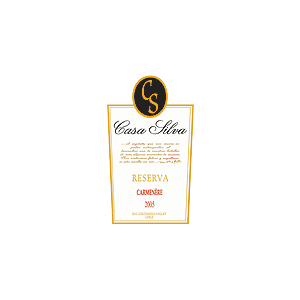
Casa Silva Los Lingues Gran Reserva Carmenère 2005 – Chile
As recent reviews will attest, Casa Silva continues to astound critics and consumers alike with the quality as well as the variety of the wines it produces. Casa Silva is a very modern, clean, well-run winery that is not afraid to push the quality envelope with each passing vintage, which qualifies this esteemed property as one of South America's top wine estates. Located some two hundred kilometers south of Santiago, in the heart of Colchagua, an area many are now calling Chile's Napa Valley, Casa Silva has garnered more recognition and awards at international wine competitions than any other Chilean winery. Furthermore, Catad'Or Hyatt, Chile's most prestigious wine competition, has named Casa Silva "The Best Chilean Producer" three consecutive times. And that's not all: the International Wine & Spirit Competition recently named Casa Silva as "The Best South American Producer." Kudos to the Silva family, father Mario and sons Mario Pablo, Gonzalo, and Francisco, as well as to Mario Geise, the winery's outstanding consulting enologist, for taking this beautiful property to such lofty heights in just ten years' time.
Surprisingly, Casa Silva's inception dates back to only 1997, the year this property began bottling premium wines under its own name. However, historical accounts tell us that the Silva family's predecessors were pioneers in Colchagua more than a century ago, when they brought the first grape varieties from France to their Angostura estate at the base of the towering Andes. Today, the Silvas remain pioneers: they are Colchagua's foremost experts on Carmenère, Chile's emblematic red grape variety, and they produce the finest Sauvignon Gris and Viognier in South America. Moreover, this great property is at the vanguard of South America's success with many other grape varieties, including Sauvignon Blanc, Semillon, and Cabernet Sauvignon. Casa Silva contains many old vines, some approaching 100 years of age, which helps account for the quality and intensity one finds in the estate's wines.
The Casa Silva estate is located at the northern edge of the Colchagua Valley at the foot of the Cordilleran Andes. This is a magical place that is steeped in sheer physical beauty as well as Chilean tradition. Colchagua's natural climatic conditions and terroir make it an extraordinary place to produce wine, which in no small way accounts for the great number of award-winning wineries now in Colchagua. This pioneering Chilean valley actively promotes its appellation and was the first to establish a bona fide wine route for visitors. Today, it is Chile's most important wine region, and nearly all of its grapes are premium varietals. So, is there any longer a doubt as to why the wines of Colchagua are the most highly acclaimed in South America?
As pioneers in viticulture, the Silvas, along with their masterful winemaker Mario Geisse, have established several vineyard estates in Colchagua, each specializing in the production of one or more varietals that are especially suited to that estate's terroir. From these individual estates, single vineyard offerings are produced that reflect the best that Casa Silva produces, and that is saying a lot. From Los Lingues comes a very flavorful and sophisticated Cabernet Sauvignon as well as the estate's classic Carmenère, which has been deemed South America's finest. Meanwhile, Los Lingues specializes in a big, chewy Syrah that has only recently been released in North America.
Tasting Notes: With the release of Casa Silva's 2005 Los Lingues Gran Reserva Carmenère there is no doubt as to Mario Geisse's reputation as the "King of Carmenère." The 2005 Casa Silva Los Lingues Gran Reserva Carmenère is simply the most stunning example of Chilean Carmenère available. As good as this estate's regular 2005 Reserva Carmenère was, the 2005 Los Lingues Gran Reserva is even better. It is knockout stuff upon which legends are made. Truly, aficionados of Chile's emblematic varietal will be talking about this wine for years to come. The 2005 Los Lingues Gran Reserva sports a deeply saturated purple robe with ruby highlights and a bouquet that can fill a room with its breath. Deep woodsy scents, entwined in rich blackberry fruit, and edged with hints of dark chocolate, leather, and spice form a savory olfactory attack. In the mouth, herbal, woodland flavors mingle with plenty of ripe, solid fruit to add complexity and intrigue – in typical Casa Silva fashion. The essences of blackberry, blueberry, and cherry dominate the wine's deep center and are mingled with fine grained notes of coffee and cocoa. And to make matters even more attractive, all this goodness lies wrapped in a blanket of soft, ripe tannin and toasty oak. Layered, textured, and immediately appealing, the 2005 Casa Silva Los Lingues Gran Reserva Carmenère has just taken Chile's finest grape variety and moved it several more steps forward. Enjoy this tantalizing red wine at cool room temperature (60°-66° F), after a few minutes of aeration.
Accompaniments: The 2005 Casa Silva Los Lingues Gran Reserva Carmenère could cause many a wine lover to miss a meal because even in its youthful state it offers all of the pleasure and subtle nuances of scent and savor that an entire table of food can offer. Nonetheless, combining great Carmenère with fine food can more than make one's day. Consequently, we suggest pairing the 2005 Casa Silva Los Lingues Gran Reserva Carmenère with gastronomic delights. Certainly, classics, such as Beef Wellington, Duck à l'Orange, and Rack of Lamb would be in order. However, Churrasco, an Argentine or Nicaraguan-style Grilled Beef Tenderloin has earned our nod as the ultimate dish for the best Carmenère. The rich flavors and spicy sauces of the Churrasco complement the Los Lingues Gran Reserva perfectly. However, almost any grilled meat, even those with moderately spicy sauces, will find an indulgent partner in Casa Silva's most flamboyant wine. Mediterranean style dishes rich in fresh tomatoes, olive oil, and garlic pair nicely with this wine, too. And if you are not a cook, just invite a friend over, open a bottle of Mario Geise's magic, and let the good times roll. Enjoy!
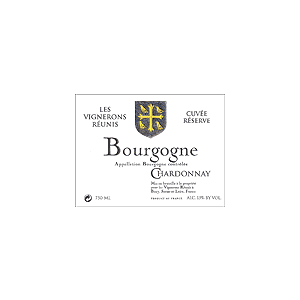
Vignerons Réunis de Buxy Cuvée Réserve Bourgogne Chardonnay 2006 – France
Once in a while, life presents us with a pleasant surprise. It may come in the form of a windfall, an unforeseen visit, an unexpected inheritance, or even as a minor miracle. Finding and choosing wines of quality and unequivocal value from one of the planet's most expensive wine regions at a time when the dollar is at an all-time low against European currency certainly fits the abovementioned criteria and constitutes a most pleasant surprise, especially if that famous and often overpriced wine region were named Burgundy. Yet, life is full of unexpected delights and minor miracles, especially if we take the time to savor each day and are willing loose ourselves from pre-conceived notions.
A small growers' cooperative in Buxy on the Côte Chalonnaise of southern Burgundy has turned out to be one of life's pleasant surprises. Well, if the truth be known, we were initially less than euphoric about tasting yet another Bourgogne Blanc at what we figured would be a stratospheric price, but we were willing to at least try to keep an open mind and adhere to the adage that "one can never drink a label or a price tag." And are we glad we did! Vignerons Réunis de Buxy has fashioned a beautiful Bourgogne Blanc and quite a few other charming red and white Burgundies as well. In fact, this group of thirty small growers has shamed some of the big names in Burgundy with their exemplary 2006 Côte Chalonnaise offerings, most notably the cooperative's superlative Bourgogne Blanc, which comes from vineyards surrounding the tiny village of Buxy.
Côte Chalonnaise: A Source of Unexpected Pleasures
The Côte Chalonnaise is perhaps the least known of Burgundy's wine regions, but this sequestered set of low hills and tiny villages is not likely to remain unnoticed for much longer. Increasingly, the Côte Chalonnaise is becoming the source of many unexpected pleasures and a veritable treasure trove of beautiful wines at affordable prices. Situated to the east of the sleepy little town of Chalon-sur-Saône from which the region inherits its name, the Côte Chalonnaise is for all intents and purposes a continuation of the fabled Côte de Beaune to the north.
As in all of Burgundy, Chardonnay and Pinot Noir comprise the predominant grape varieties on the Côte Chalonnaise, with allowance made for small amounts of Pinot Blanc for white wines and Pinot Liebault and Pinot Beurot for reds. The latter two Pinots are nearly identical to Pinot Noir. Four important communes dominate the region: Givry, Mercurey, Montagny, and Rully – all bona fide Burgundy appellations. In Givry and Mercurey, the emphasis is on the production of excellent red wines, as Pinot Noir reigns supreme in their vineyards. Meanwhile, Rully and Montagny specialize in fashioning from Chardonnay white Burgundies that are both flavorful and easy to drink. The tiny town of Buxy is part of the Montagny appellation, which in recent years is fashioning wines that can compete with many of the more renowned names of the Côte de Beaune, where comparable wines cost two and three times the price. The wines of the Côte Chalonnaise that are grown just outside the boundaries of the four major communes or exceed the legal production for their respective communes are sold as Bourgogne Blanc and Bourgogne Rouge, and they constitute some of the region's best values and unexpected pleasures, so enjoy!
Tasting Notes: Unlike its New World counterparts, the pleasure of white Burgundy lies neither in power nor in the judicious use of new oak. Instead, one finds in good Bourgogne Blanc a wine of blithe spirit, a potion imbued with ethereal charm, finesse, purity, and subtlety of flavor. The 2006 Vignerons Réunis de Buxy Bourgogne Blanc Cuvée Réserve possesses all of those characteristics as well as plenty of flavor and an eminent drinkability. Visually appealing, with the radiance of pure sunshine, this Bourgogne Blanc starts off right and doesn't miss a step. It willingly offers from the glass a pretty fragrance of acacia flower, lemon oil, summer apples, and pure, unfettered Chardonnay fruit. Moreover, all of this 2006 Bourgogne Blanc's aromatic profile follows through on the palate, leaving the mouth clean and refreshed, and most assuredly eager for more. Oh . . . how easy this wine slips down the gullet, without much more than a notice? As is the case with most white Burgundy, we strongly suggest only moderate chilling (40°-50° F) of the 2006 Vignerons Réunis de Buxy Bourgogne Blanc, so as not to obscure the wine's flavor or detract from its light, lovely texture. Saluté.
Accompaniments: Although most hors d'oeuvres and light starters offer excellent accompaniments to the 2006 Vignerons Réunis de Buxy Bourgogne Blanc Cuvée Réserve, seafood and the fruits of the sea provide our favorite pairing with this quaffable Côte Chalonnaise. Scallops, shrimp, and prawns make good partners, but a bowl full of first rate mussels, sautéed in a cream sauce lightly infused with saffron, remains our perennial favorite. Baked, grilled, poached or sautéed flounder, sole or sea bass pair beautifully with this elegant white wine, too. And for those who eschew the fruits of the sea, there is chicken fricassee. However, the glory of any good white wine is its ability to shine unadorned, and there is no doubt about this Bourgogne Blanc's ability to do just that. Indeed, the 2006 Vignerons Réunis de Buxy Bourgogne Blanc shines in the company of a single, thin, well-made glass as it supplies the aperitif par excellence. Just remember, it goes down ever so easy, so consider yourself forewarned!Big Mouth Red Shiraz 95% Viognier 5% 2005 – Australia
Australian winemaker David Hook makes Big Mouth wines at his Pothana Vineyard in New South Wales. Pothana is located in the Belford region of the Lower Hunter Valley, which has become famous for world class Chardonnay, Semillon, Shiraz, Verdelho, and increasingly in recent years Viognier. Hook fashions both a red and a white Big Mouth from the region's most successful grape varieties. Big Mouth Red is an artful blend of 95% Shiraz and 5% Viognier and is similar to Côte Rôtie, the Rhône Valley's most decadent and expensive red wine. The Big Mouth White is a unique blend of Verdelho 50%, Semillon 25%, and Sauvignon Blanc 25% that is truly charming.
David Hook has over 20 years' experience in grape growing and winemaking. He began his wine career working for Tyrrells, one of Australia's oldest wineries, before moving on to a stint at Lake Folly. He established his own winery in 1990. David was one of the first "flying winemakers" as he made wine at his own winery and then traveled from Australia to work harvests in California, Italy and France. This global experience exposed him to a myriad of wines and winemaking techniques, and it has helped him make some truly fascinating wines. Big Mouth is just one of Hook's fascinating wines, or as David is fond of saying: "Big Mouth is a wine with a big aroma, big flavors, and big enjoyment, a stick-it-in-your-face kind of wine." And we love it!
Tasting Notes: A blend of Shiraz (95%) and Viognier (5%), the 2005 Big Mouth Red mirrors the traditional cépage of Côte Rôtie, the Rhône's greatest and most hedonistic red wine. Big Mouth Red is deep in color, rich in aroma, and supremely soft, savory, and oh … so seductive in flavor. From the predominance of Shiraz comes the scent of black fruits and crushed mulberries, while the Viognier adds a waft of exotica – a faint scent of mimosa and tropical flowers. And unlike most of its Australian counterparts, the Big Mouth Red remains fresh and lively. It is long in flavor, but easy on tannin. A hint of black pepper and Oriental spice complete the flavor profile and round out the sprightly finish. We suggest serving this delicious, in-your-face Shiraz between cellar and cool room temperature (57°-66°F). Moreover, Big Mouth Red requires only a few minutes of breathing time to be at the top of its game. Enjoy!
Accompaniments: The 2005 Big Mouth Red is a wine made for good, everyday drinking, as it provides the ideal accompaniment to a wide variety of foods from around the world. It makes a perfect match for grilled meats, pasta, and savory ragouts and stews. Big Mouth Red also pays an equal compliment to Asian cuisine, which now dominates the contemporary food scene in Australia and is faring nearly so well in America. Pad Thai, Vietnamese spring and summer rolls, Chicken Yakitori, and Hunan style chicken or pork all provide exemplary accompaniments to Big Mouth Red. But why limit this versatile red? It offers a tasty complement to all kinds of quesadillas and Tex-Mex offerings, too. So, why not try the Big Mouth Red with a quesadilla, stuffed with grilled asparagus, smoked tomato, and goat cheese or a grilled eggplant, fresh mushroom, and cheese quesadilla? In fact, Big Mouth Red is a splendid choice for those who love to eat. So be daring, and have some fun with Big Mouth!
Bodegas Angel Rodriguez Martinsancho Rueda Verdejo 2006 – SpainWe have always thought the man and the story behind this incredible little bodega are nearly as intriguing as the property's wonderful wine. Indeed, Angel Rodriguez and the emergence of Rueda as the most prestigious still white wine-producing region of Spain are synonymous. Angel's story is the story of a unique grape called Verdejo. Although Verdejo is among only a handful of truly noble Spanish white varietals, Verdejo was in serious danger of extinction by the early 1970's due to the pervasive planting of more prolific native varietals such as Viura and Palomino and the introduction of international favorites such as Chardonnay. Through his loving refusal to uproot his ancient 17th century vineyard calledMartinsancho, Angel Rodriguez saved the shy bearing, thick-skinned Verdejo from extinction.
The original majuelo or 17th century vineyard of Martinsancho is less than one acre of gnarled, ungrafted vines, preserved in isolation as a museum of pre-phylloxera viticulture and a continuing source of undisputed varietal authenticity. Once considered an anachronism and an economic liability, nurseries throughout Europe now treasure the Martinsancho vineyard and its beloved Verdejo for the vine cuttings it provides and the legacy it has preserved. Yet, thirty-five years ago no one seemed to care about this old vineyard with extremely low yielding vines; in fact, few had even heard of Martinsancho's existence. Besides, Verdejo was not deemed profitable enough then by most experts to preserve, let alone grow, despite the vine's noble pedigree and the undisputed quality of the wine it produced. Yet, in spite of the prevailing pressure and "expert advice" to uproot the old vineyard, Angel Rodriguez preserved it, and then undertook the near impossible or what many have called sheer lunacy: he re-grafted a vineyard by hand onto 25 acres of premier land, using Martinsancho cuttings.
Subsequently, other Rueda growers have planted Verdejo with the help of Angel Rodriguez, to the point that today this shy bearing vine is once again the leading white varietal in Rueda. For his great sacrifice and untiring efforts in favor of re-establishing Verdejo's prominence in its region of origin, Angel Rodriguez has been officially honored by King Juan Carlos of Spain. Yet, in spite of his great accomplishment and the recognition that followed, Angel Rodriquez remains a humble man who believes in tradition. He steadfastly maintains a very low-tech approach to the natural production of his wine, which are totally organic and include little or no added sulfites – a rarity, especially for white wine.
Tasting Notes: Angel Rodriguez has for a decade or more fashioned one of Spain's finest dry white wines. However, each successive vintage of his Martinsancho continues to push the envelope on quality. Clearly, the 2006 Martinsancho is a tour de force in winemaking and perhaps the most profound dry Verdejo we have ever tasted. The 2006 Martinsancho displays an amplifying aroma of apricot, fresh citrus, spring flowers, minerals, and liquid stones – all of which signal a purity rarely seen in other white wines. As always, the savor and gustatory pleasure that emanate from this wine are equally outstanding. From its bright golden green robe to its long intense finish, the brilliant 2006 Martinsancho Verdejo is nothing short of remarkable and an absolute pleasure to drink. A purer, more natural white wine would be impossible to find. No wonder wine critic Robert Parker Jr. once made this comment after tasting an earlier vintage of Martinsancho: "This is the best dry white table wine I have tasted from Spain". . . and we are pleased to add that the best has just gotten even better. Enjoy the outstanding 2006 Martinsancho, moderately chilled or frosty, as you like it
Accompaniments: The 2006 Martinsancho Verdejo, like its predecessors, needs no accompaniment to shine; its purity and individuality speak volumes on their own. However, food enhances wine and vice versa, so we suggest doubling the pleasure of your visit with the 2006 Martinsancho Verdejo with some well chosen dishes. Over the years, some of our favorite pairings with Martinsancho have included tapas, hors d'oeuvres, smoked salmon with capers, various kinds of white fish, shellfish, poultry, and paella, providing the paella is not too highly charged. In addition, we highly recommend the 2006 Martinsancho with grilled red snapper or sea bass, California rolls, and the finest sushi and sashimi. Better still, why not have a party, invite some new acquaintances, and serve the Martinsancho as your opening act? We have, and it has invariably led to a host of new friendships. Enjoy!Domaine du Grand Tinel Cuvée Alexis Establet Châteauneuf-du-Pape 2005 – France
Domaine du Grand Tinel is one of the largest estates in Châteauneuf-du-Pape. However, domaines are typically small in Châteauneuf-du-Pape, at least by New World standard. Moreover, Grand Tinel is very much a hands-on, boutique operation by virtue of its relatively small production and the fact that it is very much a family run winery. The very capable and talented owner Elie Jeune is both proprietor and winemaker.
Nearly all of Grand Tinel's 136 acres are devoted to the production of the estate's very highly acclaimed red Châteauneuf-du-Pape. As is the case for most red Châteauneuf-du-Pape, Grand Tinel's red wine is fashioned primarily from old vine Grenache (80%), with the balance of the cépage shared by Syrah, Mourvèdre, Cinsault, and Counoise. By nearly all accounts, the wines of Domaine Grand Tinel remain some of the most traditional in style of all Châteauneuf-du-Pape. The house style underscores the full rich fruit of the appellation as well as the power inherent in the finest wines of Châteauneuf-du-Pape. Nonetheless, Elie Jeune's wines are quite approachable when young and will hold for a dozen years or more in vintages as fine as 2005.
In recent years, Elie Jeune has taken to fashioning two red Châteauneuf-du-Pape selections: an excellent regular estate bottled offering and the outstanding Cuvée Alexis Establet, the domaine's special reserve or tête de cuvée offering from very old vines. In addition, Domaine du Grand Tinel turns out a small quantity of admirable white Châteauneuf-du-Pape from Grenache Blanc, Clairette, and Bourboulenc.
Châteauneuf-du-Pape
Châteauneuf-du-Pape is the Rhône Valley's most important appellation. Located in Provence, astride the swift moving Rhône River, this sun-drenched locale is blessed with a dry Mediterranean climate that is nearly ideal for the cultivation of vines and the production of red wine. Châteauneuf-du-Pape also possesses some of the oldest vines in France; the average age of the vines in Châteauneuf-du-Pape is in excess of 40 years, by far the oldest of any major appellation in France. In addition, the entire production of this great wine is hand harvested. Moreover, we have not yet mentioned the region's fabulous terroir – large flat stones known as galets roulés that are mingled with plenty of decomposed gravel. The remnants of Alpine glaciers that once covered southern France, Châteauneuf-du-Pape's glacial till provides excellent drainage and imparts subtle nuances of flavor to the appellation's outstanding wines.
Châteauneuf-du-Pape, meaning the Pope's new castle, derives its name from the sprawling edifice that the Roman popes built as a summer palace during the Babylonian Captivity. Forced to flee the political tumult of Rome from 1305-1378, Pope Clement V, a Frenchman, and his successor, John XXII, left indelible marks on the history of wine by planting vines around their château and producing some of the medieval world's most noteworthy wines. Later, during the 1920's, Châteauneuf-du-Pape would once again play a significant role in the history of wine by voluntarily adopting a set of controls and guidelines put forth by Baron Le Roy of Château Fortia. This action became the model for the entire French system of Appellation Control, which prevails today, and nearly all other subsequent attempts around the world to guarantee the authenticity of wine and improve the wine of individual geographic locales.
However, the glory of Châteauneuf-du-Pape belongs as much to today as to posterity. The red wines of this sun-drenched appellation enjoy the highest standards of production in France and by all acclaim constitute some of the finest red wines in the world. Increasingly, white Châteauneuf-du-Pape approaches the quality of the appellation's red wine, but white wine still comprises less than 5% of Châteauneuf-du-Pape's entire production.
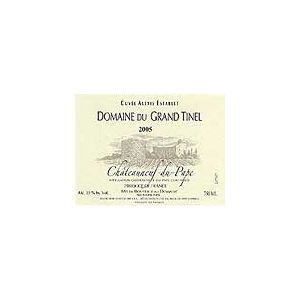
Tasting Notes: A powerful but sophisticated wine with plenty of hedonistic appeal, the 2005 Domaine du Grand Tinel Cuvée Alexis Establet captures the very essence of Châteauneuf-du-Pape. It is both deep in color and highly aromatic. Its enchanting perfume, redolent with pure berry fruit, cinnamon, and garrigue, soars from the glass. Moreover, its savor fills the mouth with the taste of lush black fruits, oriental spice, and Provençal herbs, before gracefully exiting on a long, polished finish that is deftly bolstered by lush ripe tannins. And although this special cuvée tops out at 15% plus alcohol, it never appears out of balance or over the top. In fact, the 2005 Cuvée Establet comes across as smooth and silky on the palate, even at its tender young age. Beautiful now but built for the long haul, the 2005 Grand Tinel Cuvée Alexis Establet should continue to mature in bottle for at least several more years and drink well for up to ten years or more. We suggest serving this reserve Châteauneuf-du-Pape at either cellar or cool room temperature (57°-66° F), after at least 15-20 minutes of aeration.
Accompaniments: Lamb and beef are the traditional accompaniments to Châteauneuf-du-Pape, and we would not argue with traditional wisdom on this account. However, if ever there were just a single wine for all occasions, it would have to be Grand Tinel's Cuvée Alexis Establet Châteauneuf-du-Pape. Indeed, the finest cuts of red meat make great partners with this reserve classic, but one should not overlook the virtue of sprucing up an ordinary meal with an "extra ordinary" wine like the 2005 Cuvée Establet, either. Consequently, some of our favorite offerings with the Cuvée Establet include braised lamb shank and beef tenderloin. For the beef tenderloin, we suggest cooking it medium-rare and serving it with thickly sliced portobello mushrooms in a red wine, shallot, and Herbes de Provence reduction. On a simple country note, old-fashioned lentil or split pea soup, served with crusty French bread and a spoonful of shaved hard cheese, makes for a splendid mid week banquet in the company of this excellent Châteauneuf-du-Pape, too, as does a salad of roasted red peppers, sautéed portobello mushrooms, roasted eggplant, tomato, caramelized onions, and a healthy crumbling of feta or other full-flavored cheese. Serve this healthy Mediterranean classic over a bed of complex greens or freshly baked focaccia, with a dollop of pesto mayonnaise or an olive and artichoke salsa or tapenade, and both the food and the wine will shine. Roast duckling, game, and most bean, sausage, and tomato-based dishes provide fine complements, too. Bon appétit!Domaine Alfred Edna Valley Chamisal Vineyard Chardonnay 2005 – USA
From the very first time we tasted Terry Speizer's wines, we knew they were special and we had better act fast. Moreover, we were certain that Domaine Alfred would not remain under the critic's radar for long, and we were right. Nonetheless, in spite of the great demand for every drop of Chardonnay and Pinot Noir from this meticulous estate, we are pleased to present Domaine Alfred's 2005 Chamisal Vineyard Chardonnay, the winery's premier estate-bottled Chardonnay.
Located in the cool Edna Valley of San Luis Obispo, Domaine Alfred is blessed by the wonders of the Central California coast environment, which include a long growing season, idyllic soil, and a perfect climate. In other words, great terroir! Moreover, all of Domaine Alfred's wines are estate bottled, with most of the grapes emanating from the winery's historic Chamisal Vineyard.
Chamisal, the first vineyard in Edna Valley, was originally planted in 1972. Purchased by the ingenious Terry Speizer in 1994, Chamisal, a then dormant vineyard, was replanted with six clones of Pinot Noir and five clones of Chardonnay on a total of 60 acres. Subsequently, an additional Chardonnay clone was added, followed by four clones of Syrah planted on an additional 14 acres. In 2000, Grenache and Pinot Gris were introduced into Chamisal and an additional 8 acres of Pinot Noir were planted. The original Chamisal clone of Chardonnay has also been reintroduced into this historic vineyard.
An innovative fellow, Terry Speizer is a consummate perfectionist and a great Chardonnay and Pinot Noir winemaker. And as is the case with most exceptional winemakers, Speizer's philosophy is quite simple. "The grapes are the soul of our wine," Speizer states emphatically. "If we do an exceptional job on the soul, then all we have to do is give it heart." And what a heart Speizer and his staff at Domaine Alfred have put into each of the eight vintages this property has released to date, beginning with the winery's inaugural 1998 vintage. Such work has tempted some to call Speizer the "Wizard of Oz," for each of his wines displays heart as well as brains and courage.
Chardonnay: The World's Most Celebrated White WineChardonnay is the most widely cultivated white varietal on the planet. Twice each year at harvest time (because the seasons are reversed in the northern and southern hemispheres) in its native France and in countless locales throughout the world, Chardonnay grapes command premium prices. In tribute, Chardonnay produces the finest, most flavorful dry white wines on the planet to which writers and connoisseurs devote countless columns and untold hours exalting its virtues and dissecting its flavors. Whether it be from Chablis or Champagne, Napa or McLaren Vale, or from the most illustrious of vineyards perched atop the slopes of Corton and Montrachet, Chardonnay is the yardstick by which all other dry white wines have come to be measured.
From its origins in the Burgundy region of France, Chardonnay has traveled the globe. Today, Chardonnay is produced on all continents, except Antarctica. In numerous locales Chardonnay produces outstanding wine that reflects in every detail the soil and the climate (terroir) in which it is grown. However, in California a few areas stand out for quality, and in the last decade none has been more successful than Santa Barbara and Sonoma counties and central California's Edna Valley.
With food, Chardonnay is a peerless match. Chablis-style Chardonnays provide superb complements in the company of seafood. And fuller, fleshier Chardonnay wines, typified by the best Australian and Californian versions, can more than hold their own with more complex fare, rich cream sauces, and meats. Moreover, the finest Chardonnay wines shine on their own, requiring nothing but a clean glass to please the palate. Enjoy!
Tasting Notes: Bright and sunny in the glass, the 2005 Domaine Alfred Chamisal Vineyard Chardonnay caresses the eye as well as the palate. It reminds us (at least those of us who are old enough) of the great California Chardonnays of yesteryear, those special Napa Valley offerings from the early 1970's that set the quality bar for New World Chardonnay and blew away more than a few French Burgundies in the process. If you are wondering where those wines went, they have come back. The 2005 Chamisal Vineyard Chardonnay offers up a full, heady aroma, replete with pure, intense Chardonnay fruit, the scent of acacia flower, pear, quince, and delicate spice tones, all deftly accented by toasted French oak. Fresh, flavorful, and long in the mouth, the 2005 Domaine Alfred Chamisal Vineyard Chardonnay epitomizes what it means to marry charm to flavor and power. Long, lingering, fresh, and extremely well balanced, one could drink this wine all night long and never tire of it. Up front, the 2005 Chamisal Vineyard is all California, but on the finish it is long, pure, spicy, and every bit as dry as the finest white Burgundy. We suggest only moderate chilling of this outstanding Chardonnay (about 40° F) before consumption, but patient Chardonnay fans may wish to reap the reward of additional pleasure and flavor by allowing this wine to linger awhile in the glass. Like all great Chardonnay wines, the Chamisal Vineyard benefits from a few minutes of aeration.
Accompaniments: What does one serve with the 2005 Domaine Alfred, Chamisal Vineyard Chardonnay? How about just about anything one's heart desires. However, Terry Speizer's wines are so distinct and flavorful that one would do well to build a meal around his wines, rather than plan the wines around a meal, and this is especially true for Speizer's flagship Chardonnay from the renowned Chamisal Vineyard. With that said, the 2005 Domaine Alfred Chamisal Chardonnay makes a truly a majestic companion to an elegant dinner party or special family gathering. It will highlight flavorful cheeses and hors d'oeuvres as well as fish, fowl, and pork. So, whether it is smoked salmon with all of the accoutrements, a sweet onion tart made with Vermont White Cheddar, or grilled grouper with a mango salsa, the 2005 Chamisal Vineyard Chardonnay is sure to shine. Additional serving suggestions with the 2005 Chamisal Vineyard Chardonnay include crawfish bisque with country ham, fresh shrimp and lobster spring rolls, and slowly grilled pork chops with juniper and sage roasted new potatoes. And if none of these suggestions strikes a chord, Domaine Alfred's Chamisal Chardonnay is so enjoyable and easy to drink on its own that it constitutes a meal in itself, so feel free to indulge your taste buds, unfettered. Enjoy!Joseph Drouhin Chorey-les-Beaune 2005 – France
Joseph Drouhin is one of the most respected names in the world of wine. Founded in 1880 by Joseph Drouhin, this prestigious Burgundy firm is presently being run with great critical and commercial success by the fourth generation of the Drouhin family: Frédéric, Laurent, Philippe, and Véronique Drouhin. They have taken over for their famous father Robert, who retired in 2003. Both négociant (wholesale merchant) and domain grower and producer, Maison Joseph Drouhin fashions many of Burgundy's greatest red and white wines, including Marquis de la Guiche Montrachet, a wine that has been called "the world's greatest white wine." Furthermore, the tremendous critical acclaim Drouhin's wines have received across the board in recent years only underscore just how terrific the entire Drouhin portfolio is from top to bottom. Beholden of 150 acres of prime Burgundy vineyards spread throughout the region's top communes, plus 125 acres in Oregon, one could spend a lifetime discovering the wines of Burgundy and the lure of Chardonnay and Pinot Noir without ever leaving Maison Drouhin.
Equally adept with Chardonnay and Pinot Noir, Maison Drouhin possesses some of the best vineyards in Chablis and Chassagne-Montrachet for white wines and equally superb holdings for reds on both the Côte de Beaune and Côte de Nuits. All of Drouhin's estate wines are grown and produced using sustainable methods of agriculture. The fields are still plowed, natural compost spread, and wild grass still grows between the vineyard rows, which means no chemical fertilizers or herbicides are ever used. Moreover, Maison Drouhin has for years used the most natural weapons against insects and vine diseases by introducing natural bacteria and predators into the vineyards, rather than resorting to systemic control through chemicals. All of Maison Drouhin's grapes remain hand harvested and for the estate's red wines only natural, wild yeasts are employed during fermentation. The results are simple: Drouhin produces only the best at every level of quality.
Tasting Notes: The 2005 Joseph Drouhin Chorey-les-Beaune is a tour de force in winemaking and perhaps the finest Chorey-les-Beaune ever made. From Drouhin's own holdings, this dandy exudes the essence of Côte de Beaune Pinot Noir. It is bright, pure, and packed with juicy fruit. Cherry and almond tones caress the nose and mingle in the wine's pinpoint center, while for added pleasure the 2005 Drouhin Chorey-les-Beaune is further endowed with the scent of Oriental spice. The latter displays itself in the form of cinnamon, nutmeg, and clove – flavors that pervade only the finest examples of Burgundian Pinot Noir in the best of vintages. And while imbued with plenty of charm and flavor, this sprightly Côte de Beaune retains a lightness and finesse that set it apart. From beginning to end, this red Burgundy is both fulfilling and refreshing. Moreover, the 2005 Joseph Drouhin Chorey-les-Beaune could easily double as the poster child for Pinot Noir. Drink this exemplary Chorey-les-Beaune now and for as long as you can get your hands on it. Anticipated maturity: 2007-2012.
Accompaniments: Food? Who needs food with the 2005 Joseph Drouhin Chorey-les-Beaune? No one, more than likely, but why settle for half the fun when you can have double the pleasure? A glass of Drouhin's outstanding 2005 Chorey-les-Beaune with a simple, well-prepared meal and there is no limit to life's goodness. And certainly traditional Burgundy favorites, such as Coq au Vin and Boeuf Bourguignon, offer the promise of gastronomic delight with this wine, but one need not be trained in the art of French country cooking to field a meal fit for this Burgundy. Drouhin's Chorey-les-Beaune will shine equally well in the company of a roast chicken or turkey, especially one that has been dressed with a savory bread and sage stuffing. A simple veal stew, quiche, onion and leek tart, or even just a loaf of good French bread with a full cream, un-crusted cheese will fill the bill with this magical Chorey-les-Beaune, so . . . bon appétit!