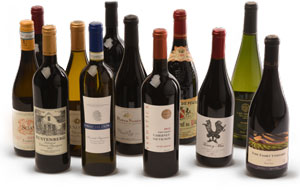
This Month's Featured Wines - March 2010
Premier Series |
|
Featured Wineries & Wines |
Membership Type |
| Château Sainte Eulalie Plaisir d’Eulalie Minervois 2007 – France | 1 Red 1 White; 2 Reds |
| Domaine de la Collonge Pouilly-Fuissé 2008 – France | 1 Red 1 White; 2 Whites |
| Bodegas Bilbainas Vina Zaco Rioja 2006 – Spain | 2 Reds |
| Gustave Lorentz Reserve Pinot Blanc d’Alsace 2008 – France | 2 Whites |
Master Series |
|
Featured Wineries & Wines |
Membership Type |
| Emilio Moro Ribera del Duero 2006 – Spain | 1 Red 1 White; 2 Reds |
| Bodegas Gormaz Viña Gormaz Rueda 2008 – Spain | 1 Red 1 White |
| Surfrider Malibu Newton Canyon Red 2005 – U.S.A. | 2 Reds |
Collector Series |
|
Featured Wineries & Wines |
Membership Type |
| Emilio Moro Ribera del Duero 2006 – Spain | 1 Red 1 White; 2 Reds |
| Molnar Family Poseidon’s Vineyard Carneros Chardonnay 2007 – U.S.A. | 1 Red 1 White |
| Bethel Heights Estate Grown Pinot Noir 2007 – U.S.A. | 2 Reds |
Please Note: Although we will make every attempt to ship the products listed, occasionally we may need to substitute them with equally outstanding wines. If you strongly desire to receive those listed, please contact us at 800-625-8238 so that we may note your account accordingly.
(The product descriptions below are excerpts from our monthly newsletter. Click here to view it in its entirety. )
Château Sainte Eulalie Plaisir d’Eulalie Minervois 2007 – France
Château Eulalie is the pride and joy of Laurent and Isabelle Coustal. The Coustals are originally from Bordeaux where Laurent still works. Together they have resurrected and restored the ancient Minervois vineyards surrounding their domaine, including the old vines at Château Eulalie. They grow Syrah, Grenache, and Carignan, the three most traditional of Languedoc varietals.
Isabelle Coustal is the winemaker and artisan in residence at Château Eulalie. She fashions several wines from old vines, including Plaisir d’Eulalie and La Cantilène. Both red wines spring from old vines from some of the Languedoc’s most renowned terroirs. Plaisir d’Eulalie is picked entirely by hand and bottled unfiltered in order to preserve its freshness and rich, haunting flavors. After more than a decade of outstanding work at Château Eulalie, Madame Coustal has earned her reputation as one of Languedoc’s premier winemakers.
Tasting Notes: The 2007 Château Eulalie Plaisir d’Eulalie Minervoisprovides the perfect wine to serve every day. Medium-bodied, pure, and full of favor, this cherry colored Minervois conveys all of the enticing scents and savors that led the Romans to name the hallowed ground of Minervois after their goddess Minerva. Perhaps one tasting panel member best described the 2007 Château Eulalie when he commented, “Ooh-La-La is more like it. This is a very accessible wine that immediately starts impressing.” Indeed first impressions are important. The 2007 Château Eulalie ingratiates itself with the aromas of ripe cherries, black fruits, thyme, garrigue, and dried Provencal flowers that evoke the potpourri of Provence. Better still the wine’s charming olfactory folds seamlessly into the flavor profile and offers smooth tasting from start to finish. This wine is like a friendly cat; soft, warm, purring and eager to please at any moment! We suggest allowing this tasty red at least 15-20 minutes of aeration, before serving it at cool room temperature (60º-66º F). Salut!
Accompaniments: The 2007 Château Eulalie Plaisir d’Eulalie Minervois charmed several tasting panels, with a glass as its only companion. However, consuming this amiable Minervois without the benefit of food truly provides only half the pleasure. Château Eulalie enhances grilled meats, including beef, lamb, and pork. This wine also does equal justice to traditional Mediterranean favorites, including most cheese and tomato laden southern Italian favorites such Eggplant Parmigiana, lasagna, and of course pizza. Hearty pasta dishes made with fresh tomatoes, herbs, and wild mushrooms are good bets, too. So is red pepper hummus and smoked meats. Salami, pepperoni and soppressata offer superb pairings, especially in the company of aged, hard cheeses. Enjoy!
For the Love of Cheese: Bring on the aged Pecorino. Slice a few pieces of Brie to serve with toasted walnuts, and don’t forget the Chèvre! The 2007 Château Eulalie Plaisir d’Eulalie Minervois is a natural with the many types of cheeses from the cows, goats, and sheep that ply the rugged mountains and secluded valleys of the Languedoc. So, why not try some of each? For more specific wine and cheese pairings or to make an inquiry regarding the world’s finest cheeses, contact us at www.cheesemonthclub.com and enjoy the exciting world of international cheeses.
Domaine de la Collonge Pouilly-Fuissé 2008 – France
Gilles Noblet at Domaine de la Collonge continues to fashion some of the Macon’s (the area of southern Burgundy that is known for its elegant Chardonnay wines) finest and most enjoyable white wines from several renowned appellations. Noblet’s Domaine de la Collonge is a small family owned and run domain of only 22 acres. Gilles is the fourth generation member of his family to make wine at this prized property. For the record, Gilles’ wife, also, comes from a traditional winemaking family. Madame Noblet is the sister of Jacky Janodet, the present dean of Grand Cru Beaujolais, so wine and winemaking run deep in the heart and soul of this couple as well as in the terroir of the domaine’s well-tended vineyards.
The name Domaine de la Collonge derives from the sector or area (known as an aire) of the Fuissé commune that is called Collonge. Most of Gilles Noblet’s estate is spread along the hills of la Collonge, which yield on average only a little more than six thousand cases of Pouilly-Fuissé each year. However, Monsieur Noblet also fashions small quantities of exceptional Macon-Fuissé, Pouilly-Loché, and St. Véran – all elegant Chardonnay based wines similar to Pouilly-Fuissé.
Although not certified organic, Gilles Noblet practices sustainable agriculture and uses non-interventionist methods almost exclusively at Domaine de la Collonge. No artificial fertilizers or insecticides are employed, and only natural yeast is used in fermentation. Moreover, the average age of the vines for Domaine de la Collonge averages more than forty years, while many vines are considerably older. Noblet’s old vines and reduced yields result in wines that are more generous and concentrated than the average Maconnais white.
In appellations that traditionally turn out large quantities of wine, Gilles Noblet decided a long time ago to dance to a different beat. Consequently, Noblet’s style of Chardonnay is one of elegance, purity, and the honest expression of each appellation’s terroir. Noblet’s Pouilly-Fuissé features a real balance between flesh and bone, fruit and minerality, if you will. In addition, Noblet uses traditional wooden foudres (large wooden tanks) with temperature control elements for fermentation to insure texture and a gentle roundness in his wine. He also ages his wine in a combination of foudres and small oak barriques, of which only 20% or less are new each year. The limited use of new oak is practiced expressly, so that the oak barrels impart roundness and texture to the wine, rather than the overwhelming taste of oak that destroys the natural delicacy of Pouilly-Fuissé and its siblings. In essence, the wines of Domaine de la Collonge are classic white Burgundies as well as some of the most compelling wines of the Maconnais.
Tasting Notes: Year in and year out, Gilles Noblet fashions crowd pleasing Pouilly-Fuissé that is bright, sunny and oh . . . so easy to drink. With every sip of the eminently drinkable 2008 Domaine de la Collonge Pouilly-Fuissé, one tastes the golden clusters of Chardonnay grapes that mature gently and slowly under the Maconnais sun. What's more, the 2008 Domaine de la Collonge Pouilly-Fuissé exhibits Noblet’s soft, seductive signature. On the nose, his vivacious 2008 Pouilly-Fuissé offers up a dazzling bouquet of fruit blossoms, soft breezes, and freshly baked bread. Furthermore, Noblet’s 2008 Pouilly-Fuissé possesses pinpoint purity and minerality – hallmarks of the finest Pouilly-Fuissé. In the mouth, the 2008 Domaine de la Collonge caresses the palate with an enticing array of flavors: acacia, freshly cut apples, pears, and cream, all of which capture the very essence of Maconnais Chardonnay. Moreover, Gilles Noblet’s gracious Pouilly-Fuissé possesses charm, elegance, and a certain nuance of flavor the French refer to as “un certain je ne sais quoi.” As authentic white Burgundy, Gilles Noblet’s Pouilly-Fuissé performs best when afforded a few minutes of aeration, so we suggest serving this wine moderately chilled (40° F) and then allowing it to evolve slowly in the glass. Salut!
Accompaniments: With the possible exception of fine French Champagne, we can think of no better aperitif or opening act than the 2008 Domaine de la Collonge Pouilly-Fuissé. Gilles Noblet’s flagship wine is light, lovely, and eminently drinkable. It is, also, an easy white wine to pair with delicate fare, especially, hors d’oeuvres, cheeses and fine fruits of the sea. Scallop and crab dishes constitute some of our favorite offerings with Gilles Noblet’s Pouilly-Fuissé. Scallops, sautéed in a light cream sauce with pistachio nuts, and Coquille St. Jacques are two perennial favorite dishes with this wine. Blue Fin Crab cocktail offers another memorable pairing to this elegant 2008 Pouilly-Fuissé. Flounder or Grouper, stuffed with crabmeat, makes a wonderful pairing, too. In addition, baked or grilled sole, sea bass, and mahi mahi offer other fine choices with Pouilly-Fuissé. And for those not beholden to the sea for sustenance, light creamy pastas and healthy garden salads topped with grilled chicken offer other excellent accompaniments to this beautiful Macon Chardonnay. Bucheron, Port Salut, and most other soft, crust-less cheeses provide excellent and easy to prepare accompaniments to Pouilly-Fuissé, too. There is, however, one caveat with Noblet’s Pouilly-Fuissé; it goes down so easily that you may want to keep an extra bottle or two on hand. You are sure to need it. Enjoy!
Bodegas Bilbainas Vina Zaco Rioja 2006 – Spain
Bodegas Bilbainas is one of the oldest and most trusted names in Rioja. Founded in 1859, Bilbainas is perhaps best known for fashioning some of Rioja’s most traditional reference point wines. Vina Pomal and La Vicalanda are the bodega’s more time-honored offerings, while Vina Zaco is the winery’s newest venture. Located in the prestigious Rioja Alta, the premier zone of the sprawling Rioja appellation, the Bilbainas estate comprises over 500 acres of some of the region’s oldest and most illustrious vines. Bilbainas is also the largest winery in the Rioja Alta. And unlike many of its neighbors, Bodegas Bilbainas uses only 100% estate grown grapes in all of its wines.
Vina Zaco draws its name from one of the oldest vineyards at Bilbainas and the entire Rioja Alta. It is made exclusively from Tempranillo grapes, the premier variety of Rioja. However, it is neither a Crianza nor a Reserva in the traditional style. Instead, it is a contemporary Rioja that draws its charm from the great fruit and essential terroir of the Zaco Vineyard. Vina Zaco is aged in American and French oak, but it is not constrained by the parochial rules of barrel aging established for Crianza and Reserva designations. Instead, Vina Zaco is bottled when the estate’s international award winning winemaker Diego Pinilla believes the wine has achieved its ultimate potential. With Vina Zaco, Bodegas Bilbainas has set out to make the ultimate modern expression of Rioja.
Tasting Notes: “A soft, succulent Rioja that captures the vibrancy of the Rioja Alta, without a preponderance of wood” is how one persnickety panel member described this wine, as the other tasters all smiled and nodded in approval. Indeed, Bodegas Bibainas’ 2006 Vina Zaco is already a reference point wine, meriting 90 plus points from the world’s most demanding critics. Moreover, the wine is a real crowd pleaser. Medium to full bodied and pleasingly aromatic, this Rioja hits all the sweet spots on the palate and everything else in between. It combines the heavenly scents of crushed red berries with hints of anise and sandalwood. In the mouth, Vina Zaco expands into a warm generous wine, rich in fruit, nut, and spice flavors that gain length and depth with aeration. Although ready to drink from the moment the cork exits the bottle, Vina Zaco will more than repay a little aeration prior to consumption. Consequently, we suggest you open this special Rioja at least twenty to thirty minutes before serving at cool room temperature (60º - 66º F).
Accompaniments: Food and wine critics and many a self proclaimed connoisseur on both sides of the Atlantic have extolled the virtues of beef and lamb in the company of Rioja, and while steaks, stews, and braised lamb shanks provide tried and true accompaniments to the 2006 Vina Zaco, the contemporary style of this wine lends itself to broader appeal. Traditional Spanish jamon, prosciutto, and other meats also provide excellent counterpoint to the fruit and gregarious charm of Vina Zaco. Duck confit; rotisserie roasted chicken, basted with Mediterranean herbs, butter, olive oil, and garlic, and even savory pasta dishes, with or without meat, pair beautifully with this wine, too. Penne pasta, served with a heady white bean sauce, made with plenty of onion, garlic, red pepper, celery, and grated hard cheese showcase the fresh and elegant side of the 2006 Vina Zaco. World class cheeses such as Mahon, Manchego, Gouda, and Havarti in the company of freshly baked bread offer more reasons to open a bottle of the 2006 Vina Zaco. In addition, most meat, vegetable, and dairy recipes get a warm welcome from Vina Zaco.
Gustave Lorentz Reserve Pinot Blanc d’Alsace 2008 – France
Gustave Lorentz is a family owned and operated winery that dates to 1836. Today, the very capable 43-year old Georges Lorentz is the Lorentz in charge, with some assistance from his “retired” father, Charles. The Lorentz winery is one of the largest family owned facilities in Alsace. It encompasses sixty-six acres of premium vineyards in Bergheim, including nearly half of the great Grand Cru vineyard of Altenberg de Bergheim and all of Kanzlerberg, the smallest Grand Cru vineyard in Alsace. Bergheim is located in the very finest section of Alsace, a mere 3 kilometers from Ribeauville and just 5 kilometers from Riquwihr. This is the “real” Alsace wine country, the very heart of the famous Route de Vin. All of the Lorentz wines come from this premier area known as the Haut Rhin and express the unique Bergheim terroir.
Like most Alsace producers, Gustave Lorentz features several levels of wine from a gamut of traditional Alsace grapes. The ubiquitous Pinot Blanc provides a steady income and a solid foundation upon which Lorentz, like the majority of Alsace growers, has built his empire. Yet, Gustave Lorentz’s Pinot Blanc stands above the rest. As one would expect, Riesling, Tokay Pinot Gris, and Gewürztraminer constitute the remaining stars in the estate’s tiara, as they do throughout Alsace. In addition, Lorentz’s wines are featured in many of the Michelin-starred restaurants in Alsace and some of the finest restaurants around the world. From simple vintage cuvées to Reserve and Grand Cru bottlings as well as the rare late harvest wines known as Vendanges Tardives, Lorentz is dedicated to the fashioning of the highest quality Alsace wines. Vive la différence!
Tasting Notes: The 2008 Gustave Lorentz Reserve Pinot Blanc is a truly dry rendition of a classic Alsace varietal. It is a bright, cheerful Pinot Blanc that offers up a gentle mineral rich aroma that is laced with the scents of crisp mountain apple and fresh soft cheeses. In the mouth, the 2008 Lorentz Pinot Blanc Reserve dances across the palate, before exiting in a flourish of clean crisp flavors that hint of almond and spice. Yet, what makes this Pinot Blanc so intriguing is the same quality that makes all of Lorentz’s wines so appealing: it is the ability to be a chameleon, ever-changing in the glass so as to present new facets and flavors with each sip. Although some may prefer this wine icy cold, we suggest you try it at a more ambient temperature (50º-55º F). The 2008 Gustave Lorentz Reserve Pinot Blanc broadens in the glass as it shrugs off an icy chill. When only moderately chilled this wine reveals considerable subtlety and nuances of flavor that are easily overlooked when the wine is icy cold . . . but as you like it!
Accompaniments: The 2008 Gustave Lorentz Reserve Pinot Blanc is one easy drinking wine, with or without food. However, its chameleon like nature makes it a versatile wine to pair with wide variety of cuisines and individualized dishes. Not surprisingly, traditional Alsatian favorites such as Quiche Lorraine and leek tarts provide excellent accompaniments to this balanced, flavorful Pinot Blanc. Baked or lightly grilled white fish such as cod, flounder, or tilapia offer good company to the 2008 Lorentz Reserve Pinot Blanc as well. Hors d’oeuvres, shellfish, and fish chowders supply additional first-rate accompaniments. Eclectic or traditionally hard to pair dishes such as Orzo Salad with garbanzo beans, Shrimp Fra Diavolo, or even Asian stir-fry, work especially well with this racy Pinot Blanc, too, so why not experiment and enjoy!
Paolo Scavino Barolo D.O.C.G. 2003 – Italy
The Paolo Scavino estate was born on the Langhe Hills in the tiny village of Castiglioni Falletto in 1921. Paolo Scavino’s original purchase of the diminutive cru Bric del Fiasc, a prime 4.5 acre hillside vineyard, began the Scavino odyssey – the quest to produce the finest wine in all Barolo. Today, under the direction of Paolo Scavino’s son Enrico, the estate has grown to nearly 44 acres, with exceptional holdings in several of Barolo’s most privileged “grand cru” vineyards. More importantly, Enrico Scavino and his daughter Elisa, a trained enologist, are fashioning a bevy of compelling wines, including a stunning array of Barolos that place this estate among the greatest in Italy.
Our first impression of Enrico Scavino is his bright, beaming face as he swings open the large wooden doors of his new winery to welcome us. A cheerful, amiable man with an open smile, Enrico Scavino treats his vineyards as well as his guests with the utmost care. In his vineyards, he employs only organic fertilizers and prunes his vines seriously to extract the greatest concentration of flavor from the grapes. In the cellar, an impressive new state of the art facility, the affable Enrico works his magic, which somehow includes imbuing each and every one of his wines with the polish of his personality and the warmth of his smile. And alongside him now is Elisa, his equally talented and engaging young daughter, who has already established herself as one of Piedmont’s most prodigious young winemakers.
Like most Piedmontese estates, Paolo Scavino produces a wide array of wines, both red and white. Dolcetto, Barbera, and Nebbiolo, the three most traditional red Piedmontese varietals, are all cultivated in ascending order on the estate’s hillsides, but Nebbiolo claims its rightful place in the hierarchy as it alone is responsible for Barolo, the estate’s greatest claim to fame. The Scavinos fashion several cru bottlings of Barolo in addition to the estate’s regular or normale bottling, including Bric del Fiasc, Bricco Ambroggio, and Cannubi. All of Paolo Scavino’s wines are produced in small quantities, often making them difficult to acquire.
Tasting Notes: The village of Castiglione Falletto is known for producing a powerful, masculine style of Barolo that is equally renowned for its longevity; and while Enrico Scavino’s Barolo wines are some of the most age worthy in all Barolo, they are also supremely balanced, highly polished offerings that trade rusticity for complexity and a staggering depth of flavor. Not surprisingly, Scavino’s 2003 Barolo normale is one of the most charming of all Barolo in 2003. It is a gracious wine, regally robed in a purple cloak, and perfumed with the scent of roses, anise, and mulberry. It is also hauntingly rich and complex in flavor. True to form, the 2003 Paolo Scavino Barolo is a polished offering. It is indeed already one of the most ingratiating of all 2003 Barolo, but let’s make no mistake on this; Scavino’s 2003 Barolo is no featherweight. The wine’s sweet fruit is wrapped around a core of ripe tannins that add considerable depth to the mid palate and reveal ultimately the power of this otherwise smooth, layered affair. Furthermore, the wine’s finish happily carries on much like its author’s smile, long after it has disappeared from sight. Enjoy this beautifully crafted Barolo now and over the next 10 years. For optimal enjoyment, one should always open young Barolo well ahead of time. We suggest opening the Scavino Barolo in the morning or early afternoon and then allowing it to stand open in a cool dry place until dinner. Decanting at least an hour or more ahead of consumption is another way to enjoy the nobility of Barolo, “the king of wines and wine of kings.”
Accompaniments: Barolo, Piedmont’s greatest wine, provides the ideal match for classic Northern Italian cuisine. Specifically, Barolo is made with the delights of the Piedmontese table in mind. Consequently, such Piedmontese classics as Tender Veal medallions; Stuffed Farm Raised Veal or Lamb Shanks; Truffle Seasoned Risottos, served with Roasted Game Birds; and Venison Stew all provide traditional, mouthwatering accompaniments to Scavino’s sensual, stylish 2003 Barolo. However, French country cooking and many tried and true continental favorites offer equally irresistible accompaniments to Enrico Scavino’s sophisticated, full-flavored Barolo. So why not consider Boeuf en Daube à la Provençale, better know as Braised Pot Roast with wine, tomatoes, and Provençal herbs; Tenderloin of Beef in Puff Pastry; or Filet of Beef with onions, mushrooms, and olives. For those less adept at the culinary arts, we have found that almost any hearty meat dish provides a beautiful canvas on which the 2003 Scavino Barolo can etch its indelible portrait, so as you like it!
Domaine des Baumard Clos du Papillon Savennières 2005 – France
Domaine des Baumard lays tucked away in the tiny village of Rochefort-sur-Loire, just south of Savennières, in the very heart of the ancient Duchy of Anjou. This property is an impeccably run estate that has been fashioning outstanding Loire Valley wines since 1634. The historical Baumards are viticulturists who specialize in the great but now nearly forsaken Chenin Blanc variety. However, under the recent guardianship of Jean and Florent Baumard, Domaine des Baumard has soared to new heights, even as many of Baumard’s neighbors have struggled to maintain their marginal vineyards.
Although Domaine des Baumard has played a key role in producing great Loire Valley wines for centuries, much of the modern day lore can be attributed to Jean Baumard, Florent’s father, who resurrected this family property in the 1950s and 1960s after decades of decline due to phyloxerra, economic depression, and the ever shifting tastes of the wine drinking public. For decades the Baumards, like many of their neighbors, were forced to concentrate their efforts on their nursery business and the cultivation of vines rather than wine making. That is until the 1950s when Jean began acquiring several of the greatest vineyards in Côteaux-du-Layon, Savennières, and Quarts de Chaume and refocused the family’s effort into the crafting of the greatest of all Loire Valley wines.
In the past decade Florent Baumard, a brilliant winemaker in his own right, has continued the great renaissance at Domaine des Baumard. Today, Florent may in fact be the region’s finest winemaker. The Wine Advocate has stated that “Baumard quietly fashions some the world’s most complex dry and sweet wines . . . and if he had been born a Californian, Burgundian, or Bordelais, wealthy vineyard owners would be standing in line to employ his services as a consultant,” which is high praise indeed.
Presently, Domaine des Baumard has one of the most extensive portfolios of Anjou wines, including outstanding dry Savennières offerings, sweet treasures from Côteaux-du-Layon and Quarts de Chaume, a host of artful cuvees, and at least three of the Loire Valleys most enjoyable sparkling wines. There are also a number of single vineyard offerings. All of Baumard’s Savennières and Côteaux-du-Layon wines are produced from low yields (1.5-2.5 tons per acre). Moreover, all of Baumard’s wines are hand harvested and each of the estate’s wines is made in small, individual lots.
Tasting Notes: Born into one of Savennières’ greatest vintages, the 2005 Baumard Clos du Papillon has received tremendous acclaim since its release, and all of it well-deserved. A stunning wine of breed, length, and profound depth of flavor, the 2005 Clos du Papillon merits an enviable position as the poster child for Savennières and the dry Chenin Blanc wines of the entire Loire Valley. Furthermore, this wine continues to improve in bottle with each passing year. It also has the uncanny ability of being able to unfold in the glass for hours on end. In typical Baumard fashion, the 2005 Clos du Papillon shines from the glass like the morning sun. It glints of gold and its bouquet beholds the breath of spring: apple and pear blossoms, clove, dried honey, marzipan, and a suave minerality dazzle the nose. Even more impressive is how the wine’s haunting aromatic profile carries through on the palate and expands in a lush, seamless array of flavors that coat the tongue and satiate the palate, without residual sugar. For optimal enjoyment we suggest consuming the 2005 Baumard Clos du Papillon only lightly chilled (45°-55º F) to highlight every bit of the subtle charm that Baumard and the beloved Savennières have to offer. In addition, we recommend that one allow the outstanding 2005 Clos du Papillon to breathe for at least several minutes in the glass, as the great wines of Anjou tend to open slowly and reveal themselves fully only with time. For savvy collectors and the more patient among us, we suggest acquiring a few extra bottles to lay away as Baumard’s Savennières offerings are some of the longest lived white wines in the world. Anticipated maturity: 2010-2017. Salut!
Accompaniments: A wine as rich and sensuous as the 2005 Clos du Papillon lends great esteem to the most exquisite morsels brought to table. Yet, unlike the more austere offerings of Savennières, the 2005 Clos du Papillon is equally splendid on its own, before or after dinner. Nevertheless, fish, poultry, and savory pork dishes provide outstanding accompaniments to this wine. A whole steamed or grilled lobster, served with drawn butter, merits high marks as does slow cooked potted pork roast, smothered in a savory homemade barbecue sauce. Foie Gras, country pâté, and creamy hard cheeses such as Mimolette from Normandy and Brittany offer outstanding complements as well. One could also consider a myriad of Asian fusion specialties with this Savennières. Even moderately spicy Chinese, Thai, and Vietnamese appetizers will not overpower Clos du Papillon. Enjoy!
Joel Gott Dillian Ranch Amador County Zinfandel 2007 – U.S.A.
Although still on the shy side of 40, Joel Gott has become a legend in wine circles. The offspring of fourth generation California winemakers, Gott was riding a tractor at his family’s farm at 4 years of age and has been involved in numerous wine and food enterprises since he was a teenager. Gott also ran the now famous Taylor’s Refresher drive up restaurant in Napa when noted wine critic Robert Parker Jr. named this eatery as the source of one his top ten meals of 1999, and in 2006 Taylor’s was honored with a James Beard Foundation Award. But these accolades are just the tip of the iceberg, or perhaps more appropriately in Gott’s case, the skin of the grape.
Gott has been making knock-out wines for more than fifteen years. A partner in several successful and highly acclaimed wine ventures, his most notable success remains the production of bodacious Zinfandels at the Joel Gott Winery. Each year Gott produces a host of wines in small lots at his winery, but the most outstanding offering is always his Dillian Ranch Amador County Zinfandel from Tom Dillian’s dry-farmed 20 acre vineyard in Plymouth, California.
The Dillian Ranch vineyard is located in the hills of “Gold Rush Country.” Planted between 1920 and 1948, Dillian Ranch is a shy bearing vineyard that produces as little as three quarters of a ton of fruit per acre and one of California’s most memorable Zinfandels. In addition to fashioning tiny quantities of Dillian Ranch Zinfandel, Joel Gott has made a name for himself among consumers for a bevy of high quality affordable California varietals, including Chardonnay, Cabernet Sauvignon, and of course Zinfandel.
Tasting Notes: Joel Gott has been making Dillian Ranch Zinfandel to great acclaim since 1996, but there has been no better effort from this outstanding vineyard than the majestic 2007 Dillian Ranch Zinfandel. Rich in robe and endowed with the heavenly scents of blackberry, wild cherry, bramble and sassafras, one could almost be satisfied by merely sniffing this delectable potion. But alas, that would be only half the pleasure. On the palate, this packed, full-throttle Zinfandel offers up even more of the savor found in its stunning olfactory along with a mélange of black fruits, herb, and sweet vanilla tones. Framed by sweet, ripe tannins, the 2007 Dillian Ranch Zinfandel can rightly claim its place as an American classic. We suggest a few minutes of aeration prior to consumption at cool room temperature (62º-66º F). Enjoy!
Accompaniments: As an American classic the 2007 Joel Gott Dillian Ranch Zinfandel is the ideal companion to serve with great American fare. So whether it is turkey and stuffing with all the trimmings, t-bone steaks, or Texas Barbecue, this flavorful Zinfandel will not disappoint. Roast loin of pork, with onion and sage dressing; spare ribs; or the best burgers around (may we suggest Taylor’s Refresher in Napa?), Joel Gott’s Dillian Ranch aims to please. We also enjoy this quintessential Zinfandel with ripe cow’s milk cheeses and unadorned, meaning all by itself. It is terrific on its own, especially after a big meal . . . but as you like it!