Vol. 5 No. 7
Standard Selection - (1) Red, (1) White
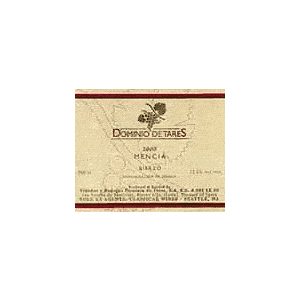
Domimio de Tares Mencia Bierzo 2000 - Spain
Freie Weingartner Wachau Terrassen Thal Riesling 2000 - Austria
Red Wines Only Featured Selections
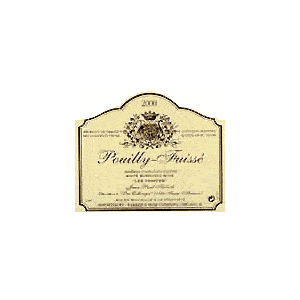
Domanie Thibert Pouilly Fuisse 2000 - France
White Wines Only Featured Selections
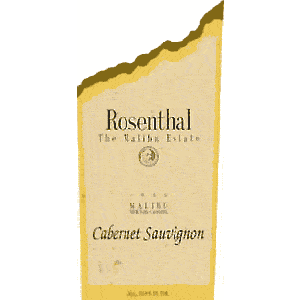
Rosenthal Malibu East Cabernet Sauvignon 1996
Dominio de Tares Mencia Bierzo 2000 Spain
Dominio de Tares lies to the Northwest of Castilla, in the province of Leon on the frontier of Galicia, above Portugal. In other words, El Bierzo is deep in the middle of nowhere, but in this case nowhere ( Bierzo) comprises one of the finest terroir for grape growing in all Europe. This isolated, wildly beautiful region sits on the bed of an ancient lake, which the Roman's drained in their quest for the area's mineral resources, namely gold. Today the Bierzo produces liquid gold in the form of red wine from the indigenous Mencia varietal.
The Mencia varietal is considered to be the direct ancestor and precursor of Cabernet Franc and hails from the plantings of the earliest Roman settlers in Bierzo some two thousand years ago. In the Bierzo, the average age of the vines is quite old and the contemporary emphasis on quality wine rather than quantity has led to the formation of Dominio de Tares.
Dominio de Tares was formed in 2000 by an enthusiastic group of local investors, leading a quality resurgence, following years of obscurity and benign neglect in the region. Given Bierzo's unique climate, a mixture of Continental and Atlantic influences, and the region's mineral rich soil, all that was needed to make world class wine from old vines in Bierzo was a world class winemaker. To the credit of Dominio de Tares, they have retained Amancio Fernandez, a Bierzo native and one of Spain's brightest young enologists, to transform Bierzo's old vine Mencia into liquid gold. The 2000 Dominio de Tares marks this bodega's debut vintage. Already, this wine has met great critical acclaim and been enthusiastically received by consumers. We think you will concur.
Spain: The Land Time Forgot?
Spain is the world's third largest producer of wine, after Italy and France. Yet, with the exception of Rioja and the lovely, affordable Cava of Penedes, Spanish wines are little known in the United States. Why?
Primarily, Spain has failed in comparison to its larger, wine-exporting counterparts in marketing its wines in the United States. Moreover, Spanish producers have only recently come on board to slake the growing American thirst for red wine, even though red wine has long accounted for the bulk of Spanish production, and Spain has long prided itself on great, old style reds. Yet, another factor behind the seemingly small selection of Spanish wines available in most stores and restaurants, at least in comparison to those of Italy and France, may indeed be the stereotype itself of the very traditional, heavily oaked style of Spanish red, typified by Rioja. It seems as if Rioja had become synonymous with Spanish wine to the detriment of the many fine Spanish reds and whites from lesser-known locales.
While Italy and France and most New World wineries have undergone nothing short of a revolution in winemaking, thanks to enological research and the advent of technical equipment (much of it made in Italy), the well-known Rioja has for the most part clung to its traditional ways of production and its Old World style.
Fortunately for Spain and American consumers, the resurrection of the Bierzo and many other once and future great wine producing regions of Spain has begun. At last the sleeping giant has awakened, bearing both new and old styles of interesting, high quality wines to our shores. Spain, the land time seemed to have forgotten, has just been rediscovered, thanks to some wonderful importers, such as Classical Wines of Spain. Stay tuned for some pretty fascinating reds and whites in the months to come.
Tasting Notes: The deep garnet, purple imbued 2000 Dominio de Tares Mencia Bierzo is a delightful red wine from one of our favorite Spanish wine regions. El Bierzo's geographical isolation, ringed by mountains with an Atlantic influenced climate and high altitude, gives rise to a distinct terroir of great nobility, which is readily evident in this debut offering from Dominio de Tares. Produced entirely from old vines of the medieval Mencia variety, a grape that is widely regarded as the direct ancestor of Cabernet Franc, the 2000 Dominio de Tares Mencia marries deep, cherry-vanilla aromas to round, spicy fruit and an elegant dry finish. A three-month stay in small oak barrels adds additional roundness and charm, without the overpowering oak overlay that often accompanies other premium Spanish reds. We suggest serving the mouthwatering Dominio de Tares at cellar temperature (55°-60°F).
Accompaniments: Grilled chicken, served over a bed of organic greens that are laced with black and green Spanish olives, red onion, and garlic sautéed green beans, makes for a wonderful accompaniment to the 2000 Dominio de Tares Mencia. A chicken and shrimp paella provides another lovely feast with the Dominio de Tares, as does a rare tuna steak dipped in a simple Japanese soy based sauce. Rice and vegetable dishes and couscous specialties are some of our other favorite choices with this elegant, friendly red. This wine's round, huggable flavors pair well with most, uncomplicated foods, so don't be afraid to experiment.
Recipe for Red Wine:
Shrimp Paella
2 tsp. olive oil
1 cup white rice
1 large onion chopped
1 cup frozen tiny peas defrosted
2 ½ cups chicken broth
½ lb. medium shrimp- peeled & deveined
½ tsp. paprika
¼ tsp. hot sauce
1 small jar pimentos drained
2 cloves garlic minced
16 oz. can tomatoes - chopped
salt & pepper to taste
Heat 1 tsp. olive oil in a large skillet and add shrimp. Saute for 4-5 minutes or until pink in color. Remove shrimp to a plate and add remaining olive oil to pan and sauté the onion and garlic and cook over low heat for 5 minutes. Stir in paprika, hot sauce and salt and pepper; cook for 2-3 minutes. Add the rice, mix well, add chicken broth, bring to boil, reduce heat and cover. Simmer rice over low heat for 20-25 minutes. Add shrimp, mix well and continue cooking over low heat 5-10 minutes.
Freie Weingartner Wachau Terrassen Thal Riesling 2000 Austria
Austria enjoys such a reputation for stunning scenery, winter sports, Viennese pastries, and picture postcard palaces that it is easy to forget that a bevy of fine wines flows from the terraced hills and lakeshore vineyards of this alpine nation. In fact, Austria enjoys an unbroken thousand year viticultural history, dating back to 955 A.D. and the decree by Otto I to replant the Austrian vineyards - the first such attempt since the departure of the Romans. In fact, Vienna is the only world capital to sustain an economically viable wine industry within its borders. Moreover, Austria presently adheres to the most stringent laws and the highest standards of wine production in the world and turns out many charming, flavorful, natural tasting wines, thanks to legislation mandated in the 1980's.
White wines dominate the Austrian wine trade in both quality and quantity, despite an increasing number of delicious reds from such unique varietals as Blaufrankisch and Zweigelt. Fine white wines are made from native Austrian varietals as well as a host of other European varietals, but unlike Germany, her neighbor to the north, the vast majority of white wine made in Austria is dry. The best and most intriguing of these white wines springs from either Riesling or the native Gruner Veltliner, the spicy, quintessential Austrian varietal, which suddenly seems the rage in the finest eateries around the globe. From Vienna to Los Angeles to Hong Kong, Gruner Veltliner is popping up to accompany an increasingly eclectic international fare that defies the ordinary Chardonnay or Sauvignon Blanc accompaniment. In addition, Austria crafts fine white wines from Weissburgunder (Pinot Blanc), Rulander (Pinot Gris), and Sauvignon Blanc, the best of which can compete with the finest such examples from France and elsewhere.
The major wine growing areas of Austria are scattered throughout the eastern third of the country, but none can claim to be more beautiful than the Wachau, the majestic valley of the Danube, located some 100 kilometers north of Vienna. This high, narrow Danube valley, between Melk and Krems, is recognized as one of the most stunning river landscapes in the world. In 1994 the Wachau was recognized as a Conservancy Area of international value and awarded the European Nature Protection Diploma. In Durnstein, at the heart of the Wachau, lies the Freie Weingartner, the world's best cooperative.
Although we rarely feature wines from cooperatives, simply because most collective endeavors turnout less than stunning wines, we felt compelled to feature Freie Weingartner, simply because the dedication, commitment and quality coming from this small cooperative is second to none. In the Wachau, where the average vineyard may only be a couple of acres, Freie Weingartner has become the most reliable and viable source of fine wine, especially under the direction of the now legendary Willi Klinger.
For its outstanding production of Wachau wines, Freie Weingartner Wachau has been voted International Winery of the Year by the influential magazine, Wine & Spirits, garnering the prestigious award in 1999. This is the fist time an Austrian producer has achieved this award. Like most first rate Austrian wineries, the Freie Weingartner specializes in Gruner Veltliner and Riesling wines, which all of the greatest wine publications and critics have lauded. Robert Parker's Wine Advocate has counted its Gruner Veltliner and Riesling among The World's Greatest Wine Values, while Decanter, the most prestigious British wine journal calls its wines some of the best there are. We hardily concur, and believe you will, too.
Tasting Notes: An ethereal, enchanting cachet of spice combines with clean, pure minerality in the bouquet of the lovely, golden-tinged 2000 Freie Weingartner Gruner Veltliner. The words racy, refreshing, and elegant are the descriptors most often used to describe the flavor of this restrained Chablis style of Gruner Veltliner. On the finish the 2000 Freie Weingartner is as dry as any Chardonnay from Chablis or the Macon, dispelling the myth that Austrian wine is little more than a German makeover. Subtle, but fine, this Gruner Veltliner charms the pants off of the taster, relying more upon persuasion and seduction than power or obtrusive spice. Like all first rate Gruner Veltliner, serve the Freie Weingertner only moderately chilled, and by all means allow the wine to open in the glass like a fine red.
Accompaniments: Lobster is the perfect companion. A Mediterranean salad, with plenty of artichoke and sun-dried tomato, olive oil and black olives, is my first choice. Shrimp Remoulade or an Asian stir fry gets my vote. these suggestions account for just a few of the panel's favorite foods with the 2000 Freie Weingartner Gruner Veltliner. The eclectic choices sighted by the panel underscore the versatile nature of Gruner Veltliner and explain why many new wave restaurants now feature this tasty varietal. However, the refreshing, restrained spiciness in this wine also makes it a fine candidate as an aperitif. Simple grilled fish, chicken or pork dishes will provide plenty of pleasure, as well, but so will more difficult hard to match fare like asparagus, so don't be afraid to experiment. Enjoy!
Recipe for White Wine
Mediterranean Salad
¼ cup olive oil
1 can artichoke hearts - drained
4 Tbl. balsamic vinegar
¼ cup sun-dried tomatoes
Pinch of salt
½ cup Calamata or Greek olives - pitted
Pinch of freshly ground pepper
4 slices red onion
Juice of 1 lemon
3 cloves garlic - minced
Juice of 1 lime
5 slices red roasted peppers
1 tsp. sugar
2 Tbl. freshly dried oregano
In a glass bowl, whisk together oil, vinegar, salt, pepper, lemon juice, lime juice, sugar, red onion and garlic. Cover and let sit for 2 hours.
In a separate bowl, combine artichoke hearts, sun-dried tomatoes, olives and roasted pepper slices. Pour liquid mixture over and refrigerate for 1 hour. Blend together carefully and shake oregano over top.
Rosenthal Malibu Estate Cabernet Sauvignon 1996
In the 19th century, Los Angeles County was reputed to have been the leading producer of wine in California. With the advent of phylloxera, Fierce's Disease, and urban sprawl, the county's most deadly disease of the 20th century, wine production nearly disappeared in Los Angeles County, Malibu included that is until George Rosenthal planted a prime portion of his Malibu ranch to European varietals in 1987.
A real estate developer, restaurant/hotel owner and breeder of fine Andalusian show horses, Rosenthal already produces the county's premier wines. Specializing in Cabernet Sauvignon, Merlot and Chardonnay in miniscule lots, George Rosenthal and French winemaker Christian Rougenet spare no expense in the pursuit of full throttle, highly extracted wines of distinction. Here, the grapes are entirely hand-picked from low yield vines and the resulting wines are all aged in the finest French oak barrels.
Presently, plans are underway at Rosenthal's Malibu Estate for a new winery and storage cave on the property. The cave will be tunneled into the side of an existing rock formation at the rear of the vineyard, nearly 1500 feet above the gleaming Pacific.
Tasting Notes: An old-fashioned California Cabernet Sauvignon, the 1996 Rosenthal Malibu Cabernet Sauvignon is a formidable, highly structured wine that hearkens back to the early days of the California wine Renaissance of the 1960's and early 1970's. The sixth Cabernet release from Rosenthal's Malibu Hills Vineyard, the cepage is 90% Cabernet Sauvignon, 5% Cabernet Franc, and 5% Merlot, resulting in a deeply colored potion of extreme depth as well as powerful fruit. Pronounced aromas of cedar, black cherry, currant, tobacco, and mint, pour from the glass, while a full-bodied essence of spice, mint, chocolate and barrel wrap around a core of fruit to form the flavor profile. Packed with flavor, the 1996 Rosenthal Cabernet Sauvignon sports a long, lingering finish that lasts for 30 seconds or more, adding dimension to the wine's opulent tannic structure. Not exactly for the faint-heated, this Rosenthal selection packs a punch and a boatload of flavor. Decant this buxom beauty and allow it to breathe for an hour or more; power will turn to depth and plenty of pleasure besides.
Accompaniments: Bring on the meat and cheese, and just about anything else that calls for body and flavor. Roast leg of lamb, prepared Provencal style with garlic, olive oil and fresh rosemary is a wonderful accompaniment to the 1996 Rosenthal Malibu Estate Cabernet Sauvignon. The pronounced flavor of the lamb melds with the wine to provide the perfect pairing. Greek food, Lebanese specialties and assorted Middle Eastern fare, with their highly charged, exotic flavors, offer other splendid choices with this full-throttle Cabernet Sauvignon. Beef, strong cheeses, spicy sausages, and piquant bean dishes are other excellent complements to the 1996 Rosenthal Malibu Estate Cabernet Sauvignon. Enjoy!
Domaine Thibert Pouilly Fuisse 2000 - France
Teeny, tiny is the best way to describe Domaine Thibert, but because good things come in small packages we won't fret over the frightfully small production at this estate; instead, we rejoice with you that we have any of this fine producer's Pouilly Fuisse to offer at all.
Jean-Paul Thibert and his family cultivate 24 acres of vines, half of which they own, the other half they share crop. The estate vineyards as well as the leased parcels are all situated within the village of Fuisse, the finest of the four towns of the Pouilly Fuisse appellation. Due to the village's location in a series of dips and rises that retain the ripening rays of the sun and the perfect combination of limestone and slate in the commune's chalky soil, Fuisse produces the ripest and most flavorful of Pouilly Fuisse. Thibert's wine is no exception. Not surprisingly, Pouilly Fuisse is the one and only wine made at this estate, and it is produced entirely from Chardonnay.
Jean-Paul and his family are responsible for the cultivation, winemaking, and everything else done at this estate. All of the domaine's wine is fermented in a combination of stainless steel and Barrique, and then given ageing in barrel. No more than 5 barrels ever seem to get bottled for export.
Tasting Notes: The 2000 Thibert Pouilly Fuisse bears the clean, seductive glean of the finest Pouilly Fuisse: a pale yellow robe that captures the sun, promising pleasure, refreshment, and never to disappoint. In the bouquet, this medium-bodied effort displays a complex combination of rich buttery components, without the excesses so often provoked in California Chardonnay by over zealous oakophiles. This wine's flavor is a refreshing combination of mineral and fruit, followed by a clean, dry, elegant finish. Drink the Thibert Pouilly Fuisse between 50°-55°F for optimum enjoyment.
Accompaniments: As King of the Maconais and all southern Burgundy, Pouilly Fuisse needs no accompaniment to shine. In fact, there is probably no better, and certainly no more gratifying aperitif than Pouilly Fuisse, and the 2000 Thibert is no exception. It goes perfectly well on its own; yet, it pairs well, too, with fish, white meats, and light cheeses. Since elegance and breed are this wine's strong suit, we suggest fresh, natural foods, without a lot of heavy sauces. Sautéed scallops, clams or oysters make fine complements, as does a steamed lobster in drawn butter. Enjoy!
For Members Only
Give Your Friends FREE Beer, Wine, Cheese, Chocolate, Cigars & Flowers!
Through our Customer Appreciation Program
Your name has real value to your friends, co-workers, and family members! Every time a friend, family member, or anyone else you know joins any one of our clubs, [or gives a gift] for 3 months or longer, we'll give them 50% off of their first month, but only when they mention your name. And we'll also give you 50% off your next month too which can either be applied towards your current membership or you can try one of our other Clubs out! (We can add one more month to your order at 50% off for prepaid memberships!)
The Fine Print: Members giving gift memberships do not qualify for referral credits and you can't give yourself a gift to qualify! This Program is mutually exclusive of any other promotions.
Membership Q & A
Note: Please do not use the web site to make any account related information changes such as address or billing changes, membership extensions, or terminations. To ensure timely processing of your request, please call us at 800-625-8238.
Q: What can I do if Im having difficulty receiving my shipment at home?
A: You should consider having our discrete box delivered to your work location or to a neighbor 21 yrs. of age that can receive it for you. The box is brown corrugated cardboard and doesnt say Wine on it anywhere. Consider having it shipped to your work location as many of our customers do.
Q: What should I do if Im moving or want to extend my membership?
A: Please call us prior to the 9 th of the month to make all account related information changes such as address changes, membership extensions & terminations, or gift accounts desiring to continue their memberships. Address changes made after that time may require a repackaging and re-shipping charge and will incur a $5.00 service charge from UPS that will be charged to your account.
Q: What happens if my shipment is damaged?
A: If your shipment arrives damaged, please call us immediately toll free at 1-800-625-8238 and report the incident for a prompt resolution.
Q: What happens if my credit card is declined?
A: We will send you a courtesy notice asking you for an alternative payment method and your order will be temporarily suspended until we hear from you. As we incur a $ 2.00 re-processing fee each time your card does not clear, that charge is passed on to you.
Q: What happens if I join under a special incentive program and dont stay a member for the entire term committed?
A: Not a problem. Although we want to do everything we can to keep you as a member, we will allow you to cancel your subscription early, however, you will be responsible to pay for the item which was given to you as part of the promotion. If you received a discount based on a specific term, the amount discounted will be charged to your card.