French Wine Regions
France
Ask almost anyone on earth to name the first country that comes to mind when wine is mentioned, and invariably the answer will be France. In addition, most people think of France as home to the most celebrated and expensive wines on earth. Names such as Châteaux Lafite, Latour, Margaux, Mouton Rothschild, Domaine Romanée Conti, Dom Perignon, and Guigal are known the world over for their quality, style, and luxury. These wines hail from such recognizable and influential regions as Bordeaux, Burgundy, Champagne, and the Rhône Valley. Despite the aristocratic and prestigious pedigree of France's top wines and producers, France and its magnificent wines are much more than a handful of famous names and places. In fact, France - the world's second leading producer of wine - remains a treasure trove of fine wines at affordable prices from many appellations, both renowned and obscure, if only one knows where to look. In France, geography is king. What often sets one celebrated estate apart from its neighbor is not always the quality of the wine produced at the properties, but rather a tiny vineyard road, a humble rock wall, or a reputation established and maintained for a hundred years or more. While a Frenchman will never discount the importance of terroir (the soil, climate, exposure, and total environment of a wine) in the production of fine wine, savvy consumers know that there is no substitute for meticulous winemaking and vineyard management, regardless of terroir. Consequently, many of France's enological treasures need not cost a king's ransom for one important reason: there is no shortage of quality wine makers or wine in France. Today, there are more fine wines being produced throughout France than ever before. From Alsace in the north to Cassis on the Mediterranean Sea and Minervois in the far south, or Midi as the south of France is often called, France still dazzles the wine consuming world with both the quality and variety of her wines. Today, even a famous château or domaine can not turn out a mediocre wine and continue to thrive solely upon its reputation. The present generation of young winemakers and vineyard owners in France continue to push the envelope in terms of quality. So in addition to the traditional big names, many unknown vignerons both in the well-established communes and even in what were once thought to be lesser appellations are fashioning wines of distinction, and we, the consumers, are the fortunate beneficiaries of this phenomenon. Salut! |
- Bordeaux
- Bordeaux: Graves
- Bordeaux: Médoc
- Bordeaux: Margaux
- Bordeaux: Pauillac
- Bordeaux: St. Estèphe
- Bordeaux: St. Emilion
Bordeaux
Bordeaux is the world's largest fine wine producing region, encompassing more than 500,000 acres and dozens of individual appellations and communes. Communes such as Margaux, Pauillac, and St. Emilion are legendary as are the scores of collectible wines that flow from their vineyards. Indeed, the wine wares of Bordeaux, (both the region and its wines are referred to as Bordeaux), are some of the finest and most expensive on earth. Furthermore, this renowned viticultural region, which has become synonymous with full-bodied red wine, is also the traditional home of Cabernet Sauvignon, Merlot, and Cabernet Franc, the three musketeers of almost all red Bordeaux and the basis for Meritage blends around the world. Malbec, Petit Verdot, and even Carmenère are other red Bordeaux varietals that figure into the cepage or blend of at least some Bordeaux châteaux. And what remains unknown to many consumers is that Bordeaux is also one of the planet's largest and greatest sources of white wine, principally from Sauvignon Blanc and Semillon. Bordeaux, meaning beside the waters, refers to the region's proximity to the Atlantic Ocean and the broad estuary, the Gironde, for which the entire viticutural department (the equivalent of a county or state in the United States) is named. Bordeaux, the region as well as the department's leading city, lie at the center of the confluence of the Dordogne and Garonne Rivers, which flow into the Gironde, which redoubles Bordeaux's effort to live up to its name. Moreover, it is Bordeaux's propinquity to the sea that provides a stable, moderate climate, which is favorable to the production of fine wine. This marriage to the sea has also provided the historical highway by which Bordeaux wines have traveled the world, gaining esteem and recognition long before most other landlocked wine regions were able to safely transport their wines overland to eager markets. |
Graves
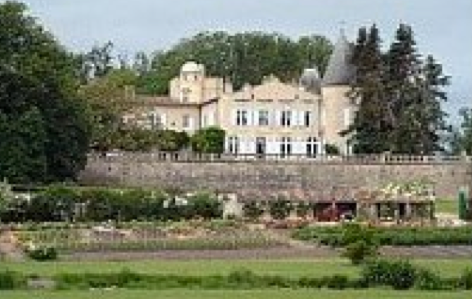
Graves is the oldest and most historic of all the Bordeaux communes. Before Latour, Lafite, Margaux, and the rest of the well-known names of the Médoc even existed or had even seen a cultivated vine, there was Graves. In fact, Graves has been the home of cultivated vines since as early as the 1st century AD; due at least in part to the Romans inability to grow other crops in the graveled soil from which the name Graves is derived. The stone and gravel deposits are vestiges of the last Ice Age, a bane to most farmers but a boon to grape growers, whose vines struggle deep into the thin porous soil to draw life and subtle complex flavors from the nutrients below. The wines of Graves appear to be the first Bordeaux wines to be exported, with archeological evidence that Roman garrisons in Britain were the happy recipients of Bordeaux's quintessential wines. And by the early 12th century, Graves was the most sought after wine in England and beyond for its quality as well as its proximity to the city and port of Bordeaux itself, which lie just a few kilometers from Graves. Today, the northern section of Graves called Pessac-Léognan must battle the urban sprawl that has broken out of the confines of the city of Bordeaux and spread to the nearby suburbs of Talence and Pessac. A little south of these towns lays the pastoral heart of Graves, a pretty, rural country that includes La Brède, where vineyards mingle with pastures and pine forests. Here, life remains wedded to the land and the joys of the vine. Graves is rightly famous for both its red and white wines. At their best, the red wines of Graves are unsurpassed for their aromatic beauty as well as their smooth, rich flavors. Earthy fragrant aromas that resemble cedar, a classic cigar box scent, black currant, and tobacco emanate from red Graves and form a bouquet that is frequently described as enchanting and profound. Moreover, fine red Graves is often the most supple of Bordeaux on the palate. It is also the most flavorful and easily appreciated of all Bordeaux reds. White Graves is a dry, very aromatic wine that emits great freshness, along with substantial flavor. Perhaps, the greatest event in Graves in the last twenty years has been the revolution that has taken hold among the producers of white Graves. Once an obscure and expensive proposition that did not always travel well, contemporary white Graves has taken on vigor, personality and even an exotic edge that underscores the physiological ripeness that was often absent in white Graves in years past. At their best, the finest white Graves can rival the best white wines of France. |
Médoc
Bordeaux is a vast region of fine wine, with many famous châteaux and communes. However, no Bordeaux name is more renowned than Médoc, the land that occupies the Left Bank of the Gironde. The Médoc lies down river from the city of Bordeaux and is the area of Bordeaux closest to the sea. Spread out along the hills of the Médoc are the vineyards and châteaux for which Bordeaux has become renowned the world over. Here Cabernet Sauvignon is king, supported by Merlot, Cabernet Franc, Petit Verdot, and occasionally Malbec. The Médoc contains hundreds of excellent wines and individual châteaux, some of which were deemed worthy of classified growth status in 1855. This was the last official classification of the wines of the Médoc. Although many fine wines are made throughout the Médoc, several communes stand above the rest, literally and figuratively. Margaux, St. Julien, Pauillac, and St. Estèphe are by far the most important communes of the Médoc because of the consistent greatness of their wines. Nearly all of the classified growths of the Médoc hail from these four hallowed communes. And for many critics and connoisseurs, Pauillac is the greatest of the great for it contains Latour, Lafite, Mouton, Pichon-Lalande, and a coterie of other noble red wines. The name Margaux conjures more images of greatness than any other appellation in Bordeaux, and none of those images are associated with the economical or ordinary. Indeed there is nothing commonplace about the wines of the Margaux appellation nor would anyone, short of a billionaire, ever accuse the wines of Margaux of being inexpensive. Margaux is the largest and most sprawling of the great communes of the Médoc, encompassing a little over 2,800 acres. It is situated in the southern Médoc just down river from the city of Bordeaux, which makes Margaux the nearest of the Médoc appellations to Bordeaux itself. In reality, the Margaux appellation includes five separate communes, each of which is entitled to bottle its wine as Margaux: Arsac, Cantenac, Labarde, Margaux and Soussans all qualify to bear the illustrious Margaux name. A classic, fragrant perfume and an elegant, supple style are what distinguish the wines of Margaux from those of other Bordeaux communes. In addition, Cabernet Sauvignon rules the roost in Margaux, constituting up to 90% of the cepage in some Grand Vin like Château Margaux. Yet, in spite of the high percentage of Cabernet Sauvignon employed in the commune, the wines of Margaux nearly always retain an elegant suppleness that can be found nowhere else. At the same time, Margaux wines possess a true propensity for aging, which allows the finest wines of the appellation to develop tremendous complexity and texture – second to none – for decades. Exemplary bottles of Château Margaux from such illustrious vintages as 1900 and 1921 still exist, and there is currently no shortage of lesser known growths whose wines are worth seeking out after a decade or more in bottle. Pauillac is Bordeaux's finest address. Home to three of Bordeaux's five First Growths (Lafite-Rothschild, Mouton-Rothschild, and Latour) and a long list of additional Classified Growths, Pauillac possesses the ideal Bordeaux terroir for the cultivation of Cabernet Sauvignon, Merlot, Cabernet Franc, and Petit Verdot. Situated on gravel and limestone rich hills overlooking the Gironde River, the wines of Pauillac are noted for their age ability, complexity, opulence, and power. Typically, the finest wines of Pauillac rely more heavily on Cabernet Sauvignon than Merlot or Cabernet Franc, which inclines them to a long, rich life. Some connoisseurs have even gone so far as to claim immortality for the greatest wines of the appellation, most notably Lafite-Rothschild, Mouton-Rothschild, and Latour from outstanding vintages. St. Estèphe is one of the four precious jewels in the Haut-Médoc diadem. Although one could argue the merits of a few of the Médoc's lesser know jewels such as Listrac and Moulis, St. Estèphe, Pauillac, St. Julien, and Margaux are universally acknowledged to be the Médoc's crown jewels. The 2,821 acre appellation of St. Estèphe sits astride the Gironde River, at the point where the river widens on its rush to the sea. It is also the Médoc appellation farthest from the city of Bordeaux. Here the soil is heavier and the wines are generally more dense and powerful than in the other three great Haut-Médoc appellations, lending themselves to extensive aging and earning the wines of St. Estèphe a reputation for longevity. Château Montrose and Cos d'Estournel are the most compelling wines of St. Estèphe and two of the most consistently outstanding red wines produced in all Bordeaux. |
St. Emilion
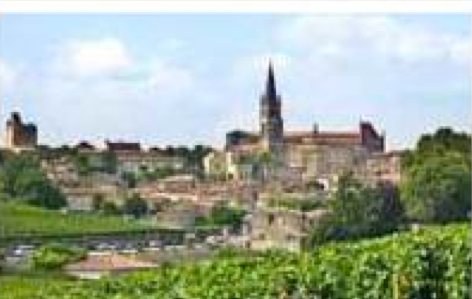
St. Émilion is Bordeaux's most important wine town and the region's hottest attraction. This walled, medieval village, perched atop a series of hills and surrounded by vines, is unquestionably the most beautiful wine village in all Bordeaux. Indeed, it is arguably the most beautiful wine village in all France. Nearly everything about St. Émilion is centered on wine, even the church in St. Émilion is a cellar. And lest you think that St. Émilion has just recently succumbed to contemporary commercialism or sold itself to the modern mania for all that is Bacchanalian, rest assured that very little has changed in principle in this village since antiquity: St. Émilion was founded by the Romans, who used it as a viticultural bastion in the then burgeoning area know as Burdigala. Interestingly, there are two distinct districts of St. Émilion, each possessing a special terroir. Both districts produce compelling red wines, but of a different sort. Typically, the côtes or hills upon the escarpment yield the fullest, slowest to mature wines of St. Émilion. Here the soil is nearly all limestone and the resulting wine is more apt to act like a great Cabernet based wine of the Médoc. The other distinct district of St. Émilion lies on the plateau adjoining Pomerol, where the soil is comprised of sand and gravel. Here the wines tend to be fleshier and quicker to mature. Each style is authentic St. Émilion, which allows the savvy consumer double the pleasure. Merlot is the predominant grape of St. Émilion. Here Cabernet Franc and to a lesser extent Cabernet Sauvignon play important supporting roles. However, St. Émilion can be produced from Merlot alone or from any combination or percentage of traditional red Bordeaux grape varieties. No commercial white wine is made in St. Émilion or is permitted to be sold as St. Émilion. |
Burgundy
Burgundy is a wine as well as a place. In fact, it is many wines and many distinct locales, all of which were once part of the ancient duchy of Burgundy. Situated several hundred kilometers southwest of Paris, Burgundy is hallowed ground to serious lovers of the vine. From its golden hillsides, whose center slopes are so aptly named the Côte d'Or, flow France's most expensive and profound wines. Names such as Romanée Conti, Chambertin, Clos de Vougeot, and Le Montrachet among others have been delighting serious wine aficionados for centuries. Yet, there is much more to Burgundy and its wines than a few illustrious names. For starters, Burgundy is the ancestral home of two of the world's most revered grape varieties – Chardonnay and Pinot Noir. Clearly, Burgundy is much more than a single wine or one great vineyard: it is a special place, a land almost entirely devoted to wine in one fashion or another. However, what remains surprising to many wine drinkers is that Burgundy is both red and white wine, the best of which come from Chardonnay and Pinot Noir exclusively. With a few rare exceptions, the finest Burgundies emanate from the region's core, the Côte d'Or, which begins on the fabled Côte de Nuits, just to the south of Dijon, and flows all the way south to Santenay at the tip of the Côte de Beaune. The Premier and Grand Cru wines from these illustrious hillsides are worth their weight in gold. Salut! Pouilly-Fuissé is the finest dry white wine of southern Burgundy. Located in the heart of the Macon, with its massif limestone bluffs and chalky alkaline soil, the Pouilly-Fuissé appellation comprises four villages. Here, Chardonnay reigns supreme on a series of steep hills, just to the north of the ten Grand Cru villages of Beaujolais. All the wine of this renowned commune is white, emanating exclusively from Chardonnay vines. Traditionally, Chardonnay is gently pressed in Pouilly-Fuissé and the resulting wines see little or only moderate oak barrel aging, so as not to obscure the delicacy, elegance, or subtle charm for which the wines of this commune are justly famous. |
Champagne
Champagne is an ancient province of France, a pastoral land of meadows and streams and most importantly chalk hills upon which some of the world's choicest grapes are grown. Champagne's boundaries are delimited by law and its wines strictly regulated by the laws of Appellation Contrôlée as to permitted grape varieties (primarily Chardonnay and Pinot Noir), yield, production, and quality. Yet, Champagne is more than a place; it is also a wine. In fact, Champagne is several different wines – only the most recognizable of which is white and bubbly. Although Champagne can be still or sparkling, white or red, and even rosé, the wine the world has come to know as Champagne is always sparkling. So synonymous now is the name Champagne with sparkling wine that the nomenclature has been applied generically and indiscriminately to any wine that bubbles, much to the regret of the Champagne producers themselves. Authentic Champagne comes only from the Champagne district of France and meets all the approved legal requirements and standards of production, including absolute adherence to the painstaking Methode Champenoise, which requires that secondary fermentation take place in the bottle for sparkling Champagne. The magic of Champagne (the bubbly kind at least that now encompasses the overwhelming majority of wine produced in Champagne) comes from encapsulating the bubbles in the very bottle in which the wine starts its life. In the old days, long before the advent of technical wine equipment, temperature control, and central heating, the slow fermentation of grapes in the cool Champagne autumn was often interrupted by winter's chill. With the onset of winter, fermentation would stop completely or at least appear to cease, so the wine was bottled and prepared for distribution. However, the following spring temperatures would rise and the fermentation process would begin anew. This delayed completion of fermentation is known as secondary fermentation. Secondary fermentation produces the beautiful bubbles and tiny streams of carbon dioxide that have come to enchant several centuries of well wishers and hedonists. What began as serendipity is now one of the wine world's highest art forms. Since the 17th century several historical personages have contributed to the development of Champagne. None is more renowned than Dom Perignon, the legendary blind monk and cellar master of the Champagne Abbey of Hautviller. Although Dom Perignon is often credited with the development of sparkling Champagne itself, the truth is he probably learned the rudimentary technique in southern France from the Benedictine monks at the Abbey at St. Hilaire. However, Dom Perignon was renowned as a master blender and he is credited with capturing the bubbling magic of Champagne by his introduction of wire wrapped cork stoppers and heavier, specially made bottles that contained the pressure of Champagne. Until his improvements were instituted, sparkling Champagne was known as vin diable (the devil's wine) because of its propensity for exploding its container – a potentially lethal proposition that surely rendered more than one monk blind. Along with Dom Perignon, Frére Oudart and later the widow Clicquot are the other two historical figures who share in the development of the Champagne Process. Frére Oudart was a contemporary of Dom Perignon and did much to improve the bottling techniques of sparkling wine. Meanwhile, the 19th century widow Clicquot is revered for her development of remuage or riddling in which each individual Champagne bottle is turned in specially made upright desks known as pupitres, so that the proliferation of sediment and dead yeast cells that naturally occur in Champagne would slide to the neck of the bottle and be released during what is referred to as disgorgement. Thanks to centuries of improvements and some of the first true brand name marketing, Champagne enjoys a special place in western culture. Champagne has been called the Belle of the Ball and has come to symbolize conviviality, hope, and all that is good in life and love. What would a wedding or any other festivity be without Champagne? But why wait for an occasion? Champagne is the perfect way to start an evening, so what are you waiting for? Pop the cork and join in the fun! |
Chateauneuf-du-Pape
Loire


Gigondas, along with the neighboring villages of Vacqueyras and Châteauneuf-du-Pape, produces the finest red wines of the southern Rhône. Relying upon old vines of Grenache, married to lesser quantities of Syrah, Mourvèdre, and Cinsault, Gigondas turns out a startling array of big, beautiful, tasty reds from nearly 2,500 acres of vineyards. Spanning a combination of soils, from the gravelly clay of the flat plains at the base of the craggy Dentelles de Montmirail, to the sheer bedrock of the Dentelles themselves, Gigondas is testament to the belief that in this enchanted corner of Provence one can even extract blood from stones, in the form of deeply colored Gigondas.