Featured Wines
September 2006
Premier Series |
|
Featured Wineries & Wines |
Membership Type |
| Gerard Bertrand Minervios | 1 Red 1 White; 2 Reds |
| Ca de Frati I Frati Lugana | 1 Red 1 White; 2 Whites |
| Bodegas Agapito Rico Carchelo | 2 Reds |
| Domaine Manciat Poncet Macon-Charnay Chardonnay | 2 Whites |
Master Series |
|
Featured Wineries & Wines |
Membership Type |
| Fattoria Montellori Dicatum | 1 Red 1 White; 2 Reds |
| Ca de Frati I Frati Lugana | 1 Red 1 White |
| Gerard Bertrand Minervois | 2 Reds |
Collector Series
|
|
Featured Wineries & Wines
|
Membership Type
|
| Fattoria Montellori Dicatum | 1 Red 1 White; 2 Reds |
| Rosenthal The Malibu Estate Chardonnay | 1 Red 1 White |
| Rosenthal The Malibu Estate Founder's Reserve Cabernet Sauvignon | 2 Reds |
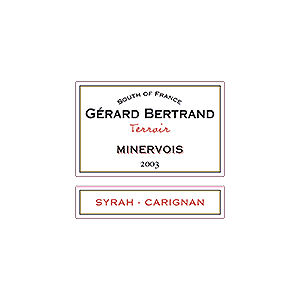
Gérard Bertrand Terroir Minervois 2003 – France
Gérard Bertrand is, perhaps, the most respected name in the Languedoc – the oldest and largest wine region in France. The Bertrand name is associated with many of the very best domains and vineyards in all of southern France, and like his father before him, Gérard has not only inherited the Bertrand legacy from his forbearers, he has augmented and cultivated the family heritage by acquiring an ever increasing array of outstanding properties – each of which produces wine of superlative quality and eminent distinction.
Unlike most of the Languedoc's growers, Georges Bertrand was a visionary. He was also a winemaker and a great wine taster, and he knew the value of premium varietals and excellent terroir Georges reconstructed his family's estate, Domaine de Villemajou, in the heart of Corbières and began acquiring other prime parcels and ancient estates. In the early 1970's, Georges also advised and supported other forward thinking Languedoc growers and winemakers who aspired to greatness. His son Gérard has continued and fortified that crusade, fashioning very fine wine, indeed, at every level. Bertrand's Terroir offerings in particular constitute extremely high quality and value.
Since his father's premature death in 1987, Gérard has brought Cigalus, the Languedoc's finest proprietary red and white wines, into the Bertrand fold. He has also acquired the Château de l'Hospitalet, an ancient hospice renowned for its wine, whose origins go back to 1561. In addition, Château Laville-Bertrou, a superlative Minervois estate, and a host of other fine properties from various Languedoc appellations and areas have come under the direction of the Gérard Bertrand. And one should not overlook the extraordinary Corbières that flows from the family's home estate, Domaine de Villemajou. All of Bertrand's estate wines are produced in respect to the environment, using sustainable methods and hand harvesting.
Languedoc
Languedoc is the world's largest single viticultural area, encompassing many appellations and distinctive sub regions – all of which are capable of producing fine wine. This sprawling viticultural wonderland stretches all the way from the Spanish border in the west, within sight of the towering Pyrenees, to the banks of the Rhône River far to the northeast. Languedoc cuts a huge swath of dry coastal plain and sheltered mountains from which flow the guts and the glory of French viticulture.
The Languedoc, whose name is synonymous with the language of southern France, was the first part of ancient Gaul to be extensively planted to the vine. And long before the Romans and Caesar's legions had subdued the Gallic tribes to the north, wine was big business in Languedoc. The Phoenicians passed this way, and not surprisingly, the region's beauty and superb conditions for the cultivation of the vine did not escape the first Greek colonists who planted vines there, making Languedoc the cradle of French viticulture in the fifth century BC. For nearly two thousand years, Languedoc remained the "big dog" and premier purveyor of wine to France and the world. Sadly, the glory of France's most historic wine region – the birthplace of troubadours and Provencal, the lyrical language of poetry – ended in the 19th century with the advent of phylloxera.
Phylloxera, the most dreaded of all vine diseases because it attacks the roots and systematically sucks the life out of a vine, devastated the vineyards of France in the 19th century, targeting Languedoc as its prime host. Following the phylloxera outbreak, the Languedoc lost most of its premier hillside vineyards, old vines and premium varietals. Subsequent replanting was undertaken using inferior grape varietals that would quickly bring high yields and much needed cash. Moreover, the great hillside vineyards descended to the plains, where soil, drainage and exposure (terroir) were inferior to the older, loftier heights of legend and lore. Unfortunately, throughout the late 19th century and most of the 20th century as well, the Languedoc languished in the doldrums of viticulural obscurity, unless of course one considers every day plonk as a beverage of choice. Once the proud bastion of French vitucultral excellence, the Languedoc became the world's major source of huge quantities of insipid wines, whose main virtues were none other than high alcohol and cheap prices – all of which were subsidized by the French government./p>
Today, the Languedoc is returning to its former glory. The worldwide demand for cheap, course wine no longer exists; the emphasis today is on quality rather than quantity. In addition, the only official incentive for grape growers is to plant premium varietals, move back to the ancient hillside sites, and produce less wine of greater quality. Since the 1970's that is exactly what has been happening, leading viticulturalists and critics alike to proclaim a veritable Renaissance in the Languedoc, much of it spearheaded by Gérard Bertrand and his father Georges before him.
Tasting Notes:The 2003 Gérard Bertrand Terroir Minervoisis a provocative, deeply colored wine that beautifully conveys all the charm and wealth of flavor for which Minervois is justly renowned. Rich, smooth and enticing, this fabulous Minervois tantalizes the senses with the aromas of black fruits and garrigue – all of which evoke the potpourri of Provence. Softer and richer than most Languedoc offerings, Bertrand's Terroir Minervois is an artful blend of Syrah and old vine Carignan and a match for many a top notch Rhône red from Vacqueyras or even Châteauneuf-du-Pape. Highly extracted, but long on the palate, soft, and utterly mouth-filling, the 2003 Bertrand Terroir Minervois is everything one can hope for from the most ancient of France's wine appellations, which was so aptly named for the wise and artistic Greek goddess Minerva.; This effort from Gérard Bertrand bears further testimony to the oenological Renaissance sweeping Languedoc and Minervois in particular. We suggest allowing this tasty red at least 15-20 minutes of aeration, before serving it between 60°-68° F. Salut!
Accompaniments: The 2003 Gérard Bertrand Terroir Minervois could easily shine by itself with just a few eager tasters as companions. However, consuming this soft, succulent Minervois without the benefit of food truly provides only half the pleasure. Bertrand's Terroir Minervois truly showcases grilled meats, including beef, lamb, and pork. This wine will also do equal justice to traditional Mediterranean favorites, including most cheese and tomato laden southern Italian favorites like Lasagna and Manicotti. Most hearty pasta dishes that are made with fresh tomatoes, herbs, and wild mushrooms are good bets, too. Smoked meats like salami, pepperoni and soppressata offer other good pairings, especially in the company of aged, hard cheeses. Enjoy!
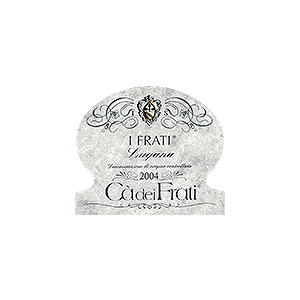
Ca dei Frati I Frati Lugana 2004 – Italy
Editor's Note: Ca dei Frati I Frati Lugana is the most esteemed named in Lugana and one of the wine club's most acclaimed estates. This month we are proud to present this wonderful property's outstanding 2004 Lugana I Frati. We wish that all of our club members could have the opportunity to taste this remarkable wine from the outstanding 2004 vintage, but Ca dei Frati's wines are available only in strictly limited quantities, so that we can only offer it to our faithful white wine only members. Enjoy!
For four generations the Dal Cero family has grown premium grapes and fashioned wines of legendary status from their modest 44-acre estate in northern Italy that lies nestled in the stunningly beautiful hills above Lake Garda. From these sunny shores, Igino, Franco, and Ana Maria Dal Cero run this impeccable azienda agricola. They combine the joys of tradition with the benefits of modern viticulture. Recently, the family has modernized the old cellar and introduced new equipment. They have also developed a new trellis system for their grapes, which has further improved the estate's impeccably tended vineyards. Moreover, the present Dal Cero trio has consented to selling a small portion of their outstanding Lugana outside of Italy, which happily allows us to offer club members one of the wine world's most unique and venerable white wines.
And like most Lugana producers who work along the precipitous shores of Lake Garda, Ca dei Frati makes a small amount of charming red wine and a tiny bit of Chardonnay and Sauvignon Blanc, too, to complement its more famous offerings of Lugana. Nevertheless, it is the estate's legendary Lugana I Frati, made from low yields of the Lugana grape (the local name for the region's particular clone of Trebbiano), that has bestowed nearly cult status upon this otherwise modest family run winery.
In addition to Ca dei Frati's hallmark Lugana I Frati, the Dal Ceros also fashion another outstanding but less traditional Lugana: Brolettino. Unlike the I Frati, the cru Brolettino is aged in small 225 liter oak barrels, which gives it an international style and an almost Burgundian character. It is fully mature upon release, but it will retain its rich intense flavor for many years. Not surprisingly, it, too, is produced in very small quantities.
Tasting Notes: The 2004 Ca dei Frati I Frati Lugana is the finest I Frati Lugana we have ever tasted, and when one considers the quality and consistency of this estate that is no easy task. We attribute this distinction to exemplary winemaking and the blessings of the 2004 vintage; the 2004 vintage produced quintessential white wines throughout northern and central Italy. The 2004 Ca dei Frati I Frati Lugana brings all of the beautiful characteristics of Lugana to fore: breed, elegance, flavor, and a tremendous visual appeal. The 2004 I Frati sports a pale yellow robe that glows like the luminescent aura of dawn. In the nose the I Frati's aromatic profile is typically redolent with the fresh heady scents of early spring, a mélange of flower blossoms and the first fruits of an awakening land. In the mouth, satiny textured fruit caress and coat the palate and nearly explode with the infusion of mineral and subtle earth, all of which adds to the wine's complexity and disarming depth of flavor. Concentrated and complex, the expressive 2004 I Frati finishes with true panache. We suggest serving it around 40° F, and as often as you can find it.
Accompaniments: "The 2004 Ca dei Frati I Frati Lugana is joy in a glass. It speaks to all that is comforting and good in life… and more," commented one salacious member of the tasting panel with a gleam in her eye. "Moreover, it conjures the romance of the terraced, flower-bedecked balconies above Lake Garda, not to mention the charm and allure of nearby Verona – the city that provided the world the lore of love in the guise of Romeo and Juliet, " reminded one of the panel's more scholarly members. Considering these endorsements, food accompaniments with the 2004 Ca dei Frati Lugana are optional for most. Nonetheless, the Ca dei Frati complements a variety of light fare, especially fish and lighter fruits of the sea. Fresh water fish, including perch and trout provide excellent choices.& From the sea, flounder, fluke, grouper, halibut, and sea bass provide superlative companions, too, to one of the world's most charismatic white wines. Canapés, light hors d'oeuvres, stuffed mushroom caps, grilled vegetables, salads, and most quiche and vegetable pies offer other superlative choices. Although full-flavored and ready to stand up to more robust cooking, the glory of this Lugana remains in our opinion its subtle complex flavors and haunting charm, which are most evident in the company of simple, uncomplicated fare. Buon Appetito!
Bodegas Agapito Rico Carchelo Jumilla 2005 – Spain
Bodegas Agapito Rico produces a fine array of Mediterranean style wines, especially Carchelo, a wine that continues to delight critics and savvy consumers alike. From 175 acres located in a high, remote mountain valley in Spain's Murcia, Jumilla native Agapito Rico fashions compelling Rhône style wines from Mourvèdre, Syrah, and small amounts of Merlot and Tempranillo. In vineyards located at over 2200 feet in the desert like climate of Murcia, the indigenous Monastrell (Mourvèdre) thrives on its own rootstock. Moreover, a good portion of the estate's grapes are completely organically farmed and yields average an impressively low 1.5 tons per acre, one of the lowest in Europe.
In the last decade a completely new winery has been put in operation at Bodegas Agapito Rico, built expressly for Carchelo and this forward thinking bodega's fermentation by carbonic maceration or whole berry fermentation – the fermentation technique now used extensively in Châteauneuf-du-Pape. Carchelo is conceived to feature the intense, fresh aromas and velvety texture and extract of the low yielding Monastrell. Hence, carbonic maceration is used to retain the full aromatic profile of the easily oxidized Mourvèdre varietal. A judicious amount of Merlot and Tempranillo blended into the cepage adds further complexity and ageability.
Just a few short years ago, it was being said that Spain was the sleeping giant of European wine, but with Bodegas Agapito and other outstanding Spanish producers coming into their own, there can be few incredulous wine drinking souls left unaware that the giant has indeed awakened.
Tasting Notes: As aficionados of Agapito Rico's wines have come to expect, the 2005 Bodegas Agapito Carchelo comes across as a hedonistic fruit bomb, at least initially, offering up copious quantities of black fruits and sandalwood, as well as a luscious vinosity. Although always eminently drinkable and utterly pleasing, the 2005 Carchelo may quite possibly be this estate's finest effort to date. Always deep in color, long on flavor, and smooth as silk in the finish, it is easy to see why this wine makes every important wine critic's "Best Buy" list. A blend of 50% Mourvèdre (locally known as Monastrell), 30% Tempranillo, and 20% Merlot, the 2005 Carchelo offers up even more intensity than usual. The 2005 Carchelo serves as ample testimony to the virtues of Mourvèdre, despite Mourvèdre's reputation for being a shy bearing grape that is difficult to grow. Indeed, Mourvèdre is a very special, highly flavored grape that it is well worth the fuss. We suggest serving the 2005 Carchelo cool or slightly chilled (about 58°-60° F or 15-20 minutes in the refrigerator). Enjoy!
Accompaniments: The 2005 Bodegas Agapito Rico Carchelo is another crowd pleaser from this very consistent producer, so this offering will undoubtedly please most palates, with or without food. However, our preference is to serve the 2005 Carchelo with good every day fare, including fresh pastas, savory stews, and simple cuts of meat. Flautas, tacos, hamburgers, ribs, pork barbecue and Shepard's Pie all provide enjoyable accompaniments, too. In our experience, the real problem with the Carchelo is not so much deciding what to serve it with, but deciding who to serve it to because Carchelo has a way of always bringing a smile to people's faces. This also means the bottle is gone before you know it. Consider yourself forewarned. However, wine was meant to be shared, so why not keep a second or third bottle on hand and remember the words of a wise old sage: "Wine without a friend is like life without a witness." Enjoy the Carchelo with some friends, or pour a few extra glasses and make some new friends.
Domaine Manciat Poncet Les Chênes Macon-Charnay 2004 – France
Domaine Manciat Poncet is one of just a hand full of great producers of traditional Macon wines, most notably Macon-Charnay and Pouilly-Fuissé. This venerable domaine is also one of the few remaining producers in the Maconnais (the southern most region of Burgundy) that strictly adheres to the traditional and time honored practice of complete hand harvesting, which allows Claude and Simone Manciat to press whole clusters of fruit to produce deeper, richer wines than their neighbors. When pressed whole-cluster, the juice bursts through the skins and extracts maximum aromas and flavor from the fruit. In addition to hand harvesting and whole cluster pressing, the Manciats are strict viticulturists, which accounts for the exceptional purity and texture that is readily apparent in their wines.
Domaine Manciat Poncet is located in the tiny hamlet of Charnay, which is connected to the more famous town of Vergisson. Vergisson lies at the heart of the prestigious appellation of Pouilly-Fuissé. The Chardonnay grapes used in Domaine Manciat Poncet's bottling of Macon-Charnay come from a vineyard of very old vines that lies protected on two sides by a small grove of oak trees – thus the name Les Chênes, which means "the oaks"in French. Production from the tiny 4.5-acre Les Chênes vineyard is strictly limited by the Manciats and averages 30% below the allowable yields of the appellation. In keeping with tradition, Manciat Poncet's Macon-Charnay Les Chênes is made in stainless steel tanks and is not aged in oak barrels to preserve the wines natural vibrancy and freshness, the very characteristics that define the finest wines of the Maconnais.
Tasting Notes: Taste and see all the goodness of the Maconnais in the rich, vibrant 2004 Domaine Manciat Poncet Les Chênes Macon-Charnay. Endowed with a bright forsythia yellow robe and a heady bouquet of acacia flowers, beeswax, citrus, minerals, and caramel apples, there is no shortage of good things going on in this wine, and we haven't even gotten to the best part – the flavor. Long, mouth filling, and utterly pleasing, the 2004 Domaine Manciat Poncet Macon-Charnay follows through on the palate and delivers a boat load of flavors reminiscent of the wine's lovely bouquet. In short, this definitive Macon-Charnay captures the essence of Chardonnay, without the preponderance of oak and the assortment of flavors that are often mistaken for Chardonnay on account of extensive barrel aging. Drink this pure, natural tasting Chardonnay lightly to moderately chilled (40°-55° F). Some tasters preferred this wine fairly well chilled while others opted for a more ambient temperature, hence the wide range of temperatures. Moderate chilling is perhaps the best approach as it allows for the wine to warm slightly in the glass and hit all the high notes. Enjoy!
Accompaniments: Given the crisp citrus fruit, long lingering minerality, and creamy texture of the exemplary 2004 Domaine Manciat Poncet Les Chênes Macon-Charnay, options galore abound for food pairings. In addition, we have always found that first rate Macon wine makes for a great aperitif and a wonderful way to begin a meal. Consequently, we suggest serving the food friendly Macon-Charnay at the beginning of an evening with an array of tasty appetizers. Some of our favorite appetizer selections with this wine include Crispy Crab Rangoons or Wontons, a Maryland Style Crab Cake, and Shrimp and Vegetable Rolls. Light to medium flavored cow's cheeses (Brick, Colby, or Monterey Jack) and a loaf of crispy French bread provide plenty of companionship as well. Almost any food that is not too highly charged will complement this wine.
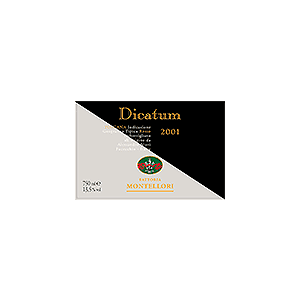
Fattoria Montellori Dicatum 2001 – Italy
On a recent trip to Italy, we discovered Fattoria Montellori and the estate's enthusiastic, serious-minded proprietor Alessandro Nieri. Fattoria Montellori is located off the beaten track, away from the glitz and glamour of the well-worn wine road that winds its way from Florence to Siena. Instead, Montellori is tucked away in the Montalbano zone of Chianti to the west of Florence, near the stately Tuscan town of San Miniato. San Miniato is renowned for its wealth of beautifully preserved Romanesque and Renaissance churches that thrust their many spires skyward, savory truffles, and heavenly wines. The latter treasures constitute some of Tuscany's most hedonistic pleasures.
The Montellori estate, which is also known as Castel Rapiti, dates from 1293. Yet, the Nieri family has been the guardian of this outstanding property only since 1895, a mere 111 years, which is a relatively short time when one considers the entire eight centuries of history that Fattoria Montellori shares with posterity. Giuseppe Nieri purchased the villa and surrounding grounds at the end of the 19th century from profits he had realized from his leather trade. He quickly set about planting vineyards and upgrading the property. Giuseppe's son Mario continued the pioneering spirit and renovation at Montellori that was begun by his father. However, it was not until Giuseppe Nieri, Alessandro's father, took control of the estate in the early 1980's that it expanded to its present 170 acres and began fashioning wine as smooth and fine as the Florentine leather his forbearers' once crafted. Today, the estate houses a modern winery, hundreds of oak barrels, great and small, and some of the finest hillside vineyards in Tuscany. Moreover, it fashions wines of great character, distinction, and personality.
Thanks to the foresight of Giuseppe Nieri, Fattoria Montellori owns six distinct vineyards, all of which possess a unique soil, microclimate, exposure, and altitude. Red wine is king here, as it is throughout Tuscany. Nonetheless, Alessandro crafts several excellent white wines, too, including Mandorlo, an artful non-traditional blend of Chardonnay, Viognier, Marsanne, Roussanne, and Clairette. Not surprisingly, Chianti remains the estate's most important wine in terms of quantity. It is a traditional, medium-bodied wine that is wonderfully representative of the Montalbano style of Chianti. However, it is Montellori's Moro, Salamartano, and Dicatum (the estate's three distinct Super Tuscan reds) that make us want to shout for joy. Moro is a single vineyard offering that is closest to Chianti in style. It is a blend of primarily Sangiovese to which small amounts of Cabernet Sauvignon and Malvasia Nera have been added. Salamartano on the other hand is a classic Bordeaux blend of Cabernet Sauvignon and Merlot that has been aged in small barriques. Meanwhile, Dicatum is the most decadent and quintessentially Tuscan of this estate's offerings. It is 100% Sangiovese from the property's finest hillside vineyard Cerreto Guidi; this is the last vineyard that Giuseppe Nieri personally planted. Dicatum spends about eighteen months in a combination of oak barriques and 500 liter barrels, which intensify the wine's structure, without impeding its elegance and aromatic fireworks – a staggering statement indeed.
Tasting Notes: A deep, dark, brooding potion, the 2001 Montellori Dicatum is ample testimony to the fact that appearances are more often than not deceiving. This Tuscan treasure reminds us more of a great young Pomerol, with its heavenly scent and layer upon layer of fleshy fruit, than a Chianti or even a "Super Tuscan" red. Although elegant, the Dicatum is not austere and exhibits none of the typical leanness of Chianti. Like Pomerol, Bordeaux's most decadent red wine, the 2001 Dicatum exudes a myriad of scents and savors to fill the senses. An aroma of violets, dark cherry and blackberry fruit, cedar, coffee, and a touch of wood smoke that recalls the good earth and the splendid country from whence it comes are just a few of the treats in store for the intrepid taster of Dicatum. This is no self effacing red. As its name implies, the 2001 Dicatum makes quite a statement that is nothing short of a bold proclamation. Enjoy this sensuous wine and its long lingering finish at cool room temperature (64°-66° F). Extended breathing is not necessary but will further enhance your enjoyment of the wine, if you have enough patience to resist its voluptuous charms from the moment the cork exits the bottle.
Accompaniments: As sumptuous as the 2001 Dicatum is, the wine hardly begs for food the way a Chianti does. Nevertheless, Dicatum provides a splendid pairing with many traditional Tuscan dishes. In addition, it will elevate nearly any meat or bean dish that it accompanies. Oven Roasted Rack of Lamb, served with an Asiago and rosemary infused risotto and a shallot-truffle reduction, wins high praise from the panel alongside the Dicatum. Grilled Center Cut Pork Chops, accompanied by a ragout of white beans, apple wood smoked bacon, spinach, and mushrooms makes our collective mouths water, too. Pan Seared Beef Tenderloin, graced with a Bordelaise Sauce, would certainly not be a hardship either. Simple, rotisserie cooked chicken makes a fine backdrop with which to enjoy the Dicatum as well. Given the Dicatum's elegance, breed, and hedonistic bent, we suggest that it warrant the company of the classics or at least the very best of simple, home style cooking. Our only caveat would be to avoid heavy tomatoes sauces or other ponderous concoctions, as they tend to dull the luster and sensual nature of this great wine, as they would any fine wine of Dicatum's caliber. Buon Appetito!
Rosenthal The Malibu Estate Chardonnay 2005 - USA
The Malibu Estate, the country home of George Rosenthal, produces Los Angeles County's finest wine, and that is no mean feat. In the 19th century, Los Angeles County was reputed to have been the leading producer of premium wine in California, but with the advent of phylloxera and Pierce's Disease, followed by urban sprawl (the county's most fatal malady), wine production had nearly ceased in Los Angeles County as early as the 1950's. Such was the unhappy state of wine affairs in and around Los Angeles until 1987, when George Rosenthal planted a prime portion of his Malibu ranch to European varietals and put Malibu and Los Angeles County back on California's viticultural map. Others have followed suit in an attempt to emulate The Malibu Estate's success, but none have fashioned wines quite as compelling as Rosenthal's The Malibu Estate.
Critics have commented that The Malibu Estate has two distinct levels of wine: great and greater, and it would be hard to argue against that summation. The estate's low yields and small production make it difficult to turn out anything but the best. Nevertheless, this winery manages to fashion in exceptional vintages tiny quantities of Founder's Reserve Cabernet Sauvignon from the property's Las Piedros Vineyard. The Founder's Reserve is a wine that has been heralded as the epitome of Cabernet Sauvignon. In addition, The Malibu Estate offers estate bottled Merlot and Cabernet Sauvignon, and as of this year the winery has added a new red release called RE. It is an outstanding Meritage that combines all three of the estate's red grapes: Cabernet Sauvignon, Merlot, and Cabernet Franc, all from low yielding vines. However, with all this talk of red wine, it would be easy to lose sight of the fact that The Malibu Estate also produces southern California's most compelling Chardonnay, albeit it in miniscule quantities. In fact, the estate's Chardonnay may be California's best kept secret. In any given vintage, The Malibu Estate may fashion anywhere from a hand full of cases to two hundred cases of outstanding, age worthy Chardonnay, weather premiting. All of Rosenthal's wines now bear the distinct Malibu Newton Canyon appellation.
The force and vision behind The Malibu Estate is of course George Rosenthal. George has been a real estate developer, restaurant/hotel owner, movie mogul, and breeder of fine Andalusian show horses. However, today, his primary passion is fashioning Rosenthal The Malibu Estate into a living, sustainable work of art. The artist in residence is French winemaker Christian Rougenet, who spares no expense in the pursuit of full throttle, highly extracted wines of distinction. At Malibu Estate, the grapes are entirely handpicked from low yield vines and the resulting hand crafted wines are all aged in the finest French oak barrels. No wine is released until it is ready to drink, a practice that defies contemporary economic exigencies but aptly defines this estate's commitment to quality. To highlight just how serious The Malibu Estate is about maturing its wines, it is just now releasing its other worldly 1999 and 2000 Founder's Reserves. Salut!
Tasting Notes: Although normally available exclusively at the winery's new tasting room in Malibu and at a hand full of world renowned restaurants, we are pleased to offer our Collector Series members a rare opportunity to taste the unique 2005 Rosenthal The Malibu Estate Chardonnay. Golden hued and finely honed, this youthful Chardonnay captures all the charm, purity, and richness of fruit that one can wish for in California Chardonnay plus the added bonus of impeccable balance – and that's not all. Add a heady bouquet and a long broad palate that burst with fresh fruit, spice, butterscotch, and vanilla and you have the best of the New World meeting the Old World. The 2005 Rosenthal The Malibu Estate Chardonnayis every bit a California classic. Yet, it also possesses the elegance, suavity, and texture of a fine white Burgundy. Enjoy this rare Chardonnay moderately chilled (40°-45° F). It is perfectly enjoyable now. However, if previous vintages of this wine are any indication, the 2005 Rosenthal The Malibu Estate Chardonnay will continue to mature beautifully for at least a couple more years.
Accompaniments: As charming, balanced, and personality filled as the 2005 Rosenthal Chardonnay is, the temptation is to consume it long before one ever gets to the table. "Nearly irresistible," is how one panel member described it. Nonetheless, the greater glory awaits those disciplined souls who plan a scrumptious meal with which to enjoy this first rate Chardonnay. For starters, we suggest an appetizer of Pan Seared Scallops in a light curry and mint cream sauce, topped off with toasted almonds. Another faithful companion is a Sweet Lump Crab Meat Napoleon, served with avocado and sweet corn and topped by a mild red pepper coulis. A whole Maine Lobster, steamed to perfection, and served with drawn butter, provides another wonderful accompaniment to the 2005 Rosenthal The Malibu Estate Chardonnay. A plate of fine French cheeses offers an alternative to meat and another superb way to celebrate The Malibu Estate Chardonnay. However, whatever you choose to serve, we suggest you take the time to savor it along with this very special Chardonnay. Enjoy!
Rosenthal The Malibu Estate Founder's Reserve 1999 - USA
The Malibu Estate, the country home of George Rosenthal, produces Los Angeles County's finest wine, and that is no mean feat. In the 19th century, Los Angeles County was reputed to have been the leading producer of premium wine in California, but with the advent of phylloxera and Pierce's Disease, followed by urban sprawl (the county's most fatal malady), wine production had nearly ceased in Los Angeles County as early as the 1950's. Such was the unhappy state of wine affairs in and around Los Angeles until 1987, when George Rosenthal planted a prime portion of his Malibu ranch to European varietals and put Malibu and Los Angeles County back on California's viticultural map. Others have followed suit in an attempt to emulate The Malibu Estate's success, but none have fashioned wines quite as compelling as Rosenthal's The Malibu Estate.
Critics have commented that The Malibu Estate has two distinct levels of wine: great and greater, and it would be hard to argue against that summation. The estate's low yields and small production make it difficult to turn out anything but the best. Nevertheless, this winery manages to fashion in exceptional vintages tiny quantities of Founder's Reserve Cabernet Sauvignon from the property's Las Piedros Vineyard. The Founder's Reserve is a wine that has been heralded as the epitome of Cabernet Sauvignon. In addition, The Malibu Estate now has a new release called RE. It is an outstanding Meritage that combines all three of the estate's red grapes: Cabernet Sauvignon, Merlot, and Cabernet Franc, all from low yielding vines. All of Rosenthal's wines now bear the distinct Malibu Newton Canyon appellation.
Tasting Notes: It's hard to imagine any Cabernet Sauvignon being better than the 1999 Rosenthal The Malibu Estate Founder's Reserve. Indeed, it is even difficult to fathom how the 1999 Founder's Reserve can eclipse Rosenthal's excellent regular estate bottling of Cabernet Sauvignon, but Rosenthal's winemaker Christian Rougenet has truly outdone himself with the estate's 1999 Founder's Reserve – The Malibu Estate's finest release to date. To begin with, the 1999 vintage was at its absolute best in Southern California. The 1999 Founder's Reserve Cabernet Sauvignon is a monolithic wine. It is a nearly opaque offering that possesses a monumental set of aromatics. It tantalizes the nose with copious quantities of blackberry, cassis, currant, tobacco, refined oak, and wild mint, all of which carry over into every sip where they grow more profound and seductive with gentle aeration. The only problem with this fortuitous scenario is that it becomes nearly impossible not to consume the 1999 Founder's Reserve before it has reached its apogee. The longer the 1999 Founder's Reserve airs the more intriguing it becomes, so allow at least an hour or more for optimum enjoyment. This wine is the essence of Cabernet Sauvignon and the very finest wine produced in Los Angeles County. We suggest decanting this flavorful, highly endowed beauty before serving it at cool room temperature (about 65° F). Enjoy!
Accompaniments: One could serve almost anything with the 1999 Rosenthal The Malibu Estate Cabernet Sauvignon or nothing at all and be perfectly satisfied. However, the finest cuts of beef, served with mushrooms, truffle infused sauces, and all the mashed potatoes, butter, and cheese you can handle provide excellent accompaniments to Rosenthal's finest wine. Osso Bucco, lamb chops, or even simply prepared roast legs of lamb provide other splendid complements to this powerful, but subtley complex wine. In addition, garlic, olive oil and fresh Provencal herbs pose no threat to this full-bodied wine, so no need to spare the spice or savory in preparing accompaniments to the 1999 Founder's Reserve Cabernet Sauvignon. Pronounced flavors will only add to the sensory crescendo. Buffalo steak, kangaroo, ostrich, spicy sausages, and piquant bean dishes also provide excellent complements, but then again so does an empty glass and good friend. Need we say more?