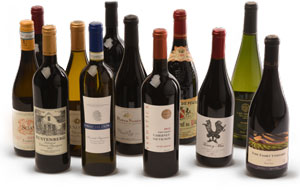
Featured Wines
November 2006
Premier Series |
|
Featured Wineries & Wines |
Membership Type |
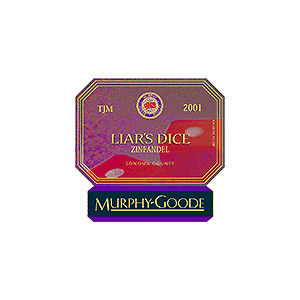
| Murphy-Goode Liar’s Dice Sonoma Zinfandel | 1 Red 1 White; 2 Reds |
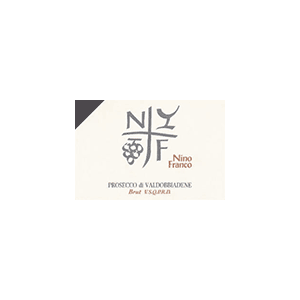
| Nino Franco Prosecco Rustico Brut NV | 1 Red 1 White; 2 Whites |
| Casa Silva Reserva Carmenère | 2 Reds |
| Jack William Alexander Valley Sauvignon Blanc | 2 Whites |
Master Series |
|
Featured Wineries & Wines |
Membership Type |
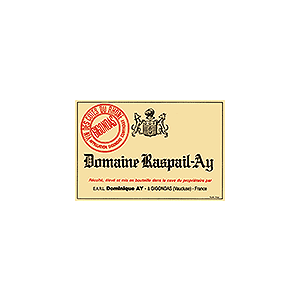
| Domaine Raspail-Ay Gigondas | 1 Red 1 White; 2 Reds |
| Nino Franco Prosecco Rustico Brut NV | 1 Red 1 White |
| Murphy-Goode Liar’s Dice Sonoma Zinfandel | 2 Reds |
Collector Series
|
|
Featured Wineries & Wines
|
Membership Type
|
| Domaine Raspail-Ay Gigondas | 1 Red 1 White; 2 Reds |
| Nicolas Feuillatte Brut NV Champagne | 1 Red 1 White |
| Murphy-Goode All In Alexander Valley Claret | 2 Reds |
Murphy-Goode Liar's Dice Sonoma Zinfandel 2004 — USA
Since its inception in 1985, the Murphy-Goode winery has consistently turned out a formidable portfolio of compelling wines at affordable prices. And as mind-boggling as it may be, this winery keeps raising the bar with each successive vintage. Murphy-Goode is a unique family venture, an enterprise some have described as an adventure as well as a model in cooperative excellence and marketing acumen. Call it what you will, this superb Sonoma County winery fashions some of California's most pleasurable wines at any price. Moreover, even with more than 300 acres of prime Sonoma County vineyards, Murphy-Goode remains a family owned and operated winery — a joint undertaking of two neighbors and long time family friends and grape growers, the Murphy's and the Goode's, along with their marketing guru pal Dave Ready. All three families still actively tend the vineyards, make the wine, and handle all sales and marketing for this estate — much to the chagrin of the less adept competition.
From the beginning the Murphy, Goode, and Ready families have shared a singular mission: to make excellent wine from exceptional grapes, and "produce something that brings to mind a three-day weekend." Now these are our kind of folks. Who doesn't like three-day weekends? Stand up and be counted, and we'll cart you off to the asylum. And as true friends, the three families have been good to their word as well as their mission. Indeed, it is hard to get enough of Murphy-Goode's delicious wines — even over a three-day weekend.
In the 1980s, Murphy-Goode first gained recognition for its bold, full throttle Fumé Blanc, which it still produces, but today the winery is more renowned as one of Sonoma County's best red wine producers, with gold medal winning Cabernet Sauvignon, Merlot, Liar's Dice Zinfandel, and Pinot Noir to complement the estate's white wine portfolio of Reserve Fumé, Chardonnay, and Gewürztraminer. In addition, Murphy-Goode's has introduced Wildcard, a plush blend of Cabernet Sauvignon, Merlot, and Cabernet Franc and All In, a luxury Meritage offering that highlights the very best that Sonoma County's Alexander Valley can produce. Murphy-Goode draws its fruit exclusively from estate hillside vineyards and prime bench land grapes for its reserve wines, utilizing minimal intervention and natural farming techniques to produce wines that are truly special, like a long three-day weekend. And when was the last time you heard anyone complain about having a three-day weekend?
Tim Murphy was the initial guardian and impetus behind Liar's Dice Zinfandel, creating the name and fashioning the wine to his exacting standards. Regrettably, the affable and ever mischievous Tim Murphy passed away a few years ago, but as Murphy-Goode has always been a family affair, neither the estate's commitment to quality nor its style of wine has changed. Tim's three sons continue to handle much of the day to day management of the vineyard, while Dave Ready's sons still make up the formidable wine making team. Dave Ready, Jr. is Murphy-Goode's Winemaker, while his younger brother, Adam, serves as Cellarmaster. Dale Goode and Dave Ready, Sr. still put in a full day as well. The continued success of Murphy-Goode is a fine tribute to Tim Murphy, one of the premier architects of the post prohibition Renaissance in viticulture in Sonoma County. It feels good to still see and taste the legacy, which lives on and promises many more good things to come!
Tasting Notes: A fleshy, flamboyant, and just plain fun to drink wine, the 2004 Murphy-Goode Liar's Dice Zinfandelremains true to the estate's commitment to fashion plush hedonistic wines that offer complete and utter pleasure from start to finish. As one would expect, the 2004 Liar's Dice is richly colored and laden with the tantalizing aroma of top notch Zinfandel: crushed bramble and blueberries, hints of herb and spice, and everything nice come to fore. Isn't this what great California Zinfandel is about? And let's not forget the wine's lusty flavor, a heady combination of rich fruit, toasted barrel, and the distinctly Californian version of garrigue, that wild herb scent and flavor that permeates California's North Coast. It caresses the palate and satiates the senses, and that's before the wine's formidable alcohol courses through your veins. For our way of thinking, if there ever were just one style of Zinfandel in the world, Murphy-Goode's Liar's Dice would have to be it. This wine combines all of the rich, ripe fruit for which California is famous with a suave, sophisticated European elegance and style. We suggest serving this fine Zinfandel fairly cool (60°-66° F), with a minimum of aeration. Zinfandel is one of the few red wines that can optimally be enjoyed without extensive breathing. Enjoy!
Accompaniments: What we like best about the 2004 Murphy-Goode Liar's Dice Zinfandel is how well it pairs with food, or not. Ultimately, we think Murphy-Goode's Zinfandel is a quintessential food wine, whether it's with Roast Turkey and all the trimmings, a simple burger off the grill, or better still a host of classic Mediterranean delights straight out of the brick oven. Southern Italian classics such as Baked Ziti, Eggplant or Zucchini Parmigiana, Lasagne, and Manicotti provide great complements to this wine. After all, Zinfandel, or more accurately its ancestor Primitivo, thrives in southern Italy, where it marries perfectly with the tomato rich sauces of Italy's Mezzogiorno. Moreover, Zinfandel became the grape of choice in the United States among many Italian immigrant winemakers, which they molded in the last century and half into an American classic. However, we should not lose sight of the fact that Liar's Dice Zinfandel is made with good old-fashioned drinking in mind, so it will complement both simple and sophisticated dinner party fare as well as provide a solitary respite from life's drudgery, with nothing but a glass to speak its praises, so as you like it.
Nino Franco Prosecco Rustico Brut NV — Italy
Editor's Note: Prosecco is a wine that is under pressure. It should always be well chilled before opening. Always exercise caution when opening a bottle of sparkling wine. Point the bottle away from people and objects. Use a clean towel or clothe to firmly grip the bottle. Gently remove the wire stopper while firmly holding the cork in place. Then with thumb and forefinger, remove the cork slowly from the bottle. Do not let the cork fly. Enjoy!
The Nino Franco Winery is located in the upper reaches of the Veneto in the province of Venice. Here the Alps begin their ascent and the great Adige and Piave Rivers lie far to the south. This is Valdobbiadene, about as far from Venice as one can go and still be in the Veneto — an enclave of viticultural excellence that lies nestled among the foothills of the Alps. Valdobbiadene also happens to be Italy's finest production zone for Prosecco, Italy's most ebullient bubbly, and Nino Franco is its consummate craftsman.
More than a decade ago, Primo Franco took over this sparkling wine estate from his father, Nino Franco, and invested heavily in improvements to the winery and vineyards. The result has been the transformation of this estate into the region's foremost producer of sparkling Prosecco — much to the delight of the estate's legion's of fans.
In addition to fashioning Valdobbiadene's premier Prosecco, Primo Franco takes an active part in governing the Prosecco DOC, setting high standards of quality for Italy's most beloved sparkling wine and assuring the preeminence of the region's vineyards as the most meticulously tended in Italy.
Prosecco is a native Italian varietal, which deserves the beloved status it has long been accorded in Italy and is now, too, finally garnering abroad. In its native Veneto, Prosecco is the symbol of Venetian conviviality and a staple in every welcoming home. It is routinely offered to houseguests and served at nearly every wedding and Sunday luncheon. From any afternoon affair to the wee hours of the morning, to the occasional sip before lunch, life in the Veneto would simply not be the same without Prosecco. From Venice to the Dolomite Alps, Prosecco is undeniably the wine of the Veneto.
Although Prosecco can be made sparkling or still, the emphasis in Valdobbiadene, as in most of the Veneto, is on beautiful, dry, lightly sparkling versions like the Nino Franco Rustico. However, it is with Prosecco's predominance as a sparkling wine that the inevitable comparison with Champagne ends. Italian DOC regulation allows for a wide range of styles and techniques, resulting in a host of fresh, delicious bubbly that is meant to be consumed young, and with abandon. Alcohol levels for Prosecco are typically lower than for Champagne, too, usually no more than 10.5%-11%. For high quality Prosecco, the mousse (bubbles) is intentionally soft and non-aggressive, to heighten rather than mask natural fruit flavors. Austere, bone-dry examples as well as slightly sweet sparkling versions of Prosecco can still be found, but such wines are very much the exception today rather than the rule. Today, most Proseccos are light and pleasantly dry, but without the high acidity of Champagne or even worse its cheap imitations.
Most Prosecco producers, Nino Franco included, make several different Prosecco wines. In addition to the Rustico, Nino Franco's most popular wine, this firm turns out two other excellent sparkling wines from Prosecco and a lovely still Prosecco called Sassi Bianchi. No other wines are produced at Nino Franco, allowing this great house to concentrate on what it does best — make delicious, quaffable Prosecco that will make an aficionado out of even the most ardent opponent of Champagne.
Tasting Notes: Marvelously consistent with each release, Nino Franco's Prosecco Rustico Brut NV is an outstanding example of the exuberant Valdobbiadene style of Prosecco. It graciously embodies all that is good about an awakening land and the fruits of the harvest. It offers up the light, lovely scents of pear, apple, and white peach, all of which are entwined in a delicate, round body. In addition, what makes the Rustico even more appealing is that it offers a creamy mousse that sparkles and caresses, without ever trying to imitate Champagne. Although dry and refreshing on the palate, the Nino Franco never slips into austerity; it doesn't pretend to be Chardonnay or Pinot Noir either, and it remains forever lively, sprite, and wholly approachable. Moreover, the Nino Franco Prosecco Rustico Brut is a clean, natural tasting, "no headache" kind of sparkler that is just plain fun to drink. In fact, the Nino Franco Rustico goes down so easy that you will want to reach for another bottle, even before the first one is done. Indeed, many will be surely tempted to open a second bottle to share with others or to simply drink by themselves — horrors! We suggest you enjoy the Nino Franco Rustico often and fairly well chilled, at approximately 40° F.
Accompaniments: Nino Franco Prosecco Rustico Brut remains the perfect anytime sparkler. In the Veneto, good sparkling Prosecco is an afternoon tradition, beginning with a fine lunch or simply as a toast to the end of another busy day. Prosecco also provides the sparkle to any evening get together or romantic interlude, so whatever your fancy, the Nino Franco Rustico provides the perfect companion to all of those events and more. It also makes for a wonderful aperitif, and it pairs well with most light hors-d'oeuvres. We also suggest that you try it with risotto, fish, and light meats. Shrimp, scallops, sautéed shellfish, and lightly fried tempura dishes offer other tasty propositions with the Nino Franco Rustico. Furthermore, this Prosecco is a fine way to wash down Thanksgiving dinner and all the trimmings. With such an eminent drink ability and friendly welcoming spirit, the Nino Franco Rustico is truly a crowd pleaser, making it easy to see why Prosecco is undeniably the wine of the Veneto and Primo Franco its favored son.
Note: Nino Franco Prosecco is the original Prosecco, which was first served at Harry's Bar in Venice in the early 20th century. It is also worth mentioning that Nino Franco Rustico when mixed with white peach juice provides the authentic Bellini. And as with any sparkling wine, please exercise caution in opening the Nino Franco Rustico as the wine is under pressure. When opening, always firmly hold the cork and wire stopper under a clean cloth, while pointing the bottle away from anyone or anything fragile. Then gently ease the cork out with thumb and forefingers. Salut!
Casa Silva Reserva Carmenère 2005 — Chile
Casa Silva continues to astound with the quality as well as the variety of the wines it produces. Indeed, this is a very clean, well run winery that is not afraid to ratchet up the quality with each successive vintage. Undoubtedly, Casa Silva is one of a hand full of South America's very finest wine estates. Located some two hundred kilometers south of Santiago, in the heart of Colchagua, an area many are now calling Chile's Napa Valley, Casa Silva has garnered more recognition and awards at international wine competitions than any other Chilean winery. Furthermore, Catad'Or Hyatt, Chile's most prestigious wine competition, has named Casa Silva "the Best Chilean Producer" three consecutive times. And that's not all, the International Wine & Spirit Competition recently named Casa Silva as "The best South American Producer." Kudos to the Silva family, father Mario and sons Mario Pablo, Gonzalo, and Francisco, and Mario Geise, the winery's outstanding consulting enologist, for taking this beautiful property to such lofty heights in just ten years time.
Surprisingly, Casa Silva's present inception dates back to only 1997, the year this property began bottling premium wines under its own name. However, historical accounts tell us that the Silva family's predecessors were pioneers in Colchagua more than a century ago, when the Silvas brought the first grape varieties from France to their Angostura estate at the base of the towering Andes. Today, the Silvas remain pioneers: they are Colchagua's foremost experts on Carmenère, Chile's emblematic red grape variety, and they produce the finest Sauvignon Gris and Viognier in South America. Moreover, this great property is at the vanguard of South America's success with other traditional Bordeaux grape varieties, most notably Cabernet Sauvignon, Sauvignon Blanc, and Semillon. Can there be any doubt as to why the wines of Casa Silva are the most highly acclaimed in South America?
Tasting Notes: If there were still any doubt as to Mario Geise's reputation as the "King of Carmenère," the 2005 Casa Silva Reserva Carmenère should dispel any such notions. The 2005 Reserva Carmenère from Casa Silva is knockout stuff. The wine is deep purple with ruby highlights, but before the glass can even reach the mouth all kinds of deep woodsy scents are leaping from the glass. Lots of blackberry, graphite, leather, and spice form a seductive olfactory attack, which merely serves to prepare the palate for the pleasure to follow. In the mouth, herbal, woodsy flavors mingle with plenty of ripe, solid fruit to add complexity and intrigue — in typical Carmenère fashion. The essences of blackberry, blueberry, and cherry ride front and center, mingled with fine grained notes of coffee and dark chocolate. And to make matters even more attractive, all this goodness lay wrapped in a blanket of soft tannin and toasty oak. Layered, textured, and immediately appealing, the 2005 Casa Silva, Reserva Carmenère has just taken Chile's finest grape variety one notch up. Enjoy this expressive red at cool room temperature (64°-68° F), with our without aeration.
Accompaniments: The 2005 Casa Silva Reserva Carmenère is the rare young red wine that is actually a pleasure to drink on its own. Unadorned, one has the full effect of all the subtle nuances of scent and savor that Carmenère has to offer. Nonetheless, wine is food, and well-chosen companions only complement and enhance a meal. With this in mind, we suggest pairing the 2005 Casa Silva Reserva Carmenère with such classics as Beef Wellington, Duck à l'Orange, or Grilled Loin Lamb Chops. In other words, treat this wine like first rate red Bordeaux. In another vein, Mediterranean fare such as Pork Shoulder with lentils or a thin crusted Three Cheese and Mushroom Pizza more than does justice to this first rate Carmenère, too, highlighting just how versatile good Carmenère can be. And if all else should fail, invite a friend over and open a bottle of "The King of Carmenère's" latest marvel and just revel in its royal presence. Enjoy!
Jack William Alexander Valley Sauvignon Blanc 2005 — U.S.A.
Jack William wines are a brand new wine venture created by David Ready Jr. David is the head winemaker for Murphy-Goode. David launched Jack William on his own in 2005 in response to his passion for producing small lots of handcrafted wines. All of the wines that bear the Jack William label have been made in an artisan manner from Alexander Valley's finest vineyards. In David's own words: "Jack William wines are my greatest passion. Named after my son, Jack William wines are representative of a legacy. My father passed on to me his love of wine and passion for the wine business, and I hope to pass on the same love and passion to my son. Nothing but the best will have Jack William's name on it. By focusing on small lots and by using exemplary vineyards I am able to handcraft wines that are able to stand the test of time."
David Ready Jr. has been making wine in Alexander Valley for 18 years. David started his wine career as a cellar hand at Murphy-Goode. He is now one of California's most respected winemakers. The 2005 Jack William Alexander Valley Sauvignon Blanc is David's first release from Jack William. It is a combination of Murphy Ranch Sauvignon Blanc from the fabled Musque clone (56%) and Sauvignon Blanc from nearby Redwood Ranch. David has adeptly used both tank and barrel fermentation to produce a wine of extraordinary flavor and texture.
Tasting Notes: The 2005 Jack William Alexander Valley Sauvignon Blanc is a majestic example of California Sauvignon Blanc. In the words of one panel member, "it's a true Sauvignon Blanc drinker's Sauvignon Blanc." Furthermore, this blend of tank and barrel fermented Musque with other assorted Sauvignon Blanc clones makes an expert case for clone variation; at the same time it provides evidence that California has not forgotten how to make complex, dry, beautifully textured Sauvignon Blanc. Big and bursting with flavor, the 2005 Jack William weighs in at 13.9% alcohol. Yet, what shines through on the nose and palate is hardly alcoholic heat but a mélange of fig, melon, orange blossom, and tangerine, all of which are wedded to a smooth, textured body. Dry and refreshing to the last drop the 2005 Jack William could easily pose as the poster child for California Sauvignon Blanc. We suggest a good chill (about 40° F) on this youthful white, at least initially, before allowing it to evolve slowly in the glass as it strives toward ambient temperature.
Accompaniments: Seafood and Sauvignon Blanc share a natural affinity and with a substantial portion of musque present in the 2005 Jack William Alexander Valley Sauvignon, the proclivity turns to downright attraction. Scallops, shrimp, lobster, and crab all provide wonderful accompaniments to David Ready Jr.'s premier release of Jack William. Clams, mussels, and most especially oysters pair superbly as well. The 2005 Jack William Sauvignon Blanc is the rare California Sauvignon Blanc that can match and even surpass the traditional French versions of Sauvignon Blanc (i.e. Sancerre and Pouilly-Fumé) when paired with shellfish. However, if seafood is simply not in the offering, pasta and poultry provide other tasty treats to serve with the young Jack William. Enjoy!
Domaine Raspail-Ay Gigondas 2003 — France
Dominique Ay, the affable but serious minded proprietor of Domaine Raspail-Ay, makes a warm, charming and oh, so drinkable Gigondas at his 40 acre domaine. Located on the terraces of the rugged Gigondas appellation, the last outcropping of the mighty alpine chain with the imposing rock formation of the Dentelles de Montmirail looming as a backdrop, this classic southern Rhône estate makes only about 8,000 cases of a single wine — a superb Gigondas. Dominique Ay's Gigondas is a more elegant and fruit driven style of wine than what many of his neighbors favor, and it is better for it.
The Gigondas of Domaine Raspail-Ay is an artful blend of 80% Grenache, 15% Syrah and 5% Mourvèdre that is always ripe, generous, and rich on the palate. One can always count on this estate to fashion a wine with a mouthful of ripe, dark fruits — black cherries, cassis, and raspberries — with notes of licorice and black pepper in the background. Curiously, the tannins of this domaine's ethereal Gigondas always appear ripe and supple, too, mellowed no doubt by a hiatus of 20 months or more in large, ancient oak foudres. In addition, Monsieur Ay ages his wine several more months in old demi-muids in his refreshingly cool chais. The result is a wine with ripe, dark fruit aromas and a supple, rich texture that belie its 14% plus alcohol content. Miraculously, the fruit lasts all the way from beginning to end, before exploding in a long, ripe, satisfying finish.
Gigondas: A Sleepy Little Town with a Big Beautiful Wine
Gigondas, along with the neighboring villages of Vacqueyras and Chôteauneuf-du-Pape, produces the finest red wines of the southern Rhône. Relying upon old vines of Grenache, married to lesser quantities of Syrah, Mourvèdre, and Cinsault, Gigondas turns out a startling array of big, beautiful, tasty reds from nearly 2,500 acres of vineyards. Spanning a combination of soils, from the gravelly clay of the flat plains at the base of the craggy Dentelles de Montmirail, to the sheer bedrock of the Dentelles themselves, Gigondas is testament to the belief that in this enchanted corner of Provence one can even extract blood from stones, in the form of deeply colored Gigondas.
Originally the premier village in the sprawling Côtes du Rhône-Villages appellation, Gigondas was elevated to its own appellation in 1971. Quickly, Gigondas made a name for itself; and after several decades of notoriety, the wine that bears the name of Gigondas has taken the world of wine by storm. Yet, the village of Gigondas itself remains one of the prettiest and least spoiled of the comely hilltop villages in this corner of Provence known as the Vaucluse. Nevertheless, Gigondas is a wine that has captured the palate of critics and savvy consumers alike. Today, the wines of Gigondas are highly sought after in fine wine shops around the world and they are increasingly well represented at upscale restaurants, whose clientele can appreciate the bold, extroverted, savory nature of this appellation's red wine. For the record, tiny quantities if white and rosé wine are also made in Gigondas, but only the red wine of this endearing appellation is entitled to the name Gigondas.
Tasting Notes: The 2003 Domaine Raspail-Ay Gigondas is one sexy, seductive wine, owing its allure to a combination of expert winemaking and the searing summer heat of 2003. Gigondas is, perhaps, best known for its rustic charm and unfailing ability to ward off the chill of a cold winter night . . . and Dominique's Ay's heaven scented, full flavored, sensual 2003 Gigondas can more than fill that bill; it reflects back every bit of the glorious warmth of a Provencal summer that is so thankfully captured in every glass. It may be cold outside, but it won't be inside, not as long as this fine Gigondas is open. The 2003 Domaine Raspail-Ay Gigondas offers up plenty of flavors to savor, too, including black fruits, oriental spice, and more, all if which are set in a silky smooth body and a sea of soft tannin. The 2003 Raspail-Ay Gigondas is a pleasure to drink now. Yet, it will continue to develop additional complexity over the next 4 to 5 years. We highly recommend allowing this hedonistic Gigondas a few minutes of aeration before serving. In addition, this charming Provencal delight is at its best when served cool (60°-66° F). Anticipated maturity; now-2011. Santé!
Accompaniments: As a child of the southern Rhône, the 2003 Domaine Raspail-Ay Gigondas provides a superb match for grilled meats, especially lamb or chicken flavored with rosemary, garlic and black pepper. With such a glorious combination, we guarantee you will soon be picturing the rocky terrain of the "garrigue" of the southern Rhône, inhaling the scents of rosemary, lavender and wild flowers that infuse the summer air, and feeling the refreshing shade of a hot summer's day — Provence in a glass. What more can one ask? If you can't make a trip to the south of France, a glass of this wine is most assuredly the next best thing. However, with all this talk about Provence, let us not forget the surfeit of culinary delights that await the intrepid gastronome, dishes like Ravioli Stuffed Lobster, Roast Quail, and sumptuous Ratatouilles. Traditional Italian favorites, such as Lasagna, Manicotti, and almost anything else with fresh tomato sauce, garlic, or olive oil, marry well with Dominique Ay's superb Gigondas as well, so set the table and let the good times roll. Enjoy!
Nicolas Feuillatte Brut NV Champagne — France
Editor's Note: Champagne is a wine that is under pressure. It should always be well chilled before opening. Always exercise caution when opening a bottle of sparkling wine. Point the bottle away from people and objects. Use a clean towel or clothe to firmly grip the bottle. Gently remove the wire stopper while firmly holding the cork in place. Then with thumb and forefinger, remove the cork slowly from the bottle. Do not let the cork fly. Enjoy!
By Champagne standards, with centuries of tradition, legend and lore behind it, Nicolas Feuillatte is a relative newcomer. Founded in 1976 by the Feuillatte brothers, Nicolas Feuillatte Champagne has quickly become one of the hottest selling and most critically acclaimed brands of Brut Champagne in the United States, and with good reason. Nicolas Feuillatte consistently fashions authentic, smooth, flavorful, crowd pleasing Champagnes that reflect the special nature and unique terroir of Champagne itself.
Today, Nicolas Feuillatte is part of the Centre Vinicole de la Champagne, one of Champagne's largest unions of producers. Centre Vinicole de la Champagne's access to over 4,500 acres of prime Champagne vineyards on the Côtes de Blancs, the Montagne de Reims, in the Vallée de la Marne, and elsewhere ensures the highest quality product year in and year out, a critical factor for true Champagne which is rarely vintage labeled. Feuillatte's flagship wine is its excellent Brut Non Vintage Champagne. However, Nicolas Feuillatte also produces several other excellent sparkling Champagnes, including a very fine Brut Rosé and a special series of vintage Tête de Cuvée wines under the Palmes D'Or label.
Champagne: More Than a Wine
Champagne is an ancient province of France, a pastoral land of meadows and streams and most importantly chalk hills upon which some of the world's choicest grapes are grown. Champagne's boundaries are delimited by law and its wines strictly regulated by the laws of Appellation Contrôlée as to permitted grape varieties (primarily Chardonnay and Pinot Noir), yield, production, and quality. Yet, Champagne is more than a place; it is also a wine. In fact, Champagne is several different wines — only the most recognizable of which is white and bubbly.
Although Champagne can be still or sparkling, white or red, and even rosé, the wine the world has come to know as Champagne is always sparkling. So synonymous now is the name Champagne with sparkling wine that the nomenclature has been applied generically and indiscriminately to any wine that bubbles, much to the regret of the Champagne producers themselves. Authentic Champagne comes only from the Champagne district of France and meets all the approved legal requirements and standards of production, including absolute adherence to the painstaking Methode Champenoise, which requires that secondary fermentation take place in the bottle for sparkling Champagne.
The magic of Champagne (the bubbly kind at least that now encompasses the overwhelming majority of wine produced in Champagne) comes from encapsulating the bubbles in the very bottle in which the wine starts its life. In the old days, long before the advent of technical wine equipment, temperature control, and central heating, the slow fermentation of grapes in the cool Champagne autumn was often interrupted by winter's chill. With the onset of winter, fermentation would stop completely or at least appear to cease, so the wine was bottled and prepared for distribution. However, the following spring temperatures would rise and the fermentation process would begin anew. This delayed completion of fermentation is known as secondary fermentation. Secondary fermentation produces the beautiful bubbles and tiny streams of carbon dioxide that have come to enchant several centuries of well wishers and hedonists. What began as serendipity is now one of the wine world's highest art forms.
Since the 17th century several historical personages have contributed to the development of Champagne. None is more renowned than Dom Perignon, the legendary blind monk and cellar master of the Champagne Abbey of Hautviller. Although Dom Perignon is often credited with the development of sparkling Champagne itself, the truth is he probably learned the rudimentary technique in southern France from the Benedictine monks at the Abbey at St. Hilaire. However, Dom Perignon was renowned as a master blender and he is credited with capturing the bubbling magic of Champagne by his introduction of wire wrapped cork stoppers and heavier, specially made bottles that contained the pressure of Champagne. Until his improvements were instituted, sparkling Champagne was known as vin diable (the devil's wine) because of its propensity for exploding its container — a potentially lethal proposition that surely rendered more than one monk blind.
Along with Dom Perignon, Frère Oudart and later the widow Clicquot are the other two historical figures who share in the development of the Champagne Process. Frère Oudart was a contemporary of Dom Perignon and did much to improve the bottling techniques of sparkling wine. Meanwhile, the 19th century widow Clicquot is revered for her development of remuage or riddling in which each individual Champagne bottle is turned in specially made upright desks known as pupitres, so that the proliferation of sediment and dead yeast cells that naturally occur in Champagne would slide to the neck of the bottle and be released during what is referred to as disgorgement.
Thanks to centuries of improvements and some of the first true brand name marketing, Champagne enjoys a special place in western culture. Champagne has been called the Belle of the Ball and has come to symbolize conviviality, hope, and all that is good in life and love. What would a wedding or any other festivity be without Champagne? But why wait for an occasion? Champagne is the perfect way to start an evening, so what are you waiting for? Pop the cork and join in the fun!
Tasting Notes: An authentic Champagne, the Nicolas Feuillatte Brut NV is delightfully creamy, light, lovely, and round — all at the same time. There is no harsh bite or acidic overload: the Feuillatte Brut is the real deal. Scents of golden apples and freshly baked bread straight from the oven are brought to life in a steady stream of pinpoint bubbles that gently caress the nose and the palate. Soft, seductive, and ohhh so easy to drink, the Feuillatte Brut courses quickly down the gullet and begs the tongue for more. We strongly suggest that this Champagne, like all sparkling wines under pressure, be well chilled (40° F) before opening and serving. Once in the glass one can allow the wine to open slowly as it sheds the chill. Anticipated maturity; now-2008. Enjoy!
Accompaniments: Given Champagne's image as the Belle of Ball, we heartily suggest serving the comely Nicolas Feuillatte NV Brut as an aperitif or as the "opening act" for a great party. What more could one ask than to sip this wine the whole night through? Yet, true Champagne, not the legion of bubbling pretenders, is a true food wine as well one of the world's finest aperitifs. Consequently, we suggest serving the Nicolas Feuillatte Brut with Smoked Salmon with capers, onion, and a soft spread of cheese. A light Salmon Mousse could double here as well. Salmon and Champagne seem to have a natural affinity and provide all the food many seafood lovers ever need to be ecstatic. Hors d'oeuvres, cheeses, stuffed mushrooms, and most salty foods provide equally satisfying accompaniments to fine Brut Champagne. Grilled or sautéed fish, shellfish, light meats, and even most fruit and vegetable medleys offer wonderful accompaniments to the Feuillatte Brut, too. This brings us to the panel's sole caveat: Brut Champagne (dry Champagne) is designed to be drunk before or with a meal, not afterwards or with dessert. Waiting to serve dry Champagne at the end of an evening or celebration is the primary reason some people choose not to imbibe. Sweet or sugary concoctions tend to throw Brut Champagne off balance, so enjoy this Nicolas Feuillatte Brut early in the evening for optimum enjoyment. Salut!
Murphy-Goode All In Alexander Valley Claret 2003 — USA
Since its inception in 1985, the Murphy-Goode winery has consistently turned out a formidable portfolio of compelling wines at affordable prices. This outstanding Alexander Valley property also has a super luxury, proprietary Meritage that answers to the name All In. To its credit All In doesn't take a back seat to any luxury proprietary wine from California. And as mind-boggling as it may be, the Murphy-Goode winery keeps raising the bar on quality with each successive vintage. Murphy-Goode is a unique family venture, an enterprise some have described as an adventure as well as a model in cooperative excellence and marketing acumen. Call it what you will, this superb Sonoma County winery fashions some of California's most pleasurable wines at any price. Moreover, even with more than 300 acres of prime Sonoma County vineyards, Murphy-Goode remains a family owned and operated winery — a joint undertaking of two neighbors and long time family friends and grape growers, the Murphy's and the Goode's, along with their marketing guru pal Dave Ready. All three families still actively tend the vineyards, make the wine, and handle all sales and marketing for this estate — much to the chagrin of the less adept competition.
From the beginning the Murphy, Goode, and Ready families have shared a singular mission: to make excellent wine from exceptional grapes, and "produce something that brings to mind a three-day weekend." Now these are our kind of folks. Who doesn't like three-day weekends? Stand up and be counted, and we'll cart you off to the asylum. And as true friends, the three families have been good to their word as well as their mission. Indeed, it is hard to get enough of Murphy-Goode's delicious wines — even over a three-day weekend.
In the 1980s, Murphy-Goode first gained recognition for its bold, full throttle Fumé Blanc, which it still produces, but today the winery is even more renowned as one of Sonoma County's best red wine producers, with gold medal winning Cabernet Sauvignon, Merlot, Liar's Dice Zinfandel, and Pinot Noir to complement the estate's white wine portfolio of Reserve Fumé, Chardonnay, and Gewürztraminer. In addition, Murphy-Goode's has introduced Wildcard, a plush blend of Cabernet Sauvignon, Merlot, and Cabernet Franc and All In, a luxury meritage offering that highlights the very best that Sonoma County's Alexander Valley can produce. Murphy-Goode draws its fruit exclusively from estate hillside vineyards and prime bench land grapes for its reserve wines, utilizing minimal intervention and natural farming techniques to produce wines that are truly special, like a long three-day weekend. And when was the last time you heard anyone complain about having a three-day weekend?
Tasting Notes: The 2003 Murphy-Goode All In Claret is a tour de force in winemaking. To put it simply, All In is "all there" and then some. All In is a blend of Murphy-Goode's finest lots of Cabernet Sauvignon, Merlot, and Petit Verdot, and like all of Murphy-Goode's wines it is already approachable and quite seductive, even at a mere three years of age. Although early drink ability and the capability to age and develop additional complexity are the calling cards of all Murphy-Goode reds, All In takes this estate's red wine program to the next level. If California had a Grand Cru ranking similar to that of Bordeaux, the 2003 All In would be one of the chosen few. All In combines the rich, ripe fruit for which California is famous with the suave, sophisticated European elegance and style that characterize the finest wines of Bordeaux. Plenty of blackberry fruit, crème de cassis, pain grillé, vanilla, and smooth new oak await those fortunate enough to come by this very limited production claret or meritage offering. We suggest serving the exemplary 2003 All In fairly cool (60°-66° F), after at least an hour of aeration. Anticipated maturity: 2007-2014. Enjoy!
Accompaniments: The 2003 Murphy-Goode All In Claret resembles a classified Bordeaux as much as it does a top notch California Cabernet blend, offering a multitude of possibilities for food pairings. Given All In's strength and vigor, we suggest red meats, game, and wild turkey as first responders and accompaniments. Specifically, Prime Rib, Venison Tenderloin, and Loin Lamb Chops have all received rave reviews with All In. For a simple but delectable treat, brush the lamb chops with extra virgin olive oil, finely chopped garlic, fresh mint, and rosemary before grilling, and then allow the All In to breathe and open in the glass until dinner is done. Almost any cut of good steak can be substituted for lamb chops as well. Duck à l'Orange or duck prepared with a plum or blackberry sauce plays to the Bordeaux or claret side of this wine and brings out the best in All In, too. However, one should never lose sight of the fact that Murphy-Goode's wines are made with good old-fashioned drinking in mind, so All In will complement both simple and sophisticated dinner party fare and even provide a solitary respite from life's drudgery, so as you like it!