Vol. 8 No. 8
Premier
Series
|
|
Featured Wineries & Wines
|
Membership Type
|
| Guelbenzu Hoppe Valle de Colchagua - 2003 Chile | 1 Red 1 White; 2 Reds |
| Lurton Les Salices Voigner - 2004 France | 1 Red 1 White; 2 Whites |
| Pasanau Ceps Nous Priorat - 2002 Spain | 2 Reds |
| Koehler Santa Ynez Chardonnay - 2003 USA | 2 Whites |
Master
Series
|
|
Featured Wineries & Wines
|
Membership Type
|
| Macaw Creek Shiraz Cabernet - 1999 Australia | 1 Red 1 White; 2 Reds |
| Lurton Les Salices Voigner - 2004 France | 1 Red 1 White |
| Guelbenzu Hoppe Valle de Colchagua - 2003 Chile | 2 Reds |
Collector
Series
|
|
Featured Wineries & Wines
|
Membership Type
|
| Macaw Creek Shiraz Cabernet - 1999 Australia | 1 Red 1 White; 2 Reds |
| Rutherford Hill Napa Chardonnay - 2002 USA | 1 Red 1 White |
| Pasanau La Morera Priorat - 2001 Spain | 2 Reds |
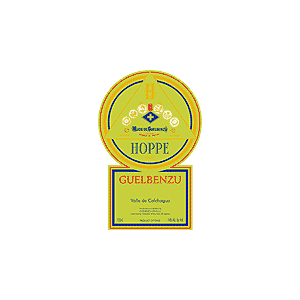
Guelbenzu Hoppe Valle de Colchagua 2003 – Chile
For centuries, the Guelbenzu family of Navarra, Spain has enjoyed great acclaim
for their innovative, award winning wines. As far back as 1851and the First
Universal Exposition in London (the forerunner of the World’s Fair),
Don Miquel Guelbenzu was wowing audiences with his remarkably rich, atypical
Navarra wines, at a time when Navarra was hardly a household word. A graduate
of the Sorbonne with a degree in Chemistry, Don Miquel went on to great critical
and commercial success in Navarra; his wines won gold medals in all of Europe’s
most illustrious competitions. This includes gold at the Exposition Universelle
Bordeaux, then the world’s most prestigious wine fair. Therefore, it
is in the spirit and tradition of Don Miquel that in 1980 his eight great-grandchildren
pooled their financial resources and resurrected their ancestor’s great
Spanish wine estate, thereby restoring the legacy and good name of their famous
forefather. But the story and the glory only begin here. In 2002, the Guelbenzu
family once again struck gold. They formed a partnership with the Hoppe family
in Chile, and together this erudite union gave birth to Hoppe and Bodegas Guelbenzu-Chile.
A joint venture with the Hoppe family of Rancagua, Guelbenzu Hoppe’s Chilean vineyards are all located near the village of Peralillo, in the heart of the Valle de Colchagua. Colchagua is the source of most of Chile’s finest and most concentrated red wines. Here, Cabernet Sauvignon, Merlot, and increasingly Carmenère (Chile’s intense, unique red varietal that once played a significant role in Bordeaux, its ancestral home, prior to the mid 19th century and the phylloxera epidemic) reign supreme. In addition, Colchagua is now home to excellent Syrah, Malbec, and other red grape varietals. Recently, Colchagua has begun making its mark with white wines, too, by fashioning compelling Viogniers. In all, the Hoppe Estate vineyard estate comprises 425 acres of some of Chile’s best vineyard land. Hoppe is the bodega’s flagship wine; it is a blend of Cabernet Sauvignon and Carmenère.
Tasting Notes: An artful blend of Cabernet Sauvignon (50%) and Carmenère (50%), the 2003 Guelbenzu Hoppe is well endowed with a dense, profound, nearly opaque royal robe, opulent fruit, and subtle but complex earth tones that recall top notch classified Bordeaux. The product of an excellent estate as well as one of Chile’s finest vintages in recent memory, the 2003 Hoppe is nothing short of masterful. The sensual scents of Cabernet and Carmenère play beautifully off of one another, creating a feast for the nose. Blackberry, plum, dark Belgian chocolate, and roasted coffee cascade from the glass. In addition, a set of rich, well-delineated flavors fill the mouth and leave the senses begging for more. Full but quite textured, a myriad of complex flavors well up from the depths of the Hoppe: black fruits, chocolate, fennel, and spicy oak come readily to mind. In the finish, this lush, highly textured red is complete; it makes its exit with rich, ripe tannins that complement the wine’s luxurious fruit. Although beautiful to drink now, the 2003 Hoppe will continue to improve in bottle for at least several more years. Serve the 2003 Guelbenzu Hoppe a little above cellar temperature (about 65?F), and allow it to breathe for at least ten or fifteen minutes before serving.
Accompaniments: The noble pairing of Cabernet Sauvignon and Carmenère provides both strength and grace to the 2003 Guelbenzu Hoppe. It also allows for great versatility when choosing accompaniments. Grilled lamb or beef, pungent meat and vegetable stew, and most highly charged vegetarian recipes all pair well with this wine. Consequently, traditional Chilean dishes, such as Pastel del Choclo; a delicious meat and vegetable pot pie; Cheese Empanadas; and Lomo, Chilean barbecued beef, constitute favored choices with Guelbenzu’s latest success. Southern Italian cooking provides other desirable backdrops to the Hoppe: Roast leg of lamb encrusted with black olive paste, Eggplant Parmigiana, and Sausage and Peppers are all tried and true accompaniments to this wine. And if you are looking to elevate some lowly, but tasty bean dish or a mid week meatloaf, the 2003 Hoppe more than fills the bill; it can turn an ordinary Wednesday into a holiday. In addition, the 2003 Hoppe offers an excellent dinner party selection with classic, more complex fare, so as you like it. Enjoy!
For the Love of Cheese: Given the opulent flavor and texture of the 2003 Guelbenzu Hoppe, it offers an excellent accompaniment to hand crafted cheeses, especially at the end of a meal. Some particularly fine pairings include Aged Cheddar, Smoked Gouda, and Havarti. Manchego also provides a veritable treat and a crowning touch to a superb dinner party, especially when accompanied by a glass of Hoppe. To find out more about exceptional international cheeses and pairings, visit our In Pursuit of Cheese website at www.cheesemonthclub.com
Lurton Les Salices Vin De Pays D’Oc Viognier 2004 – France
Jacques and Francois Lurton have made the most of their early experience in
the vineyards of Bordeaux, the advantage of being the offspring of André Lurton,
one of Bordeaux’s most renowned movers and shakers and the proprietor
of such famous Chateaux as Chateau Bonnet, Chateau La Louvière, and
Clos Fourtet. Since 1988, the erudite Lurton brothers have capitalized on the
considerable expertise in wine production and distribution that they garnered
personally and collectively at home and abroad from various international experiences.
From these experiences has arisen the brothers’ overriding philosophy;
namely, that fine wine can be produced in a myriad of locales, at least as
long as quality is the desired outcome and there is a sufficient supply of
well tended old vines upon which to draw.
In their quest, the Lurtons have demonstrated ample proof of their hypothesis by fashioning outstanding wines. Moreover, they have exposed the fact that in many wine regions around the world the overall improvement in the quality of wines has not consistently kept pace with the technological progress made by cutting edge winemakers, such as themselves. Happily, the Lurton bothers have set upon improving that scenario, along with the overall state of winemaking around the world, so that consumers can now enjoy consistently the high quality wines they have every right to expect. Bravo!
The Lurton brothers first and foremost success came in Languedoc, France’s oldest viticultural area. Here, Jacques and Francois craft excellent varietals from a number of old vine properties in Minervois, Corbieres, Fitou, St. Chinian, and the area around the great medieval city of Carcassonne. The firm’s top range of Southern French varietals is Les Salices. The red Les Salices wines are rich and harmonious. Meanwhile, their white counterparts provide haunting delicacy and elegance, and they exhibit supreme aromatic profiles. The Les Salices Viognier is the finest and most critically acclaimed of all these wines. It has even garnered one of France’s most prestigious wine awards, a Gold Medal at the Concours des Grands Vins du Languedoc. Since 2003, it has been bottled with a cap, rather than a cork, in order to insure absolute freshness.
Today, les frères Lurton produce world-class wine not only in France but also in other countries around the world. Working always on the principle that it is possible to make fine wine wherever vines grow under good normal, healthy conditions, the Lurtons have put together half a dozen different ventures in as many countries. Each venture is unique and fashions a truly impressive range of wines from local or traditional varietals.
Currently, the Lurtons have operations in Argentina, Australia, Chile, Spain, and Uruguay as well as France. Each of the Lurton offerings possesses its own distinctive style and reflects the terroir of its origin. Furthermore, and more important, perhaps, to conscious consumers are the ultimate quality and value inherent in each bottle of Lurtons’ wines. In fact, Lurton wines have quickly come to be the yardstick by which other producer’s wines from the same locale are now measured.
Tasting Notes: Blessed with a blithe, gentle spirit, the 2004 Lurton Les Salices Viognier is both charming and flavorful. Light, but not lean, it possesses an attractive bouquet that conjures the intoxicating scents of flowers, apricots, pears, and a cachet of spice. Upon first impression, fruit manifests itself as the calling card of the 2004 Les Salices, but this is only the first step in the evolution of Viognier on the palate. Citrus, strength (Les Salices, like most Viognier is surprisingly high in alcohol), and a silent vigor provide the underpinning for this often chameleon like wine that culminates perfectly dry in the finish. The 2004 Les Salices shows well at varying temperatures, depending upon the season and weather. In very hot climates, we suggest that it be served well chilled (36º-40º F) and much closer to room temperature in more temperate locales. Salut!
Accompaniments: Cheerful, light, and endowed with the seductive scent and savor of early summer, the 2004 Lurton Les Salices Viogner makes a splendid aperitif and a wonderful accompaniment to light meals. However, all this wine truly needs is a glass in which to pour it. Better still, the Les Salices Viognier loves a party, so why not invite some friends over and celebrate the day. The only downside to this scenario is the need for another bottle or two, but how bad is that? With the right guests and an ample supply of Lurton Viognier, food will be superfluous. However, for a veritable feast, all one needs to serve are some ripe pears, melted Brie, a light Chèvre, or just about any ripe, soft cheese. Salmon Mousse and a delicate veal or pork pâté with crusty French bread provide other savory accompaniments. So, when is the party?
Pasanau Ceps Nous Priorat 2002 – Spain
During the past decade, the Pasanau family and their beloved Priorat have achieved international fame. Currently, Priorat is Spain’s most glamorous wine producing region, fashioning more than just a hand full of sensational wines. At the forefront of this viticultural revival has been the Pasanau family.
Pasanau commands the high ground in Priorat, literally and figuratively. At over 2, 400 feet, Pasanau’s Finca La Planeta, which is devoted entirely to Cabernet Sauvignon, dominates Priorat’s arid, landscape. Planted on gravely scree and slate, this 12.5-acre vineyard yields, perhaps, the most intense of all Priorat wines. In addition to Finca La Planeta, the Pasanau estate includes equally impressive parcels of ancient, ungrafted Garnacha and Mazuelo vines, which are crafted into La Morera – a traditional Priorat style of wine. More recently, Pasanau released Ceps Nous, another delicious red Priorat, comprised primarily of the estate’s traditional Garnacha (Grenache) and Mazuelo, along with a healthy dollop Merlot and Syrah from young vines. Small amounts of excellent Viognier are also crafted at this great property.
Working out of a small modern bodega that was completed in 1995, Pasanau fashions some of Spain’s most compelling wines. Here, grapes are routinely picked quite late, often not until late October, in order to extract the greatest intensity from each low yielding vine. All tanks are gravity fed and racking and fining are done only during a full moon using all natural ingredients, which says a little something about this estate’s commitment to excellence as well as tradition.
Tasting Notes: “Oh my, this is good wine, and handsome, too” uttered one female member of the tasting panel to a chorus of bobbing heads. Indeed, the youthful, deeply colored 2002 Pasanau Ceps Nous Priorat is one fine specimen of a wine, and it tastes good, too. Redolent with the scents of black cherry and forest woodlands, the 2002 Ceps Nous intrigues with its comely aroma as well as its wealth of rustic, deep down flavors. Moreover, the Ceps Nous is rich in fruit; it is also balanced and sophisticated. At first, it is hard to believe just how much flavor the Ceps Nous packs into its sturdy, medium-bodied frame, but oh …. how it does! A blend of 44% Garnacha (Grenache), 30% Merlot, 20% Mazuelo, and 6% Syrah, this young vines Priorat doesn’t need to grow up; we like it just the way it is. Already, it accentuates all the best qualities of its respective components and blends them into one beautiful harmonious statement. From the looks and tastes of this wine, it’s no wonder Priorat is now considered to be Spain’s most exciting wine region. Enjoy this palate popping wine, with or without extended breathing time, but for optimum enjoyment do allow it at least 15 minutes aeration in the glass before consuming.
Accompaniments: Invariably, food and wine enhance each other, but wine as pure and extroverted as the 2002 Pasanau Ceps Nous demands at least on occasion the opportunity to stand firmly on its own. Having said this, the 2002 Ceps Nous is a delight to drink with or without food. If brought to table, we suggest it be served with simple, artfully prepared meals or the finest cuts of beef, lamb, pork, or free range poultry. Traditional Spanish fare marries well to the Ceps Nous as do many regional Italian favorites such as Chicken with Capers and Olives, Three Cheese Soft Polenta, and Crepes with Porcini Mushrooms. Enjoy!
Koehler Santa Ynez Chardonnay 2003 – U.S.A.
The Koehler Estate is located in the beautiful Santa Ynez Valley, which lies at the heart of the Santa Barbara wine country. Recently, this picturesque land has been referred to as Sideways country, after the award winning film of the same name. Here, in Santa Ynez on Foxen Canyon Trail (more than a few illustrious names are located along this route) Peter Koehler makes award-winning wines from sixty-seven acres of lovingly tended vines, many of which are approaching forty years of age.
In 1997, Peter Koehler purchased the hundred-acre property upon which his vineyard thrives because of the area’s diversity of microclimates and the property’s reputation for supplying neighboring wineries with fruit they were fashioning into critical acclaim. So, why not just make great wine yourself from your own vineyard and enjoy the accolades as well as the work of your own hands?
Today, Peter Koehler and his winemaker Michael Roth fashion a surprising number of wines from this small estate’s vines, which they augment with an outstanding Monterey Pinot Noir. Not surprisingly, Chardonnay and Pinot Noir are the focus of the Koehler estate. According to many critics and oenologists, Chardonnay and Pinot Noir are the apparent raison d’être of Santa Barbara winemaking as well. Nevertheless, Koehler is successful, too, with Cabernet Sauvignon, Riesling, Syrah, Sangiovese, Sauvignon Blanc, Grenache, and Viognier on account of his property’s unique microclimates.
Tasting Notes: “Bold and beautiful,” is how one
panel member described the 2003 Koehler Santa Ynez Chardonnay. One could stop
there, but that would be cruel. Besides, only three words would drive the layout
guys crazy. How would they format a mere three words? No worries, we can rectify
that. Koehler’s Santa Ynez Chardonnay makes its appearance in a bright
rich robe, with glints of golden sunshine. And like most serious Chardonnays,
the Koehler begs for a little attention prior to consumption. Consequently,
we suggest giving this wine a little aeration. Within ten or fifteen minutes
of opening, a myriad of scents and savors rise from the glass and fill the
olfactory. Butter, spice, and vanilla oak appear and wind around a core of
open knit fruit that caresses with each sip. Providing one exercises a little
patience, the 2003 Koehler Santa Ynez Chardonnay will more than fulfill its
promise. Chilling this wine to approximately 40° F and then allowing it
to unfold slowly in the glass will pay more than a respectable dividend. Enjoy!
Accompaniments: Bold, open knit wines like the 2003 Koehler
Santa Ynez Chardonnay beg for food of similar stature. So, whether it is
fish or fowl, we suggest serving this wine with a rich sauce. Why not serve
Haddock or Sea Bass, prepared with a fennel infused cream sauce, with the
Koehler Chardonnay? Chicken and Walnuts, simmered in butter, onion, spices,
and pomegranate juice provides another audacious treat. For a vegetarian
venue, classic Fettuccine Alfredo offers plenty of interest as well. In fact,
most cheese or cream rather than tomato based pasta sauces should yield similar
results.
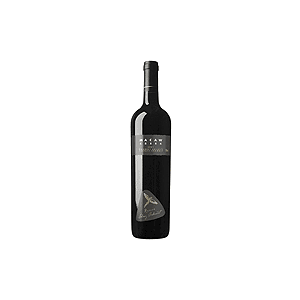
Macaw Creek Shiraz Cabernet Mount Lofty Ranges Reserve 1999 – Australia
Macaw Creek is hard to find. In the middle of what seems like nowhere, one
could easily miss the turn off down an all but concealed dirt lane to Rod Hooper’s
charming 19th century winery, which bears the undistinguishable look of Little
House on the Prairie and the Wild West. The low stone structure that constitutes
Macaw Creek is a tiny, neatly kept winery, replete with an attached storage
shed and a cozy antique tasting room, which is often aglow with a wood fire
and always ablaze with proprietor Rod Hooper’s passion for pioneering
the Gilbert Valley, South Australia’s small but rapidly growing wine
region.
Rod Hooper is all but a one-man band at Macaw Creek. Nearly single handedly, he has resurrected his family’s old farmhouse and winery and become the voice for the burgeoning number of wine growers and fledgling wineries popping up astride the low South Australia hills of the Gilbert Valley, about an hour an half north of Adelaide. He is truly a pioneer, much as his ancestors were more than a century and half ago when they came as free settlers to what we now know as South Australia. Thanks to Rod’s forebear, a skilled stone mason, the winery and several nearby stone buildings still survive, more or less intact. One such structure, now overgrown with flowering almond trees and a high field of tall grass and wild flowers is slated to become a bed and breakfast, a popular concept among small wineries whose cash flow and customer base have remained relatively tiny, in spite of selling annually all of their wine in short order. Fortunate will be the lucky souls who get to bed down at the Hooper’s. The wines are great and Rod’s mother knows how to cook and welcome weary travelers, too.
Rod Hooper is a man with a vision, and there is little doubt that he has succeeded in fashioning some of South Australia’s most compelling wines. From his tiny Macaw Creek winery, Hooper turns out a wide range of excellent traditional Australian reds, including a quintessential Grenache Shiraz that contains traces of Cabernet and Malbec for added grip, one of the best organic Shiraz in all Australia, and a beautifully wrought Shiraz Cabernet Reserve that recalls some of the finest examples of Châteauneuf-du-Pape we have ever tasted. Rod also fashions very nice Riesling and is experimenting with other grape varietals, including Sangiovese.
As a trained oenologist, Rod has taught at the university and assists other area winemakers in the burgeoning Gilbert and nearby Clare Valleys. In addition, Rod fashions wines under contract for some of the biggest and most prestigious wineries in Australia. Indeed, Rod Hooper is a man with energy, vision, and the talent to make things happen. Consequently, his wines win many awards and are strictly allocated due to limited production and tremendous consumer demand. Cheers!
Tasting Notes: The 1999 Macaw Creek Shiraz (78%) Cabernet (22%) is, perhaps, best described as an Australian rendition of great Châteauneuf-du-Pape. The wine’s tremendous aromatic profile is the first sign that this Hooper Reserve is something special. Redolent with the scents of ripe blackberry, violets, and white pepper, its entrancing aroma can quickly fill a room with its breath. On the palate, the wine is truly sublime. Open knit and decadently rich, all the textured fruit this mature Châteauneuf-du-Pape like wine ever possessed is still alive and well; its savor completely fills the mouth as well as the senses. Add in a pinch of spice and a smidgen of pepper and the 1999 Macaw Creek Shiraz Cabernet Reserve takes on a monolithic quality that is hard to resist, right down to the last drop in the glass and the gargantuan finish that stays with you for thirty seconds or more as a reminder of just how tasty this wine is. The 1999 Macaw Creek Shiraz Cabernet Reserve puts to shame other renditions of this popular blend, and for that it is all the better. Approaching its apogee, this exuberant unfined unfiltered wine still benefits from an hour or more of aeration, but it is ready to drink straight away, with a mere perfunctory swirl. For optimum enjoyment, we suggest serving this delightful elixir at no more than 68º F.
Accompaniments: The 1999 Macaw Creek Shiraz Cabernet Reserve is sure to be a hit at any convivial gathering, whether it is an elegant dinner party or a simple impromptu get together. Indeed, this wine carries its own welcome with it, so food is strictly optional. However, one can’t go wrong pairing well-prepared dishes of comparable quality with Rod Hooper’s flagship wine. Consequently, we suggest simple, but artfully prepared selections with this mature Macaw Creek offering. Lamb Stew, with a tomato base, herbs, and plenty of beans or lentils to highlight the Rhône like qualities of the wine is always a perennial favorite. A Herbe de Provence-Grilled Chicken Breast, with rosemary fries, makes another fine accompaniment. Grilled Loin Lamb Chops and fine cuts of beef will do justice to the wine as well. Nevertheless, for adventurous eaters the most memorable meal we have had with this Macaw Creek Reserve is kangaroo steak; grilled rare and served under a canopy of chanterelle mushrooms in a red wine reduction, there is nothing better. Enjoy!
Rutherford Hill Napa Valley Chardonnay 2002 – U.S.A.
Rutherford Hill Winery commands a spectacular view of Napa Valley’s famed Rutherford Bench, California’s most distinctive terroir, from a perch high in the eastern hills of Napa. Begun in 1976, before Napa Valley had become a household word, Rutherford Hill Winery specialized early in its inception on Merlot, a rare grape variety in California three decades ago. The original owners believed the Valley’s soil and climate resembled that of Pomerol, Bordeaux’s premier appellation for Merlot based wines. Not surprisingly, Rutherford Hill quickly established itself as California’s premier Merlot producer, but what the world would have to wait to discover was just how outstanding this winery’s other varietal wines could be, namely the estate’s Chardonnay.
In 1996, the Terlato family, owners of Paterno Wines International, purchased Rutherford Hill Winery and initiated a renaissance at the property. Immediately, Anthony Terlato set about improving overall quality as well as broadening the winery’s palette of wines. Today, Rutherford Hill’s portfolio includes more than excellent Merlot and Chardonnay. It also boasts a fine Cabernet Sauvignon, Cabernet Sauvignon Reserve, Sangiovese, Gewürztraminer, Sauvignon Blanc, and Zinfandel Port. Like nearly all California wineries, Rutherford Hill draws fruit from its neighbors as well as its own 60-acre estate vineyard in order to fashion its award winning wines.
Since acquiring Rutherford Hill, the Terlato’s have made major capital improvements to the property and winery, not the least of which is a special 5,100 square foot facility that houses an assortment of small capacity fermentation tanks, a gentle destemmer, and a pneumatic press. In essence, this miniature facility is a winery within a winery. It affords Rutherford Hill’s winemakers tremendous flexibility in terms of fermentation and maceration, and it permits all the estate’s small individual vineyard selections to be vinified separately.
Perhaps, the most distinctive aspect of viticulture at Rutherford Hill is the winery’s extensive hillside cave aging system. Carved into the hills and cliffs behind the winery is a mile long system of caves that house the more than 8,000 French and American barrels the winery employs for gracefully aging its wine. Rutherford Hill was one of the first Napa Valley wineries to dig caves for aging and this enterprise remains one of the most extensive such facilities in North America. These subterranean caves remain at a constant 59° F and 85% humidity all year round.
Tasting Notes: A classic mature Napa Valley Chardonnay, the 2002 Rutherford Hill reveals enormous charm, flavor, and style, all of which are revealed persistently and progressively. In this regard, the 2002 Rutherford Hill Chardonnay acts more like a red wine than a white wine, but such is nearly always the case with well-bred Chardonnay; as it matures it takes on secondary and tertiary qualities that blossom with moderate aeration. Accordingly, the Rutherford Hill Chardonnay reveals a beguiling nose of textured fruit, toasted coconut, and vanilla spice. And on the palate, it divulges a litany of Chardonnay flavors along with a supreme tactile quality. Consequently, we suggest that you savor this wine by holding it in your mouth for a few seconds before swallowing. Balanced, classy, subtle, and full of flavor, the 2002 Rutherford Hill may very well be the Napa Valley equivalent to Grand Cru Chablis; it contains plenty of underpinning and a taste of minerally terroir to back up its ample fruit and understated taste of tempered oak. In short, this is serious mature Chardonnay for those who like only the best. We found it to be at its finest when only moderately chilled (50° F). Enjoy!
Accompaniments: In its youth, California Chardonnay is often a show wine; its bold flavors, ribald fruit, and lavish oak leap from the glass. Eager and powerful, a youthful Chardonnay catapults itself upon its opponent, in much the way a prizefighter advances upon his adversary. Initially, these wines are best consumed without food or at wine tastings. However, the finest examples of California Chardonnay, like the 2002 Napa Valley Rutherford Hill, mellow and mature. They become food wines, much like their European counterparts, white Burgundies. Consequently, we heartily suggest that the 2002 Rutherford Hill Chardonnay be given a noble dish or two in order to strut its stuff. It will shine with an eclectic selection of well-prepared recipes from Cheese and Pear Risotto to Lobster au Gratin. Indeed, savory seafood dishes provide natural companions to this wine. Scallops in Puffed Pastry, Poached Salmon, or nearly any grilled white fish that is served with an herbed mayonnaise offer superb accompaniments to the 2002 Rutherford Hill Chardonnay. However, poultry goes well, too. Chicken Cordon Bleu and Chicken Fricassee provide excellent companionship as well. In addition, a glass of 2002 Rutherford Hill Chardonnay and a selection of soft goat cheeses or un-crusted semi hard cow’s milk cheeses like Gruyere or Panela offer an excellent alternative to dessert. Enjoy!
Pasanau La Morera Priorat 2001 – Spain
During the past decade, the Pasanau family and their beloved Priorat have achieved international fame. Priorat is currently Spain’s most glamorous wine producing region, fashioning more than mere hand full of sensational wines. And at the forefront of Priorat’s viticultural renaissance is the Pasanau family.
Pasanau commands the high ground in Priorat, literally and figuratively. At over 2, 400 feet, Pasanau’s Finca La Planeta, which is devoted entirely to Cabernet Sauvignon, dominates Priorat’s arid, landscape. Planted on gravely scree and slate, this 12.5-acre vineyard yields, perhaps, the most intense of all Priorat wines. In addition to Finca La Planeta, the Pasanau estate includes equally impressive parcels of ancient, ungrafted Garnacha and Mazuelo vines, which are crafted into La Morera – a more traditional Priorat style of wine than Finca La Planeta. More recently, Pasanau has released Ceps Nous, a delicious light red Priorat, comprised primarily of the estate’s traditional Garnacha (Grenache) and Mazuelo, along with a healthy dollop Merlot and Syrah from young vines. Small amounts of excellent Viognier are also crafted at this great property.
Working out of a small modern bodega that was completed in 1995, Pasanau fashions three of Spain’s most compelling wines. Here, grapes are routinely picked quite late, often not until late October, in order to extract the greatest intensity from each low yielding vine. All tanks are gravity fed and racking and fining are done only during a full moon, using all natural ingredients, which says a little something about this estate’s commitment to excellence as well as tradition.
Tasting Notes: A deep hauntingly complex wine, the 2001 Pasanau La Morera is classic Priorat. This youthful red is wrapped in a deep noble robe that appears profound and impenetrable. Its aroma unfolds slowly, almost imperceptibly, until the enticement is complete: a combination of black fruits, angostura, and oriental spice tantalize the nose. Suave and sophisticated, the 2001 La Morera is velvety smooth on the palate – at least initially. Only after holding it in the mouth for a few seconds does one realize just quite how packed this great Priorat is and just how much promise it affords the patient taster. The product of a great vintage in Spain, the 2001 La Morera embodies a near perfect balance between fruit and tannin, extract and charm. Layered and urbane, all of this wine’s up front appeal lies wrapped around a ripe complex core of sophisticated flavors. All of this bodes well for future cellaring and provides a boon to those looking to lay down a few bottles for that special meal or occasion. Patience is the key to the ultimate enjoyment of nearly all great wines, so either allow the 2001 La Morera a little more time in bottle or open it at least an hour before serving and permit it to unfold gracefully in a cool, clean decanter.
Accompaniments: Complex sophisticated wines call for food, but not just any old morsel will do. The finest cuts of meat, a complex sauce, or simple fare made from the very freshest ingredients are the hallmark of great food and wine pairings, especially in the case of the 2001 Pasanau La Morera where the wine’s pedigree is above reproach. Roast Leg of Tender Spring Lamb, Chateaubriand, or Loin Veal Chops, served with shitake mushrooms and an herb rice pilaf, are just a few of our favorite selections with the La Morera. Roasted Quail, stuffed with apple-smoked bacon and mushrooms, served over a corn based risotto, makes for another tasty suggestion. Truly, it is not so much what one serves with the La Morera that matters most, providing the dish is not too spicy, but the quality of the ingredients used. Enjoy!