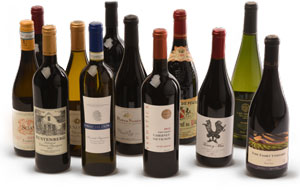
Welcome to The International wine of the Month Club

Past Newsletters

Vol. 4 No. 3

Standard Selection - (1) Red, (1) White
1998 Mastroberardino Lacryma Christi DOC Rosso del Vesuvio - Italy
2000 Vinedos Torreon de Paredes Sauvignon Blanc - Chile

Red Wines Only Featured Selections
1997 Torres Gran Sangre de Toro - Spain

White Wines Only Featured Selections
1998 Lacryma Christi del Vesuvio DOC Bianco - Italy

Mastroberardino Lacryma Christi DOC Rosso del Vesuvio 1998
From Ancient Vines Spring Modern Wines

Among the world's wine authorities, the name Mastroberardino is synonymous with the oldest and most dignified of Italy's grapes. Mastroberardino vinifies ancient varieties traditional to the area of Campania, varieties that date back to Greek and Roman times. Like faithful historians, this family has preserved the ancient vines of antiquity and sheltered them from extinction and the vagaries of trends. As master vintners, they've created from these grapes an array of wines as thoroughly contemporary as they are world-renowned. Today, as a preeminent Italian producer, Mastroberardino defines both the regional style of Campania, and the resurgence of indigenous varieties and terroir throughout Italy. The new millennium promises to broaden the Mastroberardino audience, as a growing number of enlightened wine drinkers come to appreciate a range of varietals that boast bold personalities, refreshing originality and a glorious legacy.

The Greeks introduced viticulture to Campania, home of Mount Vesuvius and Pompeii, in the eighth century B.C. Grape growing spread throughout the peninsula, but flourished most notably in the volcanic soils of Campania. By the end of the first century B.C., the region was supplying wines to the entire Roman Empire. The writings of Horace, Virgil and Pliny the Elder attest to the fame of the region's wines.

The Mastroberardino's have been making wine for nearly three centuries in the southwestern coastal region of Campania, considered by many the cradle of Italian viticulture. As far back as 1580, a Neapolitan named Berardino was recorded as a "Mastro" of wine. When the family moved inland a century and a half later, the notary unwittingly combined Mastro with Berardino to create the now legendary surname. The family built its winery in Atripalda, 40 miles east of Naples, in the 1720's.

Today, Antonio Mastroberardino and his two sons lead the flourishing family business. Antonio is the winemaker and patriarch of the family, while Piero oversees operations and Carlo spearheads international marketing.

Ruin and Renewal - A Technological Renaissance

The earthquakes of 1980, centered very near Atripalda, heavily damaged the winery. But from that tragedy emerged a technological renaissance. Mastroberardino seized the opportunity to refurbish the facility with state-of-the-art equipment, such as specially designed presses customized by grape variety, refrigerated stainless steel tanks for the white wines and rotary fermentation vessels for the red wines. Currently, the family is developing a groundbreaking new technology capable of analyzing a wine's aroma, known as the "electronic nose". Today, the winery is recognized as one of the most advanced in all of Europe.

In recent years, the Mastroberardino's have created several consortiums that offer technical support of area farmers. The consortiums continue to raise the quality level of Campania wines, while preserving the area's winemaking culture and boosting its economy. Mastroberardino's commitment to the area has not been lost on the Italian government. Recently the winery, registered as a research body with the Ministry of Universities and Scientific Research, was awarded the project of replanting ancient vineyards in the historic city of Pompeii.

Mastroberardino produces a wonderful array of white, red and rose wines which are all vinified exclusively from "archeological" vines, indigenous varieties like Fiano and Piedirosso, cultivated by the Romans some 2,000 years ago, as well as Greco and Aglianico, vines introduced by the Greeks 2,500 years ago. Yet, there are more to these varietals than their historical significance; these ancient grapes boast exciting personalities that result in equally exciting wines. Just as important in shaping the character of Mastroberardino's wines, though, is the vines' terroir - the soil, elevation, exposure and climate that nurtures these grapes.

Tasting Notes: Lacryma Christi (meaning tears of Christ), is Mastroberardino's most popular wine. Produced from 100% Piedirosso, the 1998 Lacryma Christi Rosso del Vesuvio is grown in the volcanic soil around Mount Vesuvius. The result is a dark, ruby wine that is both full-bodied and distinctively smooth. Characteristic of the finest Lacryma Christi from around the village of Boscotrecase, this wine exhibits the rich scent and flavor of black cherry, plum, spice and truffle-endowed woodlands, all wrapped in soft, plush tannins. Requiring specially designed presses and fermentation equipment for his Lacryma Christi, Mastroberardino has crafted a highly extracted, complex wine, without a harsh tannic bite. Moreover, ageing for six months in small oak barrels has added an additional layer of flavor and complexity that is rare in southern Italian wines. Indeed, Carlo Mastroberardino has it right when he says: "I don't think the world needs another good producer of Cabernet or Chardonnay". It would be a crime against oenology to have let Lacryma Christi pass in antiquity.

Accompaniments: Whether you favor "Haute Cuisine" or the savory, rustic fare of southern Italy, the 1998 Lacryma Christi Rosso de Vesuvio will enhance the experience. Recent food pairings have included a delicious pasta arabbiata, as well as a truffle-infused beef tenderloin, much to the delight of the panel. Complex, more refined dishes such as the beef tenderloin, accentuate the elegance and depth of flavor in the Lacryma, while the more highly charged pasta arabbiata brings out he latent strength and vigor in the wine. Other notable accompaniments include pork braciole, homemade lasagna, arancini and eggplant fried with garlic and olive oil. Buon Apetito!

Recipe for Red Wine:

Pork Braciole

1 ½ lb. pork tenderloin - flattened and pounded thin
2 Tbl. toasted pine nuts
¼ cup fresh parsley - chopped
¼ cup fresh mint - chopped
4 cloves garlic - minced
¼ cup lemon juice - fresh
3 Tbl. olive oil
½ cup red wine
¼ cup Parmesan cheese - grated
2-4 cups tomato sauce

Mix together pine nuts, mint, parsley, garlic, cheese, lemon juice and half of the olive oil. Once mixed well, rub mixture over meat on one side and roll meat up tightly jellyroll style. Tie the meat together with string fry in pan with remaining oil until browned on all sides.

Place meat in a casserole and cover with tomato sauce and wine. Bring to a boil and cover and simmer gently for 1 hour; turning once or twice. Turn off heat and let meat sit in casserole for 20 minutes. Slice across grain with and serve with sauce.

Quote for Red Wine:

"I don't think the world needs another good producer of Cabernet or Chardonnay."
----Carlo Mastroberardino

Vinedos Torreon de Paredes Sauvignon Blanc 2000 - Chile

Vinedos Torreon de Paredes is one of Chile's "hottest" new wineries. Founded in 1979 on the sight of an ancient vineyard by industrialist Amado Paredes, this relatively young venture is already producing a whole gamut of exciting Bordeaux-style wines, as well as small quantities of Chardonnay and Gewurztraminer.

Located in and around the Chilean town of Rengo, Vinedos Torreon de Paredes is a thriving family concern of over 300 acres. Presently, two of Amado's seven sons, Javier and Alvaro, manage this burgeoning estate. Putting aside their own successful careers in law and architecture respectively, the Paredes brothers have transformed an old rundown vineyard into one of the country's leading estates. With the help of many international consultants - several from France's prestigious Montpellier University, as well as others from as far away as South Africa - Vinedos Torreon de Paredes has become a leader in vineyard management. The Paredes family has also started its own vine nursery with cuttings from France. However, the most impressive of the family's projects has been the development and planting of 35 hectares of a stony wasteland, so desert-like that a viticulture professor at Montpellier University, published a study on it with the title, "How to Plant a Vineyard on the Moon". It took no less than five years to successfully cultivate vines at this sight. Nevertheless, the results have been outstanding due to a special drip irrigation system developed for the site, extremely low yields, and a stalwart refusal to fertilize.

Considering Chile's success and tradition of excellence with Bordeaux varietals, it should come as no surprise that Vinedos Torreon de Paredes has chosen to specialize in Cabernet Sauvignon, Merlot, Sauvignon Blanc and Semillon. In addition, the estate is cultivating Chardonnay, Riesling, and even Gewürztraminer, a rare varietal in Chile. In keeping with Bordeaux tradition, Vinedos Torreon de Paredes uses a combination of concrete and stainless steel for fermentation and is increasingly turning to oak barrel ageing of its wines in the estate's romantic 18th century cask cellar.

A fresh, Bordeaux-like Sauvignon Blanc consisting of 80% Sauvignon Blanc and 20% Semillon is the only white wine produced in any sizeable quantity at Vinedos Torreon de Paredes. Reminiscent of fine Entre-Deux-Mers from Bordeaux, it is one of the few Chilean examples of this varietal with true crispness and definition. Two other fine offerings (a regular and a Reserve bottling) of each of the estate's primary reds: Cabernet Sauvignon and Merlot, constitute the majority of Vinedos de Torreon's production. All other varietals are produced in limited quantities, although plans are afloat to augment the estate's production as young vineyards mature. We are also told that a very limited release of a special Meritage (Cabernet Sauvignon, Merlot, Carmenare blend) named Don Amado Reserva Especial, is also produced here in very limited quantities, but only in exceptional vintages. Heretofore, this luxury bottling has not been exported, but through the efforts of the wine club, we have been assured of at least a tiny allocation upon the next release.

Aptly named for the ancient, restored watchtower or Torreon that stands guard over the estate's vineyards, the brothers Paredes pay great attention to detail at their estate, overseeing all aspects of production from the cultivation of the vine to the final shipment of bottled wine from the cellar. To insure that a bevy of delicious, fresh tasting wines continue to pour from the estate that bears their name, Javier and Alvaro spare little expense, including washing all bottles in purified water and corking the estate's wines under vacuum to boost the life of the wine and insure the utmost purity in the finished products. Under the watchful eyes of "los hermanos" Paredes, it is no wonder Vinedos Torreon de Paredes is Chile's hottest new winery.

Tasting Notes: The 2000 Torreon de Paredes looks and acts like good white Bordeaux. Reminiscent of a fine Entre Deux Mers, this fresh, lively Sauvignon Blanc sports a pale yellow robe with a green hint. Fresh, tropical fruits: grapefruit, guava and pineapple, combine forces with light floral and herbal notes in this wine's beguiling bouquet. Grass, herbs and tropical fruits overlay crisp acidity in the mouth, giving this Torreon de Paredes a healthy balance-the very attribute so often lacking in other Chilean whites. Not surprisingly, several tasters picked this Sauvignon Blanc as a white Bordeaux, no doubt on account of its cepage, (80% Sauvignon Blanc, 20% Semillon) as well as its lively acidity. Serve the Torreon de Paredes Sauvignon Blanc well chilled and have a party!

Accompaniments: Although the 2000 Torreon de Paredes Sauvignon Blanc makes an excellent aperitif or party wine, the fruits of the sea transform this enjoyable white wine into a bona fide elixir. Plates of shrimp, steamed or lightly fried, offer a wonderful accompaniment to the Torreon de Paredes. A Maryland-style crab cake on a bed of aromatic greens also makes an excellent partner to this Chilean dandy. Yet, several tasters voted for a grilled tilapia with a mango and red pepper chutney as the perfect foil to the 2000 Torreon Sauvignon Blanc. A spicy, Brazilian-style shrimp in a roasted garlic and tomato compote was another favorite. Clams, oysters and scallops also bring out that tangy, sweet and fresh scent and flavor of the sea, which renders the Torreon de Paredes Sauvignon Blanc so much more than the simple quaff it first appears. Hot peppers and normally hard to pair spices don't pose too much of a problem either, as the Torreon de Paredes Sauvignon Blanc is as versatile as any light, dry seafood wine. Enjoy!

Recipe for White Wine

Maryland-style Crab Cakes

¾ lb. lump crab meat - cleaned
½ cup plain bread crumbs
1 small onion- finely chopped
3 Tbl. Fresh parsley - chopped
1 egg - beaten
2 tsp. Worcestershire sauce
2 tsp. lemon juice
¼ cup butter
½ cup milk

Combine crabmeat, breadcrumbs, onion and parsley in a medium bowl. Slowly stir in milk, egg, lemon juice and Worcestershire sauce. Mix very well. Shape into patties about ½ inch thick. If mixture is too wet, you can add a little more breadcrumbs. Pan-fry each patty in butter. Fry until golden brown on each side. Serve over a bed of mixed greens with your favorite seafood sauce.

Quote for White Wine:

"Fine wine can only be made from fine grapes"
----The brothers Javier and Alvaro Paredes

Torres Gran Sangre de Toro 1997

The Torres family has made wine in the ancient Catalan town of Vilafranca del Penedes, since at least the 17th century. Yet, it wasn't until 1870 that Don Jaime Torres officially established a winery and began the house of Torres. Today, Torres wines are known around the world, as "the best Spain has to offer".

Presently, Torres is headed by Miguel A. Torres, the president and winemaker of this exclusively family-owned and managed winery. Trained in both Spain and Bordeaux, Torres has guided his family's winery to the top echelon of wine producers, not only in Spain but worldwide. Through a combination of deep traditional roots and innovation, Miguel Torres manages to turn out a dizzying array of white and red wines from both traditional Catalan grapes and the very best clones of imported varietals. Consequently, Wine & Spirits Magazine named Torres the International Winery of the Year in 1999, while others continue to heap accolades such as, "the most important winery in Spain," upon this estate.

Torres produces a delicious 100% Parellada, an ancient white varietal, under the Vina Sol label. The winery also turns out considerable quantities of Sangre de Toro, a blend of Garnacha and Carinena, as well as Coronas, from the indigenous Tempranillo varietal. Moreover, there are Reserva bottlings of each of these wines, demonstrating considerable variations on the basic theme. The most notable among them is the splendid Gran Sangre de Toro. Torres also offers many more traditional and experimental blends. In all, a staggering two million cases of premium wine flow each year from the estate's 2,300 acres of Penedes vines, prompting many international critics to compare Torres to France's Baron de Rothschild or California's Robert Mondavi.

Tasting Notes: The 1997 Torres Gran Sangre de Toro is a blend of 75% Garnacha and 25% Carinena that has spent a year in small oak barrels. This special bottling of Sangre de Toro, or "bull's blood", sports a deep, intense ruby robe with mahogany highlights. Aromatically, the wine is classically elegant with the scent of blackberry, cherry and jam over a cachet of spices, redolent with clove and black pepper with underlying hints of toasted oak mingled into the soul of the wine. The palate is big and sensual, with round tannins that reveal the fruit of the wine as it airs. Enjoy this wine at cool room temperatures after a half hour of airing.

Accompaniments: Stuffed peppers, game stews, casseroles, ragout, goulash and spicy meat dishes all make excellent pairings with the 1997 Torres Gran Sangre de Toro. Pork and baked ham, as well as black bean dishes with rice, also, make wonderful accompaniments to this immensely pleasing offering from Torres, Spain's First Family of Wine. Enjoy the Gran Sangre de Toro, too, with a most pasta or meat dishes, as well as with cheese.

Lacryma Christi del Vesuvio DOC Bianco 1998

For nearly three centuries, Mastroberardino has been vinifying grapes traditional to the region of Campania, varieties favored by the Greeks and Romans millenniums ago. Today, armed with a progressive mindset and a state of the art winemaking operation, the family interprets these "archeological" vines for modern tastes, producing a host of wines as contemporary as they are rich in history.

Making use of Campania's rugged terrain and its highly variable climate with four distinct zones, Mastroberardino turns out a large number of unique and highly individual tasting wines, though none more famous than Lacryma Christi. Known as the world's foremost producer of both white and red Lacryma Christi, this family has raised this DOC on the slopes of Mount Vesuvius to new heights. Lacryma Christi means "tears of Christ", a reference to the legend of Lucifer's expulsion from heaven. It is said that Christ wept when he saw the devil steal away a piece of paradise. His tears then gave root to vines from which the wine, Lacryma Christi is made.

In addition to the legendary Lacryma Christi wines, Mastroberardino also produces the world's finest Taurasi in the hinterlands of the Campania, as well as a score of excellent varietal offerings from ancient grapes.

Tasting Notes: Produced exclusively from the ancient Coda de Volpe varietal (which translates to "tail of the fox", a name coined by Pliny the Elder for the shape of the grape clusters) the 1998 Mastroberardino Lacryma Christi del Vesuvio Bianco is a spicy, fruit-filled wine of great depth. Medium bodied with the aromas and flavors of honey, liquid minerals and piecrust, this Campanion beauty has been likened to an exquisite dry Riesling with a taste of the Mediterranean sun in its veins. Extremely well made, this wine exhibits charm as well as intrigue from its pretty, pale yellow appearance to its long, classy finish.

Accompaniments: Seafood, especially shellfish, is the ideal accompaniment to the 1998 Mastroberardino Lacryma Christi del Vesuvio Bianco. Shrimp, prawns, scallops and langoustines are all excellent choices with this Lacryma Bianco. Moreover, many local cognoscenti suggest "chioppino", a thick, rich tomato-based fish stew that serves as the Italian version of bouillabaisse, as the perfect soul mate for Mastroberardino's Lacryma Bianco; and we can certainly support that claim, having feasted on chioppino in the company of this exquisite wine.

Terms of the Vine

AGGRESSIVE: Unpleasantly harsh in taste or texture, usually due to a high level of tannin or acid.

APPELLATION: Defines the area where a wine's grapes were grown, such as Bordeaux, Gevrey-Chambertin, Alexander Valley or Russian River Valley. Regulations vary widely from country to country. In order to use an appellation on a California wine label, for example, 85 % of the grapes used to make the wine must be grown in the specified district.

CARBONIC MACERATION: Fermentation of whole, uncrushed grapes in a carbon dioxide atmosphere. In practice, the weight of the upper layers of grapes in a vat will break the skins of the lowest layer; the resultant wine is partly a product of carbonic maceration and partly of traditional fermentation of juice.

DEMI-SEC: In the language of Champagne, a term relating to sweetness. It can be misleading; although demi-sec means half-dry, demi-sec sparkling wines are usually slightly sweet to medium sweet.

FLINTY: A descriptor for extremely dry white wines such as Sauvignon Blanc, whose bouquet is reminiscent of flint struck against steel.

HAZY: Used to describe a wine that has small amounts of visible matter. A good quality if a wine is unfined and unfiltered.

IMPERIAL: An oversized bottle holding 4 to 6 liters; the equivalent of eight standard bottles.

JEROBOAM: An oversized bottle holding the equivalent of six bottles. In Champagne, a jeroboam holds four bottles.

LATE HARVEST: On labels, indicates that a wine was made from grapes picked later than normal and at a higher sugar (Brix) level than normal. Usually associated with botrytized and dessert-style wines.

LEES: Sediment remaining in a barrel or tank during and after fermentation. Often used as in sur lie aging, which indicates a wine is aged "on its lees."

LIMOUSIN: A type of oak cask from Limoges, France.

MACERATION: During fermentation, the steeping of the grape skins and solids in the wine, where alcohol acts as a solvent to extract color, tannin and aroma from the skins.

METHODE CHAMPENOISE: The labor-intensive and costly process whereby wine undergoes a secondary fermentation inside the bottle, creating bubbles. All Champagne and most high-quality sparkling wine is made by this process.

MURKY: More than deeply colored; lacking brightness, turbid and sometimes a bit swampy. Mainly a fault of red wines.

PRODUCED AND BOTTLED BY: Indicates that the winery crushed, fermented and bottled at least 75 percent of the wine in the bottle.

STEMMY: Wines fermented too long with the grape stems may develop this quality: an unpleasant and often dominant stemmy aroma and green astringency.

TARTRATES: Harmless crystals of potassium bitartrate that may form in cask or bottle (often on the cork) from the tartaric acid naturally present in wine.

VEGETAL: Some wines contain elements in their smell and taste which are reminiscent of plants and vegetables. In Cabernet Sauvignon a small amount of this vegetal quality is said to be part of varietal character. But when the vegetal element takes over, or when it shows up in wines in which it does not belong, those wines are considered flawed. Wine scientists have been able to identify the chemical constituent that makes wines smell like asparagus and bell peppers.

VOLATILE (or Volatile Acidity): Describes an excessive and undesirable amount of acidity, which gives a wine a slightly sour, vinegary edge. At very low levels (0.1 percent), it is largely undetectable; at higher levels it is considered a major defect.

For Members Only

Give Your Friends FREE beer, wine and cigars!
Through our Customer Appreciation Program

Your name has real value to your friends, co-workers and family members through our Customer Appreciation Program! Every time a friend, family member, or frankly anyone joins our Microbrewed Beer, Premium Cigar or International Wine of the Month Clubs [or gives a gift] for 3 months or longer, we'll give them 50 % off of their first month, but only when they mention your name. And we’ll also give you 50 % off your next month too which can either be applied towards your current membership or you can try one of our other Clubs out! (We can add one more month to your order at 50% off for prepaid memberships!)

The Fine Print: Members giving gift memberships do not qualify for referral credits and you can’t give yourself a gift to qualify! This Program is mutually exclusive of any other promotions.

Membership Q & A

Note: Please do not use the web site to make any account related information changes such as address or billing changes, membership extensions, or terminations. To ensure timely processing of your request, please call us at 800-625-8238.

Q: What can I do if I’m having difficulty receiving my shipment at home?
A: You should consider having our discrete box delivered to your work location or to a neighbor 21 yrs. of age that can receive it for you. The box is brown corrugated cardboard and doesn’t say “Wine” on it anywhere. Consider having it shipped to your work location as many of our customers do.

Q: What should I do if I’m moving or want to extend my membership?
A: Please call us prior to the 9 th of the month to make all account related information changes such as address changes, membership extensions & terminations, or gift accounts desiring to continue their memberships. Address changes made after that time may require a repackaging and re-shipping charge and will incur a $5.00 service charge from UPS that will be charged to your account.

Q: What happens if my shipment is damaged?
A: If your shipment arrives damaged, please call us immediately toll free at 1-800-625-8238 and report the incident for a prompt resolution.

Q: What happens if my credit card is declined?
A: We will send you a courtesy notice asking you for an alternative payment method and your order will be temporarily suspended until we hear from you. As we incur a $ 2.00 re-processing fee each time your card does not clear, that charge is passed on to you.

Q: What happens if I join under a special incentive program and don’t stay a member for the entire term committed?
A: Not a problem. Although we want to do everything we can to keep you as a member, we will allow you to cancel your subscription early, however, you will be responsible to pay for the item which was given to you as part of the promotion. If you received a discount based on a specific term, the amount discounted will be charged to your card.


logo for wine club
Since 1994
Home
Join Our Wine Club
Gift Memberships

Membership Renewals
Reorder Your Favorites
Wine of the Month Club
More Information
Current Selections
Past Selections
Testimonials
Other Gourmet Gifts
Corporate Gifts
Wedding Gift Ideas
All About Wine
Website Tools
Who We Are
Contact Us

1 - 800 - 625 - 8238
(Outside US call: 949-206-1904)
P.O. Box 1627, Lake Forest, CA 92609