Past Newsletters - June 2010
Premier Series |
|
Featured Wineries & Wines |
Membership Type |
| Guigal Côtes du Rhône Rouge 2006 – France | 1 Red 1 White; 2 Reds |
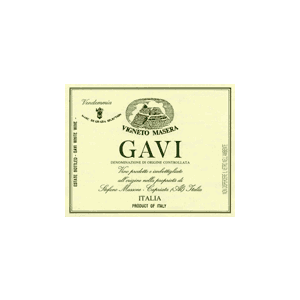
| Stefano Massone Vigneto Masera Gavi 2008 – Italy | 1 Red 1 White; 2 Whites |
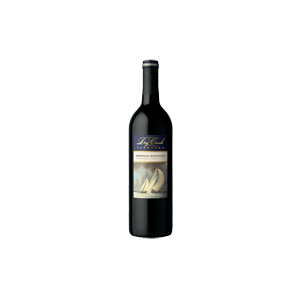
| Dry Creek Vineyard Heritage Zinfandel 2007 – U.S.A. | 2 Reds |
| Domaine des Baumard La Calèche 2006 – France | 2 Whites |
Master Series |
|
Featured Wineries & Wines |
Membership Type |
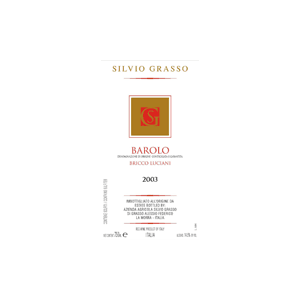
| Silvio Grasso Bricco Luciani Barolo 2003 – Italy | 1 Red 1 White; 2 Reds |
| Stefano Massone Vigneto Masera Gavi 2008 – Italy | 1 Red 1 White |
| Guigal Côtes du Rhône Rouge 2006 – France | 2 Reds |
Collector Series |
|
Featured Wineries & Wines |
Membership Type |
| Silvio Grasso Bricco Luciani Barolo 2003 – Italy | 1 Red 1 White; 2 Reds |
| Dog Point Section 94 Marlborough Sauvignon Blanc 2007 – New Zealand | 1 Red 1 White |
| Molnar Family Poseidon’s Vineyard Carneros Pinot Noir 2007 – U.S.A. | 2 Reds |
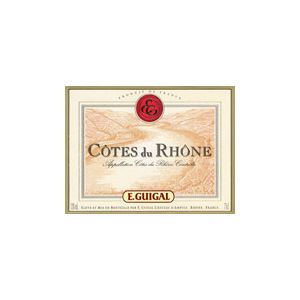
Guigal Côtes du Rhône Rouge 2006 – France
Marcel Guigal has been called everything from “the man with the Midas touch” to “the planet’s greatest living winemaker.” Unquestionably, Guigal has earned the reputation for fashioning some of southern France’s greatest wines, as the plethora of favorable reviews and critical acclaims of his wines will attest but, perhaps, even more impressive is Guigal’s knack for consistency. Without fail, Guigal wines, red, white and even rose, are at the top of the charts in both good years and bad. Moreover, each of Guigal’s many fine wine offerings has become the yardstick by which all others are judged in their respective appellations.
From the antique village of Ampuis, the birthplace of the great Côte-Rôtie appellation, the burgeoning wine empire of Guigal has spread to every significant appellation in the Rhône Valley. Led by Marcel and his adept son and protégé, Philippe, the Guigals have sown success and quality far and wide, forcing less quality minded producers to improve their wines or perish. Although most notable of Guigal’s wines are the firm’s several Côte-Rôtie offerings, which are universally acknowledged to be the supreme examples from this ancient 2,400 year old vineyard that dates back to early Roman times, the Guigals excel equally with all of their Rhone offerings. The firm’s delicious Côtes du Rhône offerings – red, white, and rose – provide ample testimony to that fact. Guigal’s red Côtes du Rhône is consistently one of highest rated wines of the appellation. It contains a high percentage of old vine Syrah, a practice few other producers would even think to emulate, but it is just such practices, along with a consummate dedication to low yields and minimal intervention, which set Guigal apart.
Tasting Notes: Classic, juicy Côtes du Rhône best describes Guigal’s eminently drinkable 2006 Côtes du Rhône Rouge. With 50% Syrah as the wine’s base, it should come as no surprise that a mélange of red and black fruits dominate the aromatic profile of this wine. And on the palate crème de cassis flavors emerge from this hedonistic potion to meld with a seductive dollop of garrigue (the alluring scent and savor of Provencal brush and wild herbs) that characterizes the finest red wines of the Rhône. What are equally impressive are the hints of pepper and spice that fold surreptitiously into this wine’s soft, juicy center to lend length and complexity. All these attributes add up to one good drinking wine. Consume Guigal’s 2006 Côtes du Rhône now and over the next couple of years. We suggest drinking this Provencal beauty at cool room temperature in temperate weather and just slightly chilled (55° F) when temperatures rise above 80º F as is the custom in Provence.
Accompaniments: Côtes du Rhône is one of the most versatile of all red wines. It has an affinity for a wide variety of cuisines and individual dishes as well as the proclivity to accompany the endless array of gastronomic delights that emerge from traditional Provencal kitchens. Cassoulet, roast leg of lamb, and spicy ratatouille are just a few Provencal staples that offer outstanding companionship to Guigal’s 2006 Côtes du Rhône Rouge. However, nearly all grilled meats and vegetables provide ideal accompaniments to this classic Côtes du Rhône as do many spicy fish dishes in tomato and garlic laden broths. For a simple, mid week treat we suggest pairing the 2006 Guigal Côtes du Rhône with beef or lamb burgers, meatloaf, marinated steaks, tomato and cream based pasta dishes, and pizzas any way you can envision them. The Provencal claim to having invented pizza (and there is some evidence to support this claim) may explain the proliferation of all kinds of thinly crusted pizzas in Provence. The myriad of delicious vegetable, cheese (cow, goat or sheep) and meat laden pizzas in Provence certainly underscore the wonder of this dish with a bottle or two of Guigal’s Côtes du Rhône. Enjoy!
For the Love of Cheese: What could be finer than a glass or two of the 2006 Guigal Côtes du Rhône and a plate of hand selected, international cheeses? Not much, especially when one considers Côtes du Rhône’s penchant for cheese. The juicy, vinous qualities of Côtes du Rhône propose an ideal partnership with traditional French, Italian, and Spanish cheeses. The most exquisite Chèvre (goat’s cheese), Port Salut and St. Paulin from France, Fontina from Italy, and Manchego cheese from Spain are just some of the superb cheese selections to savor with Guigal’s Côtes du Rhône. For more outstanding cheese accompaniments to this wine or to obtain information on expertly selected international cheeses to accompany a vast assortment of fine wines, please visit our Gourmet Cheese of the Month Club website at www.cheesemonthclub.com. Why settle for only one of life’s pleasures when you can have two?
Stefano Massone Vigneto Masera Gavi 2008 – Italy
Stefano Massone has crafted a model estate in Gavi, which is unequivocally the finest white wine zone in Italy’s Piedmont. Massone works a mere 8 hectares (or just a little less than 18 acres) from which he fashions two exceptional Gavis from two special vineyards: Vigneto Masera and San Cristoforo. Located in Capriata d’Orba in the southeastern section of the Gavi DOC, Massone’s vineyards enjoy prime southern exposures.
Stefano Massone is a rarity in Piedmont: he produces only white wine and from a single grape varietal. At his estate, the blithe Cortese varietal rules, and there are no compromises or cut corners. Quality is paramount. Consequently, the estate’s Masera and Cristoforo vineyards are farmed organically. There are no herbicides, pesticides, fertilizers, or systemic chemicals used in the vineyards. The rows of vines are sown with ground cover, which is either tilled or mown to turn to humus in alternating fashion. Furthermore, yields are kept very low to assure ripeness and sulfite usage is at a minimum. All of this care allows Massone himself to ferment the delicate golden clusters of Cortese di Gavi to perfection in his modern winery.
Piedmont
In the north of Italy, nestled just beneath the great Alpine wall as it tumbles out of Switzerland and the gleaming Mediterranean Sea, lies Piemonte, Italy’s Piedmont. It is a region of myriad beauty. It is also the region of Italy closest to France in proximity as well as in the sheer quality and variety of exceptional wines it produces. For centuries, Italy’s Piedmont remained a prize to be won among warring European powers, no doubt at least in part on account of the province’s world famous cuisine that still draws happily on the abundance and quality of local truffles. Yet today, it is the superbly made wines of Italy’s Piedmont that garner the most international recognition: complex, hedonistic red wines, still delicate whites such as Gavi, and sweet haunting Muscats. With such exquisite fare, should anyone question why the wines of the Piedmont and the hearty robust delights of the Piedmontese table remain the region’s most famous ambassadors to a hungry and thirsty world?
Gavi DOC
Gavi has been likened to white Burgundy, but the comparison does neither wine justice. At their best Gavi and white Burgundy possess ripe, rich fruit, a clean mineral quality, and ideal balance, but Gavi will always remain a more delicate wine than white Burgundy. The Cortese varietal, from which authentic Gavi is born, coupled with the soil, climate, and ultimate terroir of the Gavi zone render a decidedly different wine from white Burgundy and similarly styled Chardonnay wines. Gavi will almost always be the lighter, drier, more ethereal wine, but none the less for the difference. True Gavi provides perfect balance, delicious fruit, and vibrant acidity, which makes it ideal as an aperitif.
Tasting Notes: Stefano Massone has once again fashioned a fresh, lively, natural Gavi of supreme elegance and breed from the six hectare Vigneto Masera. From the wine’s inviting straw-colored robe to a blithe, refreshing finish the 2008 Massone Masera Gavi is another unequivocal success from this estate. It offers the usual clean, refreshing fruit flavors and overt appeal for which Gavi is renowned, and more. Delicate grape, pear, pineapple, and fresh squeezed lime scents caress the nose, and as always Massone’s 100% Cortese Vigneto Masera threads the magical line on the palate between soft succulence and refreshing crispness. Gavi shines in the hands of Stefano Massone, a master wine maker who rightly eschews the use of oak barrel ageing in favor of highlighting Gavi’s natural attributes: delicacy of perfume, subtlety of flavor, and a refreshing zip. In the mouth, the savor of soft fruit, crushed flowers, minerals, and lemon oil meld with a bright acidity that carries through to the wine’s long, pleasingly dry finish. We suggest you serve this delightful Gavi well chilled (about 40º F) and then allow it to slowly reach ambient temperature in the glass. This will afford the 2008 Vigneto Masera time to unfold in the glass and reveal its ultimate charms and cornucopia of nuanced flavors. Salute!
Accompaniments: Considering the supreme elegance and purity of the 2008 Stefano Massone Masera Gavi, the possibility of a second or third glass may be all that is needed for the ultimate enjoyment of this wine. True to form, Massone’s Gavi drinks beautifully as an aperitif. Although often served in the Piedmont as the prelude to a sumptuous meal, it would be a shame to relegate this artfully made Gavi to the sole role of aperitif extraordinaire . . . but we could think of a lot worse things. However, if you add the company of a special someone and some well prepared seafood to the mix, you have a recipe for a sublime dining experience. Sautéed Sea Scallops, prepared in a cream sauce with unsalted pistachio nuts and Mediterranean herbs is one of our favorite dishes with this Gavi. Pan Seared Red Snapper, Stuffed Flounder, and Sautéed Grouper all provide delicious accompaniments to Stefano Massone’s delicious 2008 Vigneto Masera as well. A simple Pasta Primavera and delicately prepared Chicken Francese offer more outstanding choices of accompaniment. In addition, most cream based sauces and soft cow’s milk cheeses pair nicely with Gavi; the Cortese grape seems to have natural proclivity for accompanying dairy as well as seafood. Enjoy!
Dry Creek Vineyard Heritage Zinfandel 2007 – U.S.A.
When David Stare opened the doors of Dry Creek Vineyard in 1972, his foresight signaled a dramatic change for Sonoma County’s Dry Creek Valley. Dry Creek Vineyards was the first new winery to open in Dry Creek Valley since Prohibition. Guided by a new vision for a long neglected grape growing region, Stare’s initiative launched a new era in American viticulture. Furthermore, Stare’s action and vision have subsequently transformed Sonoma County and shaped much of the way we think about American wine.
David Stare began his illustrious affair with wine in Dry Creek Valley in 1972 when he purchased a single parcel of land on Dry Creek Road, which was then nothing more than a run down prune orchard. There, he planted his first forty acres of grapes, mostly Sauvignon Blanc, Chenin Blanc, and Chardonnay. The locals ridiculed him and even the “farm experts” laughed at his folly, going so far as to exclaim, “Sauvignon Blanc will never grow successfully in Dry Creek Valley.” Today, Fumé Blanc (dry Sauvignon Blanc) is Dry Creek Vineyard’s flagship white wine, while Heritage Zinfandel enjoys its rightful place as the estate’s flagship red. We wonder who is laughing now . . . well, so much for the naysayers and so called experts. It takes courage, persistence, and vision to be a pioneer.
Dry Creek Vineyard’s leadership under Stare has inspired many important changes for Sonoma County. Not only was Sonoma County’s first Fumé Blanc created at Dry Creek Vineyard, but new standards of quality in California have resulted from Stare’s advocacy for Bordeaux style blending for red wines. Stare proposed meritage offerings, as opposed to strict varietal bottling of a single grape variety, long before almost anyone else. In addition, Dry Creek’s much heralded Heritage Zinfandel contains up to 15% Petite Sirah, a departure from 100% varietal bottling that many of California’s most expensive and sought after Zinfandel producers have emulated. Yet, Stare’s greatest contribution to American viticulture is, perhaps, his success in securing appellation status for the entire Dry Creek Valley, due almost entirely to Stare’s own accomplishments and the success of his Dry Creek Vineyard.
Tasting Notes: By combining fruit from the warm Dry Creek Valley and the cooler Russian River Valley appellation, Dry Creek Vineyard has created an aromatic, flavor packed 2007 Heritage Zinfandel that is simply delicious. Aromas of blueberry, bramble, chocolate and white pepper seep from the glass. On the palate, crushed berries, mint, and tobacco flavors mingle with suave oak tones and the wine’s own refined tannins. Although ripe, redolent, and fully charged, the 2007 Dry Creek Vineyards Heritage Zinfandel weighs in at a modest 13.5% alcohol and comes across as both balanced and beautiful. To our collective palate it combines the best of California fruit with the classic distinction of fine European wine. For optimal enjoyment we suggest allowing the 2007 Dry Creek Zinfandel 20-30 minutes of aeration prior to serving. And like most red Zinfandels, this Heritage Zin is at its best when served cool (58º-66º F).
Accompaniments: For nearly two centuries Zinfandel has been a staple at California winemakers’ tables and in the homes of humble immigrants and connoisseurs alike. Consequently, Zinfandel has evolved into the classic American wine and the quintessential red wine for American fare as well as many traditional Mediterranean dishes. So let’s open a bottle of the 2007 Dry Creek Heritage Zinfandel, fire up the grill, and light the oven. Grilled pork chops or braised ribs, marinated in a savory barbecue sauce; sweet or hot Italian sausage; calzones; lasagna; manicotti; pizza; and almost any southern Italian dish served with tomato sauce will complement this wine with aplomb. And let’s not forget burgers, steaks, barbecued and fried chicken, meatloaf, and the repository of salads and pasta dishes we have created over the years. Zinfandel is truly a wine for all seasons and an American classic, and the 2007 Dry Creek Heritage Zinfandel is out to prove it, so enjoy!
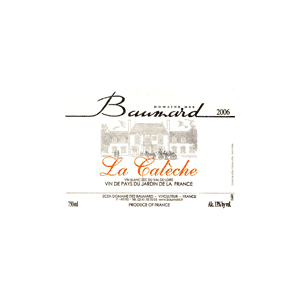
Domaine des Baumard La Calèche 2006 – France
Domaine des Baumard lays tucked away in the tiny village of Rochefort-sur-Loire, just south of Savennières, at the very heart of the ancient Duchy of Anjou. This is an impeccably run estate that has been fashioning outstanding Loire valley wines since 1634. The historical Baumards are viticulturists who specialize in the great but nearly forgotten Chenin Blanc variety. Under the recent guardianship of Jean and Florent Baumard, Domaine des Baumard has soared to new heights, even as many of Baumard’s neighbors have struggled to maintain their marginal vineyards.
Although Domaine des Baumard has played a key role in producing great Loire Valley wines for centuries, much of the estate’s modern day lore can be attributed to Jean Baumard, Florent’s father, who resurrected this family property in the 1950s and 1960s after decades of decline due to phyloxerra, economic depression, and the ever shifting tastes of the wine drinking public. For decades the Baumards, like many of their neighbors were forced to concentrate their efforts on their nursery business and the cultivation of vines rather than wine making. That is until the 1950s when Jean began acquiring several of the greatest vineyards in Côteaux-du-Layon and Quarts de Chaume and refocused the family’s effort into the crafting of the greatest of all Loire Valley wines.
In the past decade, Jean’s son Florent, a brilliant winemaker in his own right, has continued the great renaissance at Domaine des Baumard. In fact, Florent may be the region’s finest winemaker. The Wine Advocate has stated that “Baumard quietly fashions some the world’s most complex dry and sweet wines . . . and if he had been born a Californian, Burgundian, or Bordelais, wealthy vineyard owners would be standing in line to employ his services as a consultant,” which is high praise indeed.
Presently, Domaine des Baumard has one of the most extensive portfolios of Anjou wines, including outstanding dry Savennières offerings, sweet treasures from Côteaux-du-Layon and Quarts de Chaume, a host of artful cuvées like La Calèche, and at least three of the Loire Valley’s most enjoyable sparkling wines. There are also a number of single vineyard offerings. All of Baumard’s Savennières and Côteaux-du-Layon wines are produced from low yields (1.5-2.5 tons per acre). Moreover, all of Baumard’s wines are hand harvested and each of the estate’s wines is made in small, individual lots, including the special cuvées La Calèche and Cuvée Ancienne de Jean Baumard.
Tasting Notes: The 2006 Domaine des Baumard La Calèche is a light golden wine that captures the beguiling charm and pastoral beauty of France’s Loire Valley. Like the countryside of this fabled part of France known as Le Jardin de France (The Garden of France), Baumard’s La Calèche captivates the senses slowly and imperceptibly. It is both subtle and ingratiating. As a special cuvée of Chenin Blanc from a number of Baumard’s Anjou vineyards, La Calèche possesses everything that a fine white Anjou has to offer: soft floral aromas that recall the seductive scents of an orchard in bloom; a multitude of flavors that unfold surreptitiously as the wine reaches for ambient temperature; and a light lingering finish that recalls the flavors of fresh quince and dried butterscotch. Most assuredly, La Calèche is a wine for good old fashioned drinking, or for the less inhibited, more forthright among us . . . guzzling. La Calèche possesses Chenin Blanc’s most endearing quality, a combination of floral seduction and a citrus twist. Interesting and pleasing in a straightforward format, we suggest drinking the ebullient 2006 Baumard La Calèche only moderately chilled (40º- 50° F), but only after you have given it a little time in a glass to collect its coquettish charms. Salut!
Accompaniments: Although not a style of wine that most Americans are accustomed to standing around and sipping, the 2006 Baumard La Calèche offers an enchanting introduction to the realm of world class Chenin Blanc. Fish, poultry, and other demure, self effacing fare, will admirably complement the 2006 Baumard La Calèche, but by all means please do not stop there. Although light and easy, La Calèche, like most top rated Chenin Blanc wines, provides more than a passing complement to ordinary foods. Consequently, we suggest a daring hand in the kitchen. Why not start with a mild Loire Valley goat cheese like Sainte-Maure de Touraine and serve it with almonds, walnuts, and toasted French bread? A glass of La Calèche with this appetizer will set the tone for a rewarding evening. If a main course is more to your thinking, we suggest crab cakes, lobster croquettes with a mild salsa, or even sushi. Chicken or seafood crêpes offer yet another rewarding accompaniment to Baumard’s special cuvée. Mild Chinese, Thai, and Vietnamese dishes provide additional companionship to be enjoyed with La Calèche, so as you like it.
Silvio Grasso Bricco Luciani Barolo 2003 – Italy
Silvio Grasso is a small family run estate that specializes in Piemonte’s most important red grape varieties: Barbera and Nebbiolo. Located in the Barolo commune of La Morra this estate has been making Piemontese classics since 1927. However, in the last decade this property’s star has risen sharply and continues to ascend, thanks to the guidance and passion of its present guardian Federico Grasso, who manages both the vineyard and the cellar himself. He is a proponent of the “new style” of Barolo and an ardent advocate of seductive, barrel aged Barbera.
Federico fashions two exceptional single vineyard cru Barolos, Bricco Luciani and Bricco Manzoni, from his own southwestern facing vineyards on the slopes of La Morra. Grasso also produces a single vineyard Barbera d’Alba Fontanile, one of Piemonte’s finest Barbera wines and ample testimony to the benefits of barrel aging and the deft touch of Federico Grasso. In addition to these single vineyard selections, Federico Grasso fashions an assortment of Barbera and Nebbiolo based wines from surrounding vineyards. Perhaps, most intriguing among the estate’s non cru wines is L’Insieme, an increasingly popular blend of Barbera, Cabernet Sauvignon, Merlot, and Nebbiolo. As a member of the L’Insieme Association, Silvio Grasso is entitled to use the name “L’Insieme” (which means roughly together or the ensemble), and blend the two traditional Piemontese grape varieties Barbera and Nebbiolo with Cabernet Sauvignon and Merlot. Proceeds from L’Insieme wines go to charity.
Barolo: The King of Wines, and the Wine of Kings
Barolo has affectionately and appropriately been referred to as the “king of wines, and the wine of kings.” In a fine vintage and in the hands of a skilled winemaker, Barolo is unquestionably a noble wine, richly deserving of the many accolades that have been bestowed upon it. Barolo is born on the Langhe Hills of Italy’s Piedmont, on steep craggy Alpine foothills as they tumble out of nearby Switzerland and France. Typically, it is the most masculine of Piedmont’s three great Nebbiolo wines and the focal point in the region’s viticultural tiara. Its lineage dates back to the Middle Ages, and by the mid 18th century Barolo had begun to evolve into its present form in the vicinity of Alba, a distinct Old World city that serves as the white truffle capital of Italy as well as Piedmont’s premier wine town.
Today, the limited production of Barolo generates from the huddled hills of two valleys, Serralunga and Barolo, and their five principal communities, all of which lie to the southwest of the city of Alba and are reputed to impart distinctive characteristics and traits to their respective progeny. The townships of Serralunga, Castiglione Falletto, and Monforte are situated in the Serralunga Valley and are reputed to produce the region’s most masculine, longest-lived Barolos. Meanwhile, Barolo and La Morra, from which the more “delicate” wines of the zone are said to flow, are part of the Barolo Valley. However, there are many exceptions and innumerable variations in Barolo on the same theme, and this does not even take into account the decades old debate in Barolo over the relative merits of the modern and traditional styles of Barolo, which have as much to do with individual winemaking techniques as they do the amount and kind of barrel aging the wines receive. Happily, in the end, there is great Barolo fashioned in all five of the major townships, in both modern and traditional styles. Salute!
Tasting Notes: A deep complex wine that combines power with finesse, the 2003 Silvio Grasso Bricco Luciani Barolo provides the perfect snapshot of Grasso’s style. A quintessential La Morra Barolo, this wine offers up a beautiful bouquet of redcurrant, coffee, plum, mocha, and spice. On the palate the wine is broad and expansive, exhibiting a smooth, polished core of fruit, spice, and roasted coffee. Furthermore, the wine’s youthful tannins have begun to recede, providing the 2003 Bricco Luciani with a balanced, congenial frame upon which to strut its stuff. Fine and almost velvety in texture with an hour or more of aeration, the 2003 Silvio Grasso Bricco Luciani caresses the tongue and envelopes the soul. Splendid now, it will most assuredly continue to improve in bottle for several more years before arriving at its peak of perfection. In short, this Barolo has what it takes, and then some. For optimal pleasure, we would allow it at least an hour and a half of aeration, but don’t worry if you can’t wait. The 2003 Bricco Luciani Barolo possesses up front all that it needs for your drinking pleasure. As for the preferred serving temperature for this wine, cellar temperature (57º-62º F) gets our nod. Enjoy!
Accompaniments: Traditional Piemontese specialties provide delightful accompaniments to Federico Grasso’s 2003 Bricco Luciani Barolo. A blend of rusticity and sophistication, Piemontese cuisine is some of the finest in Italy. Moreover, it complements the region’s full-bodied wines with aplomb. Veal Tartare, served with mushroom caps or shaved truffles, a hunk of well-aged parmigiano, and a glass of this Barolo may be one of the best ways to start a meal in Northern Italy. For the less adventuresome, Milk Fed Veal sautéed in a luscious brown sauce can substitute for the tartare. Sautéed Rabbit with Peppers; Roast Duck, prepared with a cherry or blackberry sauce; or even fresh Bowtie Pasta and Pesto, served with crusty bread and a well-aged cheese can turn a meal into a veritable feast. So, whether you choose to serve simple food or sophisticated fare, Silvio Grasso’s 2003 Bricco Luciani Barolo will stand and deliver. Buon Appetito!
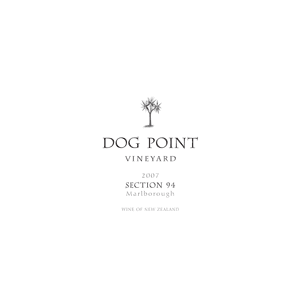
Dog Point Section 94 Marlborough Sauvignon Blanc 2007 – New Zealand
James Healy and Ivan Sutherland are the heart and soul of the Dog Point Vineyard. Both helped make Cloudy Bay a household name more than a decade ago when Cloudy Bay was a Marlborough benchmark. They served as winemaker and vineyard manager respectively. They began Dog Point Vineyard to make their own style of wine and establish Dog Point as the non plus ultra of Marlborough And what wines they make! In less than a half dozen vintages, James, Ivan, and their wives Margaret and Wendy have created benchmark Chardonnay and Pinot Noir in addition to the finest New Zealand Sauvignon Blanc we have ever tasted.
Dog Point uses well-established old vines from which yields have been strictly limited. This practice results in an optimal flavor profile in each of the estate’s wines. In addition, only natural yeasts are employed, adding to the complexity of the wines. The results of Dog Point’s meticulous practices are clearly evident in the rich, flavorful, and highly textured products they send to our table.
Dog Point derives its name from the stark hills overlooking Marlborough’s Wairau Valley, where in times past packs of wild dogs would roam and attack the flocks of sheep that grazed on the hills. Dog Point is also home to one of New Zealand’s national treasures, the indigenous “ti kouka” or cabbage tree, whose image graces all of Dog Point’s labels.
Marlborough: New Zealand’s Mythical Land of Vines
Marlborough is situated on the northern tip of New Zealand’s mystical South Island, where it enjoys a unique dry maritime climate. High mountains isolate this enchanted land from the cold alpine interior of the rest of the South Island, while the spectacular Marlborough Sound to the north provides a conduit to the sea as well as the planet’s most majestic view of New Zealand’s North Island as it soars skyward across the swells of Wellington Straits – a sight that ranks as one of the world’s most stunning vistas. Moreover, Marlborough is about as close to viticultural paradise as one can find, especially for Chardonnay, Sauvignon Blanc, and increasingly Pinot Noir.
Marlborough’s long, sunny, but not excessively hot growing season provides nearly ideal conditions for grape growing. The average summer daytime temperature hovers between 24° C and 28° C (72° - 80° F) depending upon one’s altitude and proximity to the sea. The air is crystal clear and the light luminous; with nary an overcast day let alone much rain during the long growing season. Cool nights keep acid levels high in the grapes, even as sugar levels rise abruptly. Such conditions lend themselves to an extended growing season and provide slow, even, ripening and extended hang time for the grapes. The result is ripe healthy fruit, with fresh vibrant flavors and the ability to develop subtle complexity over time.
In addition to its superb summer climate, Marlborough also boasts excellent soil for grapes. Most of Marlborough consists of silt and free draining alluvial loams over gravelly sub-soils. In addition, river stones lie scattered throughout Marlborough, remnants of the many rivers that once coursed through the land. These river stones store heat from the warm sunny days and radiate that heat back into the vineyards at night, thereby providing a unique microclimate and terroir, much like that of Châteauneuf-du-Pape. Moreover, most Marlborough growers are committed to sustainable agricultural practices in order to preserve the region’s noble terroir. And the French thought they had a monopoly on terroir; we think not!
Tasting Notes: James Healy and Ivan Sutherland have created their finest Sauvignon Blanc to date in the super premium 2007 Dog Point Vineyard Section 94. Consequently, Dog Point’s flagship Section 94 Marlborough Sauvignon Blanc appears on nearly every outstanding restaurant wine list in New Zealand, and if there were enough to go around Section 94 would be known the world over. For starters, this outstanding Sauvignon Blanc offers up a sensual, complex cachet of spring grass, fresh herbs, melon and fig. On the palate the wine is balanced, flavorful, long, and persistent as it combines the savor of its captivating bouquet with hints of tropical fruit flavors, pear, pineapple, gooseberry, and complex mineral tones. Suave and sophisticated, the 2007 Section 94 Sauvignon Blanc ranks among the finest New World Sauvignon Blancs. Moreover, it has the aristocratic charm of the noblest Sancerre and the finest White Graves. Dry, long, layered, and deep, the 2007 Dog Point Section 94 Sauvignon Blanc is the very finest Marlborough Sauvignon Blanc we have ever tasted. Enjoy this super premium offering moderately chilled (40º-45º F).
Accompaniments: While it is true that there is more to food and wine pairings than seafood and Sauvignon Blanc, it may be hard to convince New Zealanders of that. Not only is the Sauvignon Blanc produced in that island nation first rate, the seafood is downright superb as well. However, one need not buy an expensive plane ticket to enjoy the 2007 Dog Point Section 94 with the fruits of the sea. Fish, crustaceans, mollusks, and just about anything edible that comes from the sea is sure to be elevated in the presence of Dog Point’s 2007 Section 94 Sauvignon Blanc. Certainly, a bowl of New Zealand Green Tip Mussels are a perennial favorite as are clams and oysters on the half shell. For those who prefer fish, we suggest a simple filet of cod or flounder, baked with white wine, garlic, herbs and mustard. For more adventuresome gourmands, we suggest Spicy Chorizo Mussels, served with garlic bread. Herb crusted shrimp or prawns provide another tasty treat. Section 94 will more than do justice to a lobster dinner, too. For those who eschew seafood, this wonderful Sauvignon Blanc also pairs magnificently with highly charged chicken salads and Indian vegetable specialties, even those with a touch of curry. The 2007 Section 94 Sauvignon Blanc is no wilting flower, so no need to be overly cautious. Enjoy!
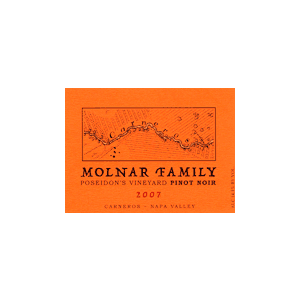
Molnar Family Poseidon’s Vineyard Carneros Pinot Noir 2007 – U.S.A.
Nicolas Molnar was one of the fortunate survivors of the 1956 Hungarian Uprising against Soviet communist oppression; he managed to escape. His odyssey led him to America where in the early 1960s he discovered Napa Valley. The wines of Napa Valley reminded him of Hungary, and the land was both bountiful and beautiful. When everyone else with a few dollars and a passion for wines was buying land in the northern part of Napa Valley and planting Chardonnay and Cabernet Sauvignon in the hot zones of Napa, Molnar quietly began purchasing land and developing vineyards in the coolest part of southern Napa in a place called Carneros.
In the 1960s, sheep outnumbered people in Carneros. Carneros, which lies along San Pablo Bay (the northern extension of San Francisco Bay), was considered a favored locale for agriculture by the early Spanish missionaries. Carneros viticulture thrived in the colonial period and during the Gold Rush, but since Prohibition, grazing had become the Carneros district’s only real claim to fame. Most of Nicholas Molnar’s contemporaries thought he was crazy for choosing Carneros over more favored locales in Napa. Happily for us, Molnar knew what he was doing. He planted Chardonnay and Pinot Noir in his vineyards, the two varietals perfectly suited to the terroir of Carneros.
In 1973 Nicolas Molnar planted the now legendary Poseidon’s Vineyard, and for three decades some of the finest California Chardonnay and Pinot Noir emerged from this vineyard astride the bay that bears the name of the Greek god of the sea, only to make its way into bottles bearing the names of California’s most renowned wineries. Acacia, Heitz, Mumm Napa Valley, Joseph Phelps, Pride Mountain, and Sterling are just a few of the names that coveted Nicolas Molnar’s stellar viticultural wares, until Nicolas’ sons decided it was time for the family to do their own thing.
With the assistance of Michael Terrien, one of California’s premier Chardonnay and Pinot Noir winemakers, the Molnar family began several years ago to make small batches of their own wine from the Poseidon Vineyard. Before practicing his magic at the Molnar Family’s Poseidon’s Vineyard, Michael Terrien made award winning wines for Hanzell and Acacia, where he served as both Winemaker and General Manager. His Acacia Pinot Noir garnered top awards and was rated among Wine Spectator’s top 100 wines in the world. His work at Molnar has been no less impressive. Recently, the talented Alex Beloz has joined the team to steer the course.
The Poseidon’s Vineyard has proved for nearly four decades what Nicolas Molnar knew straight away: his vineyard was destined to produce exemplary Chardonnay and Pinot Noir. Consequently, Chardonnay and Pinot Noir are the only two wines the Molnar family produces. Quantities are extremely limited. Less than two thousand cases of the Chardonnay and twelve hundred cases of the Pinot Noir with the Molnar Family name flow from the Poseidon’s Vineyard.
Tasting Notes: The 2007 Molnar Family Poseidon’s Vineyard Pinot Noir is one suave, sophisticated Pinot Noir. Seductive in the nose, it offers entrancing scents of crushed berries, cola, and plum. On the palate, the wine’s alluring aromatics follow through and mingle with hints of forest woodlands, herbs, and Asian spices. Smooth, textured, and expansive in the mouth, this mid-weight Pinot Noir is ideal for drinking now and for the next several years. For optimal enjoyment of Molnar’s enchanting 2007 Poseidon’s Vineyard Pinot Noir, we suggest you allow the wine 15-20 minutes of aeration in the glass before serving. And for most tastes, consumption at cool room temperature (60º-66º F) provides additional pleasure. Enjoy!
Accompaniments: When Pinot Noir is as expansive and textured as the 2007 Molnar Family Poseidon’s Vineyard Pinot Noir, it needs little in the way of accompaniment to shine. In fact, this silky Pinot Noir is a joy to drink on its own. Yet, Molnar’s savory Pinot Noir has the ability to transform a meal into a feast. So, why not pair it with roast duck or chicken or a simple beef or pork roast? Spiral sliced ham, served with a savory homemade potato salad, leek tart, or cheese pie gets our nod, too. Traditional French classics such as Coq au Vin; Boeuf Bourguignon; and Rack of Lamb, served with tender young vegetables and Mediterranean garnish, provide Molnar’s delicious Pinot Noir additional opportunities to work its magic. A plate of three or four soft cheeses, served with ripe apples, provides another simple treat. Bon Appétit!