Welcome to The International wine of the Month Club

Past Newsletters - January 2010

Premier Series
Featured Wineries & Wines
Membership Type
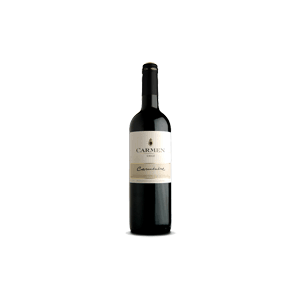
Carmen Rapel Valley Carmenere 2007 – Chile 1 Red 1 White; 2 Reds
Bergström O Willamette Valley Riesling 2008 – U.S.A. 1 Red 1 White; 2 Whites
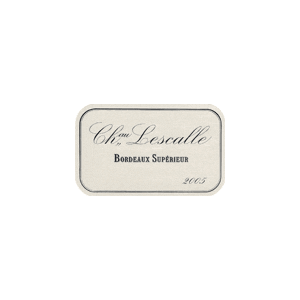
Château Lescalle Bordeaux Supérieur 2005 – France 2 Reds
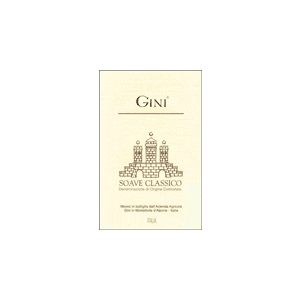
Gini Soave Classico 2008 – Italy 2 Whites


Master Series
Featured Wineries & Wines
Membership Type
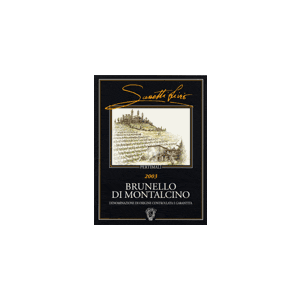
Pertimali Brunello di Montalcino 2003 – Italy 1 Red 1 White; 2 Reds
Bergström O Willamette Valley Riesling 2008 – U.S.A. 1 Red 1 White
Carmen Rapel Valley Carmenere 2007 – Chile 2 Reds


Collector Series
Featured Wineries & Wines
Membership Type
Pertimali Brunello di Montalcino 2003 – Italy 1 Red 1 White; 2 Reds
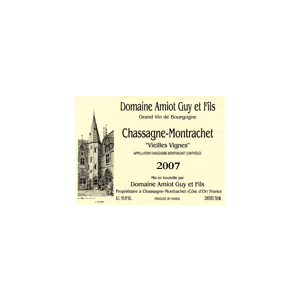
Domaine Amiot Guy et Fils Chassagne-Montrachet Vieilles Vignes 2007 – France 1 Red 1 White
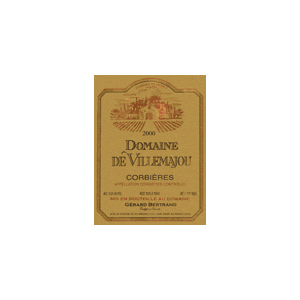
Domaine De Villemajou Corbières 2000 – France 2 Reds

Carmen Rapel Valley Carmenere 2007 – Chile

Carmen Rapel Valley Carmenere 2007Carmen is an amazing property. Furthermore, this great Chilean estate has the uncanny ability to consistently turn out top notch wines from each of its premium varietals, and the 2007 Carmen Rapel Valley Carmenère is indeed another great effort from Chile’s “grande dame” of exquisite properties.

Carmen is Chile’s oldest wine brand, dating back to 1850. A century and a half ago Christian Lanz founded Viña Carmen and lovingly named the estate’s beautiful vineyards for his wife. Today, Viña Carmen remains the showpiece Lanz envisioned more than a century and half ago. Combining tradition, superb vineyards and a state of the art winery that was constructed in 1992, Viña Carmen is currently South America’s leading winery as well as its oldest. In the 1990’s, winemaker Alvaro Espinoza, a proponent of organic viticulture, moved Carmen to the forefront of South American producers and brought international renown to this venerable property, a position it retains today under winemaker María del Pilar González. Wine & Spirits magazine has named Carmen “Top Winery of the Year” at least four times and current offerings look to be some of the finest this winery has produced to date.

Presently, the more than 500 acres of Carmen Vineyards spread across several valleys and many micro-climates surrounding Chile’s capital, Santiago. This constellation of microclimates allows Carmen to select the best grape varieties for each area and to excel with many different grapes and styles of wine. The winery has been extremely successful with French varietals, including the unique, lesser-known Bordeaux varietals, including Chile’s own “indigenous” grape, Carmenère.

Internationally renowned winemaker Alvaro Espinoza, who joined Carmen in 1993 and helped boost the winery’s stellar reputation, was instrumental in isolating and identifying Carmenère as a unique grape variety. He then went on to produce some of South America’s most exciting Carmenère based wines. Alvarez also instituted organic farming at Carmen, which continues to expand under present winemaker María del Pilar González. Presently, Carmen uses no pesticides in their vineyards and is leading the way in Chile toward more environmentally sensitive viticulture. In addition, many of Carmen’s wines are bottled unfiltered. The winery has also made the commitment to use lighter bottles in an effort to cut waste and reduce the environmental impact of transport.

Carmenère

Carmenère Barrel RoomCarmenère is a grape varietal that has virtually disappeared from its native Bordeaux, but quite literally this little known varietal has been resurrected or at the very least born again. Like the mythical phoenix that rises from the ashes, Carmenère has a new lease on life. After more than a century of obscurity, this flavorful, difficult to grow red grape variety is alive and well in Chile. It grows especially well in the scenic Colchagua and Rapel Valleys, where it ripens fully and is considered by its adherents to be next to godliness.

For a very long time, many in Chile believed or at least wanted to believe for commercial purposes that Carmenère was a clone of Merlot. And although there are some obvious differences in leaf appearance as well as the size and flavor of their fruit, both varieties had grown up alongside each other in Chilean vineyards for generations, with no distinction made between them. However, Carmenère is in fact a distinct varietal that carries its own set of attributes and characteristics. After years of speculation and extensive experimentation that culminated in 1994 with DNA testing and a positive identification by French ampelographer (vine expert) Jean-Michel Boursiquot, the true identity of Carmenère was established, or more accurately, re-established.

Winemaker Maria del Pilar GonzalezTasting Notes: A deeply colored, intense Carmenère, the 2007 Carmen Rapel Valley Carmenère highlights the attributes of Chile’s special red varietal. For starters, it provides a compelling bouquet of red and black fruits, roses, and chocolate that continuously expands as the wine rests in the glass. In the mouth this Carmenère continues to work its magic as it offers up a wealth of flavors to tantalize the palate: raspberry, dark chocolate, pepper, plum, roasted coffee, and spice all come front and center and linger in the mouth long after the wine has made its exit. Moreover, the seductive finish of the 2007 Carmen Carmenère is heightened by a dollop of ripe tannin wrapped around deft touches of cassis and wood smoke. An artful blend of 85% Carmenère and 15% Cabernet Sauvignon, Carmen has fashioned a flavorful, textured Bordeaux-style wine to electrify the senses. We found Carmen’s Carmenère to be charming from the moment we opened it. Nevertheless, it continued to open and develop for up to several hours, so we suggest you allow the 2007 Carmen Carmenère time to air before consuming. Enjoy!

Accompaniments:  For Carmenère aficionados the 2007 Carmen Carmenère requires nothing but a clean glass. However, Carmen’s delightful 2007 Carmenère complements a wide variety of foods. It also has the uncanny ability to elevate good home cooking to the level of haute cuisine, so that marinated flank steak, homemade pastas, creamy risottos, and spicy eggplant dishes constitute some of our favorite accompaniments to this wine. Baby back ribs, Texas barbecue, and a hearty dish of black beans and rice offer superb companionship to this wine, too, as these heady dishes pose no threat to the flavorful 2007 Carmen Carmenère. Mom’s mid week meatloaf will do nicely as well. Buen Provecho!

For the Love of Cheese:  Like fine red Bordeaux, Carmenère complements a wide array of cheeses. It pairs beautifully with Cantal, Port Salut, and many other traditional French cheeses. It also holds up nicely to hard and crusted Italian cheeses. For more delicious cheese selections and additional information on our outstanding international gourmet cheese club, please visit us at www.cheesemonthclub.com to enjoy all that life has to offer!

Bergström O Willamette Valley Riesling 2008 – U.S.A.

Bergström O RieslingBergström Wines proudly bills itself as Growers of Quintessential Oregon Pinot Noir since 1999, and anyone remotely familiar with world class Pinot Noir will attest to the validity of the statement. However, Bergström’s proclamation may well be the most profound understatement in the world of wine today. At the very least, this declaration tells only a small piece of the Bergström story.

Founded by Oregon surgeon John Bergström and his wife Karen in 1999, Bergström Wines has in less than a decade worked its way to the highest echelon of American producers of Pinot Noir, Chardonnay, and Riesling. Under the direction of Josh Bergström, John and Karen’s fourth child, Bergström wines have become the benchmarks by which American producers of Pinot Noir, Riesling, and Chardonnay are now measured. Considering the wealth of talent and terroir in Oregon and California, the Bergströms’ meteoric rise may come as a bit of shock to those accustomed to the glitz and glamour of Napa Valley or the high powered marketing techniques of the large, corporate owned wineries whose wares can be found in every grocery store.

Although Bergström has built its international reputation primarily on Pinot Noir, each of the estate’s many wines reflects the friendly, dynamic personality of Josh Bergström, the chief Winemaker, Vineyard Manager, and General Manager of Bergström Wines. The burly, good natured Bergström is as energetic as he is engaging. Not only does he fashion a staggering portfolio of world class Pinot Noir from up to 15 different vineyards, including the now famous Bergström vineyard that lies just outside the winery door, Josh makes one of the finest Chardonnay wines made in America. The estate’s Sigrid Chardonnay is a splendid, polished wine that is reminiscent of Puligny-Montrachet. It has even been compared favorably to the legendary Premier Cru wines of Burgundy’s Domaine Leflaive. And if that is not all, Josh Bergström exploits four of the oldest Riesling vineyards in Oregon, including a 45 year old plot on ungrafted rootstock, to craft O and Dr. Bergström Rieslings. Each expresses the unique terroir of these old vines and Josh Bergström’s inherent talent as a winemaker.

Bergström fulfills the family’s aspiration of growing quintessential Pinot Noir, and more. In pursuit of excellence, Bergström’s estate vineyards are farmed biodynamically. At Bergström, they believe “the winegrowing process must be a natural one, respecting progress of the growing season, harvesting the fruit by hand only when it has reached physiological maturity and allowing a fermentation to take place that is driven by the vineyard's indigenous yeast strains.” Moreover, they believe that “Oregon Pinot Noir must have purity of fruit that can only be achieved through non-industrial, artisan winemaking.” One sip of a Bergström wine is evidence that this winery means what it says. Enjoy!

Tasting Notes: On a recent visit to Bergström our expectations were high. Several Willamette Valley vineyard owners had previously expressed their admiration for the estate’s wines and one brave competitor took us aside and said “everyone talks about the wonderful Pinot Noirs at Bergström, but be sure not to miss Josh’s white wines. They are equally outstanding: you’re in for treat.”  Indeed, Bergström’s 2008 O Riesling is a treat. It led the charge at our tasting and immediately captivated all of us. O is a light, lively, pleasantly fruity Riesling that kept us coming back for more. Scents of rose petal, quince, and lime tantalize the nose, and in the mouth O races across the tongue and slips ever so easily down the pleading throat. High on flavor, polish and charm, O is also thankfully beautifully balanced; it finishes dry with hints of citrus to balance the wine’s pure, elegant fruit. For optimum enjoyment, we suggest giving O a moderate chill (40º-50º F) before consuming. Enjoy!

Accompaniments:  Given the genial reception O afforded us and the wine’s blithe charm, we can think of no better aperitif than the 2008 Bergström O. For many wine drinkers Riesling is the perfect way to begin an evening or event, and O lends plenty of credence to that thinking. However, a wine as pure and refreshing as Bergström O would be ill served if relegated to a sole position in life. Besides, wine as affable as O can turn an ordinary meal into a special event. We suggest serving Bergström’s O with seafood, salads, chicken, or turkey. It offers beautiful accompaniment to sautéed sea scallops; grilled salmon; and roast turkey, served with onion and sage stuffing and all the trimmings. We recommend it, too, with a highly charged chicken salad, prepared with grapes, walnuts, and plenty of fresh rosemary and thyme. You may also want to serve O with a salad of proscuitto and pear, served on top of organic greens with toasted walnut aioli. This versatile Riesling also pairs more easily than Chardonnay with mildly spicy fare, so why not be daring? We think you will be glad you did.

Château Lescalle Bordeaux Supérieur 2005 – France

Château Lescalle Bordeaux Supérieur 2005The outstanding 2005 vintage in Bordeaux continues to astound critics and consumers alike. From top to bottom, the 2005 vintage in Bordeaux offers an embarrassment of riches. Furthermore, no where does one get more bang for the buck and more pleasure on the palate than from the finest Petit Châteaux of Bordeaux in the 2005 vintage. Moreover, Château Lescalle is one of the finest 2005 Petits Châteaux from the Bordeaux Supérieur appellation. Château Lescalle is counted among the top echelon of Petits Châteaux because it consistently fashions wines of charm, grace, and remarkable drinkability. This over-achieving château is owned by Jean-Louis and Isabelle Chollet, the proprietors of several outstanding Bordeaux properties, including nearby Château Plaisance. Château Lescalle was built in 1875 and is located on the edge of the famous Margaux appellation. The estate actually consists of two pieces of land, one in Les Paruades near Château Maucamps, the other in the village of Lescalles itself.

Château Lescalle lies adjacent to the Margaux commune, but because Lescalle’s well-tended vines are planted on alluvial soils near the Gironde, rather than on higher ground further inland, it is only entitled to bear the title of Bordeaux Supérieur. However, Château Lescalle is Margaux in everything but name, and a very fine wine indeed. The only down side to this charming property is its diminutive size and limited availability. The cépage or blend at Château Lescalle consists primarily of Cabernet Sauvignon and Merlot, with a smattering of Cabernet Franc and Petit Verdot.

Tasting Notes: The 2005 Château Lescalle Bordeaux Supérieur is resplendent claret that is ripe, round, and utterly satisfying. Its regal purple robe underscores the splendor of the 2005 vintage and the particular success of Château Lescalle in what may be the finest, most consistent vintage ever in Bordeaux. Moreover, the comely Château Lescalle offers up a decadent nose of ripe berry fruit, smoke, and earth. Its supple fruit flavors and well-integrated tannins provide flesh and bone to the wine’s youthful exuberance, and at the same time they endow this handsomely wrought Bordeaux with the promise of a long, happy, life of fun-filled pleasure. For optimum enjoyment, we suggest allowing the 2005 Château Lescalle twenty to thirty minutes of aeration because like all fine Bordeaux, Château Lescalle’s fruit comes to fore and its youthful tannins recede with moderate aeration. Enjoy!

Accompaniments: Although young red Bordeaux is rarely the best wine to sit around and sip, the exuberant 2005 Château Lescalle is one exception to the rule. Simply said, this rich, smooth claret pairs as easily with a clean glass as it does with the delights of the cupboard. Perhaps more important is the recognition that the true glory of red Bordeaux in a vintage as splendid as 2005 lies in its ability to complement the culinary delights of a simple kitchen as easily as haute cuisine. One need not be elaborate when serving red Bordeaux, but Bordeaux does have an affinity for simple, well prepared foods. Whole roasted chickens, stuffed with a savory sage farce; loin lamb chops, served with garlic mashed potatoes; prime rib of beef, encrusted with mushrooms; and tender veal chops, grilled slowly to perfection and topped with morels and a blackberry reduction sauce are just a few of our favorite dishes with the 2005 Château Lescalle. Meatloaf and other mid week staples pair nicely with this wine, too, as Château Lescalle is no snob: it is equally comfortable at an elegant dinner party as it is with a simple mid-week meatloaf.

Gini Soave Classico 2008 – Italy

Gini Soave ClassicoThe Gini estate is one of those rare gems that turn up in what seems, at least at first glance, to be the most unlikely of places. In Gini’s case, Soave is the locale in question. Yet, Soave fashions some of Italy’s most tantalizing white wines, and it is only on account of the size and repute of some of the industrially made Soaves from the flat lands that consumers are sometimes surprised and delighted when confronted with authentic Soave the likes of Gini. In the hands of brothers Sandro and Claudio Gini, Gini now reigns as Soave’s iconic producer.

All of Gini’s Soave comes from supreme hillside vineyards in Soave’s Classico zone. And although one does not hear talk on this side of the Atlantic about single vineyards and grand crus when speaking of Soave, the winegrowers and producers in this picturesque corner of Italy’s Veneto acknowledge two such sites: La Frosca and Col Foscarin. Gini has had vineyards in both crus for centuries. Working a little more than 50 acres of prime hillside vineyards, Gini’s herculean efforts have greatly aided in re-establishing the reputation of Soave as one of Italy’s finest and most enjoyable white wines.

In addition to producing outstanding Soave Classico from 100% Garganega grapes (Soave’s most illustrious varietal), Gini also fashions tiny quantities of barrel fermented La Frosca from the cru of the same name. The Gini brothers also turn out an outstanding sparkling wine called Grand Cuvée Brut Millesime that they age for 48 months on the yeast. Small quantities of Pinot Noir, Chardonnay and other varietals are grown at the estate as well, but not for Soave.

Tasting Notes: A bright, golden robe is the first sign of the aromatic, luscious, personality filled wine that follows. The 2008 Gini Soave Classico is scrumptiously delicious. It offers a beguiling bouquet of apricot, cherry blossoms, and dried honey. And on the palate, Gini is pure magic; its velvety fruit fills the senses. Yet, this iconic Soave never loses its subtle minerality and gentle acidity. Moreover, the 2008 Gini Soave Classico exits with a delightful citrus twist and a dash of almond as its command performance that makes one beg for more. We suggest serving this super-charged Soave between 40º-45º F.

Accompaniments: A flavorful, medium-bodied wine, the 2008 Gini Soave Classico clamors for an audience. So, whether it is just a clean glass, a plate of tasty hors d’oeuvres, or some delicacy of the deep blue sea, Gini’s Soave Classico is ready and willing to please. Caviar, smoked salmon with capers, and cheese and herb stuffed mushroom caps provide several of our favorite appetizer companions to the 2008 Gini Soave Classico. As main course accompaniments we suggest sautéed grouper in a coconut curry sauce or a classic rendition of Charleston Shrimp and Grits. Creamy cow, sheep, and goat’s milk cheeses offer superb accompaniments to this wine, too. Gouda and lightly smoked cheeses also pair especially well with the luxurious exuberance of this exceptional, estate bottled Soave. Enjoy!

Pertimali Brunello di Montalcino 2003 – Italy

Pertimali Brunello di Montalcino 2003Livio Sassetti’s beloved Pertimali is one of Tuscany’s iconic properties. Situated in a small, sun blessed bowl sculpted into the slopes of Montalcino, Pertimali lies protected from the briny, often fierce southwesterly winds that blow off the nearby Tyrrhenian Sea to wreak havoc upon the vines of less fortunate Brunello producers. All 6 hectares (13.2 acres) of Sassetti’s Brunello flow from this sunny spot located on the hill of Montosoli, a privileged place that enjoys a well-deserved reputation as the supreme cru of Montalcino. More importantly, Sassetti’s sublime Brunello di Montalcino consistently attests in good vintages and bad to the superb terroir of Pertimali and the consummate skill and dedication of its guardian and his two attentive sons Lorenzo and Luciano.

A visit to Pertimali is truly a unique experience and certainly one of the most memorable in the world of wine. However, we suggest one put aside all preconceived notions, including the images of glamorous Tuscan villas and glitzy new wineries, the kind that have sprouted up in recent years and sprawled along the wine routes and byways of Tuscany to obscure the work of traditional Tuscan artists and artisans. No, a visit to Livio Sassetti’s Pertimali more closely resembles a walk back in time or a venture into a timeless, fantastic world where all kinds of unknown plants and produce flourish. Aside from his beloved wine, Livio Sassetti raises organic fruits and vegetables of every style and color. Much of this produce he has cloned himself, crossing tomatoes with potatoes and inventing all kinds of crops of fantastic color, shapes, and size. At first glance Pertimali appears more like a well-tended Jurassic Park than one of Italy’s iconic wine estates. However, one glance at Pertimali’s impeccably tended vineyards and the first sip of Livio Sassetti’s magical wine convince the visitor of the seriousness of the man behind the legend.

Livio Sassetti has been called “a curiously paradoxical man of disappearing kind: a very able winemaker who scrupulously vinifies his wines, and at the same time a man of ancient ways and principles,” by his importer Marc De Grazia. Indeed, Sassetti is all that and more. He follows the cycles of the moon in planting and harvesting and practices the tenets of biodynamic viticulture. He is a guardian of the land and its traditions. Livio Sassetti is, also, a man who will stay up all night in the cellar to mind his wine and assure that it is fermenting at precisely the right temperature, and then go and meet friends and winemaking neighbors in the morning for breakfast and order a cappuccino rosso, senza scuma (a red cappuccino without foam, or more precisely, a glass of Brunello wine). A poet, balladeer, and one of the ablest practitioners of the Tuscan art of lyrical bantering, Livio Sassetti remains a myth and a mystery to many in the world of wine. Nonetheless, what everyone who knows wine can agree upon is that Sassetti’s Brunello di Montalcino is second to none.

In addition to fashioning great Brunello, Sassetti and sons produce what may be the zone’s quintessential Rosso di Montalcino, a rich complex wine that emanates from Brunello but is aged only one year in cask. Furthermore, the Sassettis make very fine Montescudaio, a serious red wine from the hills opposite Montalcino, and they craft tiny quantities of Moscadello di Montalcino and other curiosities that one is sure not to find anywhere else. Pertimali is a unique place after all, not unlike Rip Van Winkle’s magical hollow, but most assuredly more than well worth the venture.

Tasting Notes: An extremely hot, dry year throughout Europe, the 2003 vintage tested the mettle of many in Montalcino. Yet, from Pertimali and the zone’s other privileged sites, the 2003 Brunellos are nothing short of profound. With that said the 2003 Pertimali Brunello di Montalcino is perhaps the finest Brunello of the vintage – a monumental wine of great color, depth, and complexity. Imbued with the personality of its maestro, the 2003 Pertimali Brunello di Montalcino sings with its soul. It offers up a stunning bouquet of roses, black cherry, tar, scorched earth, and wild herbs. On the palate, the wine is equally beguiling as it reveals a core of rich layered fruit along with seemingly endless complexity. Big, beautiful and highly concentrated, this remarkable young Brunello remains fresh and balanced from the moment it is poured. Yet, one need not be in a hurry; Pertimali’s 2003 Brunello di Montalcino evolves in the glass for hours, revealing secrets of untold beauty and power. We suggest you sit back, listen, and enjoy! And for those folks fortune enough to afford a few extra bottles, we highly recommend they put at least a few bottles of the 2003 Pertimali Brunello away for a rainy day. Enjoy!

Accompaniments: A wine as profound as the 2003 Pertimali Brunello di Montalcino rarely needs an accompaniment to shine. Yet, a bottle of Livio Sassetti’s magical Brunello can turn a well prepared meal into a vision of paradise, so why not have it all?  When all is said and done, what is great wine without equally enticing food?  So, why not serve the 2003 Pertimali Brunello di Montalcino with a thick, tender veal chop, smothered in a succulent brown sauce, or consider preparing a whole aged beef tenderloin topped with truffle butter and served with garlic mashed potatoes?  Braised lamb shanks, stuffed quail, and venison tenderloin offer other top notch pairings with Livio Sassetti’s outstanding Brunello. In fact, we can hardly think of a food that wouldn’t taste better with this Brunello. Buon Appetito!

Domaine Amiot Guy et Fils Chassagne-Montrachet Vieilles Vignes 2007 – France

Domaine Amiot Guy et Fils Chassagne-Montrachet Vieilles Vignes 2007Domaine Amiot is one of Burgundy’s finest producers of white wine, fashioning a rich portfolio of outstanding white Burgundies from the commune of Chassagne-Montrachet. Guy Amiot, the present owner and guardian of the domaine that bears his name, represents the third generation of renowned growers at this estate. However, most critics are quick to point out that over the last two decades Guy has taken his splendid domaine to the next level of quality and placed it firmly in the top echelon, alongside the very finest producers in Burgundy.

Guy’s forbearer, Arsène Amiot, an adopted Parisian, began the estate in 1920 after falling in love with the golden slopes of Chassagne-Montrachet, the world’s finest commune for Chardonnay. Arsène’s initial purchase in the tiny village of Chassagne-Montrachet accounted for a mere 2 hectares or approximately 4.5 acres of vineyard, but what jewels Arsène had acquired. These original parcels were remarkably well chosen and still form the core of the domaine. In fact, Amiot’s holdings included vineyards in Les Vergers, Le Clos Saint Jean, les Caillerets and les Dents de Chien, all of which were later to be designated as Montrachet Grand Cru, the mark of the world’s finest and most expensive white wines.

Pierre Amiot, one of Arsène’s sons took over the family business in 1936. He acquired several additional vineyard jewels for the domaine, such as La Maltroie, Les Champgains, and Les Macherelles. Under Pierre’s direction, Amiot’s production began to be sold directly to individual connoisseurs and savvy restaurateurs. After the Second World War, the acquisition of prestigious parcels like Les Chaumées or Les Demoiselles added further to the estate's very well-established reputation, both in France and abroad.

In 1984, Pierre Amiot passed away after a lifetime of producing estate bottled Burgundies and the torch passed to Guy, the present owner. Guy has taken the family estate to an even higher level. After completing studies in oenology, Guy gained considerable experience working in some of France’s greatest vineyards. He combines modern winemaking methods with a traditional knowledge of Burgundian viticulture. Moreover, he has wisely decided to retain old vines (Vieilles Vignes) and focus on bringing out the individual character and terroir in each of the wines he fashions, favoring the production of wines that are aromatic, rich and balanced, as illustrated by the remarkable quality of the wines he has produced from 1985 until present.

In 1992, the fourth generation of the Amiot family, Thierry, entered the family business and began building a new wine cellar whose elliptical vaults are ideal for the natural aging of the wines. Indeed, it is good to know that the future of this great estate is assured and remains in the hands of another capable Amiot.

Tasting Notes: Amiot Guy’s Chassagne-Montrachet Vieilles Vignes (Old Vines) 2007 is classic white Burgundy – a wine of grace, precision, and subtlety that bears little resemblance to California Chardonnay. In fact, a wholly different approach is taken in Burgundy towards Chardonnay, where the best producers like Amiot Guy strive to accentuate the ultimate attributes of Chardonnay: charm, elegance, and inherent drinkability. Rather than overlay the exemplary mineral rich flavors of Chassagne-Montrachet or obscure the appellation’s unique terroir with copious quantities of new oak, as is often the case with New World Chardonnays, Guy Amiot captures the complexity as well as the soft, sophisticated, eminent drinkability of Chardonnay in his 2007 Vieilles Vignes offering. The brilliant 2007 Amiot Guy Chassagne-Montrachet Vieilles Vignes sports a beguiling, golden-hued robe that radiates the glow of morning sunshine. A quintessential Chassagne-Montrachet, Guy Amiot’s 2007 Vieilles Vignes is an outstanding introduction to the wines of Chassagne-Montrachet, Chardonnay’s most famous village. Along with a brilliant robe, the medium-bodied Amiot Guy Vieilles Vignes possesses a mineral rich nose and a wealth of soft, seductive flavors. A cachet of flowers, minerals, and oriental spices well up from the center of this wine and frame the finish of this elegant concoction. Although still in the fresh bloom of youth, the 2007 Amiot Guy Chassagne-Montrachet Vieilles Vignes has several years of favorable evolution ahead of it; it should reach its ultimate plateau of perfection in 2010 and hold there for several years. We suggest only moderate chilling of this exemplary Chassagne-Montrachet (40º-50ºF), as we have found colder temperatures only numb the elegance and complexity of Guy Amiot’s handiwork. Anticipated maturity: 2010-2013.

Accompaniments: As quintessential Chassagne-Montrachet, Amiot Guy’s Vieilles Vignes provides what may be the ultimate accompaniment to fresh fish and sophisticated shellfish classics. Poached salmon, sole, and flounder are some of our favorite fish with this wine, especially when accompanied by a savory cream sauce. However, crab, scallops, and lobster offer superb companionship to a bottle of Amiot’s Chassagne-Montrachet, too. Artfully prepared crab dips; scallops sautéed with butter, white wine, and fresh herbs; and stuffed lobster tails, constitute several of our favorite complements to serve with Amiot Guy’s 2007 Vieilles Vignes. For those who prefer meat or crave the classics, Suprêmes de Volailles (Breast of Chicken with cream) and Escalopes de Veau (Sautéed Veal Scallops with mushrooms and cream) are two tried and true French favorites that shine in the company of this Vieilles Vignes Chassagne-Montrachet. And if good old-fashioned sipping is more to your liking, Amiot Guy’s old vine Chassagne-Montrachet provides plenty of pleasure on its own as an aperitif, without a morsel to prop it up . . . so as you like it. Bon appétit!

Domaine De Villemajou Corbières 2000 – France

Domaine De Villemajou Corbières 2000Domaine De Villemajou lies in the heart of ancient Corbières, one of the two oldest and most important appellations of Languedoc. It is to Corbières that archeologists and historians trace some of the earliest evidence of the vine in France. The Phoenicians and ancient Greeks were drawn to the beauty of Corbières, which had long been renowned for its captivating scenery, and began colonizing this dramatic sweep of Mediterranean coastline in the fifth century BC. Greek colonists planted the first vines in Corbières, making this enchanted land a cradle of French viticulture for over 2,500 years.

Georges Bertrand, who was best known as one of the Languedoc’s earliest 20th century visionaries, began the family domain of Villemajou. He sought to return the once glorious Languedoc to its former status as France’s premier wine region, a status it enjoyed before phylloxera, and was well on his way to accomplishing his goal when he died prematurely in 1987. Fortunately for the Languedoc, Domaine De Villemajou, and the serious wine consumer, Georges left the world of wine a legacy in his very talented son, Gérard, who carries on his father’s vision.

Today, Gérard Bertrand is known as one of France’s most influential winemakers. He makes his home at Domaine De Villemajou, where he transforms the traditional red Languedoc varietals:  Carignan, Cinsault, Grenache, Syrah, and Mourvèdre into powerful, lush wines that speak of old vines, low yields and a deft hand. In addition to the highly acclaimed Domaine De Villemajou, Gérard Bertrand produces other award winning wines from single vineyard sites in nearby Minervois. All of Bertrand’s estate wines are produced using sustainable agricultural methods and are hand harvested.

Tasting Notes: In the prime of its life, the richly robed, aromatic, downright plush 2000 Domaine De Villemajou Corbières underscores the latent greatness of the Languedoc and leaves little doubt in the mind of any serious wine lover as to why the Greeks and Romans were so enamored of Corbières and its viticultural acumen. Apparently, the love affair continues as the 2000 Domaine De Villemajou is nothing short of hedonism in a glass. One panel member became so despondent when he realized he had finished all of the 2000 Villemajou in his glass that he refused to taste the next wine. Another stated “I wish I could hug this wine”. Whether it’s Villemajou’s amplifying nose, redolent with the aroma of plums, roses, violets and black fruits or simply the smooth sophisticated taste and texture it possesses on the palate, the 2000 Domaine De Villemajou is one Corbières not to be missed. It is full-flavored and sophisticated, as well as elegant and structured. In other words, this wine possesses body and balance and all else in between. Without a tannic bite or even the trace of an edge, the 2000 Domaine De Villemajou requires little to no breathing time to be charming. However, aeration maximizes the wine’s round supple flavors to the point where the longer this outstanding Corbières breathes the smoother and more reminiscent of velvet it becomes. Enjoy this mature offering at cool room temperature (about 60°-66° F).

Accompaniments: Given the roundness and easy amplitude of the 2000 Domaine De Villemajou Corbières, it has for years ranked high on our list of great dinner party wines. It is the type of wine to plan a main course around. However, with more than a couple of guests, a second or third bottle of the 2000 Villemajou Corbières will most certainly be called for. Truly, this is the quintessential dinner party wine, so all you need to decide is what you want to serve. Whether it is beef, lamb, poultry, French Haute Cuisine, savory Italian specialties or good old American classics such as Texas barbecue or its Carolina sidekick – pork barbecue – the Domaine De Villemajou is a pleasure to bring to the table. Salut!

I'm ready toPlace My Order Button


logo for wine club
Since 1994
Home
Join Our Wine Club
Gift Memberships

Membership Renewals
Reorder Your Favorites
Wine of the Month Club
More Information
Current Selections
Past Selections
Testimonials
Other Gourmet Gifts
Corporate Gifts
Wedding Gift Ideas
All About Wine
Website Tools
Who We Are
Contact Us

1 - 800 - 625 - 8238
(Outside US call: 949-206-1904)
P.O. Box 1627, Lake Forest, CA 92609