Past Newsletters - July 2009

Premier Series
Featured Wineries & Wines
Membership Type
Trinity Oaks Vineyards California Pinot Noir 2007 – U.S.A. 1 Red 1 White; 2 Reds
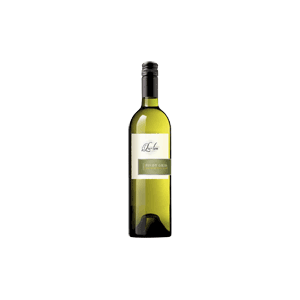
Francois Lurton Valle de Uco Pinot Gris 2008 – Argentina 1 Red 1 White; 2 Whites
Borra Vineyards Fusion Red 2005 – U.S.A. 2 Reds
Borra Vineyards Fusion White 2006 – U.S.A. 2 Whites


Master Series
Featured Wineries & Wines
Membership Type
Domaine Raspail-Ay Gigondas 2005 – France 1 Red 1 White; 2 Reds
Francois Lurton Valle de Uco Pinot Gris 2008 – Argentina 1 Red 1 White
Trinity Oaks Vineyards California Pinot Noir 2007 – U.S.A. 2 Reds


Collector Series
Featured Wineries & Wines
Membership Type
Domaine Raspail-Ay Gigondas 2005 – France 1 Red 1 White; 2 Reds
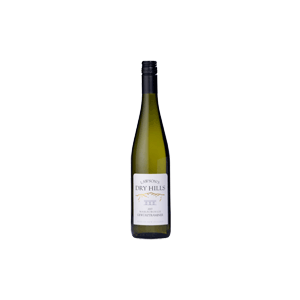
Lawson’s Dry Hills Marlborough Gewurztraminer 2007 – New Zealand 1 Red 1 White
Cusumano Sàgana Nero d’Avola Sicilia 2006 – Italy 2 Reds

Trinity Oaks Vineyards California Pinot Noir 2007 – U.S.A.

Trinity Oaks Vineyards California Pinot Noir 2007Trinity Oaks Vineyards was founded in 2001 by the Trinchero family, a long time Napa Valley producer of exceptional single vineyard offerings and a national leader in sustainable agriculture and land management. The guiding winemaking principle at Trinity Oaks is to produce the highest quality wines at the best value. To this end Trinity Oaks has over 50 years of winemaking tradition and experience. Furthermore, the Trinchero family practices sustainable methods of agriculture and farms all of their estate vineyards using organic and biodynamic practices. They eschew the use of potentially harmful chemicals and work with the state of California and other wineries to develop healthy, natural alternatives. Instead of insecticides, they use botanical oils and natural predators to take the place of potentially hazardous chemicals. In addition, Trinchero Family Estates (TFE) recycles 50 million gallons of water annually and re-cycles 20 tons of office paper, 850 tons of cardboard, and 100 tons of plastic each year. All proceeds from recycling revert to TFE’s employees in the form of an employee-in-need fund. In recognition of the Trincheros’ outstanding leadership, Trinchero Family Estates has received California’s Waste Reduction Awards Programs (W.R.A.P.) Award for at least eight consecutive years.

Grapes for Trinity Oaks’ wines are sourced from vineyards along the cool Central Coast, the marine-influenced vineyards of Lodi and the Sacramento River Delta, the emerging Lake County district, and the classic Sierra foothills region. Care is taken to manage each vineyard in a way that optimizes the quality of the fruit and maintains healthy, balanced vineyard ecosystems. And for each bottle of Trinity Oaks wine that is sold, Trinity Oaks plants a tree.

Trinity Oaks Plant a Tree Program: Some Basic Program Facts

Question – Is there really no limit to the number of trees Trinity Oaks will plant?
That's correct. It's literally a tree planted for EVERY bottle Trinity Oaks sell, without limitation.

Question - How many total trees do you think Trinity Oaks will plant?
If all goes according to plan, Trinity Oaks will be planting at least 1,800,000 trees as a result of this program. Editor’s Note:  Since 2008, Trinity Oaks has planted more than 1,250,000 trees and hopes to plant 2,000,000 trees by the end of 2009.... That’s a lot of trees.

Question – Who is helping plant the trees?
Trinity Oaks is working with an organization called Trees for the Future (www.treesftf.org) to handle the actual tree planting process. They've been around since 1989, helping rural communities around the world restore tree cover to their lands. Major replanting efforts are taking place throughout Africa, Asia and Latin America. Check out their website for a wealth of knowledge.

Question – Why plant trees in the tropics rather than in the United States?
 In terms of reducing carbon emissions and combating climate change, it is certainly best to plant trees in the tropics. Tropical species, planted in the tropics, grow much quicker and for longer periods each year than do non-tropical species planted in drier climates (i.e. North America). Therefore the trees are able to sequester much more carbon dioxide each year if they grow in the tropics. For instance, if Trinity Oaks plants one million trees over the course of a year in the tropics they would sequester around 25,000 tons of CO2 each year. This same number of trees, planted as local species in the US would, at best, sequester only about 7500 tons of CO2 per year. Editor’s Note:  In addition to planting trees in the tropics to offset CO2 emissions, the Trinchero family has planted thousands of trees in California to counter erosion and restore an ecological balance to the land.

Tasting Notes: The 2007 vintage was one of the finest in California for Pinot Noir in many years, and the 2007 Trinity Oaks Pinot Noir captures all of the splendor of that year’s long growing season, with its cooler than average day time temperatures. Yields were low in 2007, too, which is reflected in the color and intensity of the 2007 Trinity Oaks’ Pinot Noir. Aromatic and flavorful, this expressive Pinot Noir offers up a good dose of cherry and strawberry fruit in the nose, to which the savor of fresh green tea and spring mint have been gently infused.  Rich on the palate, but never blousy or over the top, the 2007 Trinity Oaks Pinot Noir makes us wonder why so many other California Pinot Noirs fall short, even those costing three and four times the price of the Trinity Oaks. For optimal drinking pleasure we suggest consuming this delightful Pinot Noir at cool room temperature (60- 65º F), after affording it just a few minutes of aeration.

Accompaniments: Good Pinot Noir rarely needs much in the way of accompaniment to be thoroughly enjoyed, and the 2007 Trinity Oaks is no exception. However, given this wine’s smooth, silky texture and relatively soft tannins it pairs well with all kinds of savory delights. Fish, roast chicken, ham, and most cured meats all get our nod with this wine. Furthermore, crispy, grilled salmon and marinated tuna steaks complement this wine and may be two of our favorite foods to accompany any Pinot Noir. In addition, we can vouch for how well the Trinity Oaks Pinot pairs with meatloaf and other hearty fare. And then there is cheese; the 2007 Trinity Oaks won’t let you down here, either. Enjoy!

For the Love of Cheese: The rich berry aromas of the 2007 Trinity Oaks Pinot Noir offer superb companionship to a wide variety of natural rind cow’s milk cheeses as well as to many sheep cheeses. Brillat-Savarin, Cheddar, and Aged Gouda constitute some of the most notable cow’s milk cheeses to pair with the Trinity Oaks. For additional suggestions or to find out how to enjoy more outstanding gourmet cheeses from around the world, contact us at www.cheesemonthclub.com. Enjoy!

Francois Lurton Valle de Uco Pinot Gris 2008 – Argentina

Francois Lurton Valle de Uco Pinot Gris 2008Francois Lurton and his brother Jacques began making wine in Argentina nearly two decades ago.Scions of André Lurton of Bordeaux legend and lore, the brothers Lurton quickly built a formidable portfolio of world class wines in Mendoza, Argentina from old vines.They also re-planted vineyards with the finest clones from around the world.However, after helping to build and re-shape the wine industry in Argentina from a bulk business into a quality affair, the brothers have decided to go their separate ways.Francois has stayed on in Argentina at Bodega Lurton’s state of the art facility, where he continues to fashion some of the world’s greatest wine values as well as a number of South American’s most compelling wines at any price.

Bodega Lurton’s vineyards surround the beautiful Mendoza winery that Francois and his brother opened in 1996. Lurton augments his production with several neighboring terroirs, many from old vines as much as 100 years of age. These hand selected vineyards reflect Lurton’s philosophy of producing natural, high quality wines. Moreover, these special terroirs have been selected for the quality of their soil and climate as well as their proximity to pure Andean water. All of Bodega Lurton’s Mendoza vineyards are planted on virgin territory: land that has never had any input of chemicals. Francois Lurton continues to safeguard his vineyards by refusing to employ herbicides and by practicing natural methods of production.

Although best known for his outstanding reserve offerings of Cabernet Sauvignon and Malbec, including the complex age-worthy Malbec Piedra Negra, Francois Lurton has time and again demonstrated that he is equally adept at fashioning distinctive white wines. In addition to turning out one of Argentina’s best Pinot Gris offerings, Lurton also crafts a very fine Torrontes, from Argentina’s own special white grape variety, and a very good Chardonnay Reserve.

Tasting Notes: All of Francois Lurton’s white wines seem blessed with a blithe, gentle spirit, as well as profound purity and plenty of up front appeal and the 2008 Francois Lurton Valle de Uco Pinot Gris is certainly no exception. This is an immensely charming and flavorful Pinot Gris that more than holds its own against a slew of Oregon Pinot Gris costing nearly twice the price. Ripe fruit is the first calling card of the 2008 Bodega Lurton Pinot Gris, but there is much more to this quaffable white wine than a dollop of fruit. Light, but not lean, it possesses an attractive bouquet that captures the most alluring aromas of Pinot Gris. The beguiling scents of acacia, roses, and apricots, infused with a light cachet of spice, work their way through this pure, very easy to drink white wine. Moreover, there is a crisp acidity and a quiet vigor about this wine that kept us coming back for more. Although gentle in appearance, the 2008 Lurton Pinot Gris carries a kick; it possesses much more alcohol than one can detect from the wine’s gregarious spirit, so consider yourself forewarned as the wine slips ever so surreptitiously down the throat. An additional attribute is its ability to show well at varying temperatures, depending upon the climate or season. In very hot climates, we suggest that it be served well chilled (36º-40º F) and much closer to room temperature in more temperate locales, but as you like it. Salut!

Accompaniments: Cheerful, light, and endowed with the seductive scent and savor of spring, the 2008 Francois Lurton Valle de Uco Pinot Gris offers superb accompaniment to most light meals. It performs equally well in the role as aperitif extraordinaire because, truly, all this wine needs to shine is a glass to pour it in. Better still, the Lurton 2008 Pinot Gris loves a party, so why not invite some friends over and celebrate the day? The only downside to this scenario is the need for another bottle, or two . . . and maybe more. So, how bad is that? With the right guests and an ample supply of Francois Lurton’s Pinot Gris, food will be superfluous. However, for a veritable feast, all one needs to serve with this wine are ripe pears and some melted Brie or Chèvre. Salmon Mousse and a delicate veal or pork pâté with crusty French bread provide other savory accompaniments. So, what time did you say the party started?

Borra Vineyards Fusion Red 2005 – U.S.A.

Borra Vineyards Fusion Red 2005Stephen J. Borra is owner and winemaker at Borra Vineyards in the Clements Hills area of Lodi, a distinct sub district of the Lodi appellation known for producing some of finest fruit in the entire region. The centerpiece of this oenological enterprise is the 200 acre Gill Creek Ranch, which sits astride the north bank of the Mokelumne River where it receives cooling breezes from San Francisco Bay.Here Stephen grows the gamut of the region’s traditional, Mediterranean grape varieties.

Alicante Bouchet, Barbera, Carignane, Grenache, Petite Sirah, Syrah, and Zinfandel all call Borra Vineyards their home. Stephen crafts some of California’s most memorable Barbera, Syrah, and Zinfandel as varietals. However, he also pays homage to his maternal grandfather  Giuseppe Manassero, who planted the first grape vines on the family property, and California’s centuries old tradition of planting a wide array of vines in a single vineyard in order to fashion robust, mouth filling reds to accompany equally rich and exciting foods. He does this by crafting wines he calls Fusion.

Borra Vineyards Fusion wines are blends of traditional California and Old World varietals. Fusion comes in both red and white versions. Fusion Red relies heavily upon the natural affinities that Syrah, Petite Sirah, Alicante Bouchet, and Zinfandel share. This month’s feature, the 2005 Fusion Red, has won numerous awards and medals, including a Gold Medal at the prestigious San Francisco Chronicle Wine Competition in 2008.

Tasting Notes: In keeping with the California tradition of field blends, Borra Vineyards has crafted an exuberant, easy to drink red in its 2005 Fusion. An artful, tasty concoction of Syrah, Petite Sirah, Alicante Bouchet, and Zinfandel from the winery’s Gill Creek Ranch, the purple, mouth staining 2005 Borra Vineyards Fusion Red makes its debut with a heady aroma of berries, black fruits, and plum. On the palate it continues to work its magic, as it offers up big, rich fruit flavors and pleasant bits of cinnamon and vanilla spice that are ever so nimbly wrapped within soft ripe tannins. To add to the festivities, the 2005 Borra Fusion offers a long, lush finish, as it exits with a flourish. Enjoy this delicious Gold Medal Winner now and over the next few years. It needs very little breathing time, but it prefers to be served at cool room temperature (no more than 66º F).

Accompaniments: As the 2005 Borra Vineyards Fusion Red takes it cue from the successful blends of Stephen Borra’s Italian and early California ancestors, we, too, need look no further than the family’s heritage for worthy accompaniments. Roasted meats, wild game, charcuterie, rich pastas, and heady stews all provide welcome complements to Borra’s Fusion Red. Chicago-style pizza; thick, crusty, oven baked rolls stuffed with sausage, peppers, and herbs; pasta and grilled chicken in a heady Alfredo sauce with Mediterranean herbs; and  barbecued spareribs constitute just a few of our favorite offerings with Borra Vineyards’ comely Proprietary Red. However, one need not limit oneself to the culinary delights of the Italian table. Giros, souvlaki, kebobs, and other Mediterranean favorites pair nicely with this wine as well. So, whether your style of cooking is rustic or elegant, simple or spicy, Borra’s Fusion Red is ready to serve. Enjoy!

Borra Vineyards Fusion White 2006 – U.S.A.

Borra Vineyards Fusion White 2006Stephen J. Borra is owner and winemaker at Borra Vineyards in the Clements Hills area of Lodi, a distinct sub district of the Lodi appellation known for producing some of finest fruit in the entire region. The centerpiece of this oenological enterprise is the 200 acre Gill Creek Ranch, which sits astride the north bank of the Mokelumne River where it receives cooling breezes from San Francisco Bay. Here Stephen grows the gamut of the region’s traditional, Mediterranean grape varieties.

Alicante Bouchet, Barbera, Carignane, Grenache, Petite Sirah, Viognier, Roussanne, Marsanne, Syrah, and Zinfandel all call Borra Vineyards their home. Stephen crafts some of California’s most memorable Barbera, Syrah, and Zinfandel as varietals. However, he also pays homage to his maternal grandfather  Giuseppe Manassero, who planted the first grape vines on the family property, and California’s centuries old tradition of planting a wide array of vines in a single vineyard in order to fashion robust, mouth filling wines to accompany equally rich and exciting foods. He does this by crafting wines he calls Fusion.

Borra Vineyards Fusion wines are blends of traditional California and Old World varietals. Fusion comes in both red and white versions. Fusion Red relies heavily upon the natural affinities that Syrah, Petite Sirah, Alicante Bouchet, and Zinfandel share; while Fusion White recalls its Rhône origins in a classic blend of Viognier, Roussanne, and Marsanne.

Tasting Notes: In the 2006 Borra Vineyards Fusion White, one discovers an exuberant, heady concoction of 83% Viognier, 16% Roussanne, and 1% Marsanne that nearly leaps from the glass. From the moment it is poured, bright, tantalizing aromas of cantaloupe, peach, and apricot waft from the glass. In the mouth, layers of peach, pineapple, and twists of toasted almond meld with hints of anise and subtle oak tones to envelope the palate and echo their gustatory chords for what seems like minutes after Fusion has slipped happily down the throat. Serve the 2006 Fusion White well chilled (36º-40º F), and then notice how the wine’s flavors emerge and change as Fusion slowly warms in the glass.

Accompaniments: For those who like to walk and taste on the wild side, or who share a simple affinity for a bit more than a touch of fruit in white wine, the 2006 Borra Vineyards Fusion White will be a wine to sip and savor on its own as the sun sinks below the nearest hill or casts its glint upon the sparkling waters of the sea. For others, fresh ripe fruit, country pâtés, and an array of Asian specialties will reveal the ultimate pleasure of Fusion White. In France, rich, country pâtés offer ideal companionship to the fruity, heady concoctions of Alsace and the Rhône, and Fusion White more than fills the bill on this score. Chinese, Thai, and Vietnamese stir fries provide especially fine complements, too. One of our favorite stir fries is Chinese Eggplant, cooked in a thick garlic sauce. The thick, rich eggplant fuses to Fusion White and creates and explosive taste sensation. Thick crusted cheeses such as Brie and creamy, highly scented cheeses on the order of Morbier offer superb accompaniments to Fusion White as well. Lastly, why not save a cup or two of Fusion White to add to a halved cantaloupe or Crenshaw melon?  Cover the wine soaked melon and allow the concoction to fuse for 24 hours, and voilà, a star is born. Enjoy!

Domaine Raspail-Ay Gigondas 2005 – France

Domaine Raspail-Ay Gigondas 2005Domaine Raspail-Ay is one of our favorite Rhône estates. It is easy to like Dominique Ay, the affable but serious minded proprietor of Domaine Raspail-Ay, and just as easy to be charmed by the warm, seductive Gigondas he coaxes from his 40 acre domain. Located on the terraces of the rugged Gigondas appellation, the last outcropping of the mighty alpine chain with the imposing rock formation of the Dentelles de Montmirail looming as a backdrop, this classic southern Rhône estate produces no more than 8,000 cases of a single wine – a superb Gigondas. Although rich and full-flavored, Dominique Ay’s Gigondas is made in a more sophisticated and fruit driven style of wine than what many of his neighbors favor, and it is better for it.

The Gigondas of Domaine Raspail-Ay is an artful blend of 80% Grenache, 15% Syrah and 5% Mourvèdre that is always ripe, generous, and rich on the palate. One can always count on this estate to fashion a wine with a mouthful of ripe, dark fruits – black cherries, cassis, and raspberries – with notes of licorice and black pepper in the background. Curiously, the tannins of this domain’s ethereal Gigondas always appear ripe and supple, too, mellowed no doubt by a hiatus of 20 months or more in large, ancient oak foudres. In addition, Monsieur Ay ages his wine several more months in old demi-muids in his refreshingly cool chais. The result is a wine with ripe, dark fruit aromas and a supple, rich texture that belie its 14% plus alcohol content. Miraculously, the fruit lasts all the way from beginning to end, before exploding in a long, ripe, satisfying finish.

Gigondas:  A Sleepy Little Town with a Big Beautiful Wine

Gigondas, along with the neighboring Provencal villages of Vacqueyras and Châteauneuf-du-Pape, produces the finest red wines of the southern Rhône. Relying upon old vines of Grenache, married to lesser quantities of Syrah, Mourvèdre, and Cinsault, Gigondas turns out a startling array of big, beautiful, tasty reds from nearly 2,500 acres of vineyards. Spanning a combination of soils, from the gravelly clay of the flat plains at the base of the craggy Dentelles de Montmirail to the sheer bedrock of the Dentelles themselves, Gigondas is testament to the belief that in this enchanted corner of Provence known as the Vaucluse one can even extract blood from stones in the form of a vigorous, deeply colored red wine.

Tasting Notes: The largesse of the 2005 vintage and the sophisticated style of winemaking practiced by Dominique Ay have combined to produce a powerful, complex 2005 Gigondas at Domaine Raspail-Ay. This is a wine that can be drunk now with great pleasure or cellared for three or more years. Although bigger, bolder, and more complex than usual, the 2005 Domaine Raspail-Ay Gigondas retains its balanced charm and sexy seductive feel. It caresses the nose with fecundity: a mélange of red and black fruits, roses, violets, pepper, and spice. On the palate the 2005 Domaine Raspail is warm, generous, and loaded with flavor, yet caressing and smooth right through to the finish. What Dominique Ay does so very well is capture in his Gigondas the glory and vibrancy of the sun-drenched Vaucluse. In this vintage it is apparent that Ay has once again fashioned a sexy, seductive Gigondas – a wine that is both complex and powerful. Enjoy this full-bodied Gigondas at cool room temperature (60°-65° F), alone or with a friend. Santé!

Accompaniments: The fine red wines of the southern Rhône and especially the 2005 Domaine Raspail-Ay provide superb accompaniments to grilled meats, especially lamb and chicken that are flavored with rosemary, garlic and black pepper. With such a glorious combination of food and wine, we guarantee you will soon be picturing the rocky terrain of the “garrigue” of the southern Rhône, inhaling the scents of rosemary, lavender, and wild flowers that infuse the summer air, and feeling the refreshing shade of a hot summer’s day – Provence in a glass. What more can one ask of a wine?  If you can’t make a trip to the south of France, a glass of Raspail-Ay Gigondas is most assuredly the next best thing. However, with all this talk about Provence, let us not forget the surfeit of culinary delights that await the intrepid gastronome, dishes like Ravioli Stuffed Lobster, Roast Quail, and sumptuous Ratatouilles. In addition, traditional Italian favorites, such as Lasagna, Manicotti, and almost any dish fashioned with fresh tomato sauce, garlic, or olive oil, marry well with Dominique Ay’s superb Gigondas, so set the table and let the good times roll. Enjoy!

Lawson’s Dry Hills Marlborough Gewurztraminer 2007 – New Zealand

Lawson’s Dry Hills Marlborough Gewurztraminer 2007Editor’s Note:  It is with great sadness that we note the recent passing of Ross Lawson, one of Marlborough’s pioneering viticulturists and a colorful character in the very best sense. Ross, to you we raise our glasses. Thanks for all the fond memories and outstanding wines, not to mention enough great stories to accompany each and every bottle of your aromatic, full-flavored wines!

Lawson’s Dry Hills is one of Marlborough’s pioneering wineries. Moreover, it is a true family winery that consistently fashions the highest quality wines. Lawson’s was founded in 1992 by Ross and Barbara Lawson, a charming, witty couple with tremendous energy and a great sense of timing, not to mention a knack for knowing what consumers like in wine. Lawson’s Dry Hills winery was one of the first small boutique wineries in Marlborough to receive international acclaim for estate bottled wines.

Committed solely to the production of premium Marlborough wines, the Lawson’s have from the beginning of their fledgling winery distinguished themselves as serious producers of full-flavored, fruit driven wines of renown. And with Barbara and Ross around, you could be sure there was nary a dull moment at Lawson’s Dry Hills, and we haven’t yet mentioned Tomi – the winery’s most esteemed character.

Tomi, Ross Lawson’s Best Friend and Every Winemaker’s DreamRoss Lawson left behind a legacy larger than most, but none more colorful or renowned than Tomi. Tomi is the Lawson’s golden retriever and by all accounts a remarkable dog. Tomi possesses the premier palate at Lawson’s Dry Hills, as the international press has so duly recorded in scores of interviews. Instead of playing in the yard or retrieving prey like most golden retrievers, Tomi has enjoyed an unprecedented career in oenology. She decides when to harvest at Lawson’s and what grapes to pick, and when. With one sniff of her supercharged olfactory she can determine the brix (brix is a measure of sugar, most notably in grapes). Intuitively, Tomi knows when the grapes attain physiological ripeness or at the very least a minimum of 22 brix – essential information to any winemaker even remotely interested in the production of fine wine. Many famous and not so famous wineries pay huge sums of money for technical equipment and consulting oenologists to tell them precisely what Tomi already knows, and does best.

Essentially, Tomi just loves grapes, but only when they are perfectly ripe. At first, Ross Lawson could hardly believe he had a grape dog on his hands, but after extensive testing and verification with expensive equipment, Tomi’s uncanny and unfailing talent have been borne out, and she is now legendary throughout New Zealand and beyond.

Lawson’s Dry Hills Marlborough Gewurztraminer 2007And lest you think we are concocting a ruse or somehow embellishing a story, we can assure you to the contrary. In fact, we are not the first to report Tomi’s oenological prowess. This canny canine enjoys celebrity status because of her unfailing ability to find and, if permitted, consume copious quantities of only the most perfect grapes. Moreover, her fame is spreading. The editor of the magazine Wine New Zealand has actually dedicated part of the periodical’s vintage report to Tomi. Without simile or metaphor or some other saccharin slop, Tomi can say all that needs to be said about a vintage with just one appreciative slurp. Now Tomi is our kind of dog!

Not surprisingly, Tomi’s pups are highly sought after. Perhaps, a whole new breed of dog may be in the offing? However, for the time being we are happy to report that Tomi is alive and well and continuing to assist Barbara Lawson at the winery.

Tasting Notes: Although renowned as one of Marlborough’s finest and most consistent producers of Sauvignon Blanc, Ross Lawson took great pride in producing small quantities of world class Gewurztraminer – the winery’s smallest and costliest offering. Ebullient, racy, rich, and satisfying, the 2007 Lawson’s Dry Hills Gewurztraminer is a tribute to Ross’s passion. Packed with a cornucopia of scents and flavors, Lawson’s 2007 Gewurztraminer is unquestionably one of New Zealand’s finest. Scents of rose petal, lichee fruit, and oriental spice soar from the glass, while on the palate a well spring of ripe exotic fruits, mingled with cinnamon and cardamom, fill the mouth and satiate the senses. What a mouthful indeed, but that’s not all! This wine lingers on the palate and haunts the senses, even long after it has been swallowed. Yes, there is a hint of residual sugar, but bright acidity balances the fruit and kept us begging for more. We suggest you serve the 2007 Lawson’s Dry Hills Gewurztraminer moderately chilled (about 40º F). Enjoy!

Accompaniments: Gewurztraminer is one of the wine world’s finest and most distinctive grape varieties. However, for some it is much like caviar or single malt scotch – an acquired taste. We believe Gewurztraminer is the most unique white varietal on the planet and one of the tastiest, too, but a fine example such as the 2007 Lawson’s Dry Hills is not a wine to be served indiscriminately. Consequently, unless you are a true Gewurz aficionado (and there are a growing number of such erudite individuals) we suggest you serve the 2007 Lawson’s Dry Hills Gewurztraminer with cuisine as spicy and individual as the wine itself. Chinese, Indian, and Thai specialties provide ideal companions to Gewurztraminer, so why not consider a Kurobuta Pork Chop, served Hong Kong style with pineapple-jasmine rice; Curry Scented Mahi, served with pork laced sushi rice, three pepper stir fry, sweet chili glaze, and fresh crab rolls; Pad Thai; Sautéed Eggplant and Scallions, smothered in a sweet, spicy garlic sauce; or any number of Indian specialties. For those who prefer meat to heat, we suggest pairing Lawson’s award winning Gewurztraminer with foie gras and country pâtés as is the custom in Alsace, the ancestral home of Gewurztraminer. For a different kind of treat, why not pour a glass of Lawson’s heady Gewurztraminer into two halves of a ripe Crenshaw or Honeydew melon, allow the two to marry overnight, and serve the melon as an appetizer the following evening at dinner. Last but not least, Ross Lawson’s 2007 Gewurztraminer provides a meditative experience, when savored slowly and pondered, all by itself. Enjoy!

Cusumano Sàgana Nero d’Avola Sicilia 2006 – Italy

Cusumano Sàgana Nero d’Avola Sicilia 2006Cusumano is one of Sicily’s most exciting wineries. It is a family owned estate that is run with extraordinary precision by brothers Alberto and Diego Cusumano. They took over the management of the estate from their father Francesco in 2001. Since that time the winery has expanded and the quality of Cusumano’s wines has skyrocketed. We have been following the meteoric success of this estate since its inception and believe the Cusumano brothers are, indeed, on to something special, with both their red and white wines. In short, these two brothers have been performing magical feats with a variety of classic and indigenous varietals from more than half a dozen vineyards they own throughout Sicily.

With a passion for terroir and the production of authentic expressions of Sicily’s rich viticultural heritage, the Cusumano brothers have set about acquiring numerous vineyards in the western and southern regions of the Mediterranean’s largest island in order to offer the world a glimpse of what Sicily has to offer. The brothers have also reconstructed a 19th century family farmstead to handle modern wine production. Cusumano’s handsome new facility, which was completed only in 2003, houses everything from the winery’s offices to a new underground barrique cellar for aging wine – a novel undertaking in Sicily.

The Cusumano brothers fashion a myriad of red wines that center around Syrah and the indigenous varietal Nero d’Avola. They also make one of Sicily’s finest white wines from the elegant and distinctive Insolia vine, an indigenous white Sicilian varietal that produces hauntingly beautiful wine. Although successful across their entire wine portfolio, the Cusumano brothers’ most profound offering is always Sàgana, a special proprietary bottling of the finest Nero d’Avola.

Tasting Notes: Cusumano Sàgana Nero d’Avola makes a profound statement in every vintage and at any age. It is such a deeply colored red wine that it comes across as opaque and black as it steeps in the glass. Stoic and reticent upon first meeting, the 2006 Cusumano Sàgana appears to capture the brooding, often tempestuous pulse of Sicily itself, but thankfully appearances can be deceiving. Sàgana holds a wealth of luxuriant, hedonistic fruit in its beguiling bouquet. It offers up scents reminiscent of ripe summer blackberries, plums, Mediterranean herbs, and oriental spices to fill the senses. This aromatic cavalcade is followed by a wellspring of smooth rich flavors that expand in the mouth and explode in the wine’s long, lush finish with a flurry of fruit, spice, and vanilla oak. A stunning combination of power and seduction, Sàgana offers the taster a true meditative experience as well as a glimpse of the oenological renaissance that is now sweeping Sicily – the Mediterranean’s most majestic island. For optimal enjoyment, we suggest serving the 2006 Cusumano Sàgana at cool room temperature (60°-65° F), but only after allowing it an hour or more to breathe. Anticipated maturity: 2009-2015. Salute!

Accompaniments: For those in search of a full-bodied wine of profound flavor and power, the 2006 Sàgana will provide a true meditative experience given additional bottle age or the requisite aeration that all the great red wines of Italy seem to crave. Yet, Sàgana at any age is a natural companion to classic Sicilian and Southern Italian specialties as well as fine cuts of meat and complex sauces. Thick slices of Sicilian pizza, topped with black olives, fresh tomatoes, and thin slices of pepperoni provide a simple but satisfying backdrop to Sàgana. Eggplant Parmigiana, lasagna, manicotti, and homemade pastas, served with crusty bread and a heady tomato sauce, provide other simple but delectable choices with Cusumano’s flagship offering. Veal Marsala; roast pork tenderloin, rubbed with an olive and artichoke tapenade; and grilled rib eye, topped with martini olive butter, pair magnificently with this wine, too.For more elaborate fare, beef or lamb Osso Bucco gets our nod, but so do some of Italy’s finest Pecorino cheeses. A glass of Sàgana and hunk of hard, aged cheese can be a transformative experience. Enjoy!

I'm ready toPlace My Order Button


logo for wine club
Since 1994
Home
Join Our Wine Club
Gift Memberships

Membership Renewals
Reorder Your Favorites
More Information
Wine of the Month Club
Current Selections
Past Selections
Testimonials
Other Gourmet Gifts
Corporate Gifts
Wedding Gift Ideas
All About Wine
Website Tools
Who We Are
Contact Us

1 - 800 - 625 - 8238
(Outside US call: 949-206-1904)
P.O. Box 1627, Lake Forest, CA 92609